第5章放射とスペクトルRadiation and Spectra
5.3 Spectroscopy in Astronomy5.3 天文学における分光学
Learning Objectives学習の目標
By the end of this section, you will be able to:
この節を終えると、次のことができるようになる。
Describe the properties of light
光の性質を説明する
Explain how astronomers learn the composition of a gas by examining its spectral lines
スペクトル線を調べることで、天文学者が気体の組成をどう知るかを説明する
Discuss the various types of spectra
スペクトルのさまざまな種類を論じる
Electromagnetic radiation carries a lot of information about the nature of stars and other astronomical objects. To extract this information, however, astronomers must be able to study the amounts of energy we receive at different wavelengths of light in fine detail. Let’s examine how we can do this and what we can learn.
英語のヒント
電磁放射は、恒星やほかの天体の性質について、多くの情報を運んでいる。しかし、この情報を取り出すには、光のさまざまな波長で受け取るエネルギーの量を、細部まで詳しく調べられなければならない。それをどう行い、何を学べるのかを見ていこう。
Properties of Light光の性質
Light exhibits certain behaviors that are important to the design of telescopes and other instruments. For example, light can be reflected from a surface. If the surface is smooth and shiny, as with a mirror, the direction of the reflected light beam can be calculated accurately from knowledge of the shape of the reflecting surface. Light is also bent, or refracted, when it passes from one kind of transparent material into another—say, from the air into a glass lens.
英語のヒント
光は、望遠鏡などの観測装置を設計するうえで重要な、いくつかの振る舞いを示す。たとえば光は、表面で反射することができる。鏡のように表面が滑らかで光沢があれば、反射面の形がわかることで、反射した光線の方向を正確に計算できる。また光は、ある透明な物質から別の透明な物質へ、たとえば空気からガラスのレンズへ入るとき、曲がる。つまり、屈折する。
Reflection and refraction of light are the basic properties that make possible all optical instruments (devices that help us to see things better)—from eyeglasses to giant astronomical telescopes. Such instruments are generally combinations of glass lenses, which bend light according to the principles of refraction, and curved mirrors, which depend on the properties of reflection. Small optical devices, such as eyeglasses or binoculars, generally use lenses, whereas large telescopes depend almost entirely on mirrors for their main optical elements. We will discuss astronomical instruments and their uses more fully in Astronomical Instruments. For now, we turn to another behavior of light, one that is essential for the decoding of light.
英語のヒント
光の反射と屈折は、眼鏡から巨大な天体望遠鏡まで、あらゆる光学機器、すなわちものをよりよく見るための装置を可能にする基本的な性質である。そのような機器は一般に、屈折の原理に従って光を曲げるガラスのレンズと、反射の性質を利用する曲面の鏡を組み合わせて作る。眼鏡や双眼鏡のような小さな光学機器は、一般にレンズを使う。それに対して、大きな望遠鏡の主な光学素子は、ほぼ全面的に鏡に依存している。天文学の観測装置とその使い方は、「天文学の観測装置」でさらに詳しく取り上げる。ここでは、光の情報を読み解くために不可欠な、光のもう一つの振る舞いへ進もう。
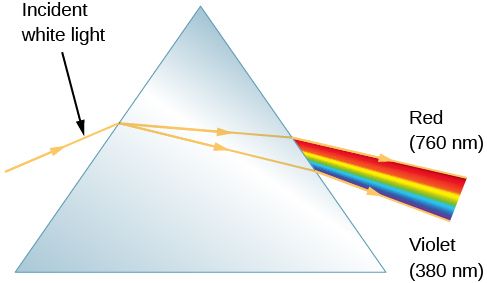
In 1672, in the first paper that he submitted to the Royal Society, Sir Isaac Newton described an experiment in which he permitted sunlight to pass through a small hole and then through a prism. Newton found that sunlight, which looks white to us, is actually made up of a mixture of all the colors of the rainbow (Figure 5.9).
英語のヒント
1672年、アイザック・ニュートンは、王立協会に提出した最初の論文で、太陽光を小さな穴に通し、そのあとプリズムに通す実験を記述した。ニュートンは、私たちには白く見える太陽光が、実は虹のすべての色の混合からできていることを見いだした(図5.9)。
Action of a Prism.プリズムの働き。
OpenStax / Rice University · CC BY 4.0
Figure 5.9 When we pass a beam of white sunlight through a prism, we see a rainbow-colored band of light that we call a continuous spectrum.
図5.9 白い太陽光の束をプリズムに通すと、虹色の光の帯が見える。これを連続スペクトルと呼ぶ。
Figure 5.9 shows how light is separated into different colors with a prism—a piece of glass in the shape of a triangle with refracting surfaces. Upon entering one face of the prism, the path of the light is refracted (bent), but not all of the colors are bent by the same amount. The bending of the beam depends on the wavelength of the light as well as the properties of the material, and as a result, different wavelengths (or colors of light) are bent by different amounts and therefore follow slightly different paths through the prism. The violet light is bent more than the red. This phenomenon is called dispersion and explains Newton’s rainbow experiment.
英語のヒント
図5.9は、プリズムによって光が色ごとに分けられる様子を示している。プリズムは、光を屈折させる面を持つ、三角形のガラス片である。光が一つの面に入ると、その経路は屈折して曲がるが、すべての色が同じだけ曲がるわけではない。光線の曲がり方は、物質の性質だけでなく、光の波長にも依存する。その結果、波長、つまり光の色が異なれば、曲がる程度も異なり、プリズムの中でわずかに違う経路を通る。紫の光は赤の光より大きく曲がる。この現象を「分散」と呼び、ニュートンの虹の実験は、これで説明できる。
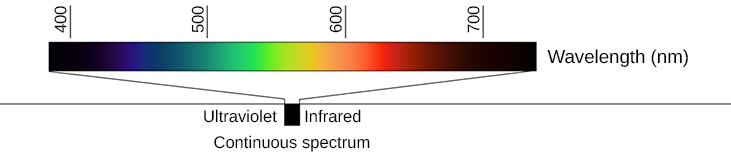
Upon leaving the opposite face of the prism, the light is bent again and further dispersed. If the light leaving the prism is focused on a screen, the different wavelengths or colors that make up white light are lined up side by side just like a rainbow (Figure 5.10). (In fact, a rainbow is formed by the dispersion of light though raindrops; see The Rainbow feature box.) Because this array of colors is a spectrum of light, the instrument used to disperse the light and form the spectrum is called a spectrometer.
英語のヒント
光はプリズムの反対側の面から出るときに、再び曲がり、さらに分散する。プリズムを出た光をスクリーン上に集めると、白色光を構成するさまざまな波長、つまり色が、虹と同じように横に並ぶ(図5.10)。実際、虹は、雨滴による光の分散で作られる。「虹」の囲み記事を参照してほしい。この色の配列が光のスペクトルなので、光を分散させてスペクトルを作る装置を「分光計」と呼ぶ。
Continuous Spectrum.連続スペクトル。
OpenStax / Rice University · CC BY 4.0
Figure 5.10 When white light passes through a prism, it is dispersed and forms a continuous spectrum of all the colors. Although it is hard to see in this printed version, in a well-dispersed spectrum, many subtle gradations in color are visible as your eye scans from one end (violet) to the other (red).
図5.10 白色光がプリズムを通ると、分散して、すべての色が連なる連続スペクトルを作る。この印刷版では見分けにくいが、十分に分散したスペクトルを、一端の紫から他端の赤へ目で追うと、色の微妙な段階的変化が数多く見える。
The Value of Stellar Spectra恒星のスペクトルが持つ価値
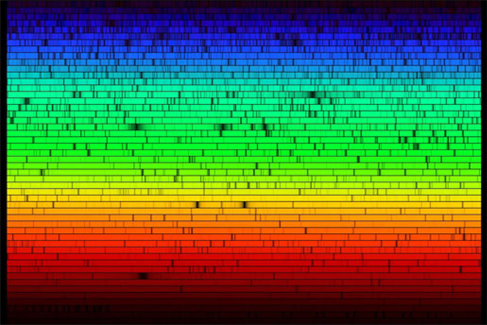
When Newton described the laws of refraction and dispersion in optics, and observed the solar spectrum, all he could see was a continuous band of colors. If the spectrum of the white light from the Sun and stars were simply a continuous rainbow of colors, astronomers would have little interest in the detailed study of a star’s spectrum once they had learned its average surface temperature. In 1802, however, William Wollaston built an improved spectrometer that included a lens to focus the Sun’s spectrum on a screen. With this device, Wollaston saw that the colors were not spread out uniformly, but instead, some ranges of color were missing, appearing as dark bands in the solar spectrum. He mistakenly attributed these lines to natural boundaries between the colors. In 1815, German physicist Joseph Fraunhofer, upon a more careful examination of the solar spectrum, found about 600 such dark lines (missing colors), which led scientists to rule out the boundary hypothesis (Figure 5.11).
英語のヒント
ニュートンが光学における屈折と分散の法則を記述し、太陽のスペクトルを観測したとき、見えたのは連続した色の帯だけだった。もし太陽や恒星の白色光のスペクトルが、単なる連続的な虹色の帯であったなら、天文学者は、平均表面温度がわかったあとは、恒星のスペクトルを詳しく研究することに、ほとんど関心を持たなかっただろう。しかし1802年、ウィリアム・ウォラストンは、太陽のスペクトルをスクリーン上に結ぶレンズを備えた、改良型の分光計を作った。この装置で、色は一様に広がっているのではなく、ある範囲の色が欠け、その部分が太陽スペクトルの暗い帯として見えることを発見した。ウォラストンは、この線が、色と色の間の自然な境界によるものだと誤って考えた。1815年、ドイツの物理学者ヨーゼフ・フラウンホーファーは、太陽スペクトルをさらに注意深く調べ、色の欠けた部分である、このような暗線を約600本見いだした。そのため科学者たちは、色の境界という仮説を退けることになった(図5.11)。
Visible Spectrum of the Sun.太陽の可視スペクトル。
credit: modification of work by Nigel Sharp, NOAO/National Solar Observatory at Kitt Peak/AURA, and the National Science Foundation · CC BY 4.0
Figure 5.11 Our star’s spectrum is crossed by dark lines produced by atoms in the solar atmosphere that absorb light at certain wavelengths. (credit: modification of work by Nigel Sharp, NOAO/National Solar Observatory at Kitt Peak/AURA, and the National Science Foundation)
図5.11 私たちの恒星である太陽のスペクトルには、暗い線が横切っている。太陽大気中の原子が、特定の波長の光を吸収するためにできた線である。(提供:Nigel Sharp、NOAO/National Solar Observatory at Kitt Peak/AURA、National Science Foundationの作品を改変)
Later, researchers found that similar dark lines could be produced in the spectra (“spectra” is the plural of “spectrum”) of artificial light sources. They did this by passing their light through various apparently transparent substances—usually containers with just a bit of thin gas in them.
英語のヒント
のちに研究者たちは、人工的な光源のスペクトルにも、同じような暗線を作れることを発見した。英語のspectraはspectrumの複数形である。彼らは、人工光を、見たところ透明なさまざまな物質に通すことで、これを行った。多くの場合、その物質とは、薄い気体をごく少量だけ入れた容器だった。
These gases turned out not to be transparent at all colors: they were quite opaque at a few sharply defined wavelengths. Something in each gas had to be absorbing just a few colors of light and no others. All gases did this, but each different element absorbed a different set of colors and thus showed different dark lines. If the gas in a container consisted of two elements, then light passing through it was missing the colors (showing dark lines) for both of the elements. So it became clear that certain lines in the spectrum “go with” certain elements. This discovery was one of the most important steps forward in the history of astronomy.
英語のヒント
これらの気体は、すべての色について透明なのではないとわかった。はっきりと限定された、少数の波長では、まったく不透明だったのである。各気体の中にある何かが、わずかな色の光だけを吸収し、それ以外は吸収していないはずだった。どの気体も同じことをしたが、元素が違えば、吸収する色の組合せも異なり、現れる暗線も異なった。容器内の気体が2種類の元素からなれば、通過する光からは、両方の元素に対応する色が欠け、暗線が現れた。こうして、スペクトル中の特定の線は、特定の元素と「組になっている」ことが明らかになった。この発見は、天文学の歴史で最も重要な前進の一つだった。
What would happen if there were no continuous spectrum for our gases to remove light from? What if, instead, we heated the same thin gases until they were hot enough to glow with their own light? When the gases were heated, a spectrometer revealed no continuous spectrum, but several separate bright lines. That is, these hot gases emitted light only at certain specific wavelengths or colors.
英語のヒント
では、気体がそこから光を取り除けるような連続スペクトルがなければ、何が起こるだろうか。代わりに、同じ薄い気体を、自分で光って輝くほど高温になるまで加熱したら、どうなるだろうか。気体を熱すると、分光計には連続スペクトルではなく、離れ離れの明るい線が何本か現れた。つまり、これらの高温の気体は、特定の波長、すなわち特定の色だけの光を放出したのである。
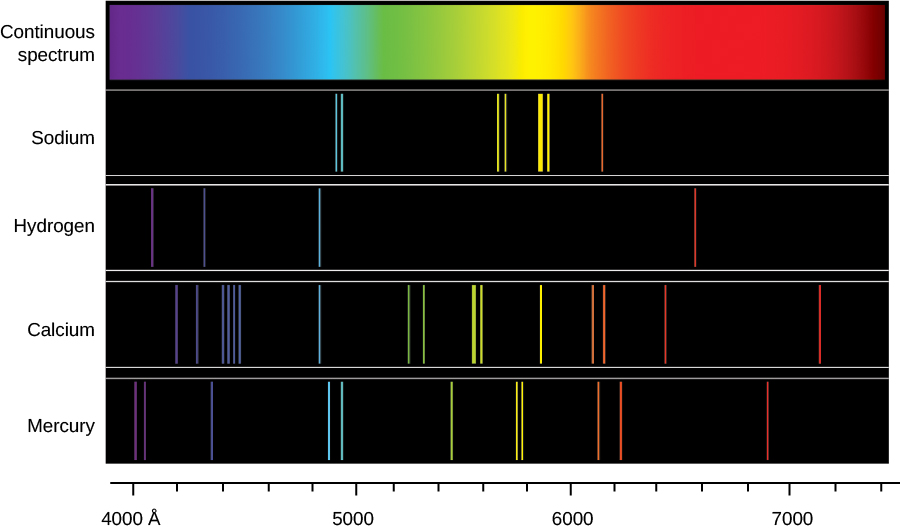
When the gas was pure hydrogen, it would emit one pattern of colors; when it was pure sodium, it would emit a different pattern. A mixture of hydrogen and sodium emitted both sets of spectral lines. The colors the gases emitted when they were heated were the very same colors as those they had absorbed when a continuous source of light was behind them. From such experiments, scientists began to see that different substances showed distinctive spectral signatures by which their presence could be detected (Figure 5.12). Just as your signature allows the bank to identify you, the unique pattern of colors for each type of atom (its spectrum) can help us identify which element or elements are in a gas.
英語のヒント
気体が純粋な水素なら、ある一つの色の並びを放出し、純粋なナトリウムなら、別の並びを放出した。水素とナトリウムの混合物は、両方の組のスペクトル線を放出した。加熱した気体が放出する色は、その後ろに連続光源を置いたときに吸収していた色と、まったく同じだった。このような実験から、物質ごとに固有の「スペクトルの署名」があり、それを使って存在を検出できると、科学者たちは気づき始めた(図5.12)。銀行が署名によって皆さんを確認するのと同じように、原子の種類ごとに固有の色の並び、つまりそのスペクトルを使えば、気体中にどの元素、あるいはどの組合せの元素があるかを特定できる。
Continuous Spectrum and Line Spectra from Different Elements.連続スペクトルと、さまざまな元素の線スペクトル。
OpenStax / Rice University · CC BY 4.0
Figure 5.12 Each type of glowing gas (each element) produces its own unique pattern of lines, so the composition of a gas can be identified by its spectrum. The spectra of sodium, hydrogen, calcium, and mercury gases are shown here.
図5.12 光る気体の種類、つまり元素ごとに固有の線の並びが現れるので、スペクトルから気体の組成を特定できる。ここにはナトリウム、水素、カルシウム、水銀の気体のスペクトルを示す。