第5章放射とスペクトルRadiation and Spectra
5.5 Formation of Spectral Lines5.5 スペクトル線のでき方
Learning Objectives学習の目標
By the end of this section, you will be able to:
この節を終えると、次のことができるようになる。
Explain how emission line spectra and absorption line spectra are formed
輝線スペクトルと吸収線スペクトルがどのようにできるかを説明する
Describe what ions are and how they are formed
イオンとは何か、またどのように生じるかを説明する
Explain how spectral lines and ionization levels in a gas can help us determine its temperature
気体のスペクトル線や電離の段階が、温度の推定にどう役立つかを説明する
We can use Bohr’s model of the atom to understand how spectral lines are formed. The concept of energy levels for the electron orbits in an atom leads naturally to an explanation of why atoms absorb or emit only specific energies or wavelengths of light.
英語のヒント
ボーアの原子モデルを使うと、スペクトル線ができる仕組みを理解できる。原子内の電子の軌道にエネルギー準位があるという考えから、原子が特定のエネルギー、すなわち特定の波長の光だけを吸収・放出する理由が、自然に説明される。
The Hydrogen Spectrum水素のスペクトル
Let’s look at the hydrogen atom from the perspective of the Bohr model. Suppose a beam of white light (which consists of photons of all visible wavelengths) shines through a gas of atomic hydrogen. A photon of wavelength 656 nanometers has just the right energy to raise an electron in a hydrogen atom from the second to the third orbit. Thus, as all the photons of different energies (or wavelengths or colors) stream by the hydrogen atoms, photons with this particular wavelength can be absorbed by those atoms whose electrons are orbiting on the second level. When they are absorbed, the electrons on the second level will move to the third level, and a number of the photons of this wavelength and energy will be missing from the general stream of white light.
英語のヒント
水素原子を、ボーアのモデルの立場から見てみよう。あらゆる可視波長の光子からなる白色光の束が、水素原子の気体を通っているとする。波長656ナノメートルの光子は、水素原子の電子を第2軌道から第3軌道へ引き上げるのに、ちょうど合うエネルギーを持つ。したがって、異なるエネルギー、波長、色を持つ光子が水素原子のそばを流れると、この特定の波長の光子は、電子が第2準位を回っている原子に吸収されうる。吸収されると、第2準位の電子は第3準位へ移り、その波長とエネルギーの光子の一部が、白色光全体の流れから欠けることになる。
Other photons will have the right energies to raise electrons from the second to the fourth orbit, or from the first to the fifth orbit, and so on. Only photons with these exact energies can be absorbed. All of the other photons will stream past the atoms untouched. Thus, hydrogen atoms absorb light at only certain wavelengths and produce dark lines at those wavelengths in the spectrum we see.
英語のヒント
別の光子は、電子を第2軌道から第4軌道へ、あるいは第1軌道から第5軌道へ引き上げるのに合うエネルギーを持ち、以下も同様である。吸収できるのは、その正確なエネルギーを持つ光子だけだ。それ以外の光子はすべて、影響を受けずに原子のそばを流れていく。こうして水素原子は、特定の波長の光だけを吸収し、観測するスペクトルのその波長に暗線を作る。
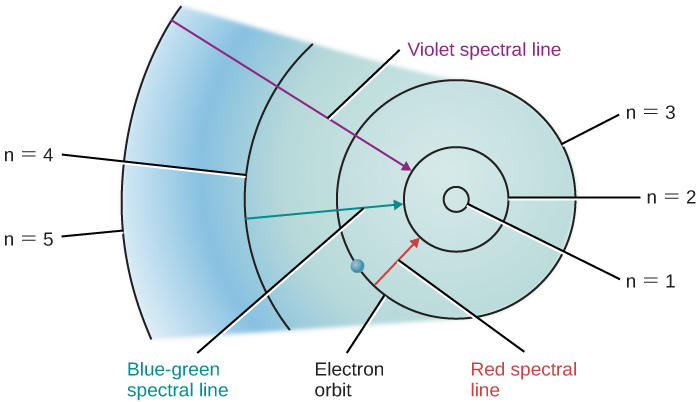
Suppose we have a container of hydrogen gas through which a whole series of photons is passing, allowing many electrons to move up to higher levels. When we turn off the light source, these electrons “fall” back down from larger to smaller orbits and emit photons of light—but, again, only light of those energies or wavelengths that correspond to the energy difference between permissible orbits. The orbital changes of hydrogen electrons that give rise to some spectral lines are shown in Figure 5.19.
英語のヒント
容器内の水素気体に、光子が次々と通過し、多くの電子が高い準位へ移っているとしよう。光源を消すと、電子は大きな軌道から小さな軌道へ「落ち」戻り、光子を放出する。ただし、ここでも放出するのは、許される軌道間のエネルギー差に対応する、特定のエネルギーまたは波長の光だけである。スペクトル線のいくつかを生む、水素の電子の軌道変化を、図5.19に示す。
Bohr Model for Hydrogen.水素のボーアモデル。
OpenStax / Rice University · CC BY 4.0
Figure 5.19 In this simplified model of a hydrogen atom, the concentric circles shown represent permitted orbits or energy levels. An electron in a hydrogen atom can only exist in one of these energy levels (or states). The closer the electron is to the nucleus, the more tightly bound the electron is to the nucleus. By absorbing energy, the electron can move to energy levels farther from the nucleus (and even escape if enough energy is absorbed).
図5.19 この単純化した水素原子モデルでは、同心円が、許された軌道またはエネルギー準位を表す。水素原子の電子は、これらのエネルギー準位、つまり状態のどれか一つにしか存在できない。電子が原子核に近いほど、より強く原子核に束縛される。エネルギーを吸収すると、電子は原子核から遠い準位へ移れる。十分なエネルギーを吸収すれば、脱出することもできる。
Similar pictures can be drawn for atoms other than hydrogen. However, because these other atoms ordinarily have more than one electron each, the orbits of their electrons are much more complicated, and the spectra are more complex as well. For our purposes, the key conclusion is this: each type of atom has its own unique pattern of electron orbits, and no two sets of orbits are exactly alike. This means that each type of atom shows its own unique set of spectral lines, produced by electrons moving between its unique set of orbits.
英語のヒント
水素以外の原子についても、同じような図を描ける。しかし、ほかの原子は通常それぞれ2個以上の電子を持つため、電子の軌道ははるかに複雑で、スペクトルも同様に複雑になる。ここでの目的にとって重要な結論は、原子の種類ごとに固有の電子軌道の組があり、異なる2つの組がまったく同じになることはない、ということである。つまり、各原子は、自分に固有の軌道の組の間を電子が移ることで生じる、固有のスペクトル線の組を示す。
Astronomers and physicists have worked hard to learn the lines that go with each element by studying the way atoms absorb and emit light in laboratories here on Earth. Then they can use this knowledge to identify the elements in celestial bodies. In this way, we now know the chemical makeup of not just any star, but even galaxies of stars so distant that their light started on its way to us long before Earth had even formed.
英語のヒント
天文学者と物理学者は、地上の実験室で原子による光の吸収と放出を調べ、各元素と対応する線を知るために懸命に研究してきた。この知識を使えば、天体の中の元素を特定できる。こうして現在では、恒星だけでなく、そこからの光が私たちへ向かい始めたのが地球の形成よりずっと前だったほど、遠くにある恒星の集まりである銀河についてさえ、その化学組成を知っている。
Energy Levels and Excitationエネルギー準位と励起
Bohr’s model of the hydrogen atom was a great step forward in our understanding of the atom. However, we know today that atoms cannot be represented by quite so simple a picture. For example, the concept of sharply defined electron orbits is not really correct; however, at the level of this introductory course, the notion that only certain discrete energies are allowable for an atom is very useful. The energy levels we have been discussing can be thought of as representing certain average distances of the electron’s possible orbits from the atomic nucleus.
英語のヒント
水素原子のボーアモデルは、原子の理解にとって大きな前進だった。しかし現在では、原子はそれほど単純な図では表せないとわかっている。たとえば、電子の軌道がはっきり定まっているという考えは、本当は正しくない。それでも、この入門講座の段階では、原子に許されるエネルギーは、特定の飛び飛びの値だけだという考え方は非常に役立つ。ここまで論じてきたエネルギー準位は、電子が取りうる軌道と原子核の間の、ある平均的な距離を表すものと考えられる。
Ordinarily, an atom is in the state of lowest possible energy, its ground state. In the Bohr model of the hydrogen atom, the ground state corresponds to the electron being in the innermost orbit. An atom can absorb energy, which raises it to a higher energy level (corresponding, in the simple Bohr picture, to an electron’s movement to a larger orbit)—this is referred to as excitation. The atom is then said to be in an excited state. Generally, an atom remains excited for only a very brief time. After a short interval, typically a hundred-millionth of a second or so, it drops back spontaneously to its ground state, with the simultaneous emission of light. The atom may return to its lowest state in one jump, or it may make the transition in steps of two or more jumps, stopping at intermediate levels on the way down. With each jump, it emits a photon of the wavelength that corresponds to the energy difference between the levels at the beginning and end of that jump.
英語のヒント
通常、原子は、可能な限りエネルギーの低い状態、すなわち「基底状態」にある。水素原子のボーアモデルでは、基底状態は電子が最も内側の軌道にいることに対応する。原子はエネルギーを吸収して、より高いエネルギー準位へ上がることができる。単純なボーアの描像では、電子が大きな軌道へ移ることに対応する。これを「励起」と呼び、原子は「励起状態」にあるという。一般に、原子が励起されたままでいる時間は非常に短い。通常は1億分の1秒ほどの短時間のあと、自然に基底状態へ戻り、それと同時に光を放出する。原子は1回の跳躍で最低の状態へ戻ることもあれば、途中の準位に寄りながら、2回以上の段階に分けて遷移することもある。各跳躍のたびに、その跳躍の出発点と到着点の準位のエネルギー差に対応する波長の光子を放出する。
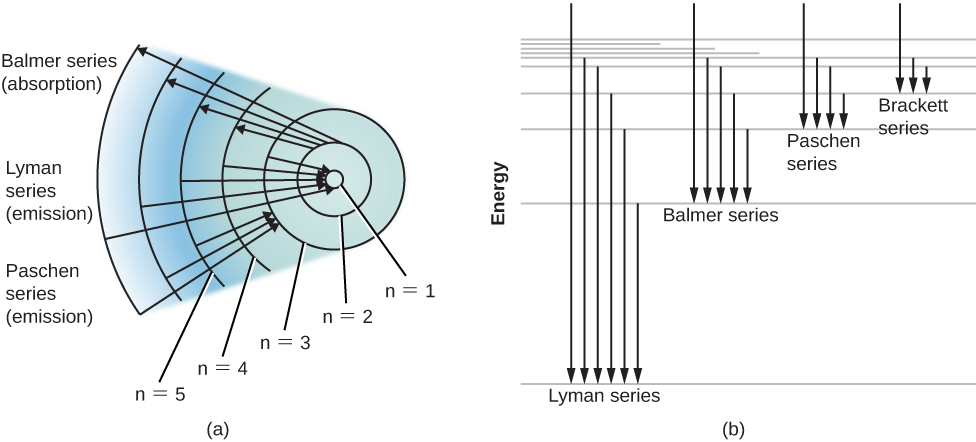
An energy-level diagram for a hydrogen atom and several possible atomic transitions are shown in Figure 5.20. When we measure the energies involved as the atom jumps between levels, we find that the transitions to or from the ground state, called the Lyman series of lines, result in the emission or absorption of ultraviolet photons. But the transitions to or from the first excited state (labeled n = 2 in part (a) of Figure 5.20), called the Balmer series, produce emission or absorption in visible light. In fact, it was to explain this Balmer series that Bohr first suggested his model of the atom.
英語のヒント
水素原子のエネルギー準位図と、起こりうる遷移のいくつかを、図5.20に示す。原子が準位の間を跳び移るときのエネルギーを測ると、基底状態へ、または基底状態からの遷移による「ライマン系列」の線では、紫外線の光子が放出・吸収されるとわかる。これに対し、図5.20の(a)でn = 2と示した最初の励起状態へ、またはそこからの遷移である「バルマー系列」では、可視光の放出や吸収が生じる。実はボーアが最初に原子モデルを提案したのは、このバルマー系列を説明するためだった。
Energy-Level Diagrams for Hydrogen.水素のエネルギー準位図。
OpenStax / Rice University · CC BY 4.0
Figure 5.20 (a) Here we follow the emission or absorption of photons by a hydrogen atom according to the Bohr model. Several different series of spectral lines are shown, corresponding to transitions of electrons from or to certain allowed orbits. Each series of lines that terminates on a specific inner orbit is named for the physicist who studied it. At the top, for example, you see the Balmer series, and arrows show electrons jumping from the second orbit (n = 2) to the third, fourth, fifth, and sixth orbits. Each time a “poor” electron from a lower level wants to rise to a higher position in life, it must absorb energy to do so. It can absorb the energy it needs from passing waves (or photons) of light. The next set of arrows (Lyman series) show electrons falling down to the first orbit from different (higher) levels. Each time a “rich” electron goes downward toward the nucleus, it can afford to give off (emit) some energy it no longer needs. (In this idealized diagram, the energy levels are shown equally spaced; in real life, they are not.) (b) At higher and higher energy levels, the levels become more and more crowded together, approaching a limit. The region above the top line represents energies at which the atom is ionized (the electron is no longer attached to the atom). Each series of arrows represents electrons falling from higher levels to lower ones, releasing photons or waves of energy in the process.
図5.20 (a)ボーアのモデルに従って、水素原子が光子を放出または吸収する様子を追う。電子が特定の許された軌道へ移る、またはそこから移る遷移に対応する、いくつかのスペクトル線の系列を示している。特定の内側の軌道に終着する各系列には、それを研究した物理学者の名が付いている。たとえば上部にはバルマー系列があり、第2軌道n = 2から第3、第4、第5、第6軌道へ電子が跳ぶことを、矢印が示す。低い準位の「貧しい」電子が暮らしの地位を上げたいときには、エネルギーを吸収しなければならない。必要なエネルギーは、通り過ぎる光の波、すなわち光子から吸収できる。次の矢印の組であるライマン系列は、さまざまな高い準位から第1軌道へ電子が落ちることを示す。「裕福な」電子が原子核へ向かって下がるたび、もう必要のなくなったエネルギーを放出する余裕ができる。この理想化した図では準位を等間隔に描いているが、実際にはそうではない。(b)高いエネルギー準位ほど、準位どうしはますます密に集まり、ある極限へ近づく。最上部の線より上は、原子が電離する、つまり電子が原子に束縛されなくなるエネルギーを表す。各系列の矢印は、電子が高い準位から低い準位へ落ち、その過程で光子、すなわちエネルギーの波を放出することを示す。
Atoms that have absorbed specific photons from a passing beam of white light and have thus become excited generally de-excite themselves and emit that light again in a very short time. You might wonder, then, why dark spectral lines are ever produced. In other words, why doesn’t this reemitted light quickly “fill in” the darker absorption lines?
英語のヒント
通過する白色光の束から特定の光子を吸収して励起された原子は、一般に、ごく短い時間で励起状態を解き、その光を再び放出する。それなら、なぜ暗いスペクトル線ができるのかと疑問に思うかもしれない。言い換えれば、再放出された光が、暗い吸収線をすぐに「埋めて」しまわないのは、なぜなのだろうか。
Imagine a beam of white light coming toward you through some cooler gas. Some of the reemitted light is actually returned to the beam of white light you see, but this fills in the absorption lines only to a slight extent. The reason is that the atoms in the gas reemit light in all directions, and only a small fraction of the reemitted light is in the direction of the original beam (toward you). In a star, much of the reemitted light actually goes in directions leading back into the star, which does observers outside the star no good whatsoever.
英語のヒント
白色光の束が、それより低温の気体を通って、こちらへ来る場面を想像しよう。再放出された光の一部は、実際に、目にする白色光の束へ戻る。しかし、これによって吸収線が埋まるのは、ごくわずかである。気体中の原子はあらゆる方向へ光を再放出し、そのうち元の光束と同じ、こちらへ向かう方向へ出るのは、ごく一部だからである。恒星では、再放出された光の多くが、実際には恒星の内部へ戻る方向へ進む。そのような光は、恒星の外側にいる観測者には、何の役にも立たない。
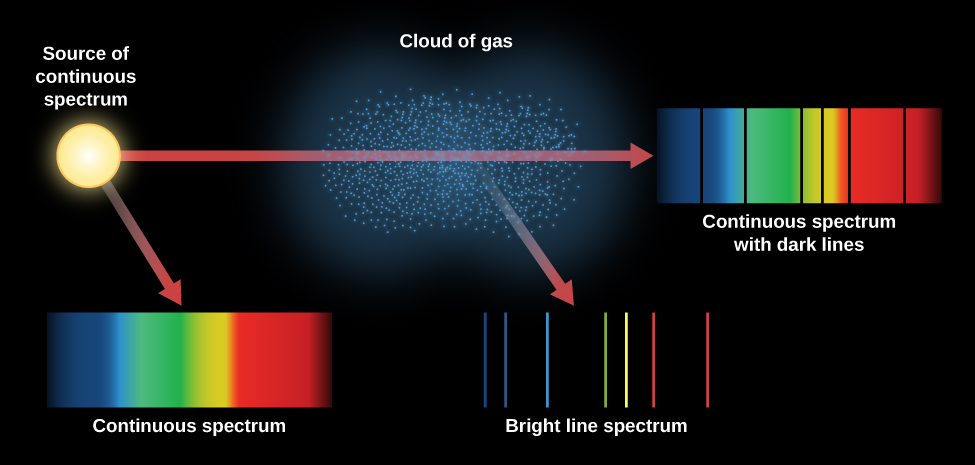
Figure 5.21 summarizes the different kinds of spectra we have discussed. An incandescent lightbulb produces a continuous spectrum. When that continuous spectrum is viewed through a thinner cloud of gas, an absorption line spectrum can be seen superimposed on the continuous spectrum. If we look only at a cloud of excited gas atoms (with no continuous source seen behind it), we see that the excited atoms give off an emission line spectrum.
英語のヒント
図5.21は、ここまで論じたスペクトルの種類をまとめたものである。白熱電球は連続スペクトルを作る。その連続スペクトルを薄いガス雲越しに見ると、連続スペクトルに重なって吸収線スペクトルが見える。背後に連続光源が見えない状態で、励起された気体原子の雲だけを見れば、励起原子が輝線スペクトルを放出することがわかる。
Three Kinds of Spectra.3種類のスペクトル。
OpenStax / Rice University · CC BY 4.0
Figure 5.21 When we see a lightbulb or other source of continuous radiation, all the colors are present. When the continuous spectrum is seen through a thinner gas cloud, the cloud’s atoms produce absorption lines in the continuous spectrum. When the excited cloud is seen without the continuous source behind it, its atoms produce emission lines. We can learn which types of atoms are in the gas cloud from the pattern of absorption or emission lines.
図5.21 電球などの連続放射の光源を見ると、すべての色が存在する。連続スペクトルを薄いガス雲越しに見ると、雲の原子が連続スペクトル中に吸収線を作る。背後に連続光源がない状態で、励起された雲を見ると、その原子は輝線を作る。吸収線や輝線の並びから、ガス雲にどの種類の原子があるかを知ることができる。
Atoms in a hot gas are moving at high speeds and continually colliding with one another and with any loose electrons. They can be excited (electrons moving to a higher level) and de-excited (electrons moving to a lower level) by these collisions as well as by absorbing and emitting light. The speed of atoms in a gas depends on the temperature. When the temperature is higher, so are the speed and energy of the collisions. The hotter the gas, therefore, the more likely that electrons will occupy the outermost orbits, which correspond to the highest energy levels. This means that the level where electrons start their upward jumps in a gas can serve as an indicator of how hot that gas is. In this way, the absorption lines in a spectrum give astronomers information about the temperature of the regions where the lines originate.
英語のヒント
高温の気体の原子は、高速で動き、互いに、また自由な電子と絶えず衝突している。光を吸収・放出する場合だけでなく、これらの衝突によっても、励起、すなわち電子が高い準位へ移ることや、脱励起、すなわち電子が低い準位へ移ることが起こる。気体中の原子の速さは温度で決まる。温度が高ければ、衝突の速さとエネルギーも高い。そのため、気体が高温であるほど、電子が最も高いエネルギー準位に対応する、最も外側の軌道を占める可能性が高くなる。つまり、気体内の電子が上向きの跳躍を始める準位は、その気体がどれくらい高温かを示す指標として使える。このように、スペクトルの吸収線は、その線が生じた領域の温度について、天文学者に情報を与える。