第17章星の光を分析するAnalyzing Starlight
17.2 Colors of Stars17.2 恒星の色
Learning Objectives学習の目標
By the end of this section, you will be able to:
この節を読み終えると、次のことができるようになる。
Compare the relative temperatures of stars based on their colors
色に基づいて恒星の温度を比較する。
Understand how astronomers use color indexes to measure the temperatures of stars
天文学者が色指数によって恒星の温度をどう測るかを理解する。
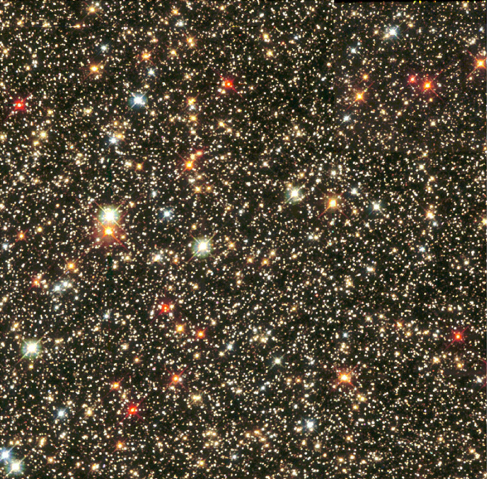
Look at the beautiful picture of the stars in the Sagittarius Star Cloud shown in Figure 17.3. The stars show a multitude of colors, including red, orange, yellow, white, and blue. As we have seen, stars are not all the same color because they do not all have identical temperatures. To define color precisely, astronomers have devised quantitative methods for characterizing the color of a star and then using those colors to determine stellar temperatures. In the chapters that follow, we will provide the temperature of the stars we are describing, and this section tells you how those temperatures are determined from the colors of light the stars give off.
英語のヒント
図17.3の、いて座のスタークラウドにある星々の美しい写真を見よう。赤、橙、黄、白、青など、星は実に多彩な色を示す。すでに見たように、星の色がすべて同じでないのは、温度がすべて同じではないためである。色を正確に定義するため、天文学者は恒星の色を数量として表し、その色から温度を求める方法を考案した。これからの章では、説明する恒星の温度を示していく。この節は、その温度が、星の放つ光の色からどう求められるかを説明する。
Sagittarius Star Cloud.いて座のスタークラウド。
credit: Hubble Heritage Team (AURA/STScI/NASA) · CC BY 4.0
Figure 17.3 This image, which was taken by the Hubble Space Telescope, shows stars in the direction toward the center of the Milky Way Galaxy. The bright stars glitter like colored jewels on a black velvet background. The color of a star indicates its temperature. Blue-white stars are much hotter than the Sun, whereas red stars are cooler. On average, the stars in this field are at a distance of about 25,000 light-years (which means it takes light 25,000 years to traverse the distance from them to us) and the width of the field is about 13.3 light-years. (credit: Hubble Heritage Team (AURA/STScI/NASA))
図17.3 ハッブル宇宙望遠鏡が撮影した、天の川銀河の中心方向の星々。黒いビロードの背景に、明るい星が色付きの宝石のようにきらめいている。恒星の色は温度を示す。青白い星は太陽よりずっと高温で、赤い星は低温である。この視野の星は平均して約25,000光年離れている。つまり、星々から私たちまで光が届くのに25,000年かかる。視野の幅は約13.3光年である。(クレジット:Hubble Heritage Team〈AURA/STScI/NASA〉)
Color and Temperature色と温度
As we learned in The Electromagnetic Spectrum section, Wien’s law relates stellar color to stellar temperature. Blue colors dominate the visible light output of very hot stars (with much additional radiation in the ultraviolet). On the other hand, cool stars emit most of their visible light energy at red wavelengths (with more radiation coming off in the infrared) (Table 17.1). The color of a star therefore provides a measure of its intrinsic or true surface temperature (apart from the effects of reddening by interstellar dust, which will be discussed in Between the Stars: Gas and Dust in Space). Color does not depend on the distance to the object. This should be familiar to you from everyday experience. The color of a traffic signal, for example, appears the same no matter how far away it is. If we could somehow take a star, observe it, and then move it much farther away, its apparent brightness (magnitude) would change. But this change in brightness is the same for all wavelengths, and so its color would remain the same.
英語のヒント
「電磁スペクトル」の節で学んだように、ウィーンの法則は恒星の色と温度を結び付ける。非常に高温の星が放つ可視光では青が優勢で、そのほかにも大量の紫外線を放つ。一方、低温の星は可視光エネルギーの大半を赤い波長で放ち、さらに多くの放射を赤外線で放つ(表17.1)。したがって、恒星の色は、その星に本来備わる、真の表面温度の尺度になる。ただし、星間塵による赤化の影響は除く。その影響は「星と星の間――宇宙のガスと塵」で説明する。色は天体までの距離によらない。これは日常の経験からもなじみがあるはずだ。たとえば信号機の色は、どれほど遠くても同じに見える。もし何らかの方法で星を観測した後、ずっと遠くへ移せたら、見かけの明るさ、すなわち等級は変わるだろう。しかし明るさの変化はどの波長でも同じなので、色は変わらない。
Example Star Colors and Corresponding Approximate Temperatures 恒星の色と、それに対応するおよその温度の例 |
||
|---|---|---|
Star Color 恒星の色 |
Approximate Temperature およその温度 |
Example 例 |
Blue 青 |
25,000 K | Spica スピカ |
White 白 |
10,000 K | Vega ベガ |
Yellow 黄 |
6000 K 6,000 K |
Sun 太陽 |
Orange 橙 |
4000 K 4,000 K |
Aldebaran アルデバラン |
Red 赤 |
3000 K | Betelgeuse ベテルギウス |
The hottest stars have temperatures of over 40,000 K, and the coolest stars have temperatures of about 2000 K. Our Sun’s surface temperature is about 6000 K; its peak wavelength color is a slightly greenish-yellow. In space, the Sun would look white, shining with about equal amounts of reddish and bluish wavelengths of light. It looks somewhat yellow as seen from Earth’s surface because our planet’s nitrogen molecules scatter some of the shorter (i.e., blue) wavelengths out of the beams of sunlight that reach us, leaving more long wavelength light behind. This also explains why the sky is blue: the blue sky is sunlight scattered by Earth’s atmosphere.
英語のヒント
最も高温の星の温度は40,000 Kを超え、最も低温の星の温度は約2000 Kである。太陽の表面温度は約6000 Kで、放射が最大になる波長の色は、少し緑がかった黄色である。宇宙から見る太陽は白く見えるはずだ。赤みのある波長の光と青みのある波長の光を、ほぼ同じ量だけ放っているからである。地表から見た太陽がやや黄色く見えるのは、地球の窒素分子が、私たちに届く太陽光の束から短い波長、すなわち青い波長の光をいくらか散乱させ、長い波長の光がより多く残るためである。これで空が青い理由も説明できる。青空は、地球の大気によって散乱された太陽光なのだ。
Color Indices色指数
In order to specify the exact color of a star, astronomers normally measure a star’s apparent brightness through filters, each of which transmits only the light from a particular narrow band of wavelengths (colors). A crude example of a filter in everyday life is a green-colored, plastic, soft drink bottle, which, when held in front of your eyes, lets only the green colors of light through.
英語のヒント
星の色を正確に表すため、天文学者は通常、フィルターを通して星の見かけの明るさを測る。それぞれのフィルターは、特定の狭い波長域、つまり特定の色の光だけを通す。日常生活にあるフィルターの簡単な例が、緑色のプラスチック製清涼飲料水ボトルである。目の前にかざすと、緑色の光だけを通す。
One commonly used set of filters in astronomy measures stellar brightness at three wavelengths corresponding to ultraviolet, blue, and yellow light. The filters are named: U (ultraviolet), B (blue), and V (visual, for yellow). These filters transmit light near the wavelengths of 360 nanometers (nm), 420 nm, and 540 nm, respectively. The brightness measured through each filter is usually expressed in magnitudes. The difference between any two of these magnitudes—say, between the blue and the visual magnitudes (B–V)—is called a color index.
英語のヒント
天文学でよく使われるフィルターの組は、紫外光、青い光、黄色い光に対応する三つの波長で星の明るさを測る。各フィルターの名称は、U(紫外)、B(青)、V(可視。黄色の光に用いる)である。これらはそれぞれ、360ナノメートル(nm)、420 nm、540 nm付近の光を通す。各フィルターを通して測った明るさは、通常、等級で表す。このうち任意の二つの等級の差、たとえば青の等級と可視の等級との差(B−V)を、色指数という。
By agreement among astronomers, the ultraviolet, blue, and visual magnitudes of the UBV system are adjusted to give a color index of 0 to a star with a surface temperature of about 10,000 K, such as Vega. The B–V color indexes of stars range from −0.4 for the bluest stars, with temperatures of about 40,000 K, to +2.0 for the reddest stars, with temperatures of about 2000 K. The B–V index for the Sun is about +0.65. Note that, by convention, the B–V index is always the “bluer” minus the “redder” color.
英語のヒント
天文学者の間の取り決めによって、UBV系の紫外・青・可視の等級は、ベガのように表面温度が約10,000 Kの星で色指数が0になるように調整されている。星のB−V色指数は、温度が約40,000 Kの最も青い星では−0.4、約2000 Kの最も赤い星では+2.0である。太陽のB−V指数は約+0.65だ。慣例により、B−V指数では必ず「青い側」の等級から「赤い側」の等級を引くことに注意しよう。
Why use a color index if it ultimately implies temperature? Because the brightness of a star through a filter is what astronomers actually measure, and we are always more comfortable when our statements have to do with measurable quantities.
英語のヒント
結局は温度を示すのなら、なぜ色指数を使うのだろうか。フィルターを通した星の明るさこそ、天文学者が実際に測るものだからである。そして私たちは、自分たちの述べることが測定可能な量に結びついているほうが、常に確かさを感じられる。