第17章星の光を分析するAnalyzing Starlight
Rotation自転
We can also use the Doppler effect to measure how fast a star rotates. If an object is rotating, then one of its sides is approaching us while the other is receding (unless its axis of rotation happens to be pointed exactly toward us). This is clearly the case for the Sun or a planet; we can observe the light from either the approaching or receding edge of these nearby objects and directly measure the Doppler shifts that arise from the rotation.
英語のヒント
ドップラー効果は、恒星がどれほど速く自転しているかを測るのにも使える。物体が回転していれば、自転軸が偶然ちょうどこちらを向いている場合を除き、その一方の側はこちらへ近づき、もう一方の側は遠ざかる。太陽や惑星では、これは明らかである。これらの近い天体では、近づく縁や遠ざかる縁から来る光を観測し、自転によるドップラーシフトを直接測れる。
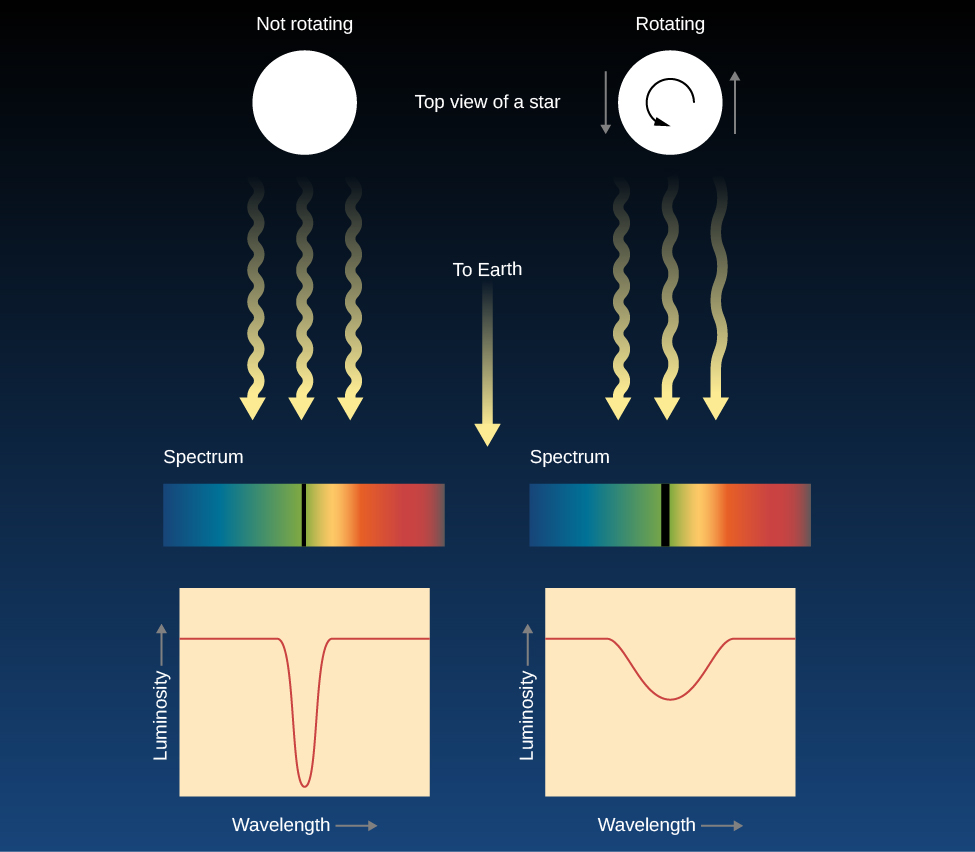
Stars, however, are so far away that they all appear as unresolved points. The best we can do is to analyze the light from the entire star at once. Due to the Doppler effect, the lines in the light that come from the side of the star rotating toward us are shifted to shorter wavelengths and the lines in the light from the opposite edge of the star are shifted to longer wavelengths. You can think of each spectral line that we observe as the sum or composite of spectral lines originating from different speeds with respect to us. Each point on the star has its own Doppler shift, so the absorption line we see from the whole star is actually much wider than it would be if the star were not rotating. If a star is rotating rapidly, there will be a greater spread of Doppler shifts and all its spectral lines should be quite broad. In fact, astronomers call this effect line broadening, and the amount of broadening can tell us the speed at which the star rotates (Figure 17.14).
英語のヒント
しかし恒星は非常に遠く、どれも大きさを見分けられない点に見える。できる限りのことは、恒星全体からの光をまとめて分析することである。ドップラー効果によって、自転でこちらへ向かう側から来る光の線は短い波長へずれ、反対側の縁から来る光の線は長い波長へずれる。観測する各スペクトル線は、私たちに対して異なる速さで動く各部分に由来するスペクトル線を、足し合わせたものと考えられる。恒星の各点にはそれぞれのドップラーシフトがある。そのため、星全体から見える吸収線は、自転していない場合に比べて実際にはずっと幅広い。高速で自転する恒星では、ドップラーシフトの広がりが大きくなり、すべてのスペクトル線がかなり幅広くなるはずである。天文学者はこの効果を線の広がりと呼び、その広がりの大きさから、星が自転する速さを知ることができる(図17.14)。
Using a Spectrum to Determine Stellar Rotation.スペクトルを使って恒星の自転を求める
OpenStax / Rice University · CC BY 4.0
Figure 17.14 A rotating star will show broader spectral lines than a nonrotating star.
図17.14 自転する恒星のスペクトル線は、自転しない恒星の線より幅広くなる。
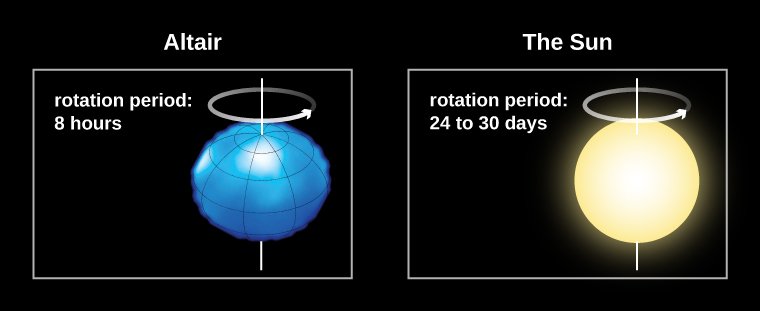
Measurements of the widths of spectral lines show that many stars rotate faster than the Sun, some with periods of less than a day! These rapid rotators spin so fast that their shapes are “flattened” into what we call oblate spheroids. An example of this is the bright star Vega, which rotates once every 12.5 hours. Vega’s rotation flattens its shape so much that its diameter at the equator is 23% wider than its diameter at the poles. Another dramatic example is in the star Altair, which rotates in less than 7 hours (Figure 17.15). The Sun, with its rotation period of about a month, rotates rather slowly. Studies have shown that stars decrease their rotational speed as they age. Young stars rotate very quickly, with rotational periods of days or less. Very old stars can have rotation periods of several months.You may have noticed that both the pressure in a star’s atmosphere and the rotation rate of a star can affect the width of a line in a star’s spectrum. You may wonder how astronomers can tell the two effects apart. It turns out they change the shape of the spectral line differently, and so a careful examination of the shape of each line can help scientists differentiate between the two effects.
英語のヒント
スペクトル線の幅を測ると、多くの恒星は太陽より速く自転し、中には周期が1日未満のものもあることがわかる。このような高速自転星は、あまりに速く回るため、形が「つぶれて」扁球と呼ばれる形になる。明るい星ベガがその例で、12.5時間に1回自転する。ベガは自転によって大きく扁平になり、赤道方向の直径は両極を結ぶ方向の直径より23%大きい。もう一つの顕著な例が、7時間未満で自転するアルタイルである(図17.15)。自転周期が約1か月の太陽は、比較的ゆっくり自転している。研究によると、恒星は年をとるにつれて自転速度が落ちる。若い恒星は非常に速く自転し、周期は数日以下である。非常に古い恒星では、自転周期が数か月になることもある。恒星大気の圧力と自転速度の両方が、スペクトル線の幅に影響することに気づいたかもしれない。天文学者は二つの効果をどう見分けるのか、と疑問に思うだろう。実は、これらはスペクトル線の形を異なる仕方で変えるため、各線の形を注意深く調べることで区別できる。
Comparison of Rotating Stars.自転する恒星の比較
OpenStax / Rice University · CC BY 4.0
Figure 17.15 This illustration compares the more rapidly rotating star Altair to the slower rotating Sun.
図17.15 自転の速いアルタイルと、それより遅い太陽を比較した図。
As you can see, spectroscopy is an extremely powerful technique that helps us learn all kinds of information about stars that we simply could not gather any other way. We will see in later chapters that these same techniques can also teach us about galaxies, which are the most distant objects that we can observe. Without spectroscopy, we would know next to nothing about the universe beyond the solar system.
英語のヒント
このように、分光法は非常に強力な技術であり、ほかの方法ではまったく集められないような、恒星に関するさまざまな情報を知る助けになる。後の章では、同じ技術が銀河についても教えてくれることを見る。銀河は、私たちが観測できる最も遠い天体である。分光法がなければ、太陽系の外の宇宙について、ほとんど何もわからないだろう。