第17章星の光を分析するAnalyzing Starlight
17.4 Using Spectra to Measure Stellar Radius, Composition, and Motion17.4 スペクトルから恒星の半径・組成・運動を測る
Learning Objectives学習の目標
By the end of this section, you will be able to:
この節を読み終えたら、次のことができるようになる。
Understand how astronomers can learn about a star’s radius and composition by studying its spectrum
恒星のスペクトルを調べて、その半径や組成がどうわかるのかを理解する。
Explain how astronomers can measure the motion and rotation of a star using the Doppler effect
ドップラー効果を使って、恒星の運動や自転を測る方法を説明する。
Describe the proper motion of a star and how it relates to a star’s space velocity
恒星の固有運動を説明し、空間速度との関係を述べる。
Analyzing the spectrum of a star can teach us all kinds of things in addition to its temperature. We can measure its detailed chemical composition as well as the pressure in its atmosphere. From the pressure, we get clues about its size. We can also measure its motion toward or away from us and estimate its rotation.
英語のヒント
恒星のスペクトルを分析すると、温度以外にもさまざまなことがわかる。詳しい化学組成と、大気中の圧力を測定できる。圧力からは、大きさの手がかりが得られる。また、こちらに近づく運動や遠ざかる運動を測り、自転を推定することもできる。
Clues to the Size of a Star恒星の大きさの手がかり
As we shall see in The Stars: A Celestial Census, stars come in a wide variety of sizes. At some periods in their lives, stars can expand to enormous dimensions. Stars of such exaggerated size are called giants. Luckily for the astronomer, stellar spectra can be used to distinguish giants from run-of-the-mill stars (such as our Sun).
英語のヒント
「恒星――星の世界の実態を調べる」で見るように、恒星には実にさまざまな大きさがある。一生のある時期には、とてつもない大きさまで膨張する場合もある。このように極端に大きい恒星を巨星と呼ぶ。天文学者にとって幸いなことに、スペクトルを使えば、巨星を太陽のような普通の恒星と区別できる。
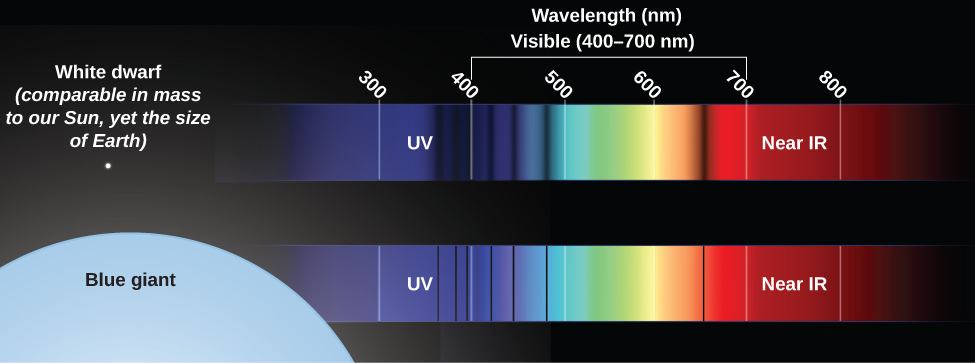
Suppose you want to determine whether a star is a giant. A giant star has a large, extended photosphere. Because it is so large, a giant star’s atoms are spread over a great volume, which means that the density of particles in the star’s photosphere is low. As a result, the pressure in a giant star’s photosphere is also low. This low pressure affects the spectrum in two ways. First, a star with a lower-pressure photosphere shows narrower spectral lines than a star of the same temperature with a higher-pressure photosphere (Figure 17.9). The difference is large enough that careful study of spectra can tell which of two stars at the same temperature has a higher pressure (and is thus more compressed) and which has a lower pressure (and thus must be extended). This effect is due to collisions between particles in the star’s photosphere—more collisions lead to broader spectral lines. Collisions will, of course, be more frequent in a higher-density environment. Think about it like traffic—collisions are much more likely during rush hour, when the density of cars is high.
英語のヒント
ある恒星が巨星かどうかを知りたいとしよう。巨星には大きく広がった光球がある。非常に大きいため、原子が広い体積に分散しており、光球の粒子の密度は低い。したがって、巨星の光球の圧力も低くなる。この低い圧力は、二つの仕方でスペクトルに影響する。第一に、光球の圧力が低い恒星のスペクトル線は、同じ温度で光球の圧力が高い恒星の線より細い(図17.9)。この違いは十分に大きいため、スペクトルを注意深く調べれば、同じ温度の2個の恒星のうち、どちらが高圧で、したがってより圧縮されており、どちらが低圧で、したがって広がっているのかを判別できる。この効果は、恒星の光球にある粒子どうしの衝突による。衝突が多いほど、スペクトル線は幅広くなる。当然、密度の高い環境ほど衝突は頻繁になる。交通にたとえて考えてみよう。車の密度が高いラッシュアワーには、衝突が起こる可能性がずっと高いのである。
Second, more atoms are ionized in a giant star than in a star like the Sun with the same temperature. The ionization of atoms in a star’s outer layers is caused mainly by photons, and the amount of energy carried by photons is determined by temperature. But how long atoms stay ionized depends in part on pressure. Compared with what happens in the Sun (with its relatively dense photosphere), ionized atoms in a giant star’s photosphere are less likely to pass close enough to electrons to interact and combine with one or more of them, thereby becoming neutral again. Ionized atoms, as we discussed earlier, have different spectra from atoms that are neutral.
英語のヒント
第二に、太陽のような、温度が同じ恒星に比べ、巨星では電離している原子が多い。恒星の外層にある原子の電離は、主に光子によって起こり、光子が運ぶエネルギー量は温度で決まる。しかし、原子がどのくらい長く電離したままでいるかは、圧力にも左右される。比較的密度の高い光球をもつ太陽の場合と比べると、巨星の光球の電離した原子は、電子と相互作用して1個以上を取り込み、再び中性になるほど電子に近づく可能性が低い。前に述べたように、電離した原子のスペクトルは、中性の原子のスペクトルとは異なる。
Spectral Lines.スペクトル線
credit: modification of work by NASA, ESA, A. Field, and J. Kalirai (STScI) · CC BY 4.0
Figure 17.9 This figure illustrates one difference in the spectral lines from stars of the same temperature but different pressures. A giant star with a very-low-pressure photosphere shows very narrow spectral lines (bottom), whereas a smaller star with a higher-pressure photosphere shows much broader spectral lines (top). (credit: modification of work by NASA, ESA, A. Field, and J. Kalirai (STScI))
図17.9 温度は同じでも圧力の異なる恒星では、スペクトル線にこのような違いが現れる。光球の圧力が非常に低い巨星のスペクトル線はとても細い(下)。一方、光球の圧力が高い小さな恒星では、線がずっと幅広い(上)。(提供:NASA、ESA、A. Field、J. Kalirai〔STScI〕の画像を改変)
Abundances of the Elements元素の存在量
Absorption lines of a majority of the known chemical elements have now been identified in the spectra of the Sun and stars. If we see lines of iron in a star’s spectrum, for example, then we know immediately that the star must contain iron.
英語のヒント
現在では、既知の化学元素の大部分の吸収線が、太陽や恒星のスペクトルで同定されている。たとえば恒星のスペクトルに鉄の線があれば、その恒星には鉄が含まれているはずだとすぐにわかる。
Note that the absence of an element’s spectral lines does not necessarily mean that the element itself is absent. As we saw, the temperature and pressure in a star’s atmosphere will determine what types of atoms are able to produce absorption lines. Only if the physical conditions in a star’s photosphere are such that lines of an element should (according to calculations) be there can we conclude that the absence of observable spectral lines implies low abundance of the element.
英語のヒント
ある元素のスペクトル線がないからといって、必ずしもその元素自体がないとは限らないことに注意しよう。すでに見たとおり、恒星大気の温度と圧力によって、どの種類の原子が吸収線を生じさせられるかが決まる。恒星の光球の物理的条件から、計算上その元素の線があるはずだといえる場合に限り、観測可能な線がないことから、その元素の存在量が少ないと結論できる。
Suppose two stars have identical temperatures and pressures, but the lines of, say, sodium are stronger in one than in the other. Stronger lines mean that there are more atoms in the stellar photosphere absorbing light. Therefore, we know immediately that the star with stronger sodium lines contains more sodium. Complex calculations are required to determine exactly how much more, but those calculations can be done for any element observed in any star with any temperature and pressure.
英語のヒント
2個の恒星の温度と圧力が同じで、たとえばナトリウムの線が片方でより強いとしよう。線が強いということは、恒星の光球で光を吸収する原子が多いということだ。したがって、ナトリウムの線が強い星のほうが、ナトリウムを多く含むとすぐにわかる。正確にどのくらい多いかを決めるには複雑な計算が必要だが、温度や圧力がどのような恒星でも、観測されたどの元素についても、その計算は行える。
Of course, astronomy textbooks such as ours always make these things sound a bit easier than they really are. If you look at the stellar spectra such as those in Figure 17.6, you may get some feeling for how hard it is to decode all of the information contained in the thousands of absorption lines. First of all, it has taken many years of careful laboratory work on Earth to determine the precise wavelengths at which hot gases of each element have their spectral lines. Long books and computer databases have been compiled to show the lines of each element that can be seen at each temperature. Second, stellar spectra usually have many lines from a number of elements, and we must be careful to sort them out correctly. Sometimes nature is unhelpful, and lines of different elements have identical wavelengths, thereby adding to the confusion. And third, as we saw in the chapter on Radiation and Spectra, the motion of the star can change the observed wavelength of each of the lines. So, the observed wavelengths may not match laboratory measurements exactly. In practice, analyzing stellar spectra is a demanding, sometimes frustrating task that requires both training and skill.
英語のヒント
もちろん、本書のような天文学の教科書は、こうしたことをいつも実際より少し簡単に聞こえるように説明している。図17.6のような恒星スペクトルを見ると、何千本もの吸収線に含まれる情報をすべて読み解くのが、どれほど難しいか少し感じられるだろう。第一に、各元素の高温の気体が、正確にどの波長にスペクトル線をもつかを決めるには、地上の実験室で長年にわたる綿密な研究が必要だった。各温度で見える各元素の線を示すため、分厚い書物やコンピューターのデータベースが編さんされてきた。第二に、恒星スペクトルには通常、多数の元素の線がたくさんあるため、注意深く正しく仕分けなければならない。ときには自然が都合よくできておらず、異なる元素の線が同じ波長をもち、混乱を増すこともある。第三に、「放射とスペクトル」の章で見たように、恒星の運動によって、各線の観測波長が変わりうる。そのため、観測した波長が実験室での測定値と正確には一致しないこともある。実際、恒星スペクトルの分析は骨の折れる、時にはもどかしい仕事であり、訓練と技量の両方を必要とする。
Studies of stellar spectra have shown that hydrogen makes up about three-quarters of the mass of most stars. Helium is the second-most abundant element, making up almost a quarter of a star’s mass. Together, hydrogen and helium make up from 96 to 99% of the mass; in some stars, they amount to more than 99.9%. Among the 4% or less of “heavy elements,” oxygen, carbon, neon, iron, nitrogen, silicon, magnesium, and sulfur are among the most abundant. Generally, but not invariably, the elements of lower atomic weight are more abundant than those of higher atomic weight.
英語のヒント
恒星スペクトルの研究によって、ほとんどの星の質量の約4分の3を水素が占めることがわかった。次に豊富な元素はヘリウムで、星の質量のほぼ4分の1を占める。水素とヘリウムを合わせると質量の96〜99%になり、99.9%を超える星もある。残る4%以下の「重元素」の中では、酸素、炭素、ネオン、鉄、窒素、ケイ素、マグネシウム、硫黄が特に多い。常にとは限らないが、一般に原子量の小さい元素ほど、原子量の大きい元素より豊富である。
Take a careful look at the list of elements in the preceding paragraph. Two of the most abundant are hydrogen and oxygen (which make up water); add carbon and nitrogen and you are starting to write the prescription for the chemistry of an astronomy student. We are made of elements that are common in the universe—just mixed together in a far more sophisticated form (and a much cooler environment) than in a star.
英語のヒント
前の段落の元素の一覧を、よく見てみよう。特に多い元素のうち二つは、水を作る水素と酸素である。炭素と窒素を加えれば、天文学を学ぶ学生を化学的に作る処方を書き始めたことになる。私たちは宇宙で普通に見られる元素からできている。ただ、それらが恒星の中よりはるかに複雑な形で、そしてずっと低温の環境で、混ざり合っているのだ。
As we mentioned in The Spectra of Stars (and Brown Dwarfs) section, astronomers use the term “metals” to refer to all elements heavier than hydrogen and helium. The fraction of a star’s mass that is composed of these elements is referred to as the star’s metallicity. The metallicity of the Sun, for example, is 0.02, since 2% of the Sun’s mass is made of elements heavier than helium.
英語のヒント
「恒星と褐色矮星のスペクトル」の節で述べたように、天文学者は水素とヘリウムより重い元素をすべて「金属」と呼ぶ。恒星の質量のうち、これらの元素が占める割合を、その恒星の金属量という。たとえば太陽の金属量は0.02である。太陽の質量の2%が、ヘリウムより重い元素からできているためだ。
Appendix K lists how common each element is in the universe (compared to hydrogen); these estimates are based primarily on investigation of the Sun, which is a typical star. Some very rare elements, however, have not been detected in the Sun. Estimates of the amounts of these elements in the universe are based on laboratory measurements of their abundance in primitive meteorites, which are considered representative of unaltered material condensed from the solar nebula (see the Cosmic Samples and the Origin of the Solar System chapter).
英語のヒント
付録Kには、宇宙に各元素がどのくらい存在するかを、水素との比較で示している。これらの推定値は主に、典型的な恒星である太陽の研究に基づく。しかし、非常にまれな元素の中には、太陽で検出されていないものもある。宇宙でのそうした元素の存在量の推定は、始原的な隕石に含まれる量を実験室で測定した結果に基づく。始原的な隕石は、太陽系星雲から凝縮した物質が変質せず残ったものの代表と考えられている。「宇宙からの試料と太陽系の起源」の章を参照してほしい。