第17章星の光を分析するAnalyzing Starlight
17.1 The Brightness of Stars17.1 恒星の明るさ
Learning Objectives学習の目標
By the end of this section, you will be able to:
この節を読み終えると、次のことができるようになる。
Explain the difference between luminosity and apparent brightness
光度と見かけの明るさの違いを説明する。
Understand how astronomers specify brightness with magnitudes
天文学者が等級によって明るさをどう表すかを理解する。
Luminosity光度
Perhaps the most important characteristic of a star is its luminosity—the total amount of energy at all wavelengths that it emits per second. Earlier, we saw that the Sun puts out a tremendous amount of energy every second. (And there are stars far more luminous than the Sun out there.) To make the comparison among stars easy, astronomers express the luminosity of other stars in terms of the Sun’s luminosity. For example, the luminosity of Sirius is about 25 times that of the Sun. We use the symbol LSun to denote the Sun’s luminosity; hence, that of Sirius can be written as 25 LSun. In a later chapter, we will see that if we can measure how much energy a star emits and we also know its mass, then we can calculate how long it can continue to shine before it exhausts its nuclear energy and begins to die.
英語のヒント
恒星の最も重要な性質は、おそらく光度である。これは、1秒間に放出する、すべての波長を合わせたエネルギーの総量を指す。以前、太陽が毎秒莫大なエネルギーを放出することを見た。宇宙には、太陽よりはるかに光度の大きな恒星もある。星同士を比べやすくするため、天文学者はほかの恒星の光度を、太陽の光度を単位として表す。たとえばシリウスの光度は、太陽の約25倍である。太陽の光度をL☉という記号で示すので、シリウスは25 L☉と書ける。後の章で見るように、恒星が放出するエネルギー量を測れ、質量もわかれば、核エネルギーを使い果たして死へ向かい始めるまで、どれほど輝き続けられるかを計算できる。
Apparent Brightness見かけの明るさ
Astronomers are careful to distinguish between the luminosity of the star (the total energy output) and the amount of energy that happens to reach our eyes or a telescope on Earth. Stars are democratic in how they produce radiation; they emit the same amount of energy in every direction in space. Consequently, only a minuscule fraction of the energy given off by a star actually reaches an observer on Earth. We call the amount of a star’s energy that reaches a given area (say, one square meter) each second here on Earth its apparent brightness. If you look at the night sky, you see a wide range of apparent brightnesses among the stars. Most stars, in fact, are so dim that you need a telescope to detect them.
英語のヒント
天文学者は、恒星の光度、すなわちエネルギー放出の総量と、実際に地上の目や望遠鏡へ届くエネルギーの量とを、注意深く区別する。恒星は放射の出し方が平等で、宇宙のどの方向にも同じ量のエネルギーを放つ。したがって、恒星から出るエネルギーのうち、地球の観測者に届くのはごく微小な割合だけである。地球上の一定の面積、たとえば1平方メートルへ、1秒ごとに届く恒星のエネルギーの量を、その星の見かけの明るさという。夜空では、恒星の見かけの明るさは幅広い範囲にわたる。実際、ほとんどの星は非常に暗く、検出するには望遠鏡が必要である。
If all stars were the same luminosity—if they were like standard bulbs with the same light output—we could use the difference in their apparent brightnesses to tell us something we very much want to know: how far away they are. Imagine you are in a big concert hall or ballroom that is dark except for a few dozen 25-watt bulbs placed in fixtures around the walls. Since they are all 25-watt bulbs, their luminosity (energy output) is the same. But from where you are standing in one corner, they do not have the same apparent brightness. Those close to you appear brighter (more of their light reaches your eye), whereas those far away appear dimmer (their light has spread out more before reaching you). In this way, you can tell which bulbs are closest to you. In the same way, if all the stars had the same luminosity, we could immediately infer that the brightest-appearing stars were close by and the dimmest-appearing ones were far away.
英語のヒント
もしすべての恒星が同じ光度で、同じ出力の規格電球のようなものなら、見かけの明るさの違いから、ぜひ知りたい情報、つまり距離を調べられるだろう。大きなコンサートホールや舞踏室にいると想像しよう。壁の周りの照明器具に付けられた数十個の25ワットの電球だけが光り、それ以外は暗い。どれも25ワットなので、光度、すなわちエネルギー出力は同じである。しかし、隅に立つあなたからは、同じ見かけの明るさには見えない。近くの電球は、多くの光が目に届くため明るく見える。遠くの電球は、届くまでに光がより広く拡散するため暗く見える。こうして、どの電球が近いかを見分けられる。恒星もすべて同じ光度なら、同じように、最も明るく見える星は近く、最も暗く見える星は遠いと、すぐに推測できるだろう。
To pin down this idea more precisely, recall from the Radiation and Spectra chapter that we know exactly how light fades with increasing distance. The energy we receive is inversely proportional to the square of the distance. If, for example, we have two stars of the same luminosity and one is twice as far away as the other, it will look four times dimmer than the closer one. If it is three times farther away, it will look nine (three squared) times dimmer, and so forth.
英語のヒント
この考えをもっと正確にするため、「放射とスペクトル」の章で学んだことを思い出そう。距離が増えると光がどう弱くなるかは、正確にわかっている。受け取るエネルギーは、距離の2乗に反比例する。たとえば光度が同じ恒星が二つあり、一方がもう一方の2倍遠ければ、遠い星の明るさは近い星の4分の1に見える。3倍遠ければ、明るさは3の2乗、すなわち9分の1になる。以下も同様である。
Alas, the stars do not all have the same luminosity. (Actually, we are pretty glad about that because having many different types of stars makes the universe a much more interesting place.) But this means that if a star looks dim in the sky, we cannot tell whether it appears dim because it has a low luminosity but is relatively nearby, or because it has a high luminosity but is very far away. To measure the luminosities of stars, we must first compensate for the dimming effects of distance on light, and to do that, we must know how far away they are. Distance is among the most difficult of all astronomical measurements. We will return to how it is determined after we have learned more about the stars. For now, we will describe how astronomers specify the apparent brightness of stars.
英語のヒント
残念ながら、恒星の光度はすべて同じではない。実際には、さまざまな種類の星があるおかげで宇宙はずっと興味深くなるので、私たちはむしろうれしく思っている。しかし、そのために、空で暗く見える星が、光度は小さいが比較的近くにあるのか、それとも光度は大きいが非常に遠くにあるのかは、見た目だけではわからない。恒星の光度を測るには、まず距離によって光が弱まる影響を補正しなければならず、そのためには距離を知る必要がある。距離は、あらゆる天文学的測定の中でも、特に難しいものの一つである。恒星についてもう少し学んでから、その求め方に戻ろう。ここではまず、恒星の見かけの明るさをどう表すかを説明する。
The Magnitude Scale等級の尺度
The process of measuring the apparent brightness of stars is called photometry (from the Greek photo meaning “light” and –metry meaning “to measure”). As we saw Observing the Sky: The Birth of Astronomy, astronomical photometry began with Hipparchus. Around 150 B.C.E., he erected an observatory on the island of Rhodes in the Mediterranean. There he prepared a catalog of nearly 1000 stars that included not only their positions but also estimates of their apparent brightnesses.
英語のヒント
恒星の見かけの明るさを測ることを、測光という。英語のphotometryは、「光」を意味するギリシャ語photoと、「測る」を意味する-metryに由来する。「空を観測する――天文学の誕生」で見たように、天文学の測光はヒッパルコスから始まった。紀元前150年ごろ、彼は地中海のロードス島に観測所を建てた。そこで約1,000個の星のカタログを作り、位置だけでなく、見かけの明るさの見積もりも載せた。
Hipparchus did not have a telescope or any instrument that could measure apparent brightness accurately, so he simply made estimates with his eyes. He sorted the stars into six brightness categories, each of which he called a magnitude. He referred to the brightest stars in his catalog as first-magnitudes stars, whereas those so faint he could barely see them were sixth-magnitude stars. During the nineteenth century, astronomers attempted to make the scale more precise by establishing exactly how much the apparent brightness of a sixth-magnitude star differs from that of a first-magnitude star. Measurements showed that we receive about 100 times more light from a first-magnitude star than from a sixth-magnitude star. Based on this measurement, astronomers then defined an accurate magnitude system in which a difference of five magnitudes corresponds exactly to a brightness ratio of 100:1. In addition, the magnitudes of stars are decimalized; for example, a star isn’t just a “second-magnitude star,” it has a magnitude of 2.0 (or 2.1, 2.3, and so forth). So what number is it that, when multiplied together five times, gives you this factor of 100? Play on your calculator and see if you can get it. The answer turns out to be about 2.5, which is the fifth root of 100. This means that a magnitude 1.0 star and a magnitude 2.0 star differ in brightness by a factor of about 2.5. Likewise, we receive about 2.5 times as much light from a magnitude 2.0 star as from a magnitude 3.0 star. What about the difference between a magnitude 1.0 star and a magnitude 3.0 star? Since the difference is 2.5 times for each “step” of magnitude, the total difference in brightness is 2.5 × 2.5 = 6.25 times.
英語のヒント
ヒッパルコスには望遠鏡も、見かけの明るさを正確に測れる装置もなかったため、自分の目だけで見積もった。星を明るさによって六つの区分に分け、それぞれを等級と呼んだ。カタログ中の最も明るい星を1等星、かろうじて見えるほど暗い星を6等星としたのである。19世紀になると天文学者は、6等星と1等星の見かけの明るさの違いを正確に定めて、この尺度を精密にしようとした。測定の結果、1等星から受け取る光は6等星の約100倍だとわかった。そこで、5等級の差が明るさの比100対1にちょうど対応する、正確な等級制度を定義した。また等級は小数で表すようになった。たとえば単に「2等星」ではなく、2.0等、2.1等、2.3等などと表す。では、同じ数を5回掛けると100倍になる数はいくらだろうか。電卓で試して、求めてみよう。答えは、100の5乗根である約2.5となる。つまり1.0等の星と2.0等の星では、明るさが約2.5倍違う。同じように、2.0等の星からは3.0等の星の約2.5倍の光が届く。1.0等と3.0等の星の違いはどうだろうか。等級を一つ進むごとに2.5倍違うので、明るさの比は2.5 × 2.5 = 6.25倍になる。
Here are a few rules of thumb that might help those new to this system. If two stars differ by 0.75 magnitudes, they differ by a factor of about 2 in brightness. If they are 2.5 magnitudes apart, they differ in brightness by a factor of 10, and a 4-magnitude difference corresponds to a difference in brightness of a factor of 40.You might be saying to yourself at this point, “Why do astronomers continue to use this complicated system from more than 2000 years ago?” That’s an excellent question and, as we shall discuss, astronomers today can use other ways of expressing how bright a star looks. But because this system is still used in many books, star charts, and computer apps, we felt we had to introduce students to it (even though we were very tempted to leave it out.)
英語のヒント
この制度を初めて学ぶ人の助けになる、大まかな目安をいくつか挙げよう。二つの星が0.75等違えば、明るさは約2倍違う。2.5等違えば10倍、4等違えば40倍の明るさの差に対応する。ここで、「天文学者は、なぜ2,000年以上も前の、こんな複雑な制度を使い続けるのか」と思うかもしれない。もっともな疑問である。これから説明するように、現在の天文学者は、星がどれほど明るく見えるかを別の方法でも表せる。それでも、この制度は今なお多くの書籍、星図、コンピューターアプリで使われるので、学習者に紹介する必要があると考えた。省いてしまいたいという誘惑も、かなりあったのだが。
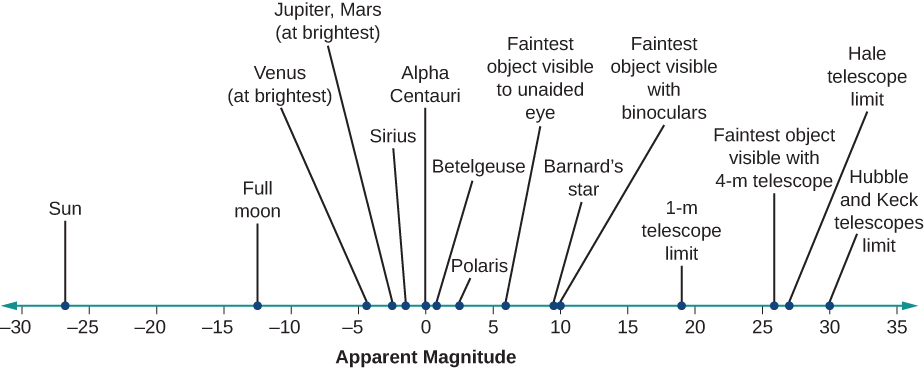
The brightest stars, those that were traditionally referred to as first-magnitude stars, actually turned out (when measured accurately) not to be identical in brightness. For example, the brightest star in the sky, Sirius, sends us about 10 times as much light as the average first-magnitude star. On the modern magnitude scale, Sirius, the star with the brightest apparent magnitude, has been assigned a magnitude of −1.5. Other objects in the sky can appear even brighter. Venus at its brightest is of magnitude −4.4, while the Sun has a magnitude of −26.8. Figure 17.2 shows the range of observed magnitudes from the brightest to the faintest, along with the actual magnitudes of several well-known objects. The important fact to remember when using magnitude is that the system goes backward: the larger the magnitude, the fainter the object you are observing.
英語のヒント
昔から1等星と呼ばれていた最も明るい星々も、正確に測ると、実際には同じ明るさではないことがわかった。たとえば夜空で最も明るいシリウスからは、平均的な1等星の約10倍の光が届く。現在の等級尺度では、見かけで最も明るい恒星であるシリウスは、−1.5等とされる。ほかの天体は、さらに明るく見えることがある。金星は最も明るいときに−4.4等、太陽は−26.8等である。図17.2は、最も明るいものから最も暗いものまでの観測等級の範囲と、よく知られたいくつかの天体の実際の等級を示す。等級を使うときに覚えるべき重要な点は、この制度が逆向きだということである。等級の数字が大きいほど、観測している天体は暗い。
Apparent Magnitudes of Well-Known Objects.よく知られた天体の見かけの等級。
OpenStax / Rice University · CC BY 4.0
Figure 17.2 The faintest magnitudes that can be detected by the unaided eye, binoculars, and large telescopes are also shown.
図17.2 肉眼、双眼鏡、大型望遠鏡で検出できる最も暗い等級も示す。
The Magnitude Equation等級の式
Even scientists can’t calculate fifth roots in their heads, so astronomers have summarized the above discussion in an equation to help calculate the difference in brightness for stars with different magnitudes. If m1 and m2 are the magnitudes of two stars, then we can calculate the ratio of their brightness using this equation:
英語のヒント
科学者でも5乗根を暗算することはできないので、天文学者は、異なる等級の星の明るさの差を計算するため、上の議論を式にまとめた。二つの星の等級をm₁とm₂とすれば、次の式で明るさの比を計算できる。
Here is another way to write this equation:
この式は、次のようにも書ける。
Let’s do a real example, just to show how this works. Imagine that an astronomer has discovered something special about a dim star (magnitude 8.5), and she wants to tell her students how much dimmer the star is than Sirius. Star 1 in the equation will be our dim star and star 2 will be Sirius.
実例で、式の使い方を確かめよう。ある天文学者が、8.5等の暗い星について特別な発見をし、その星がシリウスよりどれほど暗いかを生徒に伝えたいとしよう。式の星1をこの暗い星、星2をシリウスとする。
Solution解き方
Remember, Sirius has a magnitude of . In that case:
シリウスは等だった。この場合は、次のようになる。
Check Your Learning理解を確かめよう
It is a common misconception that Polaris (magnitude 2.0) is the brightest star in the sky, but, as we saw, that distinction actually belongs to Sirius (magnitude −1.5). How does Sirius’ apparent brightness compare to that of Polaris?
英語のヒント
2.0等の北極星が空で最も明るい星だというのは、よくある誤解である。すでに見たように、その称号は実際には−1.5等のシリウスに属する。シリウスの見かけの明るさは、北極星と比べてどれほどだろうか。
(Hint: If you only have a basic calculator, you may wonder how to take 100 to the 0.7th power. But this is something you can ask Google to do. Google now accepts mathematical questions and will answer them. So try it for yourself. Ask Google, “What is 100 to the 0.7th power?”)
ヒント:基本的な電卓しかない場合、100の0.7乗をどう求めるのか迷うかもしれない。しかし、これはGoogleに頼める計算である。Googleは数学の質問を受け付け、答えてくれる。自分で「100の0.7乗はいくら?」と尋ねて試してみよう。
Our calculation shows that Sirius’ apparent brightness is 25 times greater than Polaris’ apparent brightness.
計算から、シリウスの見かけの明るさは、北極星の25倍だとわかる。