第26章銀河Galaxies
26.4 The Extragalactic Distance Scale26.4 銀河系外の距離の尺度
Learning Objectives学習の目標
By the end of this section, you will be able to:
この節を読み終えると、次のことができるようになる。
Describe the use of variable stars to estimate distances to galaxies
変光星を使って銀河までの距離を推定する方法を説明する。
Explain how standard bulbs and the Tully-Fisher relation can be used to estimate distances to galaxies
標準光源とタリー・フィッシャー関係を使って銀河までの距離を推定する方法を説明する。
To determine many of the properties of a galaxy, such as its luminosity or size, we must first know how far away it is. If we know the distance to a galaxy, we can convert how bright the galaxy appears to us in the sky into its true luminosity because we know the precise way light is dimmed by distance. (The same galaxy 10 times farther away, for example, would look 100 times dimmer.) But the measurement of galaxy distances is one of the most difficult problems in modern astronomy: all galaxies are far away, and most are so distant that we cannot even make out individual stars in them.
英語のヒント
銀河の光度や大きさなど、多くの性質を求めるには、まずその銀河がどれだけ遠くにあるかを知る必要がある。距離が分かれば、空で見える明るさを、その銀河の本当の光度に換算できる。距離によって光がどのように弱まるかを、正確に知っているからだ。例えば同じ銀河が10倍遠くにあれば、見かけの明るさは100分の1になる。しかし、銀河までの距離の測定は、現代天文学で最も難しい問題の一つである。すべての銀河は遠くにあり、その大部分はあまりに遠いため、中の星を一つずつ見分けることさえできない。
For decades after Hubble’s initial work, the techniques used to measure galaxy distances were relatively inaccurate, and different astronomers derived distances that differed by as much as a factor of two. (Imagine if the distance between your home or dorm and your astronomy class were this uncertain; it would be difficult to make sure you got to class on time.) In the past few decades, however, astronomers have devised new techniques for measuring distances to galaxies; most importantly, all of them give the same answer to within an accuracy of about 10%. As we will see, this means we may finally be able to make reliable estimates of the size of the universe.
英語のヒント
ハッブルの最初の研究後、数十年にわたって、銀河までの距離を測る方法はあまり正確ではなかった。天文学者によって、得られる距離が2倍も異なることがあったのだ。自宅や寮から天文学の教室までの距離が、これほど不確かだったらどうだろう。時間どおりに授業へ着くのは難しいはずだ。ところがこの数十年で、銀河までの距離を測る新しい手法が考案された。何より大切なのは、どの手法でも約10%の精度の範囲で同じ答えが得られることだ。これから見るように、これは宇宙の大きさを、ついに信頼できる形で推定できるようになる可能性を意味する。
Variable Stars変光星
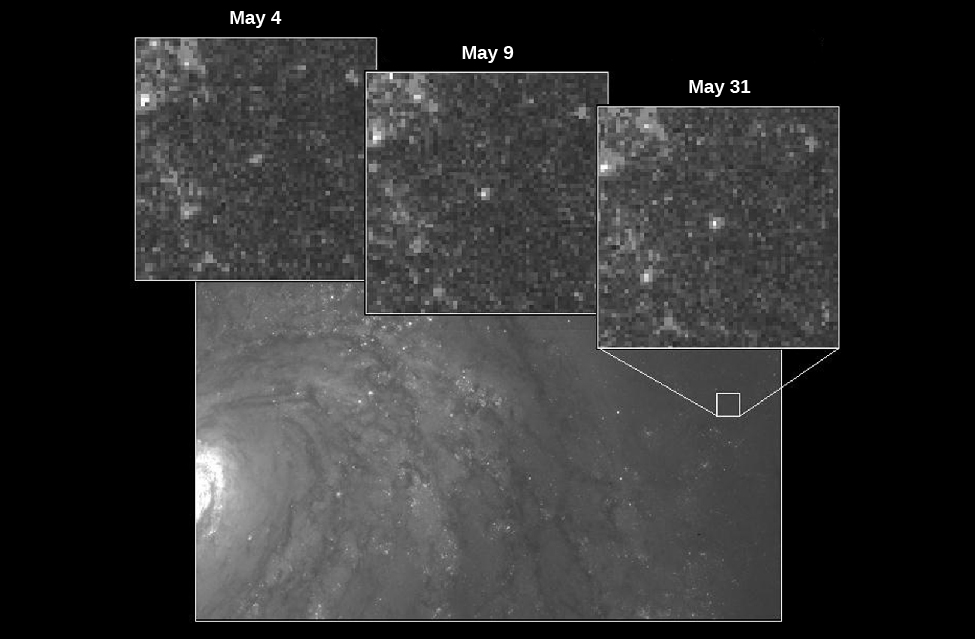
Before astronomers could measure distances to other galaxies, they first had to establish the scale of cosmic distances using objects in our own Galaxy. We described the chain of these distance methods in Celestial Distances (and we recommend that you review that chapter if it has been a while since you’ve read it). Astronomers were especially delighted when they discovered that they could measure distances using certain kinds of intrinsically luminous variable stars, such as cepheids, which can be seen at very large distances (Figure 26.11).
英語のヒント
ほかの銀河までの距離を測るには、まず銀河系内の天体を用いて、宇宙の距離の尺度を確立する必要があった。これらの測定法をつないで距離を測る仕組みは、「天体までの距離」で説明した。読んでから時間がたっているなら、その章を復習してほしい。天文学者をとりわけ喜ばせたのは、もともとの光度が大きい特定の種類の変光星を使って、距離が測れるという発見だった。例えばセファイド変光星は、非常に遠くからでも見ることができる(図26.11)。
After the variables in nearby galaxies had been used to make distance measurements for a few decades, Walter Baade showed that there were actually two kinds of cepheids and that astronomers had been unwittingly mixing them up. As a result, in the early 1950s, the distances to all of the galaxies had to be increased by about a factor of two. We mention this because we want you to bear in mind, as you read on, that science is always a study in progress. Our first tentative steps in such difficult investigations are always subject to future revision as our techniques become more reliable.
英語のヒント
近隣の銀河にある変光星を使った距離測定が始まってから数十年後、ウォルター・バーデは、セファイドには実は2種類あり、天文学者が知らずにそれらを混同していたことを示した。その結果、1950年代初めには、すべての銀河までの距離を約2倍に引き上げる必要が生じた。この話をするのは、この先を読むときにも、科学は常に進行中の研究であると心に留めてほしいからだ。このような難しい探究で踏み出す最初の暫定的な一歩は、手法の信頼性が高まるにつれて、将来修正される可能性を常に含んでいる。
The amount of work involved in finding cepheids and measuring their periods can be enormous. Hubble, for example, obtained 350 long-exposure photographs of the Andromeda galaxy over a period of 18 years and was able to identify only 40 cepheids. Even though cepheids are fairly luminous stars, they can be detected in only about 30 of the nearest galaxies with the world’s largest ground-based telescopes.
英語のヒント
セファイドを探し、その周期を測定するには、膨大な作業が必要になることがある。例えばハッブルは、18年間にわたりアンドロメダ銀河の長時間露光写真を350枚撮影したが、特定できたセファイドはわずか40個だった。セファイドはかなり明るい星だが、世界最大級の地上望遠鏡でも、検出できるのは最も近い銀河のうち約30個に限られる。
As mentioned in Celestial Distances, one of the main projects carried out during the first years of operation of the Hubble Space Telescope was the measurement of cepheids in more distant galaxies to improve the accuracy of the extragalactic distance scale. Recently, astronomers working with the Hubble Space Telescope have extended such measurements out to 108 million light-years—a triumph of technology and determination.
英語のヒント
「天体までの距離」で述べたように、ハッブル宇宙望遠鏡の運用開始から数年間に実施された主要な計画の一つが、より遠い銀河のセファイドの測定だった。銀河系外の距離の尺度を、もっと正確にするためである。近年、ハッブル宇宙望遠鏡を使う天文学者は、この測定を1億800万光年先まで広げた。技術と粘り強さの勝利である。
Cepheid Variable Star.セファイド変光星
credit: modification of work by Wendy L. Freedman, Observatories of the Carnegie Institution of Washington, and NASA/ESA · NASA media use guidelines
Figure 26.11 In 1994, using the Hubble Space Telescope, astronomers were able to make out an individual cepheid variable star in the galaxy M100 and measure its distance to be 56 million light-years. The insets show the star on three different nights; you can see that its brightness is indeed variable. (credit: modification of work by Wendy L. Freedman, Observatories of the Carnegie Institution of Washington, and NASA/ESA)
図26.11 1994年、天文学者はハッブル宇宙望遠鏡を使い、銀河M100の中にある一つのセファイド変光星を見分け、その距離を5600万光年と測定することに成功した。拡大画像は3回の異なる夜の星の姿で、明るさが実際に変化していることが分かる。(クレジット:Wendy L. Freedman、ワシントン・カーネギー研究所天文台、NASA/ESAの作品を改変)
Nevertheless, we can only use cepheids to measure distances within a small fraction of the universe of galaxies. After all, to use this method, we must be able to resolve single stars and follow their subtle variations. Beyond a certain distance, even our finest space telescopes cannot help us do this. Fortunately, there are other ways to measure the distances to galaxies.
英語のヒント
それでも、セファイドで距離を測れるのは、銀河が広がる宇宙のほんの一部分にすぎない。この方法を使うには、星を一つずつ分離して見分け、その微妙な明るさの変化を追う必要があるからだ。ある距離を超えると、最高性能の宇宙望遠鏡でも、それはできなくなる。幸い、銀河までの距離を測る方法はほかにもある。
Standard Bulbs標準光源
We discussed in Celestial Distances the great frustration that astronomers felt when they realized that the stars in general were not standard bulbs. If every light bulb in a huge auditorium is a standard 100-watt bulb, then bulbs that look brighter to us must be closer, whereas those that look dimmer must be farther away. If every star were a standard luminosity (or wattage), then we could similarly “read off” their distances based on how bright they appear to us. Alas, as we have learned, neither stars nor galaxies come in one standard-issue luminosity. Nonetheless, astronomers have been searching for objects out there that do act in some way like a standard bulb—that have the same intrinsic (built-in) brightness wherever they are.
英語のヒント
「天体までの距離」では、星は一般に標準的な電球のようなものではないと分かり、天文学者が大いに落胆した話をした。大きな講堂にある電球がすべて同じ100ワットの標準電球なら、明るく見える電球ほど近く、暗く見える電球ほど遠いはずである。星もすべて同じ光度、つまり同じワット数なら、見かけの明るさから同じように距離を「読み取れる」はずだ。残念ながら、すでに学んだとおり、星も銀河も、どれも同じ規格の光度でできているわけではない。それでも天文学者は、標準電球のように振る舞う天体を探し続けてきた。どこにあっても、本来備わっている明るさが同じになる天体である。
A number of suggestions have been made for what sorts of objects might be effective standard bulbs, including the brightest supergiant stars, planetary nebulae (which give off a lot of ultraviolet radiation), and the average globular cluster in a galaxy. One object turns out to be particularly useful: the type Ia supernova. These supernovae involve the explosion of a white dwarf in a binary system (see The Evolution of Binary Star Systems) Observations show that supernovae of this type all reach nearly the same luminosity (about 4.5 × 10⁹ LSun) at maximum light. With such tremendous luminosities, these supernovae have been detected out to a distance of more than 8 billion light-years and are therefore especially attractive to astronomers as a way of determining distances on a large scale (Figure 26.12).
英語のヒント
有効な標準光源になりそうな天体として、最も明るい超巨星、大量の紫外線を放つ惑星状星雲、銀河内の平均的な球状星団など、さまざまな候補が提案されてきた。中でも特に役立つと分かったのが、Ia型超新星である。これは連星系の白色矮星が爆発する現象だ(「連星系の進化」を参照)。観測によると、この種類の超新星は、最大光度のときにいずれもほぼ同じ光度、約4.5 × 10⁹ LSunに達する。これほど桁外れに明るいため、80億光年より遠い距離でも検出されている。そのため、宇宙の大きな尺度で距離を求める手段として、天文学者にとって特に魅力的な天体なのである(図26.12)。
Type Ia Supernova.Ia型超新星
Figure 26.12 The bright object in the galaxy M101 shown by the arrow is a type Ia supernova seen in 2011. Such a supernova can briefly outshine its entire host galaxy. Since type Ia supernovae all come from the same kind of stellar explosion and have the same extreme increase in their luminosity, astronomers can use them as a standard bulb. (credit: B. J. Fulton, Las Cumbres Observatory Global Telescope Network)
英語のヒント
図26.12 矢印が示す銀河M101の明るい天体は、2011年に観測されたIa型超新星である。このような超新星は短期間、所属する銀河全体より明るく輝くことがある。Ia型超新星は、いずれも同じ種類の恒星爆発から生じ、光度が同じように極端に増すため、標準光源として利用できる。(クレジット:B. J. Fulton、ラス・クンブレス天文台グローバル望遠鏡ネットワーク)
Several other kinds of standard bulbs visible over great distances have also been suggested, including the overall brightness of, for example, giant ellipticals and the brightest member of a galaxy cluster. Type Ia supernovae, however, have proved to be the most accurate standard bulbs, and they can be seen in more distant galaxies than the other types of calibrators. As we will see in the chapter on The Big Bang, observations of this type of supernova have profoundly changed our understanding of the evolution of the universe.
英語のヒント
遠距離からも見える標準光源としては、巨大楕円銀河全体の明るさや、銀河団の中で最も明るい銀河など、ほかにもいくつかの候補が提案されている。しかしIa型超新星は、最も正確な標準光源であることが確かめられ、ほかの種類の距離指標よりも遠い銀河で観測できる。「ビッグバン」の章で見るように、この種類の超新星の観測は、宇宙の進化についての私たちの理解を根本から変えた。