第26章銀河Galaxies
26.5 The Expanding Universe26.5 膨張する宇宙
Learning Objectives学習の目標
By the end of this section, you will be able to:
この節を読み終えると、次のことができるようになる。
Describe the discovery that galaxies getting farther apart as the universe evolves
宇宙が進化するにつれて銀河どうしが遠ざかっているという発見を説明する。
Explain how to use Hubble’s law to determine distances to remote galaxies
ハッブルの法則を使って遠方の銀河までの距離を求める方法を説明する。
Describe models for the nature of an expanding universe
膨張する宇宙のあり方を表す模型を説明する。
Explain the variation in Hubble’s constant
ハッブル定数の値の変化を説明する。
We now come to one of the most important discoveries ever made in astronomy—the fact that the universe is expanding. Before we describe how the discovery was made, we should point out that the first steps in the study of galaxies came at a time when the techniques of spectroscopy were also making great strides. Astronomers using large telescopes could record the spectrum of a faint star or galaxy on photographic plates, guiding their telescopes so they remained pointed to the same object for many hours and collected more light. The resulting spectra of galaxies contained a wealth of information about the composition of the galaxy and the velocities of these great star systems.
英語のヒント
ここで、天文学史上最も重要な発見の一つ、宇宙が膨張しているという事実に進もう。発見の経緯を説明する前に、銀河研究が最初の一歩を踏み出した時期は、分光法も大きく進歩していた時期だったことを指摘しておきたい。大型望遠鏡を使う天文学者は、暗い星や銀河のスペクトルを写真乾板に記録できた。何時間も同じ天体を向き続けるよう望遠鏡を追尾させ、多くの光を集めたのである。こうして得られたスペクトルには、銀河の組成と、この巨大な星の集団の速度についての情報が豊富に含まれていた。
Slipher’s Pioneering Observationsスライファーの先駆的な観測
Curiously, the discovery of the expansion of the universe began with the search for Martians and other solar systems. In 1894, the controversial (and wealthy) astronomer Percival Lowell established an observatory in Flagstaff, Arizona, to study the planets and search for life in the universe. Lowell thought that the spiral nebulae might be solar systems in the process of formation. He therefore asked one of the observatory’s young astronomers, Vesto M. Slipher (Figure 26.13), to photograph the spectra of some of the spiral nebulae to see if their spectral lines might show chemical compositions like those expected for newly forming planets.
英語のヒント
不思議なことに、宇宙膨張の発見は、火星人やほかの太陽系を探すことから始まった。1894年、賛否を呼び、また裕福でもあった天文学者パーシヴァル・ローウェルは、惑星の研究と宇宙の生命の探索のため、アリゾナ州フラッグスタッフに天文台を設立した。ローウェルは、渦巻星雲が形成途中の太陽系なのではないかと考えた。そこで天文台の若い天文学者ヴェスト・M・スライファー(図26.13)に、いくつかの渦巻星雲のスペクトルを撮影するよう依頼した。スペクトル線に、新しく形成されつつある惑星で予想されるような化学組成が現れないかを調べるためだった。
Vesto M. Slipher (1875–1969).ヴェスト・M・スライファー(1875〜1969年)
Figure 26.13 Slipher spent his entire career at the Lowell Observatory, where he discovered the large radial velocities of galaxies. (credit: Lowell Observatory)
図26.13 スライファーは生涯の職業人生をローウェル天文台で送り、そこで銀河の大きな視線速度を発見した。(クレジット:ローウェル天文台)
The Lowell Observatory’s major instrument was a 24-inch refracting telescope, which was not at all well suited to observations of faint spiral nebulae. With the technology available in those days, photographic plates had to be exposed for 20 to 40 hours to produce a good spectrum (in which the positions of the lines could reveal a galaxy’s motion). This often meant continuing to expose the same photograph over several nights. Beginning in 1912, and making heroic efforts over a period of about 20 years, Slipher managed to photograph the spectra of more than 40 of the spiral nebulae (which would all turn out to be galaxies).
英語のヒント
ローウェル天文台の主力装置は口径24インチの屈折望遠鏡で、暗い渦巻星雲の観測にはまったく向いていなかった。当時の技術で良質なスペクトルを得るには、写真乾板を20〜40時間も露光する必要があった。スペクトル線の位置から銀河の動きを読み取れるだけの記録を作るためだ。多くの場合、何晩にもわたって同じ写真の露光を続けることになった。スライファーは1912年から約20年間、並外れた努力を重ね、40個以上の渦巻星雲のスペクトルの撮影に成功した。それらは後に、すべて銀河だと分かることになる。
To his surprise, the spectral lines of most galaxies showed an astounding redshift. By “redshift” we mean that the lines in the spectra are displaced toward longer wavelengths (toward the red end of the visible spectrum). Recall from the chapter on Radiation and Spectra that a redshift is seen when the source of the waves is moving away from us. Slipher’s observations showed that most spirals are racing away at huge speeds; the highest velocity he measured was 1800 kilometers per second.
英語のヒント
驚いたことに、ほとんどの銀河のスペクトル線は、著しい赤方偏移を示した。「赤方偏移」とは、スペクトル線が長い波長の側、可視光のスペクトルなら赤い端の側へずれることをいう。「放射とスペクトル」の章で、波の発生源が私たちから遠ざかると赤方偏移が見られると学んだことを思い出そう。スライファーの観測は、ほとんどの渦巻星雲が猛烈な速度で遠ざかっていると示した。彼が測定した最大の速度は毎秒1800キロメートルだった。
Only a few spirals—such as the Andromeda and Triangulum Galaxies and M81—all of which are now known to be our close neighbors, turned out to be approaching us. All the other galaxies were moving away. Slipher first announced this discovery in 1914, years before Hubble showed that these objects were other galaxies and before anyone knew how far away they were. No one at the time quite knew what to make of this discovery.
英語のヒント
近づいていると分かった渦巻銀河は、アンドロメダ銀河、さんかく座銀河、M81など、ごくわずかだった。いずれも現在では、私たちの近隣の銀河と分かっている。ほかの銀河はすべて遠ざかっていた。スライファーがこの発見を初めて発表したのは1914年である。ハッブルがこれらの天体は別の銀河だと示す何年も前で、どれだけ遠くにあるかも、まだ誰も知らなかった。当時、この発見をどう受け止めるべきか、はっきり分かる人はいなかった。
Hubble’s Lawハッブルの法則
The profound implications of Slipher’s work became apparent only during the 1920s. Georges Lemaître was a Belgian priest and a trained astronomer. In 1927, he published a paper in French in an obscure Belgian journal in which he suggested that we live in an expanding universe. The title of the paper (translated into English) is “A Homogenous Universe of Constant Mass and Growing Radius Accounting for the Radial Velocity of Extragalactic Nebulae.” Lemaître had discovered that Einstein’s equations of relativity were consistent with an expanding universe (as had the Russian scientist Alexander Friedmann independently in 1922). Lemaître then went on to use Slipher’s data to support the hypothesis that the universe actually is expanding and to estimate the rate of expansion. Initially, scientists paid little attention to this paper, perhaps because the Belgian journal was not widely available.
英語のヒント
スライファーの研究がもつ深い意味が明らかになるのは、1920年代に入ってからだった。ジョルジュ・ルメートルはベルギーの司祭であり、専門教育を受けた天文学者でもあった。1927年、彼はベルギーのあまり知られていない雑誌にフランス語の論文を発表し、私たちが膨張する宇宙に住んでいると提案した。論文の題名は、英訳すると『銀河系外星雲の視線速度を説明する、質量が一定で半径が増大する均質な宇宙』となる。ルメートルは、アインシュタインの相対性理論の方程式が、膨張する宇宙と両立すると発見していた。ロシアの科学者アレクサンドル・フリードマンも、1922年に独立に同じことを発見していた。さらにルメートルはスライファーのデータを使い、宇宙は実際に膨張しているという仮説を裏づけ、その膨張率を推定した。当初、科学者はこの論文にほとんど注目しなかった。そのベルギーの雑誌が広く入手できるものではなかったためかもしれない。
In the meantime, Hubble was making observations of galaxies with the 2.5-meter telescope on Mt. Wilson, which was then the world’s largest. Hubble carried out the key observations in collaboration with a remarkable man, Milton Humason, who dropped out of school in the eighth grade and began his astronomical career by driving a mule train up the trail on Mount Wilson to the observatory (Figure 26.14). In those early days, supplies had to be brought up that way; even astronomers hiked up to the mountaintop for their turns at the telescope. Humason became interested in the work of the astronomers and, after marrying the daughter of the observatory’s electrician, took a job as janitor there. After a time, he became a night assistant, helping the astronomers run the telescope and record data. Eventually, he made such a mark that he became a full astronomer at the observatory.
英語のヒント
そのころハッブルは、当時世界最大だったウィルソン山の口径2.5メートル望遠鏡で銀河を観測していた。重要な観測を共同で進めた相手は、ミルトン・ヒューメイソンという非凡な人物だった。彼は第8学年で学校をやめ、ラバの隊列を率いてウィルソン山の山道を天文台まで登る仕事から、天文学の道に入った(図26.14)。初期には、物資はその方法で山へ運び上げなければならなかった。天文学者でさえ、自分の観測の順番には山頂まで歩いて登った。ヒューメイソンは天文学者の仕事に興味をもち、天文台の電気技師の娘と結婚した後、そこで用務員の職を得た。しばらくすると夜間助手になり、望遠鏡の操作やデータの記録を手伝うようになった。やがてその働きが大いに認められ、天文台の正式な天文学者となった。
Georges Lemaitre (1894–1966) and Milton Humason (1891–1972).ジョルジュ・ルメートル(1894〜1966年)とミルトン・ヒューメイソン(1891〜1972年)
Figure 26.14 (a) Georges Lemaitre (right) is seen here with Albert Einstein in 1932. Lemaitre was first to suggest the concept of an expanding universe. (b) Humason was Hubble’s collaborator on the great task of observing, measuring, and classifying the characteristics of many galaxies. (credit a, b: modification of work by Caltech Archives)
図26.14 (a)1932年のアルベルト・アインシュタインとジョルジュ・ルメートル(右)。ルメートルは膨張宇宙の概念を初めて提案した。(b)ヒューメイソンは、多数の銀河の特徴を観測・測定・分類する大事業で、ハッブルの共同研究者だった。(クレジットa、b:カリフォルニア工科大学文書館の作品を改変)
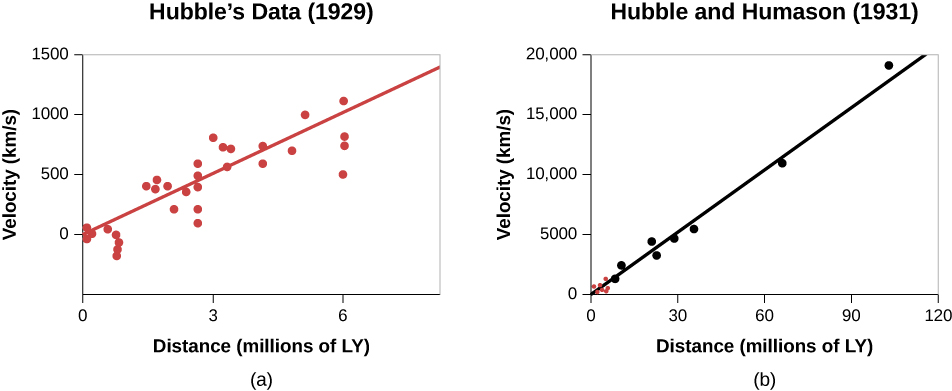
By the late 1920s, Humason was collaborating with Hubble by photographing the spectra of faint galaxies with the 2.5-meter telescope. (By then, there was no question that the spiral nebulae were in fact galaxies.) Hubble had found ways to improve the accuracy of the estimates of distances to spiral galaxies, and he was able to measure much fainter and more distant galaxies than Slipher could observe with his much-smaller telescope. When Hubble laid his own distance estimates next to measurements of the recession velocities (the speed with which the galaxies were moving away), he found something stunning: there was a relationship between distance and velocity for galaxies. The more distant the galaxy, the faster it was receding from us.
英語のヒント
1920年代後半には、ヒューメイソンは2.5メートル望遠鏡で暗い銀河のスペクトルを撮影し、ハッブルに協力していた。この時点では、渦巻星雲が実際に銀河であることに、もはや疑問はなかった。ハッブルは渦巻銀河までの距離の推定精度を高める方法を見つけていた。また、スライファーのずっと小さい望遠鏡で観測できるものよりも、はるかに暗く遠い銀河を測定できた。ハッブルが自分の距離の推定値を、後退速度、つまり銀河が遠ざかる速さの測定値と並べてみると、驚くべきことが分かった。銀河の距離と速度には関係があったのである。遠い銀河ほど、私たちから速く遠ざかっていた。
In 1931, Hubble and Humason jointly published the seminal paper where they compared distances and velocities of remote galaxies moving away from us at speeds as high as 20,000 kilometers per second and were able to show that the recession velocities of galaxies are directly proportional to their distances from us (Figure 26.15), just as Lemaître had suggested.
英語のヒント
1931年、ハッブルとヒューメイソンは、画期的な論文を共同で発表した。私たちから毎秒2万キロメートルもの速さで遠ざかる遠方の銀河について、距離と速度を比較した研究である。二人は、銀河の後退速度が私たちからの距離に正比例することを示すことができた(図26.15)。まさにルメートルが提案していたとおりだった。
Hubble’s Law.ハッブルの法則
OpenStax / Rice University · CC BY 4.0
Figure 26.15 (a) These data show Hubble’s original velocity-distance relation, adapted from his 1929 paper in the Proceedings of the National Academy of Sciences. (b) These data show Hubble and Humason’s velocity-distance relation, adapted from their 1931 paper in The Astrophysical Journal. The red dots at the lower left are the points in the diagram in the 1929 paper. Comparison of the two graphs shows how rapidly the determination of galactic distances and redshifts progressed in the 2 years between these publications.
図26.15 (a)ハッブルが1929年に『米国科学アカデミー紀要』で発表した論文に基づく、最初の速度と距離の関係。(b)ハッブルとヒューメイソンが1931年に『アストロフィジカル・ジャーナル』で発表した論文に基づく、速度と距離の関係。左下の赤い点は1929年の論文の図にあった点である。二つのグラフを比べると、発表の間の2年間で、銀河の距離と赤方偏移の測定がどれほど急速に進んだかが分かる。
We now know that this relationship holds for every galaxy except a few of the nearest ones. Nearly all of the galaxies that are approaching us turn out to be part of the Milky Way’s own group of galaxies, which have their own individual motions, just as birds flying in a group may fly in slightly different directions at slightly different speeds even though the entire flock travels through space together.
英語のヒント
現在では、この関係は最も近い少数の銀河を除き、すべての銀河で成り立つと分かっている。私たちに近づく銀河のほぼすべては、天の川銀河と同じ銀河群の一員であり、それぞれ固有の運動をしている。これは、鳥の群れ全体が一緒に空間を移動していても、その中の鳥は少しずつ違う向きや速さで飛べるのと同じである。
Written as a formula, the relationship between velocity and distance is
速度と距離の関係を式で書くと、次のようになる。
where v is the velocity, d is the distance, and H is a number called the Hubble constant. This equation is now known as Hubble’s law.In 2020, the International Astronomical Union suggested that it would be more fair to call it the Hubble-Lemaitre law. In telling the history in this textbook, we have acknowledged the role Lemaître played, and we urge our readers to keep his contributions in mind as they read on.
英語のヒント
ここで、vは速度、dは距離、Hはハッブル定数と呼ばれる数値である。この式は現在、ハッブルの法則として知られている。2020年、国際天文学連合は、ハッブル=ルメートルの法則と呼ぶほうが公正だと提案した。本書でも歴史を述べるにあたり、ルメートルの役割を認めている。この先を読むときも、彼の貢献を心に留めてほしい。
Astronomers express the value of Hubble’s constant in units that relate to how they measure speed and distance for galaxies. In this book, we will use kilometers per second per million light-years as that unit. For many years, estimates of the value of the Hubble constant have been in the range of 15 to 30 kilometers per second per million light-years The most recent work appears to be converging on a value near 22 kilometers per second per million light-years If H is 22 kilometers per second per million light-years, a galaxy moves away from us at a speed of 22 kilometers per second for every million light-years of its distance. As an example, a galaxy 100 million light-years away is moving away from us at a speed of 2200 kilometers per second.
英語のヒント
天文学者はハッブル定数の値を、銀河の速度と距離の測り方に対応した単位で表す。本書では、百万光年当たり毎秒何キロメートル、すなわちkm/s/百万光年を単位にする。長年、ハッブル定数の推定値は15〜30 km/s/百万光年の範囲にあった。最新の研究は、22 km/s/百万光年付近へ収束しつつあるように見える。Hが22 km/s/百万光年なら、銀河はその距離が百万光年増すごとに、毎秒22キロメートルずつ大きい速度で私たちから遠ざかる。例えば1億光年先にある銀河は、毎秒2200キロメートルで遠ざかっている。
Hubble’s law tells us something fundamental about the universe. Since all but the nearest galaxies appear to be in motion away from us, with the most distant ones moving the fastest, we must be living in an expanding universe. We will explore the implications of this idea shortly, as well as in the final chapters of this text. For now, we will just say that Hubble’s observation underlies all our theories about the origin and evolution of the universe.
英語のヒント
ハッブルの法則は、宇宙について根本的なことを教えてくれる。最も近い銀河を除くすべてが私たちから遠ざかるように見え、最も遠いものほど速く動くのだから、私たちは膨張する宇宙に住んでいるはずだ。この考えが意味することは、この後すぐに、また本書の終盤の章でも探究する。今のところは、宇宙の起源と進化についてのあらゆる理論が、ハッブルの観測を土台としていると述べておこう。