第26章銀河Galaxies
26.1 The Discovery of Galaxies26.1 銀河の発見
Learning Objectives学習の目標
By the end of this section, you will be able to:
この節を読み終えると、次のことができるようになる。
Describe the discoveries that confirmed the existence of galaxies that lie far beyond the Milky Way Galaxy
天の川銀河のはるか外側にも銀河が存在することを確かめた発見について説明する。
Explain why galaxies used to be called nebulae and why we don’t include them in that category any more
かつて銀河が星雲と呼ばれていた理由と、今では銀河を星雲に含めない理由を説明する。
Growing up at a time when the Hubble Space Telescope orbits above our heads and giant telescopes are springing up on the great mountaintops of the world, you may be surprised to learn that we were not sure about the existence of other galaxies for a very long time. The very idea that other galaxies exist used to be controversial. Even into the 1920s, many astronomers thought the Milky Way encompassed all that exists in the universe. The evidence found in 1924 that meant our Galaxy is not alone was one of the great scientific discoveries of the twentieth century.
英語のヒント
頭上をハッブル宇宙望遠鏡が周回し、世界各地の高い山々に巨大望遠鏡が次々と建てられる時代に育った皆さんは、ほかの銀河が存在するかどうか、長い間確信が持たれていなかったと聞いて驚くかもしれない。ほかの銀河があるという考え自体が、かつては論争の的だった。1920年代に入っても、多くの天文学者は、宇宙に存在するものすべてが天の川銀河に含まれると考えていた。天の川銀河だけが唯一の銀河ではないと示す証拠が1924年に見つかったことは、20世紀の科学上の大発見の一つである。
It was not that scientists weren’t asking questions. They questioned the composition and structure of the universe as early as the eighteenth century. However, with the telescopes available in earlier centuries, galaxies looked like small fuzzy patches of light that were difficult to distinguish from the star clusters and gas-and-dust clouds that are part of our own Galaxy. All objects that were not sharp points of light were given the same name, nebulae, the Latin word for “clouds.” Because their precise shapes were often hard to make out and no techniques had yet been devised for measuring their distances, the nature of the nebulae was the subject of much debate.
英語のヒント
科学者が問いを立てていなかったわけではない。宇宙の成り立ちや構造については、早くも18世紀から疑問を投げかけていた。しかし、当時の望遠鏡で見る銀河は、ぼんやりした小さな光のしみに見えた。天の川銀河に属する星団や、ガスと塵の雲との区別が難しかったのである。くっきりした光の点に見えない天体は、すべて「星雲(nebulae)」という同じ名前で呼ばれた。これはラテン語で「雲」を意味する。正確な形を見分けにくいうえ、距離を測る手法もまだ考案されていなかったため、星雲の正体をめぐって多くの議論が交わされた。
As early as the eighteenth century, the philosopher Immanuel Kant (1724–1804) suggested that some of the nebulae might be distant systems of stars (other Milky Ways), but the evidence to support this suggestion was beyond the capabilities of the telescopes of that time.
英語のヒント
早くも18世紀には、哲学者イマヌエル・カント(1724〜1804)が、星雲の中には遠くにある星の集団、つまり別の天の川銀河に当たるものもあるのではないかと提案していた。しかし、その考えを裏付ける証拠を得ることは、当時の望遠鏡の能力を超えていた。
Other Galaxiesほかの銀河
By the early twentieth century, some nebulae had been correctly identified as star clusters, and others (such as the Orion Nebula) as gaseous nebulae. Most nebulae, however, looked faint and indistinct, even with the best telescopes, and their distances remained unknown. (For more on how such nebulae are named, by the way, see the feature box on Naming the Nebulae in the chapter on interstellar matter.) If these nebulae were nearby, with distances comparable to those of observable stars, they were most likely clouds of gas or groups of stars within our Galaxy. If, on the other hand, they were remote, far beyond the edge of the Galaxy, they could be other star systems containing billions of stars.
英語のヒント
20世紀初めまでには、一部の星雲は星団だと正しく同定され、オリオン大星雲など別のものはガスからなる星雲だと分かっていた。しかし、大部分の星雲は、最良の望遠鏡を使っても暗く不鮮明で、距離は依然として不明だった。(なお、こうした星雲の命名法については、星間物質の章にあるコラム「星雲の命名」を参照。)これらの星雲が、観測できる星と同程度の距離にある近くの天体なら、天の川銀河内のガス雲や星の集まりである可能性が高い。逆に、天の川銀河の端をはるかに越えた遠方にあるなら、何十億もの星を含む別の星の集団かもしれなかった。
To determine what the nebulae are, astronomers had to find a way of measuring the distances to at least some of them. When the 2.5-meter (100-inch) telescope on Mount Wilson in Southern California went into operation, astronomers finally had the large telescope they needed to settle the controversy.
英語のヒント
星雲の正体を明らかにするには、少なくともその一部について、距離を測る方法を見つけなければならなかった。南カリフォルニアのウィルソン山で口径2.5メートル(100インチ)の望遠鏡が運用を始めると、天文学者はついに、この論争に決着をつけるために必要な大型望遠鏡を手にした。
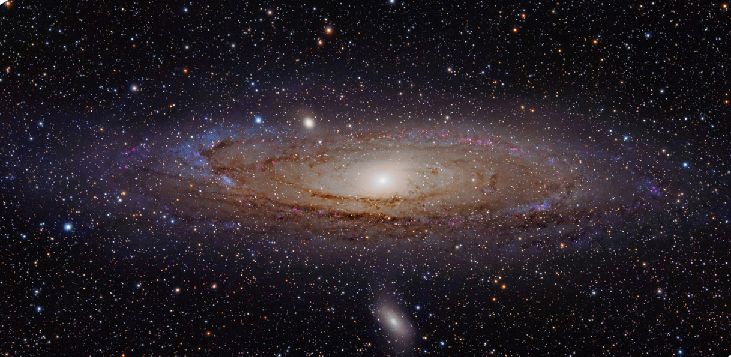
Working with the 2.5-meter telescope, Edwin Hubble was able to resolve individual stars in several of the brighter spiral-shaped nebulae, including M31, the great spiral in Andromeda (Figure 26.2). Among these stars, he discovered some faint variable stars that—when he analyzed their light curves—turned out to be cepheids. Here were reliable indicators that Hubble could use to measure the distances to the nebulae using the technique pioneered by Henrietta Leavitt (see the chapter on Celestial Distances). After painstaking work, he estimated that the Andromeda galaxy was about 900,000 light-years away from us. At that enormous distance, it had to be a separate galaxy of stars located well outside the boundaries of the Milky Way. Today, we know the Andromeda galaxy is actually slightly more than twice as distant as Hubble’s first estimate, but his conclusion about its true nature remains unchanged.
英語のヒント
エドウィン・ハッブルは、この2.5メートル望遠鏡を使い、比較的明るい渦巻形の星雲のいくつかで、個々の星を分離して見ることに成功した。その中には、アンドロメダ座にある大きな渦巻天体M31も含まれていた(図26.2)。そうした星の中に暗い変光星をいくつか見つけ、その光度曲線を分析したところ、セファイド変光星であることが分かった。これは、ヘンリエッタ・リーヴィットが開拓した手法を用いて星雲までの距離を測る、信頼できる指標だった(「天体までの距離」の章を参照)。丹念な作業の末、ハッブルはアンドロメダ銀河が私たちから約90万光年の距離にあると見積もった。それほど遠くにある以上、天の川銀河の境界をはるかに越えた、別の銀河でなければならない。現在では、アンドロメダ銀河までの実際の距離は、ハッブルが最初に見積もった値の2倍を少し超えると分かっている。それでも、その正体についての結論は変わっていない。
Andromeda Galaxy.アンドロメダ銀河
credit: Adam Evans · CC BY 2.0
Figure 26.2 Also known by its catalog number M31, the Andromeda galaxy is a large spiral galaxy very similar in appearance to, and slightly larger than, our own Galaxy. At a distance of about 2.5 million light-years, Andromeda is the spiral galaxy that is nearest to our own in space. Here, it is seen with two of its satellite galaxies, M32 (top) and M110 (bottom). (credit: Adam Evans)
英語のヒント
図26.2 カタログ番号M31としても知られるアンドロメダ銀河は、私たちの天の川銀河と外見がよく似ており、少し大きい、大型の渦巻銀河である。約250万光年の距離にあり、宇宙空間で天の川銀河に最も近い渦巻銀河である。ここでは、その衛星銀河のうちM32(上)とM110(下)の二つも一緒に見えている。(クレジット:Adam Evans)
No one in human history had ever measured a distance so great. When Hubble’s paper on the distances to nebulae was read before a meeting of the American Astronomical Society on the first day of 1925, the entire room erupted in a standing ovation. A new era had begun in the study of the universe, and a new scientific field—extragalactic astronomy—had just been born.
英語のヒント
人類の歴史上、これほど大きな距離を測った人は、それまで誰もいなかった。1925年の元日、アメリカ天文学会の会合で、星雲までの距離を扱ったハッブルの論文が読み上げられると、会場全体が立ち上がって拍手した。宇宙の研究に新しい時代が始まり、新たな科学分野「銀河系外天文学」が誕生したのである。