第25章天の川銀河The Milky Way Galaxy
25.2 Spiral Structure25.2 渦巻構造
Learning Objectives学習の目標
By the end of this section, you will be able to:
この節を読み終えると、次のことができるようになる。
Describe the structure of the Milky Way Galaxy and how astronomers discovered it
天の川銀河の構造と、天文学者がそれを明らかにした方法を説明する。
Compare theoretical models for the formation of spiral arms in disk galaxies
円盤銀河で渦状腕が形成される理論模型を比較する。
Astronomers were able to make tremendous progress in mapping the spiral structure of the Milky Way after the discovery of the 21-cm line that comes from cool hydrogen (see Between the Stars: Gas and Dust in Space). Remember that the obscuring effect of interstellar dust prevents us from seeing stars at large distances in the disk at visible wavelengths. However, radio waves of 21-cm wavelength pass right through the dust, enabling astronomers to detect hydrogen atoms throughout the Galaxy. More recent surveys of the infrared emission from stars in the disk have provided a similar dust-free perspective of our Galaxy’s stellar distribution. Despite all this progress over the past fifty years, we are still just beginning to pin down the precise structure of our Galaxy.
英語のヒント
低温の水素から出る波長21 cmのスペクトル線が発見されると、天の川銀河の渦巻構造の地図作りは大きく進んだ。「星と星の間――宇宙のガスと塵」を参照してほしい。星間塵が光を遮るため、円盤の遠くの星は可視光では見えないことを思い出そう。しかし、波長21 cmの電波は塵をそのまま通り抜けるので、銀河全体の水素原子を検出できる。さらに近年の、円盤内の星からの赤外線放射を調べる観測も、同じように塵の影響を避けて星の分布を捉える見方をもたらした。過去50年間にこれほどの進歩があっても、銀河の正確な構造を突き止める作業は、まだ始まったばかりである。
The Arms of the Milky Way天の川銀河の腕
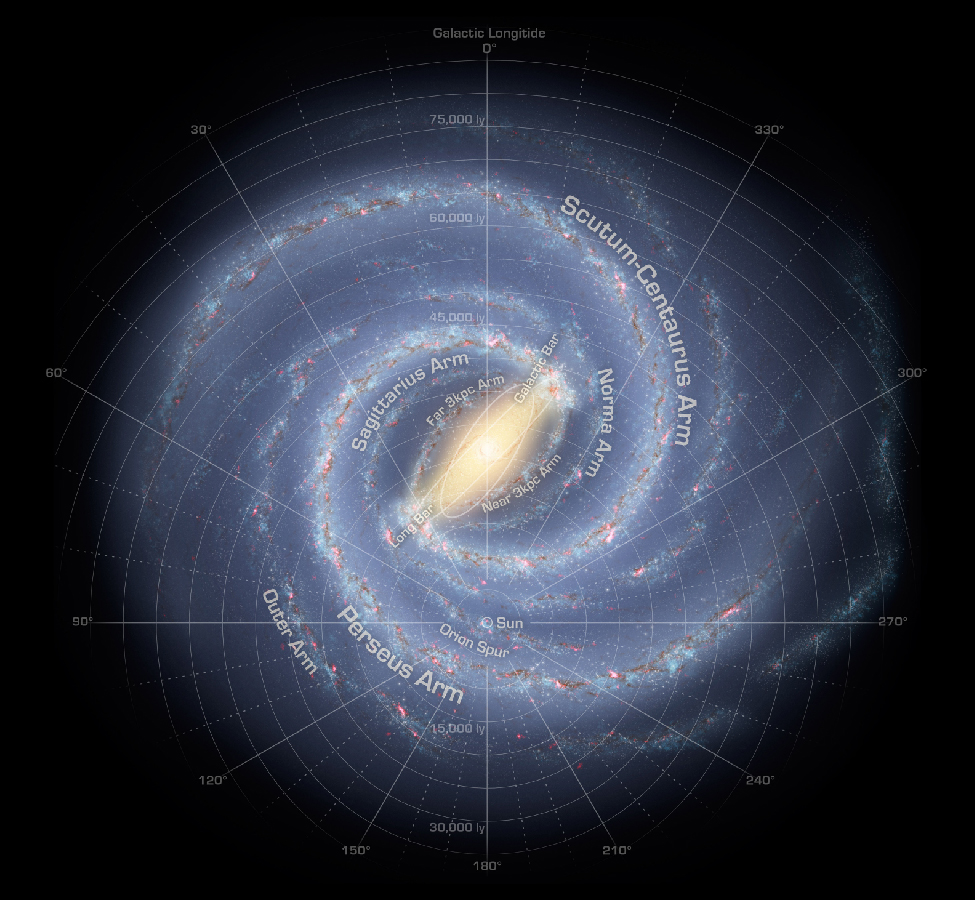
Our radio observations of the disk’s gaseous component indicate that the Galaxy has two major spiral arms that emerge from the bar and several fainter arms and shorter spurs. You can see a recently assembled map of our Galaxy’s arm structure—derived from studies in the infrared—in Figure 25.10.
英語のヒント
円盤のガス成分を電波で観測すると、天の川銀河には、棒状構造から伸びる二本の主要な渦状腕と、いくつかの暗い腕、より短い枝状構造があることが分かる。赤外線での研究から近年まとめられた腕の構造の地図を、図25.10に示す。
Milky Way Bar and Arms.天の川銀河の棒状構造と腕
credit: modification of work by NASA/JPL-Caltech/R. Hurt (SSC/Caltech) · JPL image use policy
Figure 25.10 Here, we see the Milky Way Galaxy as it would look from above. This image, assembled from data from NASA’s Spitzer mission, shows that the Milky Way Galaxy has a modest bar in its central regions. Two spiral arms, Scutum-Centaurus and Perseus, emerge from the ends of the bar and wrap around the bulge. The Sagittarius and Outer arms have fewer stars than the other two arms. (credit: modification of work by NASA/JPL-Caltech/R. Hurt (SSC/Caltech))
図25.10 天の川銀河を上から見たときの姿を示す。NASAのスピッツァー計画のデータをもとに組み立てた画像で、中心部には適度な大きさの棒状構造がある。たて・ケンタウルス座腕とペルセウス座腕という二本の渦状腕が棒の両端から伸び、バルジを取り巻いている。いて座腕と外側の腕には、ほかの二本の腕より星が少ない。(クレジット:NASA/JPL-Caltech/R. Hurt〔SSC/Caltech〕の作品を改変)
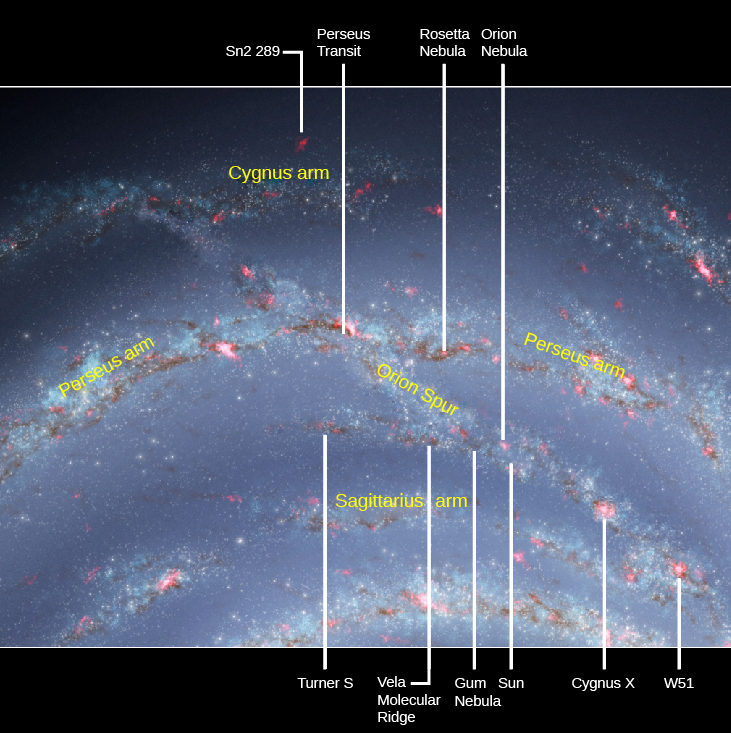
The Sun is near the inner edge of a short arm (or spur) called the Orion-Cygnus Arm, which is about 10,000 light-years long and contains such conspicuous features as the Cygnus Rift (the great dark nebula in the summer Milky Way) and the bright Orion Nebula. Figure 25.11 shows a few other objects that share this small section of the Galaxy with us and are easy to see. Remember, the farther away we try to look from our own arm, the more the dust in the Galaxy builds up and makes it hard to see with visible light.
英語のヒント
太陽は、オリオン・はくちょう座腕という短い腕、または枝状構造の内縁近くにある。この腕は長さ約1万光年で、夏の天の川にある大きな暗黒星雲「はくちょう座の裂け目」や、明るいオリオン星雲などの目立つものを含んでいる。図25.11には、銀河のこの小さな部分を私たちと共有する、見つけやすい天体をいくつか示した。自分たちの腕から遠くを見ようとするほど、視線上に銀河の塵が積み重なり、可視光では見づらくなることを覚えておこう。
Orion Spur.オリオンの枝状構造
credit: modification of work by NASA/JPL-Caltech · JPL image use policy
Figure 25.11 The Sun is located in the Orion Spur (also called the Orion-Cygnus Arm), which is a minor spiral arm located between two other arms. In this diagram, the white lines point to some other noteworthy objects that share this feature of the Milky Way Galaxy with the Sun. (credit: modification of work by NASA/JPL-Caltech)
図25.11 太陽は、別の二本の腕の間にある小さな渦状腕、オリオンの枝状構造に位置する。これはオリオン・はくちょう座腕とも呼ばれる。図の白い線は、太陽と同じ銀河の構造に属する、ほかの注目すべき天体を指している。(クレジット:NASA/JPL-Caltechの作品を改変)
Formation of Spiral Structure渦巻構造はどのようにできるか
At the Sun’s distance from its center, the Galaxy does not rotate like a solid wheel or a CD inside your player. Instead, the way individual objects turn around the center of the Galaxy is more like the solar system. Stars, as well as the clouds of gas and dust, obey Kepler’s third law. Objects farther from the center take longer to complete an orbit around the Galaxy than do those closer to the center. In other words, stars (and interstellar matter) in larger orbits in the Galaxy trail behind those in smaller ones. This effect is called differential galactic rotation.
英語のヒント
中心から太陽までほどの距離では、天の川銀河は、固い車輪やプレーヤーの中のCDのようには回転しない。個々の天体が銀河中心を回る仕方は、むしろ太陽系に似ている。星もガスや塵の雲もケプラーの第3法則に従い、中心から遠い天体ほど、近い天体より銀河を一周するのに長い時間がかかる。つまり、大きな軌道を回る星や星間物質は、小さな軌道を回るものより後に取り残される。この効果を銀河の差動回転と呼ぶ。
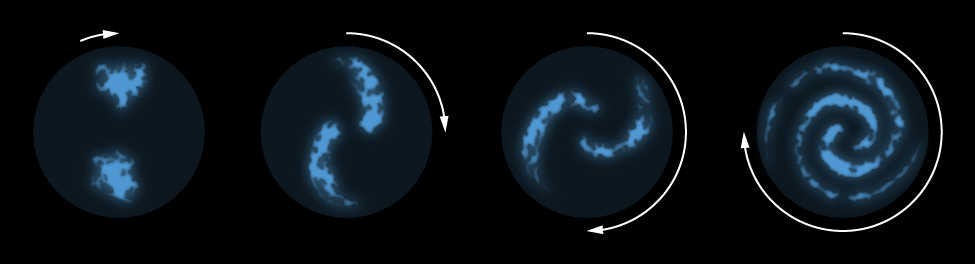
Differential rotation would appear to explain why so much of the material in the disk of the Milky Way is concentrated into elongated features that resemble spiral arms. No matter what the original distribution of the material might be, the differential rotation of the Galaxy can stretch it out into spiral features. Figure 25.12 shows the development of spiral arms from two irregular blobs of interstellar matter. Notice that as the portions of the blobs closest to the galactic center move faster, those farther out trail behind.
英語のヒント
差動回転があれば、天の川銀河の円盤内の物質の多くが、渦状腕に似た細長い構造へ集中する理由を説明できそうに見える。もとの物質の分布がどのようなものであっても、銀河の差動回転によって渦巻状に引き伸ばせるからだ。図25.12は、星間物質の不規則な二つの塊から渦状腕が発達する様子を示す。塊の中でも銀河中心に近い部分が速く動くにつれて、遠い部分が後に取り残されることに注目しよう。
Simplified Model for the Formation of Spiral Arms.渦状腕ができる仕組みの単純化した模型
OpenStax / Rice University · CC BY 4.0
Figure 25.12 This sketch shows how spiral arms might form from irregular clouds of interstellar material stretched out by the different rotation rates throughout the Galaxy. The regions farthest from the galactic center take longer to complete their orbits and thus lag behind the inner regions. If this were the only mechanism for creating spiral arms, then over time the spiral arms would completely wind up and disappear. Since many galaxies have spiral arms, they must be long-lived, and there must be other processes at work to maintain them.
英語のヒント
図25.12 星間物質の不規則な雲が、銀河内の場所ごとの回転の違いによって引き伸ばされ、渦状腕を作るかもしれない様子を描いたもの。銀河中心から遠い領域は一周に時間がかかり、内側の領域に遅れる。しかし、渦状腕を作る仕組みがこれだけなら、時間とともに腕は完全に巻き込まれて消えてしまう。多くの銀河が渦状腕を持つ以上、その構造は長く続くはずで、保つための別の過程が働いていなければならない。
But this picture of spiral arms presents astronomers with an immediate problem. If that’s all there were to the story, differential rotation—over the roughly 13-billion-year history of the Galaxy—would have wound the Galaxy’s arms tighter and tighter until all semblance of spiral structure had disappeared. But did the Milky Way actually have spiral arms when it formed 13 billion years ago? And do spiral arms, once formed, last for that long a time?
英語のヒント
このような渦状腕の描像は、すぐに天文学者を一つの問題に直面させる。それが話のすべてなら、約130億年という銀河の歴史の間に、差動回転が腕をますますきつく巻き込み、渦巻構造の面影はすべて消えていただろう。しかし、天の川銀河が130億年前にできたとき、実際にすでに渦状腕があったのだろうか。そして腕はいったんできれば、それほど長く存続するのだろうか。
With the advent of the Hubble Space Telescope, it has become possible to observe the structure of very distant galaxies and to see what they were like shortly after they began to form more than 13 billion years ago. What the observations show is that galaxies in their infancy had bright, clumpy star-forming regions, but no regular spiral structure.
英語のヒント
ハッブル宇宙望遠鏡の登場により、非常に遠い銀河の構造を観測し、130億年以上前に形成され始めて間もないころの姿を調べられるようになった。観測が示すのは、幼い銀河には、明るく塊状の星形成領域はあったが、規則正しい渦巻構造はなかったということである。
Over the next few billion years, the galaxies began to “settle down.” The galaxies that were to become spirals lost their massive clumps and developed a central bulge. The turbulence in these galaxies decreased, rotation began to dominate the motions of the stars and gas, and stars began to form in a much quieter disk. Smaller star-forming clumps began to form fuzzy, not-very-distinct spiral arms. Bright, well-defined spiral arms began to appear only when the galaxies were about 3.6 billion years old. Initially, there were two well-defined arms. Multi-armed structures in galaxies like we see in the Milky Way appeared only when the universe was about 8 billion years old.
英語のヒント
その後の数十億年間に、銀河は「落ち着き」始めた。後に渦巻銀河になる銀河では、大きな塊がなくなり、中心バルジが発達した。乱流が弱まり、星やガスの運動は回転が支配するようになり、星はずっと穏やかな円盤の中で生まれ始めた。より小さな星形成の塊が、ぼんやりした、あまり明瞭でない渦状腕を作り始めた。明るく輪郭のはっきりした渦状腕が現れ始めたのは、銀河の年齢が約36億年になってからである。最初は明瞭な腕が二本あった。天の川銀河に見られるような複数の腕を持つ構造が現れたのは、宇宙の年齢がおよそ80億年になってからだった。
We will discuss the history of galaxies in more detail in The Evolution and Distribution of Galaxies. But, even from our brief discussion, you can get the sense that the spiral structures we now observe in mature galaxies have come along later in the full story of how things develop in the universe.
英語のヒント
銀河の歴史は「銀河の進化と分布」でさらに詳しく扱う。この短い説明からでも、成熟した銀河で現在見られる渦巻構造は、宇宙のものごとの発達という全体の歴史の、後になって登場したのだと分かるだろう。
Scientists have used supercomputer calculations to model the formation and evolution of the arms. These calculations follow the motions of up to 100 million “star particles” to see whether gravitational forces can cause them to form spiral structure. What these calculations show is that giant molecular clouds (which we discussed in Between the Stars: Gas and Dust in Space) have enough gravitational influence over their surroundings to initiate the formation of structures that look like spiral arms. These arms then become self-perpetuating and can survive for at least several billion years. The arms may change their brightness over time as star formation comes and goes, but they are not temporary features. The concentration of matter in the arms exerts sufficient gravitational force to keep the arms together over long periods of time.
英語のヒント
科学者はスーパーコンピューターで、腕の形成と進化を模型化してきた。最大1億個の「星の粒子」の運動を追い、重力によって渦巻構造ができるかどうかを調べる。計算が示すのは、「星と星の間――宇宙のガスと塵」で扱った巨大分子雲が、周囲へ十分な重力の影響を及ぼし、渦状腕に似た構造の形成を始めさせられるということである。その腕は自らを保つようになり、少なくとも数十億年は存続できる。星形成が盛んになったり弱まったりするにつれて、腕の明るさは変わるかもしれないが、一時的な構造ではない。腕に集まった物質の重力が十分強いため、腕を長期間まとまった状態に保てるのである。