第25章天の川銀河The Milky Way Galaxy
25.6 The Formation of the Galaxy25.6 天の川銀河の形成
Learning Objectives学習の目標
By the end of this section, you will be able to:
この節を読み終えると、次のことができるようになる。
Describe the roles played by the collapse of a single cloud and mergers with other galaxies in building the Milky Way Galaxy we see today
単一の雲の収縮と、ほかの銀河との合体が、現在の天の川銀河を作るうえで果たした役割を説明する。
Provide examples of globular clusters and satellite galaxies affected by the Milky Way’s strong gravity.
天の川銀河の強い重力に影響される球状星団や衛星銀河の例を挙げる。
Information about stellar populations holds vital clues to how our Galaxy was built up over time. The flattened disk shape of the Galaxy suggests that it formed through a process similar to the one that leads to the formation of a protostar (see The Birth of Stars and the Discovery of Planets outside the Solar System). Building on this idea, astronomers first developed models that assumed the Galaxy formed from a single rotating cloud. But, as we shall see, this turns out to be only part of the story.
英語のヒント
種族に関する情報は、天の川銀河が時とともにどのように作られたかを知る重要な手がかりを含んでいる。平たい円盤という銀河の形は、原始星を形成するのと似た過程を経てできたことを示唆する(「星の誕生と太陽系外惑星の発見」を参照)。この考えをもとに、天文学者はまず、銀河が一つの回転する雲から生まれたと仮定するモデルを作った。しかし、これから見るように、それは物語の一部でしかなかった。
The Protogalactic Cloud and the Monolithic Collapse Model原始銀河雲と一体崩壊モデル
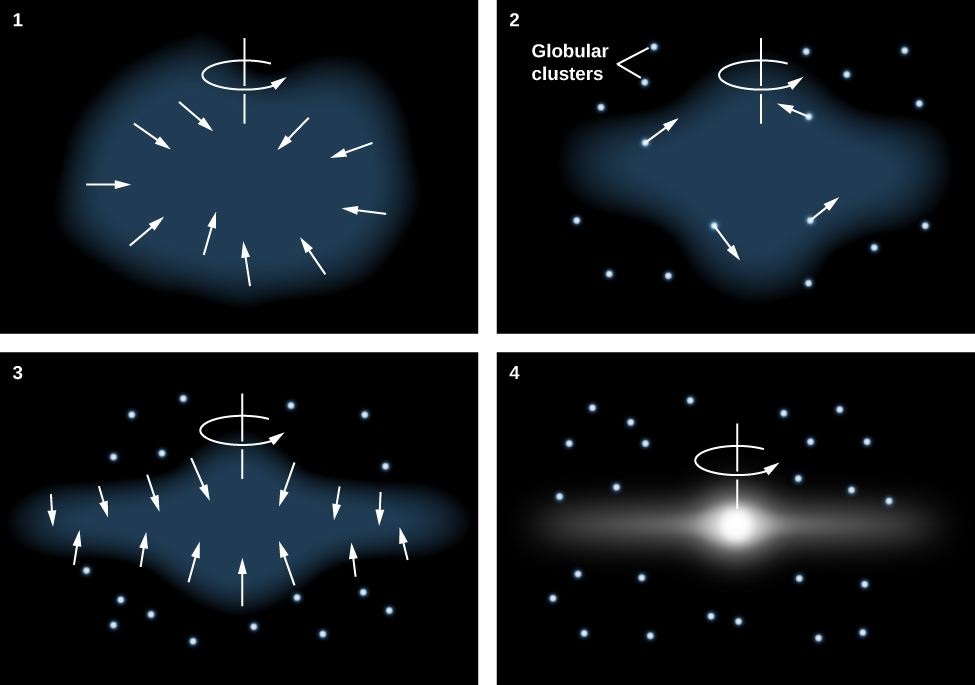
Because the oldest stars—those in the halo and in globular clusters—are distributed in a sphere centered on the nucleus of the Galaxy, it makes sense to assume that the protogalactic cloud that gave birth to our Galaxy was roughly spherical. The oldest stars in the halo have ages of 12 to 13 billion years, so we estimate that the formation of the Galaxy began about that long ago. (See the chapter on The Big Bang for other evidence that galaxies in general began forming a little more than 13 billion years ago.) Then, just as in the case of star formation, the protogalactic cloud collapsed and formed a thin rotating disk. Stars born before the cloud collapsed did not participate in the collapse, but have continued to orbit in the halo to the present day (Figure 25.21).
英語のヒント
最も古い星、つまりハローや球状星団の星は、銀河の核を中心とする球状に分布している。そのため、天の川銀河を生んだ原始銀河雲も、おおよそ球形だったと考えるのは理にかなっている。ハローで最も古い星の年齢は120億〜130億年なので、銀河の形成はおよそそれだけ昔に始まったと見積もられる。(銀河全般が130億年余り前に形成され始めたことを示す、ほかの証拠については「ビッグバン」を参照。)そして星形成と同じように、原始銀河雲が収縮して、回転する薄い円盤になった。雲が収縮する前に生まれた星は、その収縮に加わらず、現在までハローを周回し続けている(図25.21)。
Monolithic Collapse Model for the Formation of the Galaxy.銀河形成の一体崩壊モデル
OpenStax / Rice University · CC BY 4.0
Figure 25.21 According to this model, the Milky Way Galaxy initially formed from a rotating cloud of gas that collapsed due to gravity. Halo stars and globular clusters either formed prior to the collapse or were formed elsewhere. Stars in the disk formed later, when the gas from which they were made was already “contaminated” with heavy elements produced in earlier generations of stars.
英語のヒント
図25.21 このモデルによれば、天の川銀河は初め、回転するガス雲が重力で収縮してできた。ハローの星と球状星団は、収縮の前に形成されたか、別の場所で形成された。円盤の星はその後に生まれた。その材料となるガスは、すでに前の世代の星が作った重元素によって「汚染」されていた。
Gravitational forces caused the gas in the thin disk to fragment into clouds or clumps with masses like those of star clusters. These individual clouds then fragmented further to form stars. Since the oldest stars in the disk are nearly as old as the youngest stars in the halo, the collapse must have been rapid (astronomically speaking), requiring perhaps no more than a few hundred million years.
英語のヒント
重力によって薄い円盤のガスは分裂し、星団ほどの質量を持つ雲や塊になった。その個々の雲がさらに分裂して、星を作った。円盤で最も古い星は、ハローで最も若い星とほぼ同じ年齢なので、この収縮は天文学的に見れば急速だったはずである。かかった時間は、おそらく数億年以下だった。
Collision Victims and the Multiple Merger Model衝突の犠牲と複数合体モデル
In past decades, astronomers have learned that the evolution of the Galaxy has not been quite as peaceful as this monolithic collapse model suggests. In 1994, astronomers discovered a small new galaxy in the direction of the constellation of Sagittarius. The Sagittarius dwarf galaxy is currently about 70,000 light-years away from Earth and 50,000 light-years from the center of the Galaxy. It is the closest galaxy known (Figure 25.22). It is very elongated, and its shape indicates that it is being torn apart by our Galaxy’s gravitational tides—just as Comet Shoemaker-Levy 9 was torn apart when it passed too close to Jupiter in 1992.
英語のヒント
過去数十年の間に天文学者は、銀河の進化が、この一体崩壊モデルの示すほど穏やかではなかったことを知った。1994年、いて座の方向に、新たな小さい銀河が発見された。いて座矮小銀河は、現在、地球から約7万光年、銀河中心から約5万光年の距離にある。知られている中で最も近い銀河である(図25.22)。その形は非常に細長く、天の川銀河の重力による潮汐力で引き裂かれていることを示している。1992年、シューメーカー・レビー第9彗星が木星に近づきすぎて引き裂かれたのと同じである。
The Sagittarius galaxy is much smaller than the Milky Way and is about 10,000 times less massive than our Galaxy. All of the stars in the Sagittarius dwarf galaxy seem destined to end up in the bulge and halo of the Milky Way. But don’t sound the funeral bells for the little galaxy quite yet; the ingestion of the Sagittarius dwarf will take another 100 million years or so, and the stars themselves will survive.
英語のヒント
いて座銀河は天の川銀河よりずっと小さく、質量はおよそ1万分の1である。いて座矮小銀河の星は、すべて天の川銀河のバルジやハローに行き着く運命にあるようだ。しかし、この小さな銀河のために弔いの鐘を鳴らすのは、まだ早い。いて座矮小銀河がのみ込まれるまでには、あと1億年ほどかかり、星そのものは生き残るのである。
Sagittarius Dwarf.いて座矮小銀河
Figure 25.22 In 1994, British astronomers discovered a galaxy in the constellation of Sagittarius, located only about 50,000 light-years from the center of the Milky Way and falling into our Galaxy. This image covers a region approximately 70° × 50° and combines a black-and-white view of the disk of our Galaxy with a red contour map showing the brightness of the dwarf galaxy. The dwarf galaxy lies on the other side of the galactic center from us. The white stars in the red region mark the locations of several globular clusters contained within the Sagittarius dwarf galaxy. The cross marks the galactic center. The horizontal line corresponds to the galactic plane. The blue outline on either side of the galactic plane corresponds to the infrared image in Figure 25.7. The boxes mark regions where detailed studies of individual stars led to the discovery of this galaxy. (credit: modification of work by R. Ibata (UBC), R. Wyse (JHU), R. Sword (IoA))
図25.22 1994年、英国の天文学者は、いて座の中に銀河を発見した。それは天の川銀河の中心からわずか約5万光年にあり、天の川銀河へ落ち込みつつある。この画像は約70°×50°の領域を覆い、天の川銀河の円盤の白黒画像と、矮小銀河の明るさを示す赤い等高線図を重ねている。矮小銀河は、私たちから見て銀河中心の向こう側にある。赤い領域の白い星印は、いて座矮小銀河に含まれる、いくつかの球状星団の位置を示す。十字印は銀河中心、水平線は銀河面である。銀河面の両側の青い輪郭は、図25.7の赤外線画像に対応する。四角い枠は、個々の星の詳しい研究によって、この銀河の発見につながった領域を示す。(クレジット:R. Ibata〔UBC〕、R. Wyse〔JHU〕、R. Sword〔IoA〕の作品を改変)
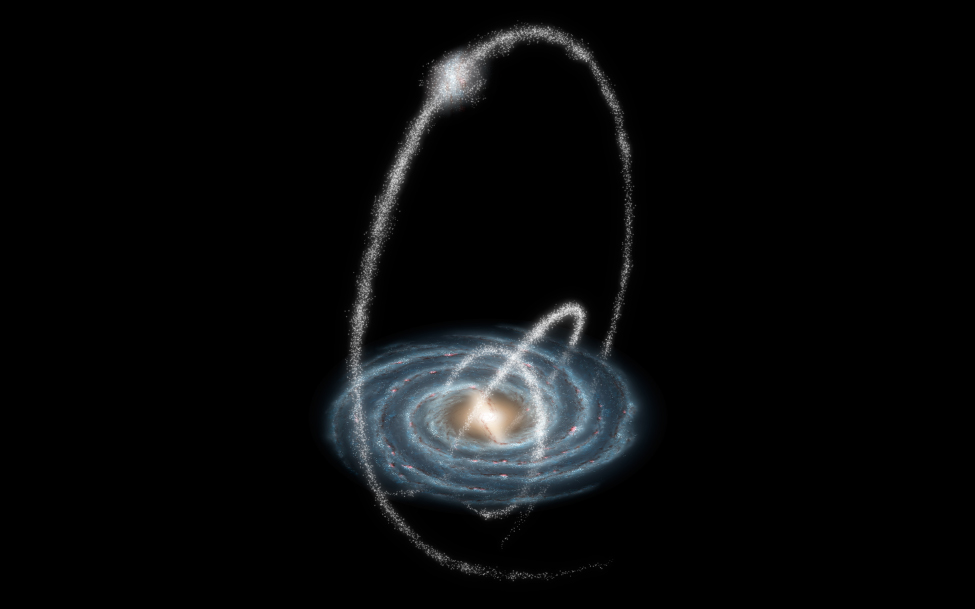
Since that discovery, evidence has been found for many more close encounters between our Galaxy and other neighbor galaxies. When a small galaxy ventures too close, the force of gravity exerted by our Galaxy tugs harder on the near side than on the far side. The net effect is that the stars that originally belonged to the small galaxy are spread out into a long stream that orbits through the halo of the Milky Way (Figure 25.23).
英語のヒント
この発見以来、天の川銀河と近隣のほかの銀河の間に、さらに多くの接近遭遇があった証拠が見つかっている。小さな銀河が近づきすぎると、天の川銀河の重力は、その遠い側よりも近い側を強く引く。その結果、もともと小さな銀河に属していた星は、天の川銀河のハローを通る軌道に沿って、長い流れとなって広がる(図25.23)。
Streams in the Galactic Halo.銀河ハロー内の星の流れ
credit: modification of work by NASA/JPL-Caltech/R. Hurt (SSC/Caltech) · JPL image use policy
Figure 25.23 When a small galaxy is swallowed by the Milky Way, its member stars are stripped away and form streams of stars in the galactic halo. This image is based on calculations of what some of these tidal streams might look like if the Milky Way swallowed 50 dwarf galaxies over the past 10 billion years. (credit: modification of work by NASA/JPL-Caltech/R. Hurt (SSC/Caltech))
図25.23 小さな銀河が天の川銀河にのみ込まれると、その星は引きはがされ、銀河ハロー内に星の流れを作る。この画像は、過去100億年に天の川銀河が50個の矮小銀河をのみ込んだとした場合に、潮汐力による星の流れの一部がどう見えるかを計算した結果に基づく。(クレジット:NASA/JPL-Caltech/R. Hurt〔SSC/Caltech〕の作品を改変)
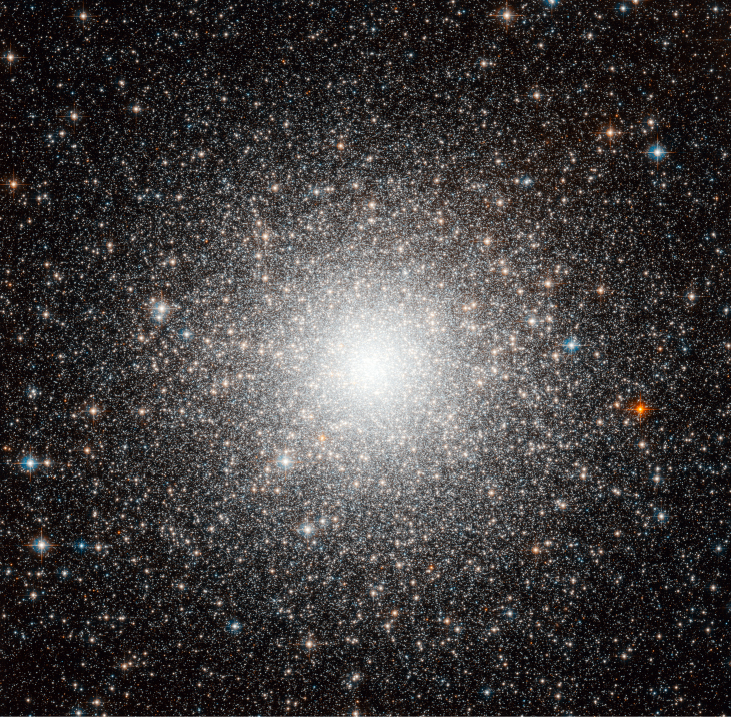
Such a tidal stream can maintain its identity for billions of years. To date, astronomers have now identified streams originating from 12 small galaxies that ventured too close to the much larger Milky Way. Six more streams are associated with globular clusters. It has been suggested that large globular clusters, like Omega Centauri, are actually dense nuclei of cannibalized dwarf galaxies. The globular cluster M54 is now thought to be the nucleus of the Sagittarius dwarf we discussed earlier, which is currently merging with the Milky Way (Figure 25.24). The stars in the outer regions of such galaxies are stripped off by the gravitational pull of the Milky Way, but the central dense regions may survive.
英語のヒント
このような潮汐ストリームは、数十億年にわたって、ひと続きの流れとして残りうる。天文学者はこれまでに、はるかに大きい天の川銀河へ近づきすぎた12個の小銀河に由来する流れを特定している。さらに6本の流れが球状星団と関係づけられている。オメガ・ケンタウリのような大型の球状星団は、実際には、のみ込まれた矮小銀河の高密度の核かもしれないと指摘されている。球状星団M54は、前に説明した、現在天の川銀河と合体しつつあるいて座矮小銀河の核だと考えられている(図25.24)。このような銀河の外側の領域の星は天の川銀河の重力で引きはがされるが、中心の高密度の領域は生き残る可能性がある。
Globular Cluster M54.球状星団M54
credit: ESA/Hubble & NASA · CC BY 4.0
Figure 25.24 This beautiful Hubble Space Telescope image shows the globular cluster that is now believed to be the nucleus of the Sagittarius Dwarf Galaxy. (credit: ESA/Hubble & NASA)
図25.24 この美しいハッブル宇宙望遠鏡の画像に写る球状星団は、現在、いて座矮小銀河の核だと考えられている。(クレジット:ESA/Hubble & NASA)
Calculations indicate that the Galaxy’s thick disk may be a product of one or more such collisions with other galaxies. Accretion of a satellite galaxy would stir up the orbits of the stars and gas clouds originally in the thin disk and cause them to move higher above and below the mid-plane of the Galaxy. Meanwhile, the Galaxy’s stars would add to the fluffed-up mix. If such a collision happened about 10 billion years ago, then any gas in the two galaxies that had not yet formed into stars would have had plenty of time to settle back down into the thin disk. The gas could then have begun forming subsequent generations of population I stars. This timing is also consistent with the typical ages of stars in the thick disk.
英語のヒント
計算によれば、銀河の厚い円盤は、ほかの銀河とのこのような衝突が、1回以上起きて生じたものかもしれない。衛星銀河を取り込むと、もともと薄い円盤にあった星やガス雲の軌道がかき乱され、銀河の中央面から、より高い位置や低い位置まで動くようになるだろう。同時に、銀河の星も、そのふくらんだ混合物に加わることになる。そのような衝突が約100億年前に起きたのなら、2つの銀河にあった、まだ星になっていないガスには、薄い円盤へ落ち着き直す時間が十分にあったはずである。そのガスは、続く世代の種族Iの星を作り始められただろう。この時期は、厚い円盤の星の典型的な年齢とも整合する。
The Milky Way has more collisions in store. An example is the Canis Major dwarf galaxy, which has a mass of about 1% of the mass of the Milky Way. Already long tidal tails have been stripped from this galaxy, which have wrapped themselves around the Milky Way three times. Several of the globular clusters found in the Milky Way may also have come from the Canis Major dwarf, which is expected to merge gradually with the Milky Way over about the next billion years.
英語のヒント
天の川銀河には、さらに衝突が待ち受けている。その一例がおおいぬ座矮小銀河で、天の川銀河の約1%の質量を持つ。すでにこの銀河からは、潮汐力によって長い尾が引き出され、天の川銀河を3周している。天の川銀河で見つかる球状星団のいくつかも、おおいぬ座矮小銀河から来たものかもしれない。この矮小銀河は、今後約10億年の間に、天の川銀河へ徐々に合体すると予想される。
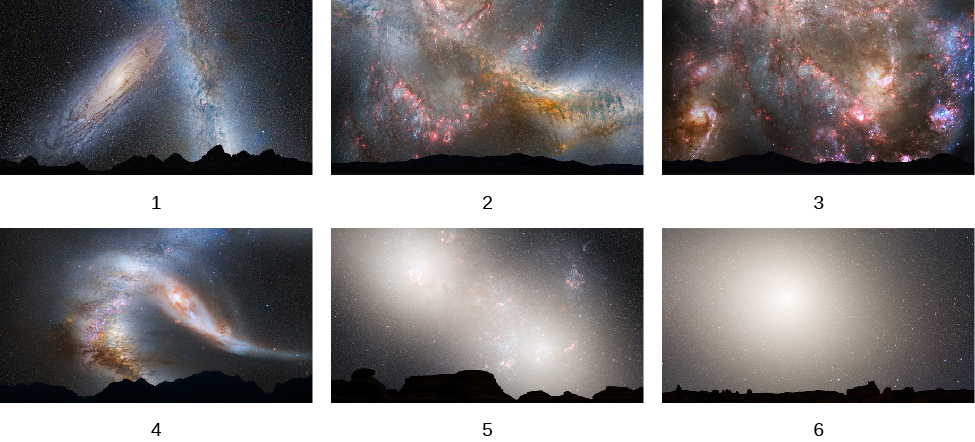
In about 4 billion years, the Milky Way itself will be swallowed up, since it and the Andromeda galaxy are on a collision course. Our computer models show that after a complex interaction, the two will merge to form a larger, more rounded galaxy (Figure 25.25).
英語のヒント
約40億年後には、天の川銀河自身がのみ込まれる。アンドロメダ銀河と衝突する進路にあるからだ。コンピューターモデルによれば、複雑な相互作用の後に、2つは合体して、より大きく、丸みを帯びた銀河になる(図25.25)。
Collision of the Milky Way with Andromeda.天の川銀河とアンドロメダ銀河の衝突
credit: NASA; ESA; Z. Levay, R. van der Marel, STScl; T. Hallas, and A. Mellinger · CC BY 4.0
Figure 25.25 In about 3 billion years, the Milky Way Galaxy and Andromeda Galaxy will begin a long process of colliding, separating, and then coming back together to form an elliptical galaxy. The whole interaction will take 3 to 4 billion years. These computer-simulated images show the following sequence: (1) In 3.75 billion years, Andromeda has approached the Milky Way. (2) New star formation fills the sky 3.85 billion years from now. (3) Star formation continues at 3.9 billion years. (4) The galaxy shapes change as they interact, with Andromeda being stretched and our Galaxy becoming warped, about 4 billion years from now. (5) In 5.1 billion years, the cores of the two galaxies are bright lobes. (6) In 7 billion years, the merged galaxies form a huge elliptical galaxy whose brightness fills the night sky. This artist’s illustrations show events from a vantage point 25,000 light-years from the center of the Milky Way. However, we should mention that the Sun may not be at that distance throughout the sequence of events, as the collision readjusts the orbits of many stars within each galaxy. (credit: NASA; ESA; Z. Levay, R. van der Marel, STScl; T. Hallas, and A. Mellinger)
英語のヒント
図25.25 約30億年後、天の川銀河とアンドロメダ銀河は、衝突し、離れ、再び近づいて楕円銀河になるという、長い過程に入る。相互作用全体には30億〜40億年かかる。このコンピューターシミュレーションに基づく画像は、次の順序を示す。(1)37億5000万年後、アンドロメダが天の川銀河に接近する。(2)38億5000万年後、新たな星形成が空を満たす。(3)39億年後も、星形成が続く。(4)約40億年後、相互作用で形が変わり、アンドロメダは引き伸ばされ、天の川銀河はゆがむ。(5)51億年後、2つの銀河核は明るい塊として見える。(6)70億年後、合体した銀河は巨大な楕円銀河になり、その輝きが夜空を満たす。この想像図は、天の川銀河の中心から2万5000光年の位置から出来事を見たものである。ただし衝突は両銀河内の多くの星の軌道を変えるので、太陽が一連の出来事を通して、この距離にあり続けるとは限らない。(クレジット:NASA、ESA、Z. Levay、R. van der Marel〔STScl〕、T. Hallas、A. Mellinger)
We are thus coming to realize that “environmental influences” (and not just a galaxy’s original characteristics) play an important role in determining the properties and development of our Galaxy. In future chapters we will see that collisions and mergers are a major factor in the evolution of many other galaxies as well.
英語のヒント
こうして、天の川銀河の性質や発達を決めるうえでは、銀河の生まれつきの特徴だけでなく、「環境からの影響」が重要な役割を果たすことが分かってきた。今後の章では、衝突と合体が、ほかの多くの銀河の進化にとっても、大きな要因であることを見る。