第25章天の川銀河The Milky Way Galaxy
Disks and Haloes円盤とハロー
With modern instruments, astronomers can now penetrate the “smog” of the Milky Way by studying radio and infrared emissions from distant parts of the Galaxy. Measurements at these wavelengths (as well as observations of other galaxies like ours) have given us a good idea of what the Milky Way would look like if we could observe it from a distance.
英語のヒント
現在の観測装置を使えば、銀河の遠い部分から届く電波や赤外線の放射を調べて、天の川を覆う「スモッグ」の向こうを見通せる。こうした波長での測定と、天の川銀河に似た別の銀河の観測によって、もし遠くから眺められたら、この銀河がどのような姿に見えるかを、かなりよく理解できるようになった。
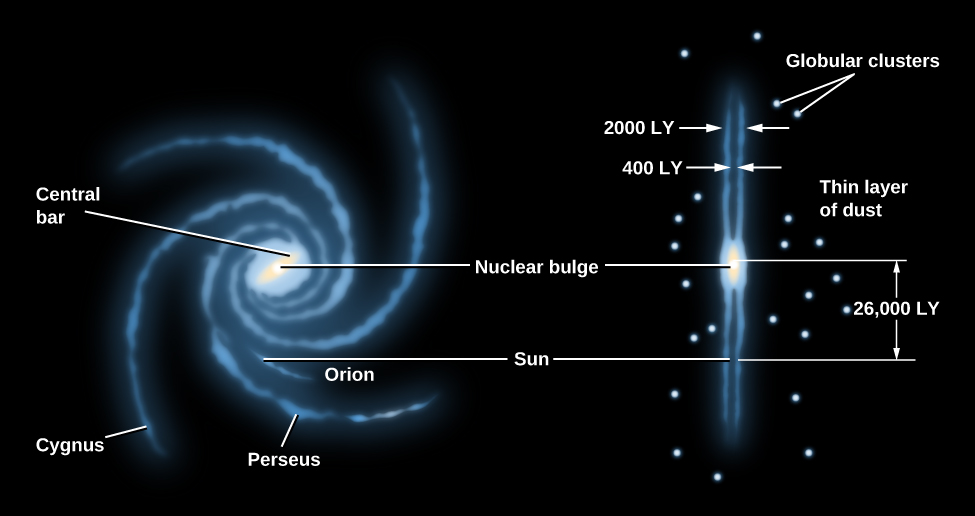
Figure 25.5 sketches what we would see if we could view the Galaxy face-on and edge-on. The brightest part of the Galaxy consists of a thin, circular, rotating disk of stars distributed across a region about 100,000 light-years in diameter and about 2000 light-years thick. (Given how thin the disk is, perhaps a CD is a more appropriate analogy than a wheel.) The very youngest stars, and the dust and gas from which stars form, are found typically within 100 light-years of the plane of the Milky Way Galaxy. The mass of the interstellar matter is about 15% of the mass of the stars in this disk.
英語のヒント
図25.5は、天の川銀河を正面から、そして真横から見られたら何が見えるかを描いたものである。銀河の最も明るい部分は、直径約10万光年、厚さ約2000光年に広がる、薄く円い、回転する星の円盤からなる。円盤の薄さを考えると、車輪よりCDのほうが適切なたとえかもしれない。最も若い星や、星が生まれる材料である塵とガスは、通常、銀河の中心面から100光年以内に見つかる。星間物質の質量は、この円盤にある星の質量の約15%である。
Schematic Representation of the Galaxy.天の川銀河の模式図
OpenStax / Rice University · CC BY 4.0
Figure 25.5 The left image shows the face-on view of the spiral disk; the right image shows the view looking edge-on along the disk. The major spiral arms are labeled. The Sun is located on the inside edge of the smaller arm (or spur) called the Orion-Cygnus Arm.
図25.5 左の図は渦巻状の円盤を正面から見た姿、右の図は円盤に沿って真横から見た姿を示す。主要な渦状腕の名前が記されている。太陽は、オリオン・はくちょう座腕と呼ばれる小さな腕、または枝状構造の内縁に位置する。
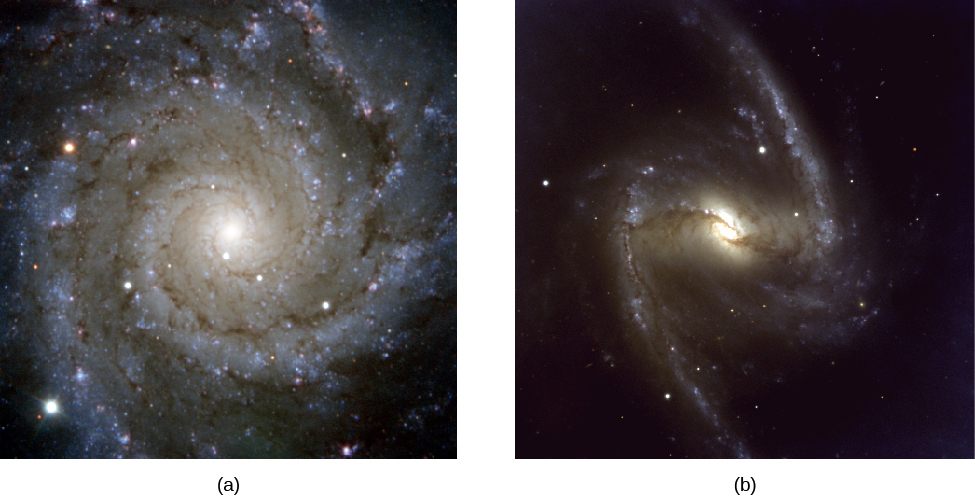
As the diagram in Figure 25.5 shows, the stars, gas, and dust are not spread evenly throughout the disk but are concentrated into a central bar and a series of spiral arms. Recent infrared observations have confirmed that the central bar is composed mostly of old yellow-red stars. The two main spiral arms appear to connect with the ends of the bar. They are highlighted by the blue light from young hot stars. We know many other spiral galaxies that also have bar-shaped concentrations of stars in their central regions; for that reason they are called barred spirals. Figure 25.6 shows two other galaxies—one without a bar and one with a strong bar—to give you a basis for comparison to our own. We will describe our spiral structure in more detail shortly. The Sun is located about halfway between the center of the Galaxy and the edge of the disk and only about 70 light-years above its central plane.
英語のヒント
図25.5のとおり、星・ガス・塵は円盤全体に一様に広がっているのではなく、中央の棒状構造と、いくつもの渦状腕に集中している。近年の赤外線観測では、中央の棒状構造は主に古い黄〜赤色の星でできていることが確かめられた。二本の主要な渦状腕は、棒の両端につながっているように見える。若く高温の星の青い光が、腕を際立たせる。中心部に棒状に星が集中する渦巻銀河は、ほかにも多く知られており、そのため棒渦巻銀河と呼ばれる。図25.6には、天の川銀河と比べる手がかりとして、棒のない銀河と、はっきりした棒を持つ銀河を一つずつ示した。天の川銀河の渦巻構造は、この後さらに詳しく説明する。太陽は、銀河の中心から円盤の端までのほぼ中間にあり、中心面から上へわずか約70光年のところに位置する。
Unbarred and Barred Spiral Galaxies.棒のない渦巻銀河と棒渦巻銀河
credit a: modification of work by ESO/PESSTO/S. Smartt; credit b: modification of work by ESO · CC BY 4.0
Figure 25.6 (a) This image shows the unbarred spiral galaxy M74. It contains a small central bulge of mostly old yellow-red stars, along with spiral arms that are highlighted with the blue light from young hot stars. (b) This image shows the strongly barred spiral galaxy NGC 1365. The bulge and the fainter bar both appear yellowish because the brightest stars in them are mostly old yellow and red giants. Two main spiral arms project from the ends of the bar. As in M74, these spiral arms are populated with blue stars and red patches of glowing gas—hallmarks of recent star formation. The Milky Way Galaxy is thought to have a barred spiral structure that is intermediate between these two examples. (credit a: modification of work by ESO/PESSTO/S. Smartt; credit b: modification of work by ESO)
英語のヒント
図25.6 (a)棒を持たない渦巻銀河M74。主に古い黄〜赤色の星からなる小さな中心バルジと、若く高温の星の青い光で際立つ渦状腕がある。(b)強い棒状構造を持つ渦巻銀河NGC 1365。バルジも、それより暗い棒も、最も明るい星が主に古い黄色巨星や赤色巨星なので、黄色みを帯びて見える。棒の両端から二本の主要な渦状腕が伸びている。M74と同じく、その腕には青い星と、輝くガスの赤い斑点がある。どちらも最近の星形成の特徴である。天の川銀河の棒渦巻構造は、この二つの例の中間にあると考えられている。(クレジットa:ESO/PESSTO/S. Smarttの作品を改変。クレジットb:ESOの作品を改変)
Our thin disk of young stars, gas, and dust is embedded in a thicker but more diffuse disk of older stars; this thicker disk extends about 1000 light-years above and 1000 light-years below the midplane of the thin disk and contains only about 5% as much mass as the thin disk. The stars thin out with distance from the galactic plane and don’t have a sharp edge. Approximately 2/3 of the stars in the thick disk are within 1000 light-years of midplane.
英語のヒント
若い星・ガス・塵からなる薄い円盤は、より古い星からなる、厚いがまばらな円盤の中に埋め込まれている。この厚い円盤は、薄い円盤の中心面から上へ約1000光年、下へ約1000光年に広がり、その質量は薄い円盤の約5%しかない。銀河面から離れるにつれて星はまばらになり、はっきりした端はない。厚い円盤の星のおよそ3分の2は、中心面から1000光年以内にある。
Close in to the galactic center (within about 10,000 light-years), the stars are no longer confined to the disk but form a central bulge (or nuclear bulge). When we observe with visible light, we can glimpse the stars in the bulge only in those rare directions where there happens to be relatively little interstellar dust. The first picture that actually succeeded in showing the bulge as a whole was taken at infrared wavelengths (Figure 25.7).
英語のヒント
銀河中心に近い、およそ1万光年以内の領域では、星はもはや円盤内に限られず、中心バルジを形作っている。可視光で観測すると、バルジの星を垣間見られるのは、たまたま星間塵が比較的少ない、限られた方向だけである。バルジ全体を実際に写すことに初めて成功した画像は、赤外線で撮られたものだった(図25.7)。
Inner Part of the Milky Way Galaxy.天の川銀河の内側
Figure 25.7 This beautiful infrared map, showing half a billion stars, was obtained as part of the Two Micron All Sky Survey (2MASS). Because interstellar dust does not absorb infrared as strongly as visible light, this view reveals the previously hidden bulge of old stars that surrounds the center of our Galaxy, along with the Galaxy’s thin disk component. (credit: modification of work by 2MASS/J. Carpenter, T. H. Jarrett, and R. Hurt)
英語のヒント
図25.7 5億個の星を示すこの美しい赤外線地図は、2ミクロン全天サーベイ(2MASS)の一環として得られた。星間塵は赤外線を可視光ほど強く吸収しないので、以前は隠れていた、銀河中心を取り囲む古い星のバルジと、薄い円盤成分が見えている。(クレジット:2MASS/J. Carpenter、T. H. Jarrett、R. Hurtの作品を改変)
The fact that much of the bulge is obscured by dust makes its shape difficult to determine. For a long time, astronomers assumed it was spherical. However, infrared images and other data indicate that the bulge is about two times longer than it is wide, and shaped rather like a peanut. The relationship between this elongated inner bulge and the larger bar of stars remains uncertain. At the very center of the nuclear bulge is a tremendous concentration of matter, which we will discuss later in this chapter.
英語のヒント
バルジの大部分が塵に隠されていることが、その形を決めにくくしている。長い間、天文学者は球状だと考えていた。しかし、赤外線画像などのデータは、バルジの長さは幅の約2倍で、むしろ落花生に似た形であることを示している。この細長い内側のバルジと、さらに大きな星の棒状構造との関係は、まだはっきりしない。中心バルジのまさに中心には物質が途方もなく集中しており、この章の後半で扱う。
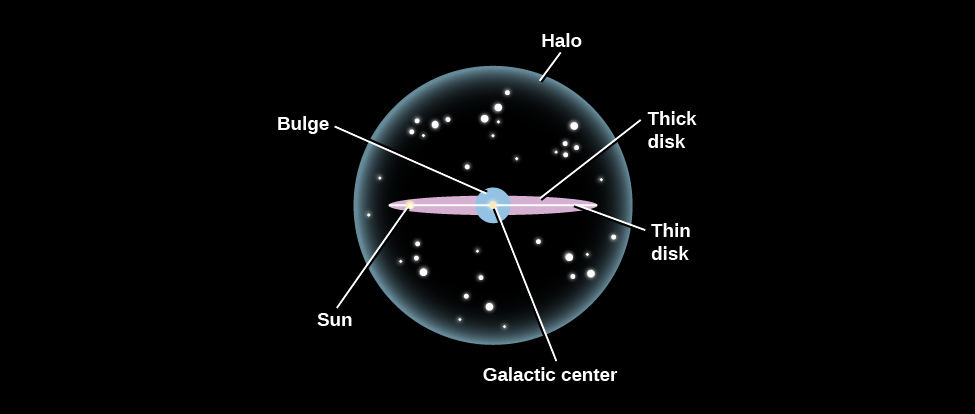
In our Galaxy, the thin and thick disks and the nuclear bulge are embedded in a spherical halo of very old, faint stars that extends to a distance of at least 150,000 light-years from the galactic center. Most of the globular clusters are also found in this halo.
英語のヒント
天の川銀河の薄い円盤・厚い円盤・中心バルジは、非常に古く暗い星からなる球状のハローに包まれている。このハローは銀河中心から少なくとも15万光年の距離まで広がる。球状星団の大部分も、このハローにある。
The mass in the Milky Way extends even farther out, well beyond the boundary of the luminous stars to a distance of at least 200,000 light-years from the center of the Galaxy. This invisible mass has been give the name dark matter because it emits no light and cannot be seen with any telescope. Its composition is unknown, and it can be detected only because of its gravitational effects on the motions of luminous matter that we can see. We know that this extensive dark matter halo exists because of its effects on the orbits of distant star clusters and other dwarf galaxies that are associated with the Galaxy. This mysterious halo will be a subject of the section on The Mass of the Galaxy, and the properties of dark matter will be discussed more in the chapter on The Big Bang.
英語のヒント
天の川銀河の質量はさらに外側へ、光を放つ星の分布の境界をはるかに越え、銀河中心から少なくとも20万光年の距離まで広がっている。この見えない質量を担う物質は、光を出さず、どの望遠鏡でも見えないため、暗黒物質と名付けられた。組成は不明で、見える物質の運動に重力で及ぼす影響によってのみ検出できる。遠方の星団や、天の川銀河と関係する別の矮小銀河の軌道への影響から、広大な暗黒物質ハローが存在することが分かる。この謎のハローは「天の川銀河の質量」で取り上げ、暗黒物質の性質は「ビッグバン」の章でさらに詳しく扱う。
Some vital statistics of the thin and thick disks and the stellar halo are given in Table 25.1, with an illustration in Figure 25.8. Note particularly how the ages of stars correlate with where they are found. As we shall see, this information holds important clues to how the Milky Way Galaxy formed.
英語のヒント
薄い円盤・厚い円盤・恒星ハローの主な基礎データを表25.1に、模式図を図25.8に示す。星の年齢と、見つかる場所との関連に特に注目してほしい。後で見るように、この情報は天の川銀河がどのようにできたかを知る重要な手がかりになる。
Characteristics of the Milky Way Galaxy 天の川銀河の特徴 |
|||
|---|---|---|---|
Property 性質 |
Thin Disk 薄い円盤 |
Thick Disk 厚い円盤 |
Stellar Halo (Excludes Dark Matter) 恒星ハロー(暗黒物質を除く) |
Stellar mass 恒星の質量 |
MSun | A few percent of the thin disk mass 薄い円盤の質量の数% |
1010 MSun |
Luminosity 光度 |
LSun | A few percent of the thin disk luminosity 薄い円盤の光度の数% |
LSun |
Typical age of stars 星の典型的な年齢 |
1 million to 10 billion years 100万〜100億年 |
11 billion years 110億年 |
13 billion years 130億年 |
Heavier-element abundance 重元素の存在割合 |
High 高い |
Intermediate 中程度 |
Very low 非常に低い |
Rotation 回転 |
High 速い |
Intermediate 中程度 |
Very low 非常に遅い |
Major Parts of the Milky Way Galaxy.天の川銀河の主要な部分
OpenStax / Rice University · CC BY 4.0
Figure 25.8 This schematic shows the major components of our Galaxy.
図25.8 天の川銀河の主要な構成要素を示した模式図。
Establishing this overall picture of the Galaxy from our dust-shrouded viewpoint inside the thin disk has been one of the great achievements of modern astronomy (and one that took decades of effort by astronomers working with a wide range of telescopes). One thing that helped enormously was the discovery that our Galaxy is not unique in its characteristics. There are many other flat, spiral-shaped islands of stars, gas, and dust in the universe. For example, the Milky Way somewhat resembles the Andromeda galaxy, which, at a distance of about 2.3 million light-years, is our nearest neighboring giant spiral galaxy. Just as you can get a much better picture of yourself if someone else takes the photo from a distance away, pictures and other diagnostic observations of nearby galaxies that resemble ours have been vital to our understanding of the properties of the Milky Way.
英語のヒント
塵に覆われた薄い円盤の内側という観測位置から、銀河のこの全体像を確立したことは、現代天文学の大きな成果の一つである。さまざまな望遠鏡を使う天文学者たちが、何十年も努力して達成したものだ。非常に役立ったのは、天の川銀河の特徴が唯一無二ではないという発見だった。宇宙には、星・ガス・塵からできた、平たい渦巻形の島がほかにもたくさんある。たとえば天の川銀河は、約230万光年の距離にある、最も近い隣の大型渦巻銀河、アンドロメダ銀河にいくらか似ている。誰かに離れた場所から撮ってもらえば、自分の姿をずっとよく捉えた写真が得られる。同じように、天の川銀河に似た近隣銀河の画像や、性質を調べるための別の観測が、私たちの銀河を理解するうえで欠かせなかった。