第25章天の川銀河The Milky Way Galaxy
25.4 The Center of the Galaxy25.4 天の川銀河の中心
Learning Objectives学習の目標
By the end of this section, you will be able to:
この節を読み終えると、次のことができるようになる。
Describe the radio and X-ray observations that indicate energetic phenomena are occurring at the galactic center
銀河中心で高エネルギーの現象が起きていることを示す、電波とX線の観測を説明する。
Explain what has been revealed by high-resolution near-infrared imaging of the galactic center
高分解能の近赤外線画像で銀河中心について何が分かったかを説明する。
Discuss how these near-infrared images, when combined with Kepler’s third law of motion, can be used to derive the mass of the central gravitating object
近赤外線画像とケプラーの第3法則を組み合わせて、中心の重力源の質量を求める方法を論じる。
At the beginning of this chapter, we hinted that the core of our Galaxy contains a large concentration of mass. In fact, we now have evidence that the very center contains a black hole with a mass equivalent to 4.6 million Suns and that all this mass fits within a sphere that has less than the diameter of Mercury’s orbit. Such monster black holes are called supermassive black holes by astronomers, to indicate that the mass they contain is far greater than that of the typical black hole created by the death of a single star. It is amazing that we have very convincing evidence that this black hole really does exist. After all, recall from the chapter on Black Holes and Curved Spacetime that we cannot see a black hole directly because by definition it radiates no energy. And we cannot even see into the center of the Galaxy in visible light because of absorption by the interstellar dust that lies between us and the galactic center. Light from the central region of the Galaxy is dimmed by a factor of a trillion (1012) by all this dust.
英語のヒント
この章の初めに、天の川銀河の核には大量の質量が集中していることをほのめかした。実際、中心には太陽460万個分の質量を持つブラックホールがあり、その全質量が水星の軌道の直径より小さい球の中に収まることを示す証拠が、現在では得られている。天文学者はこのような怪物のようなブラックホールを超大質量ブラックホールと呼ぶ。一つの星の死によってできる典型的なブラックホールより、はるかに大きな質量を持つことを示す呼び名である。このブラックホールが実際に存在することについて、非常に説得力のある証拠があるのは驚くべきことだ。「ブラックホールと曲がった時空」で学んだように、ブラックホールは定義上エネルギーを放射しないので、直接見ることはできない。私たちと銀河中心の間にある星間塵の吸収のため、可視光では銀河中心をのぞくことさえできない。中心領域からの光は、この塵によって1兆(1012)分の1にまで弱められる。
Fortunately, we are not so blind at other wavelengths. Infrared and radio radiation, which have long wavelengths compared to the sizes of the interstellar dust grains, flow unimpeded past the dust particles and so reach our telescopes with hardly any dimming. In fact, the very bright radio source in the nucleus of the Galaxy, now known as Sagittarius A* (pronounced “Sagittarius A-star” and abbreviated Sgr A*), was the first cosmic radio source astronomers discovered.
英語のヒント
幸い、別の波長では、これほど見えないわけではない。赤外線や電波は星間塵の粒の大きさに比べて波長が長く、塵の粒子に妨げられずに通り抜けるので、ほとんど暗くならずに望遠鏡へ届く。実際、現在いて座A*と呼ばれる、銀河の核にある非常に明るい電波源は、天文学者が発見した最初の宇宙電波源だった。英語ではSagittarius A*を「サジテリアス・エー・スター」と読み、Sgr A*と略す。
A Journey toward the Center中心への旅
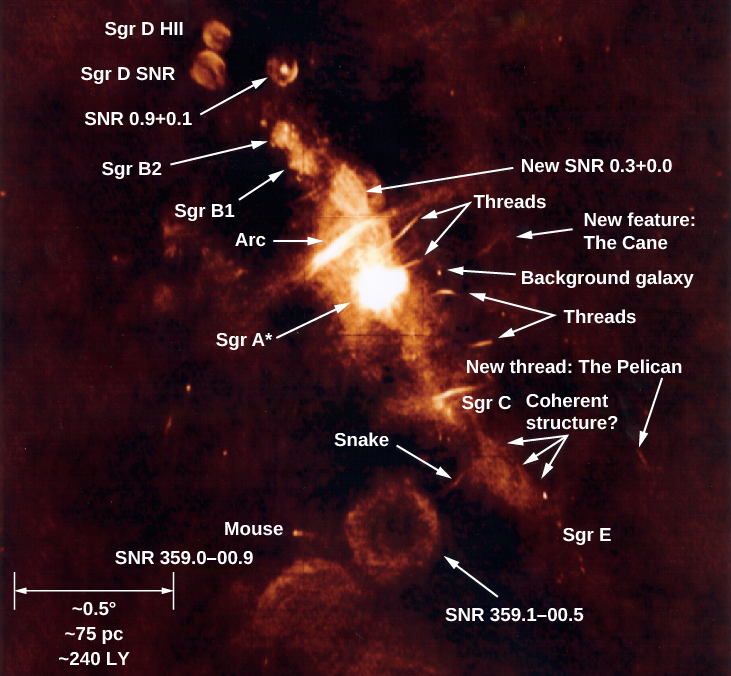
Let’s take a voyage to the mysterious heart of our Galaxy and see what’s there. Figure 25.14 is a radio image of a region about 1500 light-years across, centered on Sagittarius A, a bright radio source that contains the smaller Sagittarius A*. Much of the radio emission comes from hot gas heated either by clusters of hot stars (the stars themselves do not produce radio emission and can’t be seen in the image) or by supernova blast waves. Most of the hollow circles visible on the radio image are supernova remnants. The other main source of radio emission is from electrons moving at high speed in regions with strong magnetic fields. The bright thin arcs and “threads” on the figure show us where this type of emission is produced.
英語のヒント
天の川銀河の謎めいた中心部へ旅して、何があるか見てみよう。図25.14は、より小さないて座A*を内部に含む明るい電波源、いて座Aを中心とした、幅約1500光年の領域の電波画像である。電波放射の多くは、高温の星の集団、または超新星の爆風によって加熱された高温ガスから届く。星そのものは電波を出さず、この画像には見えない。画像にある中空の円の大部分は超新星残骸である。もう一つの主要な電波源は、強い磁場の領域を高速で動く電子である。図の明るい細い弧や「糸」は、この種類の放射が生じる場所を示している。
Radio Image of Galactic Center Region.銀河中心領域の電波画像
credit: modification of work by N. E. Kassim, D. S. Briggs, T. J. W. Lazio, T. N. LaRosa, and J. Imamura (NRL/RSD) · U.S. government work; OpenStax adaptation CC BY 4.0
Figure 25.14 This radio map of the center of the Galaxy (at a wavelength of 90 centimeters) was constructed from data obtained with the Very Large Array (VLA) of radio telescopes in Socorro, New Mexico. Brighter regions are more intense in radio waves. The galactic center is inside the region labeled Sagittarius A. Sagittarius B1 and B2 are regions of active star formation. Many filaments or threadlike features are seen, as well as a number of shells (labeled SNR), which are supernova remnants. The scale bar at the bottom left is about 240 light-years long. Notice that radio astronomers also give fanciful animal names to some of the structures, much as visible-light nebulae are sometimes given the names of animals they resemble. (credit: modification of work by N. E. Kassim, D. S. Briggs, T. J. W. Lazio, T. N. LaRosa, and J. Imamura (NRL/RSD))
英語のヒント
図25.14 波長90 cmで見た銀河中心の電波地図で、ニューメキシコ州ソコロの電波望遠鏡群、超大型干渉電波望遠鏡(VLA)のデータから作った。明るい領域ほど電波が強い。銀河中心は、いて座Aと記された領域の中にある。いて座B1とB2では、星形成が活発に起きている。多くのフィラメントや糸のような構造に加えて、SNRと記された超新星残骸の殻も見える。左下の尺度棒の長さは約240光年である。可視光で見える星雲に似た動物の名を付けることがあるように、電波天文学者もいくつかの構造に想像豊かな動物名を付けていることに注目してほしい。(クレジット:N. E. Kassim、D. S. Briggs、T. J. W. Lazio、T. N. LaRosa、J. Imamura〔NRL/RSD〕の作品を改変)
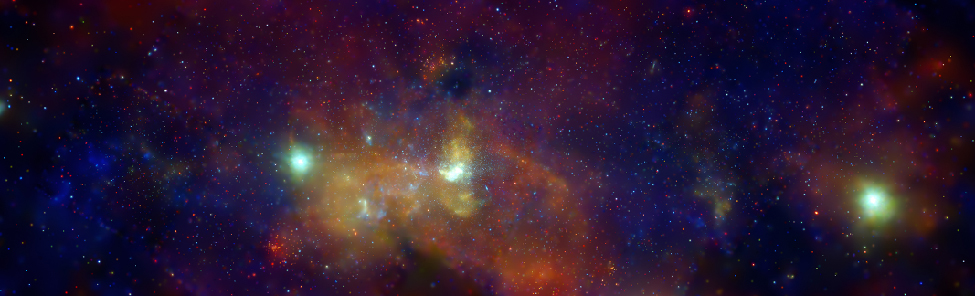
Now let’s focus in on the central region using a more energetic form of electromagnetic radiation. Figure 25.15 shows the X-ray emission from a smaller region 400 light-years wide and 900 light-years across centered in Sagittarius A*. Seen in this picture are hundreds of hot white dwarfs, neutron stars, and stellar black holes with accretion disks glowing with X-rays. The diffuse haze in the picture is emission from gas that lies among the stars and is at a temperature of 10 million K.
英語のヒント
今度は、さらに高エネルギーの電磁波を使い、中央の領域へ焦点を絞ろう。図25.15は、いて座A*を中心とする400×900光年の、より小さな領域のX線放射を示す。画像には、X線で輝く降着円盤を伴う高温の白色矮星、中性子星、恒星質量ブラックホールが数百個見えている。ぼんやりしたもやは、星と星の間にある、温度1000万Kのガスからの放射である。
Galactic Center in X-Rays.X線で見た銀河中心
credit: modification of work by NASA/CXC/ UMass/D. Wang et al. · NASA/SAO media use
Figure 25.15 This artificial-color mosaic of 30 images taken with the Chandra X-ray satellite shows a region 400 × 900 light-years in extent and centered on Sagittarius A*, the bright white source in the center of the picture. The X-ray-emitting point sources are white dwarfs, neutron stars, and stellar black holes. The diffuse “haze” is emission from gas at a temperature of 10 million K. This hot gas is flowing away from the center out into the rest of the Galaxy. The colors indicate X-ray energy bands: red (low energy), green (medium energy), and blue (high energy). (credit: modification of work by NASA/CXC/ UMass/D. Wang et al.)
図25.15 チャンドラX線衛星による30枚の画像をつなぎ合わせた疑似カラーモザイク。中央の明るい白い光源、いて座A*を中心とする400×900光年の領域を示す。X線を放つ点状の光源は白色矮星、中性子星、恒星質量ブラックホールである。広がった「もや」は温度1000万Kのガスからの放射で、この高温ガスは中心から銀河のほかの部分へ流れ出している。色はX線のエネルギー帯を表し、赤が低エネルギー、緑が中エネルギー、青が高エネルギーである。(クレジット:NASA/CXC/UMass/D. Wangほかの作品を改変)
As we approach the center of the Galaxy, we find the supermassive black hole Sagittarius A*. There are also thousands of stars within a few lightyears of Sagittarius A*. Most of these are old, reddish main-sequence stars. But there are also about a hundred hot OB stars that must have formed within the last few million years. There is as yet no good explanation for how stars could have formed recently so close to a supermassive black hole. Perhaps they formed in a dense cluster of stars that was originally at a larger distance from the black hole and subsequently migrated closer.
英語のヒント
銀河中心へ近づくと、超大質量ブラックホール、いて座A*がある。その数光年以内には、何千個もの星も存在する。大部分は古く赤みを帯びた主系列星である。しかし、高温のOB星も約100個あり、過去数百万年以内に生まれたはずである。超大質量ブラックホールのこれほど近くで、最近どのように星が生まれたかには、まだよい説明がない。もともとブラックホールから遠くにあった密な星団の中で生まれ、その後、より近くへ移動してきたのかもしれない。
There is currently no star formation at the galactic center, but there is lots of dust and molecular gas that is revolving around the black hole, along with some ionized gas streamers that are heated by the hot stars. Figure 25.16 is a radio map that shows these gas streamers.
英語のヒント
現在、銀河中心では星形成は起きていないが、ブラックホールの周りを回る塵と分子ガスが大量にあり、高温の星に加熱された、電離ガスの流れもいくつかある。図25.16の電波地図には、こうしたガスの流れが見えている。
Sagittarius A.いて座A
Figure 25.16 This image, taken with the Very Large Array of radio telescopes, shows the radio emission from hot, ionized gas in the center of the Milky Way. The lines slanting across the top of the image are gas streamers. Sagittarius A* is the bright spot in the lower right. (credit: modification of work by Farhad Zadeh et al. (Northwestern), VLA, NRAO)
図25.16 超大型干渉電波望遠鏡(VLA)で撮影した画像で、天の川銀河の中心にある高温の電離ガスからの電波放射を示す。画像の上側を斜めに横切る線はガスの流れで、右下の明るい点がいて座A*である。(クレジット:Farhad Zadehほか〔Northwestern〕、VLA、NRAOの作品を改変)