第25章天の川銀河The Milky Way Galaxy
25.5 Stellar Populations in the Galaxy25.5 天の川銀河の種族
Learning Objectives学習の目標
By the end of this section, you will be able to:
この節を読み終えると、次のことができるようになる。
Distinguish between population I and population II stars according to their locations, motions, heavy-element abundances, and ages
位置、運動、重元素の存在量、年齢に基づいて、種族Iの星と種族IIの星を区別する。
Explain why the oldest stars in the Galaxy are poor in elements heavier than hydrogen and helium, while stars like the Sun and even younger stars are typically richer in these heavy elements
銀河で最も古い星には水素とヘリウムより重い元素が乏しく、太陽のような星やさらに若い星には一般にそれらが多い理由を説明する。
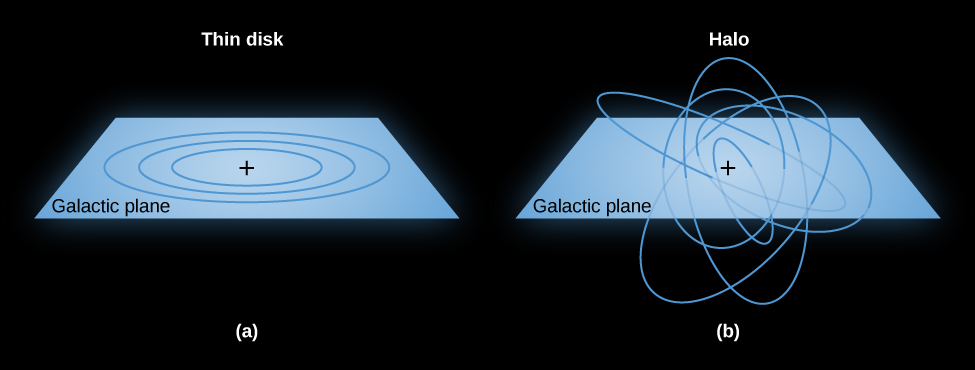
In the first section of this chapter, we described the thin disk, thick disk, and stellar halo. Look back at Table 25.1 and note some of the patterns. Young stars lie in the thin disk, are rich in metals, and orbit the Galaxy’s center at high speed. The stars in the halo are old, have low abundances of elements heavier than hydrogen and helium, and have highly elliptical orbits randomly oriented in direction (see Figure 25.19). Halo stars can plunge through the disk and central bulge, but they spend most of their time far above or below the plane of the Galaxy. The stars in the thick disk are intermediate between these two extremes. Let’s first see why age and heavier-element abundance are correlated and then see what these correlations tell us about the origin of our Galaxy.
英語のヒント
この章の最初の節では、薄い円盤、厚い円盤、そして恒星ハローを説明した。表25.1に戻って、いくつかの傾向に注目しよう。若い星は薄い円盤にあり、金属に富み、銀河中心の周りを高速で回っている。ハローの星は古く、水素とヘリウムより重い元素の存在量が少ない。また、さまざまな向きを向いた、細長い楕円軌道を回っている(図25.19)。ハローの星は円盤や中央のバルジを突き抜けることもあるが、大部分の時間を銀河面のはるか上方か下方で過ごす。厚い円盤の星は、この両極端の中間に位置する。まず、年齢と重元素の存在量に相関がある理由を調べ、次に、この相関から天の川銀河の起源について何が分かるかを考えよう。
How Objects Orbit the Galaxy.天体は銀河をどのように周回するか
OpenStax / Rice University · CC BY 4.0
Figure 25.19 (a) In this image, you see stars in the thin disk of our Galaxy in nearly circular orbits. (b) In this image, you see the motion of stars in the Galaxy’s halo in randomly oriented and elliptical orbits.
図25.19 (a)天の川銀河の薄い円盤にある星が、ほぼ円形の軌道を回る様子。(b)銀河のハローにある星が、さまざまな向きの楕円軌道を回る様子。
Two Kinds of Stars2種類の星
The discovery that there are two different kinds of stars was first made by Walter Baade during World War II. As a German national, Baade was not allowed to do war research as many other U.S.-based scientists were doing, so he was able to make regular use of the Mount Wilson telescopes in southern California. His observations were aided by the darker skies that resulted from the wartime blackout of Los Angeles.
英語のヒント
2種類の異なる星があることを最初に発見したのは、第2次世界大戦中のウォルター・バーデだった。ドイツ国籍だったバーデは、米国を拠点とする多くの科学者が従事した戦争研究に参加することを許されず、そのため南カリフォルニアのウィルソン山の望遠鏡を日常的に使うことができた。戦時中のロサンゼルスの灯火管制で夜空が暗くなったことも、彼の観測を助けた。
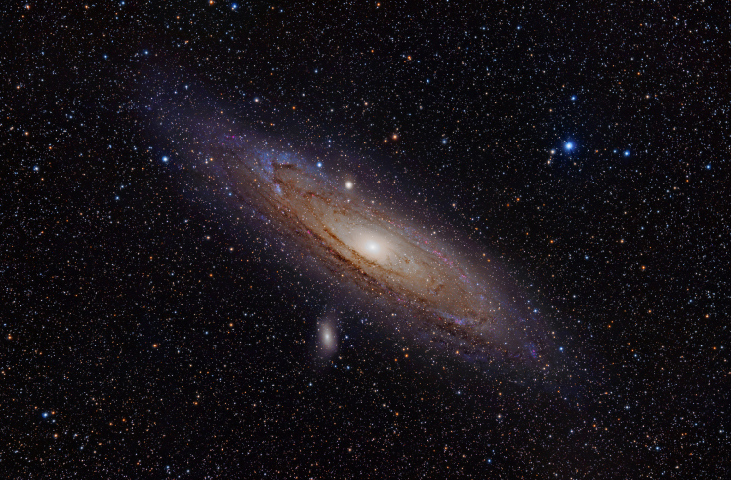
Among the things a large telescope and dark skies enabled Baade to examine carefully were other galaxies—neighbors of our Milky Way Galaxy. We will discuss other galaxies in the next chapter (Galaxies), but for now we will just mention that the nearest Galaxy that resembles our own (with a similar disk and spiral structure) is often called the Andromeda galaxy, after the constellation in which we find it.
英語のヒント
大型望遠鏡と暗い空のおかげでバーデが詳しく調べられたものの中には、天の川銀河の近隣にある、ほかの銀河もあった。ほかの銀河は次の章「銀河」で扱うが、ここでは、私たちの銀河と似た円盤や渦状構造を持つ最も近い銀河が、ふつう、それが見える星座の名を取ってアンドロメダ銀河と呼ばれることだけ述べておこう。
Baade was impressed by the similarity of the mainly reddish stars in the Andromeda galaxy’s nuclear bulge to those in our Galaxy’s globular clusters and the halo. He also noted the difference in color between all these and the bluer stars found in the spiral arms near the Sun (Figure 25.20). On this basis, he called the bright blue stars in the spiral arms population I and all the stars in the halo and globular clusters population II.
英語のヒント
バーデは、アンドロメダ銀河の中心のバルジにある、主に赤みを帯びた星が、天の川銀河の球状星団やハローの星に似ていることに感銘を受けた。また、これらの星すべてと、太陽の近くの渦状腕で見つかる青みを帯びた星との、色の違いにも気づいた(図25.20)。このことから、渦状腕の明るい青い星を種族I、ハローと球状星団の星をすべて種族IIと呼んだ。
Andromeda Galaxy (M31).アンドロメダ銀河(M31)
credit: Adam Evans · CC BY 2.0
Figure 25.20 This neighboring spiral looks similar to our own Galaxy in that it is a disk galaxy with a central bulge. Note the bulge of older, yellowish stars in the center, the bluer and younger stars in the outer regions, and the dust in the disk that blocks some of the light from the bulge. (credit: Adam Evans)
図25.20 この近隣の渦巻銀河は、中央にバルジを持つ円盤銀河であるという点で、天の川銀河に似ている。中心のバルジにある古い黄色がかった星、外側の領域の青く若い星、そしてバルジの光の一部を遮る円盤内の塵に注目しよう。(クレジット:Adam Evans)
We now know that the populations differ not only in their locations in the Galaxy, but also in their chemical composition, age, and orbital motions around the center of the Galaxy. Population I stars are found only in the disk and follow nearly circular orbits around the galactic center. Examples are bright supergiant stars, main-sequence stars of high luminosity (spectral classes O and B), which are concentrated in the spiral arms, and members of young open star clusters. Interstellar matter and molecular clouds are found in the same places as population I stars.
英語のヒント
現在では、種族は銀河内での位置だけでなく、化学組成、年齢、銀河中心の周りの軌道運動も異なると分かっている。種族Iの星は円盤にだけ見られ、銀河中心の周りをほぼ円形の軌道で回る。例として、明るい超巨星、渦状腕に集中する光度の高い主系列星(スペクトル型OとB)、若い散開星団の星が挙げられる。星間物質や分子雲も、種族Iの星と同じ場所で見つかる。
Population II stars show no correlation with the location of the spiral arms. These objects are found throughout the Galaxy. Some are in the disk, but many others follow eccentric elliptical orbits that carry them high above the galactic disk into the halo. Examples include stars surrounded by planetary nebulae and RR Lyrae variable stars. The stars in globular clusters, found almost entirely in the Galaxy’s halo, are also classified as population II.
英語のヒント
種族IIの星の分布には、渦状腕の位置との相関がない。これらの天体は銀河全体に見られる。円盤にあるものもいるが、多くは離心率の大きい楕円軌道に沿って、銀河円盤のはるか上方のハローまで移動する。例として、惑星状星雲に囲まれた星や、こと座RR型変光星が挙げられる。ほぼすべて銀河のハローにある球状星団の星も、種族IIに分類される。
Today, we know much more about stellar evolution than astronomers did in the 1940s, and we can determine the ages of stars. Population I includes stars with a wide range of ages. While some are as old as 10 billion years, others are still forming today. For example, the Sun, which is about 5 billion years old, is a population I star. But so are the massive young stars in the Orion Nebula that have formed in the last few million years. Population II, on the other hand, consists entirely of old stars that formed very early in the history of the Galaxy; typical ages are 11 to 13 billion years.
英語のヒント
今日では、1940年代の天文学者よりはるかに多くのことを恒星進化について知っており、星の年齢を求められる。種族Iには、幅広い年齢の星が含まれる。100億年にもなる星がある一方、今なお生まれつつある星もある。例えば、約50億歳の太陽は種族Iの星である。しかし、過去数百万年の間に生まれた、オリオン大星雲の若い大質量星も同じく種族Iである。これに対して種族IIは、銀河の歴史のごく初期に生まれた古い星だけからなり、典型的な年齢は110億〜130億年である。
We also now have good determinations of the compositions of stars. These are based on analyses of the stars’ detailed spectra. Nearly all stars appear to be composed mostly of hydrogen and helium, but their abundances of the heavier elements differ. In the Sun and other population I stars, the heavy elements (those heavier than hydrogen and helium) account for 1–4% of the total stellar mass. Population II stars in the outer galactic halo and in globular clusters have much lower abundances of the heavy elements—often less than one-hundredth the concentrations found in the Sun and in rare cases even lower. The oldest population II star discovered to date has less than one ten-millionth as much iron as the Sun, for example.
英語のヒント
星の組成も、現在ではかなり正確に求められる。これは星の詳しいスペクトルを分析した結果に基づく。ほとんどすべての星は主に水素とヘリウムでできているようだが、より重い元素の存在量は異なる。太陽やほかの種族Iの星では、重元素(水素とヘリウムより重い元素)が星の全質量の1〜4%を占める。銀河外側のハローや球状星団の種族IIの星では、重元素の存在量ははるかに少なく、多くの場合、太陽の濃度の100分の1未満で、まれにはさらに少ない。例えば、これまでに発見された最も古い種族IIの星では、鉄の存在量が太陽の1000万分の1未満である。
As we discussed in earlier chapters, heavy elements are created deep within the interiors of stars. They are added to the Galaxy’s reserves of raw material when stars die, and their material is recycled into new generations of stars. Thus, as time goes on, stars are born with larger and larger supplies of heavy elements. Population II stars formed when the abundance of elements heavier than hydrogen and helium was low. Population I stars formed later, after mass lost by dying members of the first generations of stars had seeded the interstellar medium with elements heavier than hydrogen and helium. Some are still forming now, when further generations have added to the supply of heavier elements available to new stars.
英語のヒント
前の章で述べたように、重元素は星の内部深くで作られる。星が死ぬと、重元素は銀河に蓄えられた原材料に加わり、その物質が新しい世代の星へと再利用される。こうして時がたつにつれ、星はより多くの重元素を持って生まれるようになる。種族IIの星は、水素とヘリウムより重い元素の存在量が少なかった時代に生まれた。種族Iの星はその後、最初の世代の星が死に際に失った物質によって、星間物質に水素やヘリウムより重い元素がまかれた後で生まれた。種族Iの星の中には、今なお形成されているものもある。その時点では、さらに後の世代によって、新しい星が利用できる重元素の蓄えが増えている。