第25章天の川銀河The Milky Way Galaxy
25.3 The Mass of the Galaxy25.3 天の川銀河の質量
Learning Objectives学習の目標
By the end of this section, you will be able to:
この節を読み終えると、次のことができるようになる。
Describe historical attempts to determine the mass of the Galaxy
天の川銀河の質量を求めようとした歴史上の試みを説明する。
Interpret the observed rotation curve of our Galaxy to suggest the presence of dark matter whose distribution extends well beyond the Sun’s orbit
天の川銀河で観測された回転曲線を読み解き、暗黒物質の分布が太陽の軌道をはるかに越えて広がることを推測する。
When we described the sections of the Milky Way, we said that the stars are now known to be surrounded by a much larger halo of invisible matter. Let’s see how this surprising discovery was made.
天の川銀河の各部分を説明したとき、星々は、見えない物質からなる、はるかに大きなハローに包まれていると述べた。この驚くべき発見がどのようになされたのかを見てみよう。
Kepler Helps Weigh the Galaxyケプラーの法則で銀河の質量を測る
The Sun, like all the other stars in the Galaxy, orbits the center of the Milky Way. Our star’s orbit is nearly circular and lies in the Galaxy’s disk. The speed of the Sun in its orbit is about 200 kilometers per second, which means it takes us approximately 225 million years to go once around the center of the Galaxy. We call the period of the Sun’s revolution the galactic year. It is a long time compared to human time scales; during the entire lifetime of Earth, only about 20 galactic years have passed. This means that we have gone only a tiny fraction of the way around the Galaxy in all the time that humans have gazed into the sky.
英語のヒント
太陽は、銀河のほかのすべての星と同じく、天の川銀河の中心を公転する。太陽の軌道はほぼ円形で、銀河円盤の中にある。軌道上の速さは約200 km/sで、銀河中心を一周するのに約2億2500万年かかる。この太陽の公転周期を銀河年と呼ぶ。人間の時間尺度と比べると長い時間であり、地球が存在してきた全期間でも、約20銀河年しか経っていない。つまり、人類が空を見上げてきた時間をすべて合わせても、私たちは銀河の周りの道のりを、ごくわずかしか進んでいない。
We can use the information about the Sun’s orbit to estimate the mass of the Galaxy (just as we could “weigh” the Sun by monitoring the orbit of a planet around it—see Orbits and Gravity). Let’s assume that the Sun’s orbit is circular and that the Galaxy is roughly spherical, (we know the Galaxy is shaped more like a disk, but to simplify the calculation we will make this assumption, which illustrates the basic approach). Long ago, Newton showed that if you have matter distributed in the shape of a sphere, then it is simple to calculate the pull of gravity on some object just outside that sphere: you can assume that gravity acts as if all the matter were concentrated at a point in the center of the sphere. For our calculation, then, we can assume that all the mass that lies inward of the Sun’s position is concentrated at the center of the Galaxy, and that the Sun orbits that point from a distance of about 26,000 light-years.
英語のヒント
太陽の軌道の情報を使えば、銀河の質量を推定できる。太陽を回る惑星の軌道を観測して太陽を「はかりにかけた」のと同じ考え方である。「軌道と重力」を参照してほしい。太陽の軌道は円で、天の川銀河はおおよそ球状だと仮定しよう。銀河がむしろ円盤に近い形だとは分かっているが、基本的な方法を示すため、計算を簡単にするこの仮定を置く。はるか以前にニュートンは、物質が球状に分布するとき、そのすぐ外側の天体に働く重力は簡単に計算できると示した。すべての物質が球の中心の一点に集まっているかのように扱えばよい。したがって今回の計算では、太陽の位置より内側の全質量が銀河中心に集まっており、太陽はそこから約2万6000光年の距離でその点を公転すると仮定できる。
This is the sort of situation to which Kepler’s third law (as modified by Newton) can be directly applied. Plugging numbers into Kepler’s formula, we can calculate the sum of the masses of the Galaxy and the Sun. However, the mass of the Sun is completely trivial compared to the mass of the Galaxy. Thus, for all practical purposes, the result (about 100 billion times the mass of the Sun) is the mass of the Milky Way. More sophisticated calculations based on more sophisticated models give a similar result.
英語のヒント
これは、ニュートンが拡張したケプラーの第3法則を直接適用できる種類の状況である。式に数値を入れると、銀河と太陽の質量の和を計算できる。しかし、太陽の質量は銀河の質量と比べればまったく無視できる。したがって、実際上、得られた結果――太陽質量の約1000億倍――が天の川銀河の質量になる。より精密な模型に基づく詳しい計算でも、同じような結果が得られる。
Our estimate tells us how much mass is contained in the volume inside the Sun’s orbit. This is a good estimate for the total mass of the Galaxy only if hardly any mass lies outside the Sun’s orbit. For many years astronomers thought this assumption was reasonable. The number of bright stars and the amount of luminous matter (meaning any material from which we can detect electromagnetic radiation) both drop off dramatically at distances of more than about 30,000 light-years from the galactic center. Little did we suspect how wrong our assumption was.
英語のヒント
この推定が教えるのは、太陽の軌道の内側の領域にどれだけの質量があるかである。これが銀河の総質量のよい推定になるのは、太陽の軌道の外側にはほとんど質量がない場合に限られる。長年、天文学者はこの仮定を妥当だと考えていた。明るい星の数と、光る物質――電磁波を検出できるあらゆる物質――の量は、銀河中心から約3万光年を越えると、ともに急激に減るからである。この仮定がどれほど間違っていたか、私たちはほとんど想像もしなかった。
A Galaxy of Mostly Invisible Matter大部分が見えない物質からなる銀河
In science, what seems to be a reasonable assumption can later turn out to be wrong (which is why we continue to do observations and experiments every chance we get). There is a lot more to the Milky Way than meets the eye (or our instruments). While there is relatively little luminous matter beyond 30,000 light-years, we now know that a lot of invisible matter exists at great distances from the galactic center.
英語のヒント
科学では、妥当に見える仮定が後になって間違いだと分かることがある。だからこそ、機会があるたびに観測と実験を続けるのである。天の川銀河には、目や観測装置に見えるものより、はるかに多くのものがある。3万光年より外側の光る物質は比較的少ないが、銀河中心から遠く離れた場所にも、見えない物質が大量に存在すると分かっている。
We can understand how astronomers detected this invisible matter by remembering that according to Kepler’s third law, objects orbiting at large distances from a massive object will move more slowly than objects that are closer to that central mass. In the case of the solar system, for example, the outer planets move more slowly in their orbits than the planets close to the Sun.
ケプラーの第3法則によると、大きな質量を持つ天体の周りを遠くで回るものは、その中心の質量に近いものより遅く動くことを思い出せば、見えない物質をどのように検出したかが理解できる。たとえば太陽系では、外側の惑星は太陽に近い惑星より軌道上を遅く動く。
There are a few objects, including globular clusters and some nearby small satellite galaxies, that lie well outside the luminous boundary of the Milky Way. If most of the mass of our Galaxy were concentrated within the luminous region, then these very distant objects should travel around their galactic orbits at lower speeds than, for example, the Sun does.
英語のヒント
球状星団や近隣の小さな伴銀河などの天体が、天の川銀河の光る部分の境界より、かなり外側にもある。銀河の質量のほとんどが光る領域内に集中しているなら、これら非常に遠い天体は、たとえば太陽より遅い速さで銀河の周りを公転するはずである。
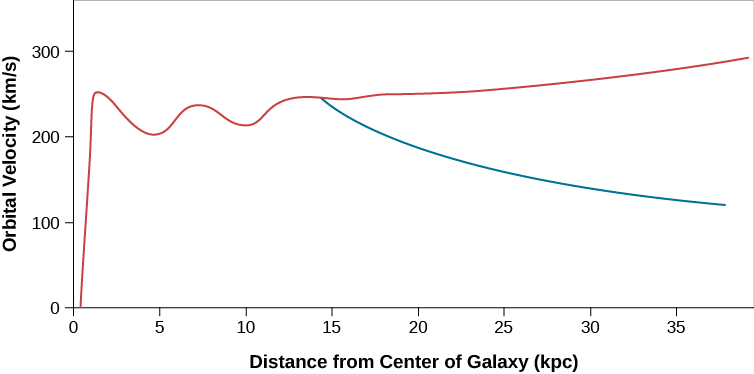
It turns out, however, that the few objects seen at large distances from the luminous boundary of the Milky Way Galaxy are not moving more slowly than the Sun. There are some globular clusters and RR Lyrae stars between 30,000 and 150,000 light-years from the center of the Galaxy, and their orbital velocities are even greater than the Sun’s (Figure 25.13).
しかし、天の川銀河の光る部分の境界から遠く離れたところに見える天体は、太陽より遅く動いてはいないと分かった。銀河中心から3万〜15万光年にある球状星団やこと座RR型変光星の公転速度は、太陽よりさらに大きいのである(図25.13)。
Rotation Curve of the Galaxy.天の川銀河の回転曲線
OpenStax / Rice University · CC BY 4.0
Figure 25.13 The orbital speed of carbon monoxide (CO) and hydrogen (H) gas at different distances from the center of the Milky Way Galaxy is shown in red. The blue curve shows what the rotation curve would look like if all the matter in the Galaxy were located inside a radius of 50,000 light-years. Instead of going down, the speed of gas clouds farther out remains high, indicating a great deal of mass beyond the Sun’s orbit. The horizontal axis shows the distance from the galactic center in kiloparsecs (where a kiloparsec equals 3,260 light-years).
図25.13 天の川銀河の中心からさまざまな距離にある一酸化炭素(CO)と水素(H)のガスの公転速度を赤で示す。青い曲線は、銀河の全物質が半径5万光年以内にあるなら、回転曲線がどのようになるかを示している。実際には外側のガス雲の速さは下がらず、高いままであり、太陽の軌道より外側にも大量の質量があることを示す。横軸は銀河中心からの距離をキロパーセクで表す。1キロパーセクは3260光年である。
What do these higher speeds mean? Kepler’s third law tells us how fast objects must orbit a source of gravity if they are neither to fall in (because they move too slowly) nor to escape (because they move too fast). If the Galaxy had only the mass calculated by Kepler, then the high-speed outer objects should long ago have escaped the grip of the Milky Way. The fact that they have not done so means that our Galaxy must have more gravity than can be supplied by the luminous matter—in fact, a lot more gravity. The high speed of these outer objects tells us that the source of this extra gravity must extend outward from the center far beyond the Sun’s orbit.
英語のヒント
これほど大きい速さは何を意味するのだろうか。ケプラーの第3法則は、遅すぎて落ち込むことも、速すぎて逃げ去ることもなく、重力源の周りを回るには、どれだけの速さが必要かを教える。銀河の質量がケプラーの法則で計算した分しかないなら、高速で動く外側の天体は、とっくに天の川銀河の重力を振り切っていたはずだ。そうなっていないという事実は、銀河には光る物質だけで生み出せるより、ずっと大きな重力があることを意味する。外側の天体の高速な運動は、この余分な重力の源が、中心から外へ、太陽の軌道をはるかに越えて広がっていなければならないことを示している。
If the gravity were supplied by stars or by something else that gives off radiation, we should have spotted this additional outer material long ago. We are therefore forced to the reluctant conclusion that this matter is invisible and has, except for its gravitational pull, gone entirely undetected.
英語のヒント
重力の源が星や、ほかの放射を出す物質なら、この外側の追加の物質は、はるか前に見つかっていたはずである。したがって私たちは、不本意ながら、この物質は見えず、重力による引力を除いてはまったく検出されていない、と結論せざるを得ない。
Studies of the motions of the most remote globular clusters and the small galaxies that orbit our own show that the total mass of the Galaxy is at least MSun, which is about twenty times greater than the amount of luminous matter. Moreover, the dark matter (as astronomers have come to call the invisible material) extends to a distance of at least 200,000 light-years from the center of the Galaxy. Observations indicate that this dark matter halo is almost but not quite spherical.
英語のヒント
最も遠い球状星団や、天の川銀河の周りを回る小銀河の運動を調べると、銀河の総質量は少なくとも太陽質量である。これは光る物質の量のおよそ20倍に当たる。また、この見えない物質を天文学者が呼ぶようになった暗黒物質は、銀河中心から少なくとも20万光年まで広がる。観測によると、この暗黒物質ハローはほぼ球状だが、完全な球ではない。
The obvious question is: what is the dark matter made of? Let’s look at a list of “suspects” taken from our study of astronomy so far. Since this matter is invisible, it clearly cannot be in the form of ordinary stars. And it cannot be gas in any form (remember that there has to be a lot of it). If it were neutral hydrogen gas, its 21-cm wavelength spectral-line emission would have been detected as radio waves. If it were ionized hydrogen, it should be hot enough to emit visible radiation. If a lot of hydrogen atoms out there had combined into hydrogen molecules, these should produce dark features in the ultraviolet spectra of objects lying beyond the Galaxy, but such features have not been seen. Nor can the dark matter consist of interstellar dust, since in the required quantities, the dust would significantly obscure the light from distant galaxies.
英語のヒント
当然の疑問は、暗黒物質は何からできているのか、ということだ。ここまで学んだ天文学から、「容疑者」の一覧を見てみよう。見えない以上、普通の星ではないことは明らかだ。そして、どの形のガスでもない。大量に存在しなければならないことを思い出そう。中性水素ガスなら、波長21 cmのスペクトル線の放射が電波として検出されていたはずである。電離した水素なら、可視光を出せるほど高温のはずだ。大量の水素原子が水素分子になっているなら、銀河の向こうの天体の紫外線スペクトルに暗い特徴を作るはずだが、見つかっていない。星間塵でもありえない。必要な量の塵があれば、遠い銀河からの光を著しく遮るからだ。
What are our other possibilities? The dark matter cannot be a huge number of black holes (of stellar mass) or old neutron stars, since interstellar matter falling onto such objects would produce more X-rays than are observed. Also, recall that the formation of black holes and neutron stars is preceded by a substantial amount of mass loss, which scatters heavy elements into space to be incorporated into subsequent generations of stars. If the dark matter consisted of an enormous number of any of those objects, they would have blown off and recycled a lot of heavier elements over the history of the Galaxy. In that case, the young stars we observe in our Galaxy today would contain much greater abundances of heavy elements than they actually do.
英語のヒント
ほかにどんな可能性があるだろうか。暗黒物質は、大量の恒星質量ブラックホールや古い中性子星でもありえない。そのような天体へ落ち込む星間物質は、観測されるより多くのX線を生み出すはずだからである。また、ブラックホールや中性子星ができる前には相当量の質量が失われ、重元素が宇宙へ散らばって、次の世代の星に取り込まれることを思い出そう。暗黒物質がこれらの天体のどれかの膨大な集まりなら、銀河の歴史を通じて大量の重元素が吹き飛ばされ、再利用されたはずである。その場合、現在観測する若い星には、実際よりはるかに多くの重元素が含まれているだろう。
Brown dwarfs and lone Jupiter-like planets have also been ruled out. First of all, there would have to be an awful lot of them to make up so much dark matter. But we have a more direct test of whether so many low-mass objects could actually be lurking out there. As we learned in Black Holes and Curved Spacetime, the general theory of relativity predicts that the path traveled by light is changed when it passes near a concentration of mass. It turns out that when the two objects appear close enough together in the sky, the mass closer to us can bend the light from farther away. With just the right alignment, the image of the more distant object also becomes significantly brighter. By looking for the temporary brightening that occurs when a dark matter object in our own Galaxy moves across the path traveled by light from stars in the Magellanic Clouds, astronomers have now shown that the dark matter cannot be made up of a lot of small objects with masses between one-millionth and one-tenth the mass of the Sun.
英語のヒント
褐色矮星や、単独で存在する木星のような惑星も除外されている。まず、これほど大量の暗黒物質をまかなうには、途方もない数が必要になる。しかし、そのような低質量の天体が本当に大量に潜んでいるかを確かめる、より直接的な方法もある。「ブラックホールと曲がった時空」で学んだように、一般相対性理論は、光が質量の集中する場所の近くを通ると経路が変わると予言する。二つの天体が空で十分近くに見えるとき、手前の質量が奥から来る光を曲げられる。位置関係がちょうどよければ、遠い天体の像は大きく明るくなる。天の川銀河内の暗黒物質の天体が、マゼラン雲の星からの光の経路を横切るときの一時的な増光を探すことで、太陽質量の100万分の1から10分の1までの小天体の大量の集まりでは、暗黒物質を構成できないと示されている。
What’s left? One possibility is that the dark matter is composed of exotic subatomic particles of a type not yet detected on Earth. Very sophisticated (and difficult) experiments are now under way to look for such particles. Stay tuned to see whether anything like that turns up.
英語のヒント
残るのは何だろうか。一つの可能性は、地球上でまだ検出されたことのない種類の、通常とは異なる素粒子で暗黒物質ができているというものだ。現在、そのような粒子を探す、非常に精密で難しい実験が進められている。何かが見つかるか、今後の展開に注目しよう。
We should add that the problem of dark matter is by no means confined to the Milky Way. Observations show that dark matter must also be present in other galaxies (whose outer regions also orbit too fast “for their own good”—they also have flat rotation curves). As we will see, dark matter even exists in great clusters of galaxies whose members are now known to move around under the influence of far more gravity than can be accounted for by luminous matter alone.
英語のヒント
暗黒物質の問題は、決して天の川銀河に限られないことも付け加えておこう。観測によれば、別の銀河にも暗黒物質が存在しなければならない。外側の領域が、そのままでは銀河にとどまれないほど速く回り、同じく平らな回転曲線を持つからである。後で見るように、暗黒物質は大きな銀河団にもある。銀河団の各銀河は、光る物質だけでは説明できない、はるかに強い重力のもとで動き回っていることが分かっている。
Stop a moment and consider how astounding the conclusion we have reached really is. Perhaps as much as 95% of the mass in our Galaxy (and many other galaxies) is not only invisible, but we do not even know what it is made of. The stars and raw material we can observe may be merely the tip of the cosmic iceberg; underlying it all may be other matter, perhaps familiar, perhaps startlingly new. Understanding the nature of this dark matter is one of the great challenges of astronomy today; you will learn more about this in The Challenge of Dark Matter.
英語のヒント
少し立ち止まり、ここで達した結論がどれほど驚くべきものか考えてみよう。天の川銀河や多くの別の銀河では、質量の実に95%ほどが見えないだけでなく、何からできているかすら分からない可能性がある。観測できる星や材料は、宇宙の氷山の一角にすぎないのかもしれない。その下には、よく知っている物質か、驚くほど新しい物質か分からない、別の物質が潜んでいるのかもしれない。暗黒物質の正体の理解は、現代天文学の大きな課題の一つである。「暗黒物質という難問」でさらに詳しく学ぶ。