第28章銀河の進化と分布The Evolution and Distribution of Galaxies
28.4 The Challenge of Dark Matter28.4 ダークマターという難題
Learning Objectives学習の目標
By the end of this section, you will be able to:
この節を学ぶと、次のことができるようになる。
Explain how astronomers know that the solar system contains very little dark matter
太陽系にはダークマターがほとんどないと、天文学者がどのように判断するかを説明する。
Summarize the evidence for dark matter in most galaxies
大半の銀河にダークマターがあることを示す証拠をまとめる。
Explain how we know that galaxy clusters are dominated by dark matter
銀河団の質量の大半をダークマターが占めると、どうしてわかるのかを説明する。
Relate the presence of dark matter to the average mass-to-light ratio of huge volumes of space containing many galaxies
多数の銀河を含む巨大な空間領域の平均的な質量光度比と、ダークマターの存在を結び付ける。
So far this chapter has focused almost entirely on matter that radiates electromagnetic energy—stars, planets, gas, and dust. But, as we have pointed out in several earlier chapters (especially The Milky Way Galaxy), it is now clear that galaxies contain large amounts of dark matter as well. There is much more dark matter, in fact, than matter we can see—which means it would be foolish to ignore the effect of this unseen material in our theories about the structure of the universe. (As many a ship captain in the polar seas found out too late, the part of the iceberg visible above the ocean’s surface was not necessarily the only part he needed to pay attention to.) Dark matter turns out to be extremely important in determining the evolution of galaxies and of the universe as a whole.
英語のヒント
この章ではここまで、恒星、惑星、ガス、塵など、電磁エネルギーを放射する物質に、ほぼ話を絞ってきた。しかし、以前のいくつかの章、特に「天の川銀河」で述べたように、銀河が大量のダークマターも含むことは、今では明らかである。実際、ダークマターは、見える物質よりはるかに多い。宇宙の構造を説明する理論で、その見えない物質の影響を無視するのは愚かだということになる。極地の海で、氷山の海面から見える部分だけに注意を払えばよいわけではないと、手遅れになってから気付いた船長が何人もいたようなものだ。ダークマターは、銀河と宇宙全体の進化を決めるうえで、きわめて重要なのである。
The idea that much of the universe is filled with dark matter may seem like a bizarre concept, but we can cite a historical example of “dark matter” much closer to home. In the mid-nineteenth century, measurements showed that the planet Uranus did not follow exactly the orbit predicted from Newton’s laws if one added up the gravitational forces of all the known objects in the solar system. Some people worried that Newton’s laws may simply not work so far out in our solar system. But the more straightforward interpretation was to attribute Uranus’ orbital deviations to the gravitational effects of a new planet that had not yet been seen. Calculations showed where that planet had to be, and Neptune was discovered just about in the predicted location.
英語のヒント
宇宙の大部分がダークマターで満ちているという考えは、奇妙に思えるかもしれない。しかし、もっと身近な「見えない物質」の歴史的な例がある。19世紀半ば、太陽系で知られている全天体の重力を足し合わせても、天王星が、ニュートンの法則で予測した軌道を正確にはたどらないことが測定からわかった。太陽系のそれほど遠い所では、ニュートンの法則が通用しないのではないか、と心配する人もいた。しかし、より直接的な説明は、まだ見つかっていない新しい惑星の重力が、天王星の軌道のずれを生むというものだった。計算は、その惑星がどこにあるはずかを示し、ほぼ予測位置で海王星が発見された。
In the same way, astronomers now routinely determine the location and amount of dark matter in galaxies by measuring its gravitational effects on objects we can see. And, by measuring the way that galaxies move in clusters, scientists have discovered that dark matter is also distributed among the galaxies in the clusters. Since the environment surrounding a galaxy is important in its development, dark matter must play a central role in galaxy evolution as well. Indeed, it appears that dark matter makes up most of the matter in the universe. But what is dark matter? What is it made of? We’ll look next at the search for dark matter and the quest to determine its nature.
英語のヒント
同じように、天文学者は今、見える天体に及ぼす重力効果を測り、銀河のダークマターの場所と量を日常的に求めている。また、銀河団内の銀河の動きを測定し、ダークマターが、銀河同士の間にも分布することを発見した。周囲の環境は銀河の発達にとって重要なので、ダークマターも銀河進化の中心的な役割を担うはずである。実際、宇宙の物質の大半は、ダークマターからなるらしい。しかし、ダークマターとは何か。何でできているのか。次は、その捜索と、正体を突き止める試みを見ていこう。
Dark Matter in the Local Neighborhood身近な領域のダークマター
Is there dark matter in our own solar system? Astronomers have examined the orbits of the known planets and of spacecraft as they journey to the outer planets and beyond. No deviations have been found from the orbits predicted on the basis of the masses of objects already discovered in our solar system and the theory of gravity. We therefore conclude that there is no evidence that there are large amounts of dark matter nearby.
英語のヒント
太陽系にはダークマターがあるのだろうか。天文学者は、既知の惑星の軌道と、外惑星やその先へ向かう探査機の軌道を調べた。太陽系で発見済みの天体の質量と重力理論に基づいて予測した軌道からの、ずれは見つかっていない。したがって、近くに大量のダークマターがあるという証拠はない、と結論する。
Astronomers have also looked for evidence of dark matter in the region of the Milky Way Galaxy that lies within a few hundred light-years of the Sun. In this vicinity, most of the stars are restricted to a thin disk. It is possible to calculate how much mass the disk must contain in order to keep the stars from wandering far above or below it. The total matter that must be in the disk is less than twice the amount of luminous matter. This means that no more than half of the mass in the region near the Sun can be dark matter.
英語のヒント
天文学者は、天の川銀河の中で太陽から数百光年以内の領域についても、ダークマターの証拠を探してきた。この近隣では、恒星の大半は薄い円盤内に限られている。星が円盤の上下へ遠く離れていかないために、円盤がどれほどの質量を持たなければならないかを計算できる。必要な全物質量は、光を出す物質の量の2倍未満である。つまり、太陽の近くでは、ダークマターは質量の半分を超えない。
Dark Matter in and around Galaxies銀河内と銀河の周囲のダークマター
In contrast to our local neighborhood near the Sun and solar system, there is (as we saw in The Milky Way Galaxy) ample evidence strongly suggesting that about 90% of the mass in the entire galaxy is in the form of a halo of dark matter. In other words, there is apparently about nine times more dark matter than visible matter. Astronomers have found some stars in the outer regions of the Milky Way beyond its bright disk, and these stars are revolving very rapidly around its center. The mass contained in all the stars and all the interstellar matter we can detect in the galaxy does not exert enough gravitational force to explain how those fast-moving stars remain in their orbits and do not fly away. Only by having large amounts of unseen matter could the galaxy be holding on to those fast-moving outer stars. The same result is found for other spiral galaxies as well.
英語のヒント
太陽や太陽系の近隣とは対照的に、銀河全体では、質量の約90%がダークマターのハローの形を取ることを強く示す、豊富な証拠がある。「天の川銀河」で見たとおりである。言い換えれば、見える物質の約9倍のダークマターがあるらしい。天文学者は、天の川銀河の明るい円盤を越えた外側に恒星を見つけており、それらは銀河中心を非常に速く回っている。しかし、検出できる恒星と星間物質の全質量だけでは、その速い星が飛び去らず、軌道上にとどまる理由を説明するほどの重力は生まれない。銀河が、こうした外側の高速の星をつなぎ留められるのは、大量の見えない物質を持つ場合だけである。他の渦巻銀河でも、同じ結果が見つかっている。
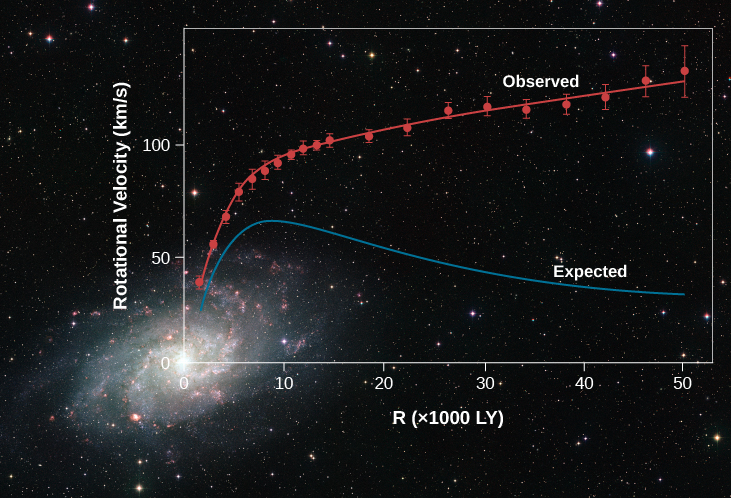
Figure 28.23 is an example of the kinds of observations astronomers are making, for the Triangulum galaxy, a member of our Local Group. The observed rotation of spiral galaxies like Andromeda is usually seen in plots, known as rotation curves, that show velocity versus distance from the galaxy center. Such plots suggest that the dark matter is found in a large halo surrounding the luminous parts of each galaxy. The radius of the halos around the Milky Way and Andromeda may be as large as 300,000 light-years, much larger than the visible size of these galaxies.
英語のヒント
図28.23は、天文学者が行う観測の例で、局所銀河群の一員である、さんかく座銀河を示す。アンドロメダ銀河のような渦巻銀河の回転は、通常、銀河中心からの距離に対して速度を描く「回転曲線」というグラフで示される。こうしたグラフは、各銀河の光る部分を囲む大きなハローに、ダークマターがあることを示唆する。天の川銀河やアンドロメダ銀河を囲むハローの半径は、最大30万光年にも及ぶかもしれない。見える銀河の大きさより、はるかに大きい。
Rotation Indicates Dark Matter.回転が示すダークマター
credit background: modification of work by ESO · CC BY 4.0
Figure 28.23 We see the Milky Way’s neighbor, the Triangulum galaxy, with a graph that shows the velocity at which stars and clouds of gas orbit the galaxy at different distances from the center (red line). As is true of the Milky Way, the rotational velocity (or orbital speed) does not decrease with distance from the center, rather than showing the decline expected outside a centrally concentrated mass distribution. A calculation (blue line) based on the total mass visible as stars, gas, and dust predicts that the velocity should be much lower at larger distances from the center. The discrepancy between the two curves implies the presence of a halo of massive dark matter extending outside the boundary of the luminous matter. This dark matter causes everything in the galaxy to orbit faster than the observed matter alone could explain. (credit background: modification of work by ESO)
図28.23 天の川銀河の隣にある、さんかく座銀河と、その中心からの距離ごとに、恒星やガス雲がどれほどの速度で回るかを示すグラフである。赤線が観測された回転速度を表す。天の川銀河と同様、中心から離れても、回転速度、つまり軌道速度は下がらない。中心に集中した質量の外側で予想されるような減少が、見られないのである。恒星、ガス、塵として見える全質量に基づく計算は、中心から遠い所では速度がずっと小さくなると予測する(青線)。二つの曲線の食い違いは、光を出す物質の境界より外まで、大きな質量のダークマター・ハローが広がることを示唆する。そのダークマターによって、銀河内の物体は、観測される物質だけで説明できるより速く回る。(背景画像のクレジット:ESOによる作品を改変)