第28章銀河の進化と分布The Evolution and Distribution of Galaxies
Mass-to-Light Ratio質量光度比
We described the use of the mass-to-light ratio to characterize the matter in galaxies or clusters of galaxies in Properties of Galaxies. For systems containing mostly old stars, the mass-to-light ratio is typically 10 to 20, where mass and light are measured in units of the Sun’s mass and luminosity. A mass-to-light ratio of 100 or more is a signal that a substantial amount of dark matter is present. Table 28.1 summarizes the results of measurements of mass-to-light ratios for various classes of objects. Very large mass-to-light ratios are found for all systems of galaxy size and larger, indicating that dark matter is present in all these types of objects. This is why we say that dark matter apparently makes up most of the total mass of the universe.
英語のヒント
「銀河の性質」では、銀河や銀河団の物質の特徴を調べるために、質量光度比を使う方法を説明した。主に古い恒星を含む系では、質量光度比は典型的に10〜20である。ここでは、質量は太陽質量、光度は太陽光度を単位にしている。100以上の質量光度比は、かなりの量のダークマターがある徴候になる。表28.1に、さまざまな種類の天体について測定した質量光度比をまとめる。銀河サイズ以上のすべての系で、非常に大きな質量光度比が見つかり、どの種類にもダークマターがあることを示す。ダークマターが宇宙の全質量の大半を占めるらしい、と言うのは、このためである。
Mass-To-Light Ratios 質量光度比 |
|
|---|---|
Type of Object 天体の種類 |
Mass-to-Light Ratio 質量光度比 |
Sun 太陽 |
1 |
Matter in vicinity of Sun 太陽近傍の物質 |
2 |
Mass in Milky Way within 80,000 light-years of the center 天の川銀河の中心から8万光年以内の質量 |
10 |
Small groups of galaxies 小さな銀河群 |
50–150 50〜150 |
Rich clusters of galaxies 豊かな銀河団 |
250–300 250〜300 |
The clustering of galaxies can be used to derive the total amount of mass in a given region of space, while visible radiation is a good indicator of where the luminous mass is. Studies show that the dark matter and luminous matter are very closely associated. The dark matter halos do extend beyond the luminous boundaries of the galaxies that they surround. However, where there are large clusters of galaxies, you will also find large amounts of dark matter. Voids in the galaxy distribution are also voids in the distribution of dark matter.
英語のヒント
銀河の集まり方から、ある空間領域の全質量を求められる。一方、見える放射は、光を出す質量がどこにあるかの、よい指標となる。研究によると、ダークマターと光る物質は、非常に密接に結び付いている。ダークマター・ハローは、それが囲む銀河の光る境界の外まで、確かに伸びている。しかし、大きな銀河団がある場所には、大量のダークマターも見つかる。銀河分布のボイドは、ダークマター分布でもボイドになっている。
What Is the Dark Matter?ダークマターとは何か
How do we go about figuring out what the dark matter consists of? The technique we might use depends on its composition. Let’s consider the possibility that some of the dark matter is made up of normal particles: protons, neutrons, and electrons. Suppose these particles were assembled into black holes, brown dwarfs, or white dwarfs. If the black holes had no accretion disks, they would be invisible to us. White and brown dwarfs do emit some radiation but have such low luminosities that they cannot be seen at distances greater than a few thousand light-years.
英語のヒント
ダークマターが何からできているかを、どう調べればよいだろうか。使える方法は、その組成によって変わる。まず、ダークマターの一部が、陽子、中性子、電子という普通の粒子からできている可能性を考えよう。これらの粒子が集まって、ブラックホール、褐色矮星、白色矮星になっているとする。降着円盤のないブラックホールは、私たちには見えない。白色矮星と褐色矮星は多少の放射を出すが、光度が低いため、数千光年を超える距離では見えない。
We can, however, look for such compact objects because they can act as gravitational lenses. (See the Astronomy Basics feature box Gravitational Lensing.) Suppose the dark matter in the halo of the Milky Way were made up of black holes, brown dwarfs, and white dwarfs. These objects have been whimsically dubbed MACHOs (MAssive Compact Halo Objects). If an invisible MACHO passes directly between a distant star and Earth, it acts as a gravitational lens, focusing the light from the distant star. This causes the star to appear to brighten over a time interval of a few hours to several days before returning to its normal brightness. Since we can’t predict when any given star might brighten this way, we have to monitor huge numbers of stars to catch one in the act. There are not enough astronomers to keep monitoring so many stars, but today’s automated telescopes and computer systems can do it for us.
英語のヒント
しかし、こうしたコンパクト天体は重力レンズとして働くので、探すことができる。「天文学の基礎:重力レンズ」を参照しよう。天の川銀河のハローのダークマターが、ブラックホール、褐色矮星、白色矮星からなるとする。これらには、MAssive Compact Halo Objects、つまり大質量コンパクト・ハロー天体を略して、遊び心のあるMACHOという名前が付けられた。見えないMACHOが遠方の星と地球のちょうど間を通ると、重力レンズとして星の光を集める。その結果、星は数時間から数日かけて明るくなり、元の明るさに戻るように見える。どの星がいつこのように増光するかは予測できないため、その瞬間を捉えるには、膨大な数の星を監視しなければならない。そんなに多くの星を見張り続ける天文学者はいないが、現在の自動望遠鏡とコンピューターなら、代わりに行える。
Research teams making observations of millions of stars in the nearby galaxy called the Large Magellanic Cloud have reported several examples of the type of brightening expected if MACHOs are present in the halo of the Milky Way (Figure 28.26). However, there are not enough MACHOs in the halo of the Milky Way to account for the mass of the dark matter in the halo.
英語のヒント
近くの大マゼラン雲という銀河で何百万もの恒星を観測する研究チームは、天の川銀河のハローにMACHOがある場合に予想される増光を、いくつか報告した(図28.26)。しかし、ハローのダークマターの質量を説明できるほど、十分な数のMACHOがあるわけではない。
Large and Small Magellanic Clouds.大マゼラン雲と小マゼラン雲
credit: ESO/J. Colosimo · CC BY 4.0
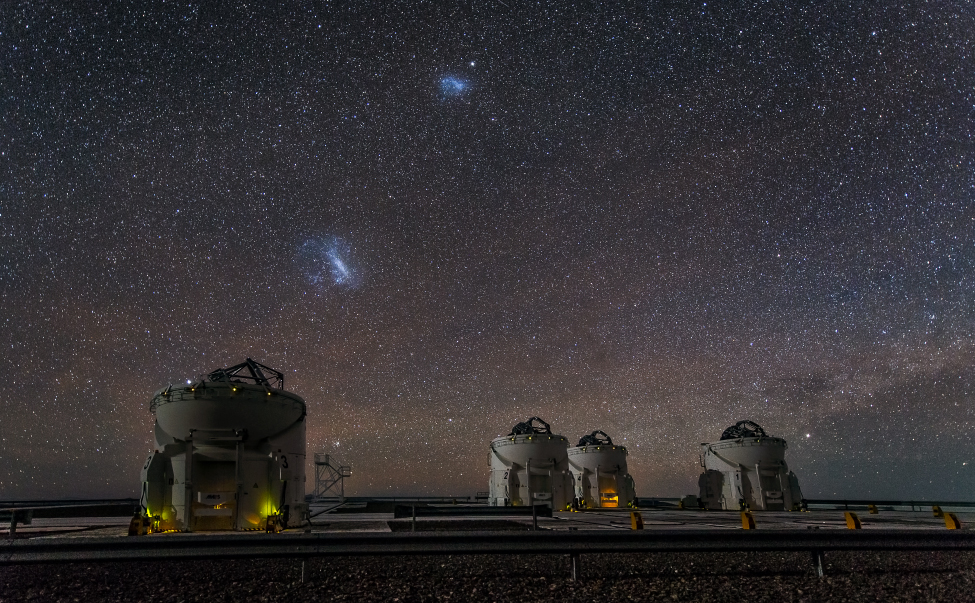
Figure 28.26 Here, the two small galaxies we call the Large Magellanic Cloud and Small Magellanic Cloud can be seen above the auxiliary telescopes for the Very Large Telescope Array on Cerro Paranal in Chile. You can see from the number of stars that are visible that this is a very dark site for doing astronomy. (credit: ESO/J. Colosimo)
図28.26 チリのセロ・パラナルで、VLT望遠鏡群の補助望遠鏡の上に、大マゼラン雲と小マゼラン雲という二つの小銀河が見える。見える星の多さから、天体観測に適した、非常に暗い場所であることがわかる。(クレジット:ESO/J. Colosimo)
This result, along with a variety of other experiments, leads us to conclude that the types of matter we are familiar with can make up only a tiny portion of the dark matter. Another possibility is that dark matter is composed of some new type of particle—one that researchers are now trying to detect in laboratories here on Earth (see The Big Bang).
英語のヒント
この結果と、さまざまな他の実験を合わせると、私たちがよく知る種類の物質は、ダークマターのごく一部しか占められないと結論される。別の可能性は、何か新しい種類の粒子からできているというものだ。研究者は今、地球の実験室で、その粒子を検出しようとしている。「ビッグバン」を参照しよう。
The kinds of dark matter particles that astronomers and physicists have proposed generally fall into two main categories: hot and cold dark matter. The terms hot and cold don’t refer to true temperatures, but rather to the average velocities of the particles, analogous to how we might think of particles of air moving in your room right now. In a cold room, the air particles move more slowly on average than in a warm room.
英語のヒント
天文学者や物理学者が提案してきたダークマター粒子は、大きく二種類に分かれる。ホットダークマターとコールドダークマターである。「熱い」「冷たい」という言葉は、実際の温度を直接指すのではなく、粒子の平均速度を指す。これは、今、部屋の空気の粒子がどう動いているかを考えるのに似ている。冷たい部屋では、暖かい部屋に比べ、空気の粒子は平均してゆっくり動く。
In the early universe, if dark matter particles easily moved fast and far compared to the lumps and bumps of ordinary matter that eventually became galaxies and larger structures, we call those particles hot dark matter. In that case, smaller lumps and bumps would be smeared out by the particle motions, meaning fewer small galaxies would get made.
英語のヒント
初期宇宙で、後に銀河やより大きな構造になる普通の物質の塊や凹凸に比べ、ダークマター粒子が簡単に速く、遠くまで動いたなら、その粒子をホットダークマターと呼ぶ。その場合、小さい塊や凹凸は粒子の運動によってならされ、小さな銀河は、あまり作られなくなる。
On the other hand, if the dark matter particles moved slowly and covered only small distances compared to the sizes of the lumps in the early universe, we call that cold dark matter. Their slow speeds and energy would mean that even the smaller lumps of ordinary matter would survive to grow into small galaxies. By looking at when galaxies formed and how they evolve, we can use observations to distinguish between the two kinds of dark matter. So far, observations seem most consistent with models based on cold dark matter.
英語のヒント
反対に、ダークマター粒子がゆっくり動き、初期宇宙の塊の大きさに比べて、わずかな距離しか移動しなかったなら、コールドダークマターと呼ぶ。速度とエネルギーが低ければ、小さい普通の物質の塊も生き残り、小さな銀河へ成長できる。銀河がいつ形成され、どう進化するかを観測すれば、この二種類を区別できる。これまでのところ、観測はコールドダークマターに基づくモデルと、最もよく一致しているようである。
Solving the dark matter problem is one of the biggest challenges facing astronomers. After all, we can hardly understand the evolution of galaxies and the long-term history of the universe without understanding what its most massive component is made of. For example, we need to know just what role dark matter played in starting the higher-density “seeds” that led to the formation of galaxies. And since many galaxies have large halos made of dark matter, how does this affect their interactions with one another and the shapes and types of galaxies that their collisions create?
英語のヒント
ダークマター問題の解決は、天文学者が直面する最大の課題の一つである。なにしろ、宇宙の物質の中で最も大きな質量を占める成分が何からできているかを知らずに、銀河進化や宇宙の長い歴史を理解することは難しい。例えば、銀河形成へつながる高密度の「種」を作り始める際、ダークマターが、いったいどのような役割を果たしたのかを知る必要がある。また、多くの銀河はダークマターの大きなハローを持つが、それが銀河同士の相互作用や、衝突で作られる銀河の形・種類に、どう影響するのだろうか。
Astronomers armed with various theories are working hard to produce models of galaxy structure and evolution that take dark matter into account in just the right way. Even though we don’t know what the dark matter is, we do have some clues about how it affected the formation of the very first galaxies. As we will see in The Big Bang, careful measurements of the microwave radiation left over after the Big Bang have allowed astronomers to set very tight limits on the actual sizes of those early seeds that led to the formation of the large galaxies that we see in today’s universe. Astronomers have also measured the relative numbers and distances between galaxies and clusters of different sizes in the universe today. So far, most of the evidence seems to weigh heavily in favor of cold dark matter, and most current models of galaxy and large-scale structure formation use cold dark matter as their main ingredient.
英語のヒント
天文学者は、さまざまな理論を武器に、ダークマターを適切に取り入れた、銀河の構造と進化のモデルを懸命に作っている。ダークマターの正体はわからなくても、最初の銀河の形成にどう影響したかについては、手がかりがある。「ビッグバン」で見るように、ビッグバン後に残ったマイクロ波放射を精密に測定すると、現在の大きな銀河の形成につながった、初期の種の実際の大きさに、非常に厳しい制限を置ける。また、現在の宇宙について、大きさの異なる銀河や銀河団の相対的な数と、それらの間の距離も測定されている。これまでのところ、証拠の大半はコールドダークマターを強く支持するように見える。現在の銀河形成や大規模構造形成のモデルの多くは、主要な材料としてコールドダークマターを使っている。
As if the presence of dark matter—a mysterious substance that exerts gravity and outweighs all the known stars and galaxies in the universe but does not emit or absorb light—were not enough, there is an even more baffling and equally important constituent of the universe that has only recently been discovered: we have called it dark energy in parallel with dark matter. We will say more about it and explore its effects on the evolution of the universe in The Big Bang. For now, we can complete our inventory of the contents of the universe by noting that it appears that the entire universe contains some mysterious energy that pushes spacetime apart, taking galaxies and the larger structures made of galaxies along with it. Observations show that dark energy becomes more and more important relative to gravity as the universe ages. As a result, the expansion of the universe is accelerating, and this acceleration seems to be happening mostly since the universe was about half its current age.
英語のヒント
ダークマターだけでも十分な謎である。重力を及ぼし、宇宙で知られているすべての恒星や銀河を上回る質量を持ちながら、光を放出も吸収もしない物質なのだから。ところが、最近になって、さらに不可解で、同じくらい重要な宇宙の成分が発見された。ダークマターに倣い、ダークエネルギーと呼んでいる。「ビッグバン」で、さらに詳しく説明し、宇宙進化への影響を探る。今は、宇宙の中身の目録を完成させるため、宇宙全体に、時空を押し広げ、銀河や銀河からなる大きな構造も一緒に引き離す、謎のエネルギーがあるらしいと述べておこう。観測によると、宇宙が年を取るほど、ダークエネルギーは重力に比べてますます重要になる。その結果、宇宙膨張は加速している。この加速は主に、宇宙の年齢が現在の約半分になったころから起きているようである。
What we see when we peer out into the universe—the light from trillions of stars in hundreds of billions of galaxies wrapped in intricate veils of gas and dust—is therefore actually only a sprinkling of icing on top of the cake: as we will see in The Big Bang, when we look outside galaxies and clusters of galaxies at the universe as a whole, astronomers find that for every gram of luminous normal matter, such as protons, neutrons, electrons, and atoms in the universe, there are about 4 grams of nonluminous normal matter, mainly intergalactic hydrogen and helium. There are about 27 grams of dark matter, and the energy equivalent (remember Einstein’s famous E = mc2) of about 68 grams of dark energy. Dark matter, and (as we will see) even more so dark energy, are dramatic demonstrations of what we have tried to emphasize throughout this book: science is always a “progress report,” and we often encounter areas where we have more questions than answers.
英語のヒント
したがって、宇宙をのぞいたときに見えるものは、実はケーキの上にほんの少し振りかけた砂糖衣にすぎない。何千億もの銀河にある何兆もの恒星の光と、それらを複雑に包むガスや塵の薄布が、その砂糖衣なのである。「ビッグバン」で見るように、銀河や銀河団の外側へも目を向け、宇宙全体を調べると、陽子、中性子、電子、原子などの光る通常物質1 gに対し、光らない通常物質が約4 gあるとわかる。主に銀河間の水素とヘリウムである。さらに、ダークマターが約27 gあり、約68 gに相当するエネルギーを持つダークエネルギーがある。アインシュタインの有名な式E = mc2を思い出そう。ダークマターは、そして、これから見るように、ダークエネルギーはさらに強く、この本で繰り返してきたことを示す。科学はいつでも「途中経過の報告」であり、答えより問いの多い領域に、私たちはしばしば出会うのである。
Let’s next put together all these clues to trace the life history of galaxies and large-scale structure in the universe. What follows is the current consensus, but research in this field is moving rapidly, and some of these ideas will probably be modified as new observations are made.
英語のヒント
次は、これらの手がかりを組み合わせ、宇宙の銀河と大規模構造の歴史をたどろう。これから述べるのは、現在広く共有されている理解である。ただし、この分野の研究は速く進んでおり、新しい観測によって、一部の考えは今後修正されるだろう。