第28章銀河の進化と分布The Evolution and Distribution of Galaxies
Spectra, Colors, and Shapesスペクトル、色、形
Astronomy is one of the few sciences in which all measurements must be made at a distance. Geologists can take samples of the objects they are studying; chemists can conduct experiments in their laboratories to determine what a substance is made of; archeologists can use carbon dating to determine how old something is. But astronomers can’t pick up and play with a star or galaxy. As we have seen throughout this book, if they want to know what galaxies are made of and how they have changed over the lifetime of the universe, they must decode the messages carried by the small number of photons that reach Earth.
英語のヒント
天文学は、あらゆる測定を離れた場所から行わなければならない、数少ない科学の一つである。地質学者は研究対象の試料を採集できる。化学者は実験室で実験し、物質が何からできているかを調べられる。考古学者は炭素年代測定によって、ある物がどれほど古いかを調べられる。だが、天文学者は恒星や銀河を手に取って、あれこれ試すことはできない。この本全体を通じて見てきたように、銀河が何からできていて、宇宙の一生の間にどう変わったかを知りたければ、地球に届くわずかな数の光子が運ぶメッセージを読み解かなければならない。
Fortunately (as you have learned) electromagnetic radiation is a rich source of information. The distance to a galaxy is derived from its redshift (how much the lines in its spectrum are shifted to the red because of the expansion of the universe). The conversion of redshift to a distance depends on certain properties of the universe, including the value of the Hubble constant and how much mass it contains. We will describe the currently accepted model of the universe in The Big Bang. For the purposes of this chapter, it is enough to know that the current best estimate for the age of the universe is 13.8 billion years. In that case, if we see an object that emitted its light 6 billion years ago, we are seeing it as it was when the universe was almost 8 billion years old. If we see something that emitted its light 13 billion years ago, we are seeing it as it was when the universe was less than a billion years old. So astronomers measure a galaxy’s redshift from its spectrum, use the Hubble constant plus a model of the universe to turn the redshift into a distance, and use the distance and the constant speed of light to infer how far back in time they are seeing the galaxy—the look-back time.
英語のヒント
幸い、すでに学んだように、電磁放射は豊かな情報源である。銀河までの距離は、その赤方偏移から求められる。赤方偏移とは、宇宙膨張によって、スペクトル中の線がどれだけ赤い側へずれているかである。赤方偏移を距離に換算するには、ハッブル定数の値や、宇宙がどれほどの質量を含むかなど、宇宙のいくつかの性質が関わる。現在受け入れられている宇宙モデルは、「ビッグバン」で説明する。この章では、宇宙の年齢の最良の推定値が、現在138億年であると知っていれば十分である。60億年前に光を放出した天体を見ているなら、宇宙の年齢が80億年近くのころの姿を見ていることになる。130億年前に光を放出した天体なら、宇宙がまだ10億歳に達していなかったころの姿である。そこで天文学者は、スペクトルから銀河の赤方偏移を測定し、ハッブル定数と宇宙モデルを使って、それを距離に換算する。さらに、その距離と一定の光速を使い、どれほど過去の銀河を見ているか、つまりルックバック時間を推定する。
In addition to distance and look-back time, studies of the Doppler shifts of a galaxy’s spectral lines can tell us how fast the galaxy is rotating and hence how massive it is (as explained in Galaxies). Detailed analysis of such lines can also indicate the types of stars that inhabit a galaxy and whether it contains large amounts of interstellar matter.
英語のヒント
銀河のスペクトル線のドップラー偏移を調べると、距離やルックバック時間だけでなく、銀河の回転速度もわかる。そこから、「銀河」で説明したように、銀河の質量も求められる。こうした線を詳しく分析すると、銀河にどのような種類の恒星があるかや、大量の星間物質を含むかどうかもわかる。
Unfortunately, many galaxies are so faint that collecting enough light to produce a detailed spectrum is currently impossible. Astronomers thus have to use a much rougher guide to estimate what kinds of stars inhabit the faintest galaxies—their overall colors. Look again at Figure 28.2 and notice that some of the galaxies are very blue and others are reddish-orange. Now remember that hot, luminous blue stars are very massive and have lifetimes of only a few million years. If we see a galaxy where blue colors dominate, we know that it must have many hot, luminous blue stars, and that star formation must have taken place in the few million years before the light left the galaxy. In a yellow or red galaxy, on the other hand, the young, luminous blue stars that surely were made in the galaxy’s early bursts of star formation must have died already; it must contain mostly old yellow and red stars that last a long time in their main-sequence stages and thus typically formed billions of years before the light that we now see was emitted.
英語のヒント
残念ながら、暗すぎて、詳しいスペクトルを得るための光を十分に集められない銀河も多い。そこで天文学者は、最も暗い銀河にどのような星があるかを見積もるために、もっと粗い手がかり、すなわち銀河全体の色を使わなければならない。図28.2をもう一度見て、非常に青い銀河も、赤みがかったオレンジ色の銀河もあることに注目しよう。高温で明るい青い星は非常に大質量で、寿命がわずか数百万年しかないことを思い出そう。青色が目立つ銀河には、高温で明るい青い星が多数あるはずであり、見ている光がその銀河を出る前の数百万年の間に、星形成が起きたはずである。反対に、黄色や赤い銀河では、初期の活発な星形成で確かに作られたはずの、若く明るい青い星は、すでに死んでいるはずだ。主に残るのは、主系列段階に長くとどまる、古い黄色や赤い星である。これらは普通、現在見ている光が放出される数十億年前に形成された星々である。
Another important clue to the nature of a galaxy is its shape. Spiral galaxies can be distinguished from elliptical galaxies by shape. Observations show that spiral galaxies contain young stars and large amounts of interstellar matter, while elliptical galaxies have mostly old stars and very little or no star formation. Elliptical galaxies turned most of their interstellar matter into stars many billions of years ago, while star formation has continued until the present day in spiral galaxies.
英語のヒント
銀河の性質を知るもう一つの重要な手がかりは、形である。形によって、渦巻銀河と楕円銀河を区別できる。観測によると、渦巻銀河は若い恒星と大量の星間物質を含むのに対し、楕円銀河の恒星は大半が古く、星形成はほとんど、あるいはまったく起きていない。楕円銀河は、何十億年も前に星間物質の大半を恒星へ変えた。一方、渦巻銀河では、現在まで星形成が続いている。
If we can count the number of galaxies of each type during each epoch of the universe, it will help us understand how the pace of star formation changes with time. As we will see later in this chapter, galaxies in the distant universe—that is, young galaxies—look very different from the older galaxies that we see nearby in the present-day universe.
英語のヒント
宇宙の各時代について、種類ごとの銀河の数を数えられれば、星形成の速さが時間とともにどう変化するかを理解する助けになる。この章の後半で見るように、遠方の宇宙の銀河、つまり若い銀河の姿は、現在の宇宙で近くに見える、年を経た銀河とは大きく異なる。
The First Generation of Stars最初の世代の恒星
In addition to looking at the most distant galaxies we can find, astronomers look at the oldest stars (what we might call the fossil record) of our own Galaxy to probe what happened in the early universe. Since stars are the source of nearly all the light emitted by galaxies, we can learn a lot about the evolution of galaxies by studying the stars within them. What we find is that nearly all galaxies contain at least some very old stars. For example, our own Galaxy contains globular clusters with stars that are at least 13 billion years old, and some may be even older than that. Therefore, if we count the age of the Milky Way as the age of its oldest constituents, the Milky Way must have been born at least 13 billion years ago.
英語のヒント
天文学者は、見つけられる限り遠い銀河を調べるだけでなく、天の川銀河にある最も古い恒星も調べ、初期宇宙で何が起きたかを探る。いわば、宇宙の化石記録である。銀河が放出する光のほぼすべては恒星から来るため、その中の恒星を研究すれば、銀河進化について多くを学べる。わかってきたのは、ほぼすべての銀河が、少なくともいくらかの非常に古い恒星を含むということである。例えば、天の川銀河の球状星団には、少なくとも130億歳の恒星があり、さらに古いものもあるかもしれない。したがって、最も古い構成員の年齢を天の川銀河の年齢と数えるなら、天の川銀河は少なくとも130億年前に誕生したはずである。
As we will discuss in The Big Bang, astronomers have discovered that the universe is expanding, and have traced the expansion backward in time. In this way, they have discovered that the universe itself is only about 13.8 billion years old. Thus, it appears that at least some of the globular-cluster stars in the Milky Way must have formed less than a billion years after the expansion began.
英語のヒント
「ビッグバン」で詳しく述べるように、天文学者は宇宙が膨張していることを発見し、その膨張を時間的にさかのぼって調べた。その結果、宇宙そのものの年齢は約138億年にすぎないとわかった。したがって、天の川銀河の球状星団の恒星の少なくとも一部は、宇宙の膨張開始から10億年もたたないうちに形成されたらしい。
Several other observations also establish that star formation in the cosmos began very early. Astronomers have used spectra to determine the composition of some elliptical galaxies that are so far away that the light we see left them when the universe was only half as old as it is now. Yet these ellipticals contain old red stars, which must have formed billions of years earlier still.
英語のヒント
ほかにも、宇宙の星形成が非常に早く始まったことを裏付ける観測がある。天文学者はスペクトルを使って、現在見ている光がそこを出た時、宇宙が現在の半分の年齢にすぎなかったほど遠い楕円銀河の組成を調べた。それにもかかわらず、こうした楕円銀河は古い赤い星を含む。その星々は、さらに数十億年前に形成されていなければならない。
When we make computer models of how such galaxies evolve with time, they tell us that star formation in elliptical galaxies began less than a billion years or so after the universe started its expansion, and new stars continued to form for a few billion years. But then star formation apparently stopped. When we compare distant elliptical galaxies with ones nearby, we find that ellipticals have not changed very much since the universe reached about half its current age. We’ll return to this idea later in the chapter.
英語のヒント
こうした銀河が時間とともに進化するコンピューターモデルを作ると、楕円銀河の星形成は、宇宙の膨張が始まってからおよそ10億年以内に始まり、その後数十億年にわたって新しい星が作られ続けたことが示される。しかし、その後は、星形成が止まったようである。遠方の楕円銀河と近くの楕円銀河を比較すると、宇宙の年齢が現在の約半分に達して以来、楕円銀河はあまり変わっていないとわかる。この考えには、章の後半で戻る。
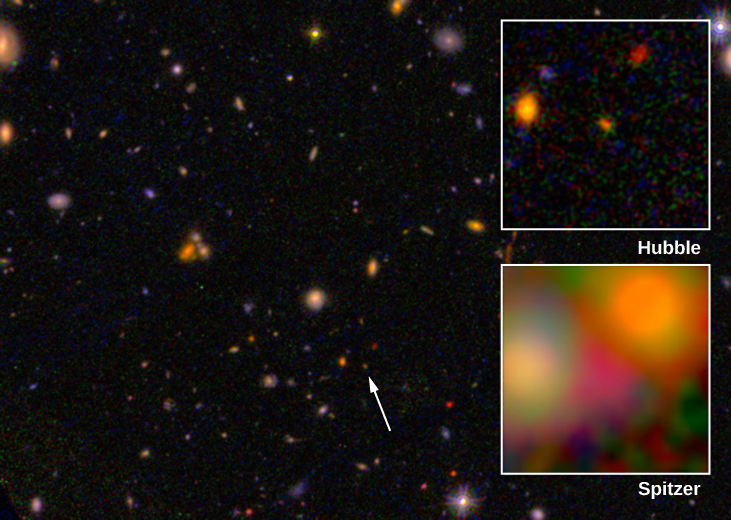
Observations of the most luminous galaxies take us even further back in time. Recently, as we have already noted, astronomers have discovered a few galaxies that are so far away that the light we see now left them less than a billion years or so after the beginning (Figure 28.3). Yet the spectra of some of these galaxies already contain lines of heavy elements, including carbon, silicon, aluminum, and sulfur. These elements were not present when the universe began but had to be manufactured in the interiors of stars. This means that when the light from these galaxies was emitted, an entire generation of stars had already been born, lived out their lives, and died—spewing out the new elements made in their interiors through supernova explosions—even before the universe was a billion years old. And it wasn’t just a few stars in each galaxy that got started this way. Enough had to live and die to affect the overall composition of the galaxy, in a way that we can still measure in the spectrum from far away.
英語のヒント
非常に光度の高い銀河を観測すれば、時間をさらにさかのぼれる。すでに述べたように、天文学者は近年、現在届いている光が、宇宙の始まりからおよそ10億年以内に放出されたほど遠い銀河を、いくつか発見した(図28.3)。それでも、一部の銀河のスペクトルには、炭素、ケイ素、アルミニウム、硫黄などの重元素の線が、すでに含まれている。これらの元素は宇宙の始まりには存在せず、恒星の内部で作られたはずである。つまり、その銀河が光を放出した時には、ある世代の恒星がすでに生まれ、一生を送り、死を迎えていたことになる。内部で作った新しい元素を、超新星爆発でまき散らしていたのである。それも、宇宙が10億歳になる前のことだ。しかも、このように出発したのは、各銀河にほんの数個の星があった、という程度ではない。遠方から届くスペクトルでも測定できるほど、銀河全体の組成を変えるには、十分な数の星が生まれ、死んでいなければならなかった。
Very Distant Galaxy.非常に遠い銀河
credit: modification of work by I. Labbé (Leiden University), NASA/ESA/JPL-Caltech · JPL image use policy
Figure 28.3 This image was made with the Hubble Space Telescope and shows the field around a luminous galaxy at a redshift z = 8.68, which corresponds to 13.2 billion light years. This means that we are seeing this galaxy as it appeared about 13.2 billion years ago. The galaxy itself is indicated by the arrow. Long exposures in the far-red and infrared wavelengths were combined to make the image, and additional infrared exposures with the Spitzer Space Telescope, which has lower spatial resolution than the Hubble (lower inset), show the redshifted light of normal stars. The very distant galaxy was detected because it has a strong emission line of hydrogen. This line is produced in regions where the formation of hot, young stars is taking place. (credit: modification of work by I. Labbé (Leiden University), NASA/ESA/JPL-Caltech)
図28.3 ハッブル宇宙望遠鏡による画像で、赤方偏移z = 8.68、132億光年に対応する明るい銀河と、その周辺を示す。つまり、私たちは約132億年前の銀河の姿を見ている。その銀河自体は矢印で示されている。赤色の長波長側から赤外線にかけての長時間露光を組み合わせて画像を作った。ハッブルより空間分解能の低いスピッツァー宇宙望遠鏡による追加の赤外線撮影では、普通の恒星から来る、赤方偏移した光が見える(下の挿入図)。この遠い銀河を検出できたのは、水素の強い輝線があるからである。この線は、高温で若い恒星が形成されている領域で生じる。(クレジット:I. Labbé〔Leiden University〕、NASA/ESA/JPL-Caltechによる作品を改変)
Observations of quasars (galaxies whose centers contain an active supermassive black hole radiating a great deal of energy) support this conclusion. We can measure the abundances of heavy elements in the gas near quasar black holes (explained in Active Galaxies, Quasars, and Supermassive Black Holes). The composition of this gas in quasars that emitted their light 12.5 billion years ago is very similar to that of the Sun. This means that a large portion of the gas surrounding the black holes must have already been cycled through stars during the first 1.3 billion years after the expansion of the universe began. If we allow time for this cycling, then their first stars must have formed when the universe was only a few hundred million years old.
英語のヒント
クエーサーの観測も、この結論を支持する。クエーサーは、中心に活動中の超大質量ブラックホールを含み、その周囲から大量のエネルギーが放射される銀河である。「活動銀河・クエーサー・超大質量ブラックホール」で説明したように、クエーサーのブラックホールの近くにあるガスについて、重元素の存在量を測定できる。125億年前に光を放出したクエーサーでは、このガスの組成は太陽の組成と非常によく似ている。これは、宇宙の膨張が始まってから最初の13億年の間に、ブラックホールを囲むガスの大きな割合が、すでに恒星を経て循環していたことを意味する。この循環に必要な時間を考慮すると、最初の恒星は、宇宙がわずか数億歳のころに形成されたはずである。