第28章銀河の進化と分布The Evolution and Distribution of Galaxies
28.1 Observations of Distant Galaxies28.1 遠方の銀河の観測
Learning Objectives学習の目標
By the end of this section, you will be able to:
この節を学ぶと、次のことができるようになる。
Explain how astronomers use light to learn about distant galaxies long ago
遠方の銀河の遠い過去を知るために、天文学者が光をどう利用するかを説明する。
Discuss the evidence showing that the first stars formed when the universe was less than 10% of its current age
宇宙の年齢が現在の10%未満のころに、最初の恒星が形成されたことを示す証拠を論じる。
Describe the major differences observed between galaxies seen in the distant, early universe and galaxies seen in the nearby universe today
遠方の初期宇宙で見える銀河と、現在の近くの宇宙で見える銀河の、主な観測上の違いを説明する。
Let’s begin by exploring some techniques astronomers use to study how galaxies are born and change over cosmic time. Suppose you wanted to understand how adult humans got to be the way they are. If you were very dedicated and patient, you could actually observe a sample of babies from birth, following them through childhood, adolescence, and into adulthood, and making basic measurements such as their heights, weights, and the proportional sizes of different parts of their bodies to understand how they change over time.
英語のヒント
まず、銀河の誕生と、宇宙の歴史を通じた変化を調べるために、天文学者が使う方法を見てみよう。大人が、どのようにして現在の姿になったのかを理解したいとする。大きな熱意と忍耐があれば、何人もの赤ちゃんを誕生時から実際に観察し、子ども時代、思春期、成人期へと追い続けられるだろう。身長、体重、体の各部分の大きさの比率など、基本的な測定を続ければ、時間とともにどう変わるかを理解できる。
Unfortunately, we have no such possibility for understanding how galaxies grow and change over time: in a human lifetime—or even over the entire history of human civilization—individual galaxies change hardly at all. We need other tools than just patiently observing single galaxies in order to study and understand those long, slow changes.
英語のヒント
残念ながら、銀河が時間とともに成長し、変化する仕組みを理解するために、同じことはできない。人の一生どころか、人類文明の全歴史を通じても、個々の銀河はほとんど変化しない。長くゆっくりした変化を調べて理解するには、一つの銀河を辛抱強く観測するだけでなく、別の手段が必要である。
We do, however, have one remarkable asset in studying galactic evolution. As we have seen, the universe itself is a kind of time machine that permits us to observe remote galaxies as they were long ago. For the closest galaxies, like the Andromeda galaxy, the time the light takes to reach us is on the order of a few hundred thousand to a few million years. Typically not much changes over times that short—individual stars in the galaxy may be born or die, but the overall structure and appearance of the galaxy will remain the same. But we have observed galaxies so far away that we are seeing them as they were when the light left them more than 13 billion years ago.
英語のヒント
しかし、銀河の進化を研究するうえでは、すばらしい利点が一つある。すでに見たように、宇宙そのものが一種のタイムマシンになり、遠くの銀河の昔の姿を観測させてくれるのである。アンドロメダ銀河のような近い銀河では、光が私たちに届く時間は、およそ数十万年から数百万年である。普通、それほど短い時間には大した変化は起こらない。銀河内の個々の星は生まれたり死んだりしても、銀河全体の構造や外見は変わらないだろう。だが、130億年以上前に光がそこを出た時の姿を見ているほど、遠い銀河も観測されている。
By observing more distant objects, we look further back toward a time when both galaxies and the universe were young (Figure 28.2). For something similar on Earth, imagine your college doing a project where families of international students around the world are asked to send a daily newspaper from their hometown. Because there is a limited budget, the papers are sent via ordinary mail. The farther a town is from the United States, the longer it takes for the papers to get to the college, and the older the news is by the time it arrives.
英語のヒント
より遠い天体を観測するほど、銀河も宇宙も若かった時代へ、さらにさかのぼることになる(図28.2)。地球上で似た例を考えるために、大学が世界各地の留学生の家族へ、故郷の日刊紙を送ってもらう計画を立てたとしよう。予算が限られるので、新聞は普通郵便で送られる。町がアメリカから遠いほど、新聞が大学に届くまでに時間がかかり、届いた時にはニュースがそれだけ古くなっている。
Astronomical Time Travel.天文学のタイムトラベル
credit: NASA, ESA, STScI · CC BY 4.0
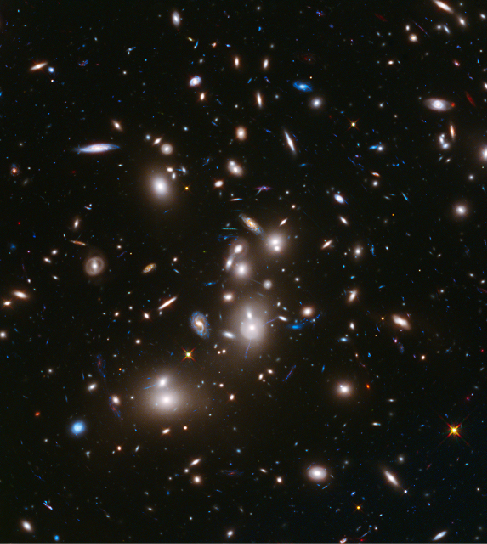
Figure 28.2 This true-color, long-exposure image, made during 70 orbits of Earth with the Hubble Space Telescope, shows a small area in the direction of the constellation Sculptor. The massive cluster of galaxies named Abell 2744 appears in the foreground of this image. It contains several hundred galaxies, and we are seeing them as they looked 3.5 billion years ago. The immense gravity in Abell 2744 acts as a gravitational lens (see the Astronomy Basics feature box on Gravitational Lensing later in this chapter) to warp space and brighten and magnify images of nearly 3000 distant background galaxies. The more distant galaxies (many of them quite blue) appear as they did more than 12 billion years ago, not long after the Big Bang. Blue galaxies were much more common in that earlier time than they are today. These galaxies appear blue because they are undergoing active star formation and making hot, bright blue stars. (credit: NASA, ESA, STScI)
図28.2 ハッブル宇宙望遠鏡が地球を70周する間に撮影した、この自然な色の長時間露光画像は、ちょうこくしつ座の方向の小さな領域を示す。手前に見えるのは、Abell 2744という大質量の銀河団である。数百個の銀河を含み、私たちは35億年前の姿を見ている。Abell 2744の巨大な重力は空間をゆがめ、重力レンズとして、背景にある約3000の遠方銀河の像を明るくし、拡大する。この章の後半の「天文学の基礎:重力レンズ」を参照しよう。さらに遠い銀河の多くはかなり青く見え、120億年以上前、ビッグバンからあまり時間がたっていないころの姿を示す。当時、青い銀河は現在よりはるかに多かった。活発な星形成によって、高温で明るい青い星が作られているため、銀河も青く見えるのである。(クレジット:NASA, ESA, STScI)
We can’t directly detect the changes over time in individual galaxies because they happen too slowly. But we can observe many galaxies at many different cosmic distances and, therefore, look-back times (how far back in time we are seeing the galaxy). If we can study a thousand very distant “baby” galaxies when the universe was 1 billion years old, and another thousand slightly closer “toddler” galaxies when it was 2 billion years old, and so on until the present 13.8-billion-year-old universe of mature “adult” galaxies near us today, then maybe we can piece together a coherent picture of how the whole ensemble of galaxies evolves over time. This allows us to reconstruct the “life story” of galaxies since the universe began, even though we can’t follow a single galaxy from infancy to old age.
英語のヒント
個々の銀河が時間とともに変わる様子は、変化が遅すぎるため、直接には検出できない。しかし、さまざまな距離にある多数の銀河を観測することで、さまざまなルックバック時間、つまり、どれほど過去の銀河を見ているかに対応する姿を観測できる。宇宙が10億歳の時の、非常に遠い「赤ちゃん」銀河を1000個、20億歳の時の、少し近い「幼児」の銀河を別に1000個、というように調べられるとしよう。そして、138億歳になった現在の宇宙で、近くの成熟した「大人」の銀河まで順にたどる。そうすれば、銀河全体の集団が時間とともにどう進化するかを、つじつまの合う一つの像につなぎ合わせられるかもしれない。この方法なら、一つの銀河を幼少期から老年期まで追いかけることはできなくても、宇宙の始まり以来の銀河の「生涯」を再構成できる。
Fortunately, there is no shortage of galaxies to study. Hold up your pinky at arm’s length: the part of the sky blocked by your fingernail contains about one million galaxies, layered farther and farther back in space and time. In fact, the sky is filled with galaxies, all of them, except for Andromeda and the Magellanic Clouds, too faint to see with the naked eye—more than 2 trillion (2000 billion) galaxies in the observable universe, each one with about 100 billion stars.
英語のヒント
幸い、研究する銀河には事欠かない。腕を伸ばして小指を立ててみよう。その爪で隠れる空の領域には、空間的にも時間的にも次々と遠くへ重なる、およそ100万個の銀河が含まれる。実際、空は銀河で埋め尽くされている。アンドロメダ銀河とマゼラン雲を除けば、どれも暗すぎて肉眼では見えない。観測可能な宇宙には2兆個、つまり20000億個を超える銀河があり、それぞれ約1000億個の恒星を含んでいる。
This cosmic time machine, then, lets us peer into the past to answer fundamental questions about where galaxies come from and how they got to be the way they are today. Astronomers call those galactic changes over cosmic time evolution, a word that recalls the work of Darwin and others on the development of life on Earth. But note that galaxy evolution refers to the changes in individual galaxies over time, while the kind of evolution biologists study is changes in successive generations of living organisms over time.
英語のヒント
この宇宙のタイムマシンによって、過去をのぞき、銀河がどこから来て、どう現在の姿になったのかという根本的な問いに答えられる。天文学者は、宇宙の歴史を通じた銀河の変化を「進化」と呼ぶ。この言葉は、地球の生命の発達に関するダーウィンらの研究を思い起こさせる。ただし、銀河進化が意味するのは、個々の銀河が時間とともに変わることである。生物学者が研究する進化は、生物の世代が次々と交代する中で生じる変化であり、その点が異なる。