第28章銀河の進化と分布The Evolution and Distribution of Galaxies
Active Galactic Nuclei and Galaxy Evolution活動銀河核と銀河進化
While galaxy mergers are huge, splashy events that completely reshape entire galaxies on scales of hundreds of thousands of light-years and can spark massive bursts of star formation, accreting black holes inside galaxies can also disturb and alter the evolution of their host galaxies. You learned in Active Galaxies, Quasars, and Supermassive Black Holes about a family of objects known as active galactic nuclei (AGN), all of them powered by supermassive black holes. If the black hole is surrounded by enough gas, some of the gas can fall into the black hole, getting swept up on the way into an accretion disk, a compact, swirling maelstrom perhaps only 100 AU across (the size of our solar system).
英語のヒント
銀河の合体は、何十万光年もの範囲で銀河全体の形をすっかり変え、大規模な星形成を引き起こしうる、巨大で派手な出来事である。しかし、銀河内部で物質を降着させるブラックホールも、母銀河の進化を乱し、変えることができる。「活動銀河・クエーサー・超大質量ブラックホール」では、活動銀河核AGNという天体の仲間を学んだ。そのすべてが、超大質量ブラックホールを動力源とする。ブラックホールが十分なガスに囲まれていれば、一部のガスはそこへ落ち込む。その途中でガスは降着円盤へ巻き込まれる。降着円盤は、幅がわずか100 AU、つまり太陽系ほどかもしれない、小さくまとまった大渦である。
Within the disk the gas heats up until it shines brilliantly even in X-rays, often outshining the rest of the host galaxy with its billions of stars. Supermassive black holes and their accretion disks can be violent and powerful places, with some material getting sucked into the black hole but even more getting shot out along huge jets perpendicular to the disk. These powerful jets can extend far outside the starry edge of the galaxy.
英語のヒント
円盤内のガスは加熱され、X線でさえ明るく輝くようになる。何十億もの恒星を持つ母銀河の残りの部分より、明るくなることもしばしばある。超大質量ブラックホールとその降着円盤は、激しく強大な力の働く場所になりうる。物質の一部はブラックホールへ吸い込まれるが、それ以上の物質が、円盤に垂直な巨大ジェットに沿って放出されることもある。この強力なジェットは、銀河の恒星がある領域の縁を、はるかに越えて伸びる。
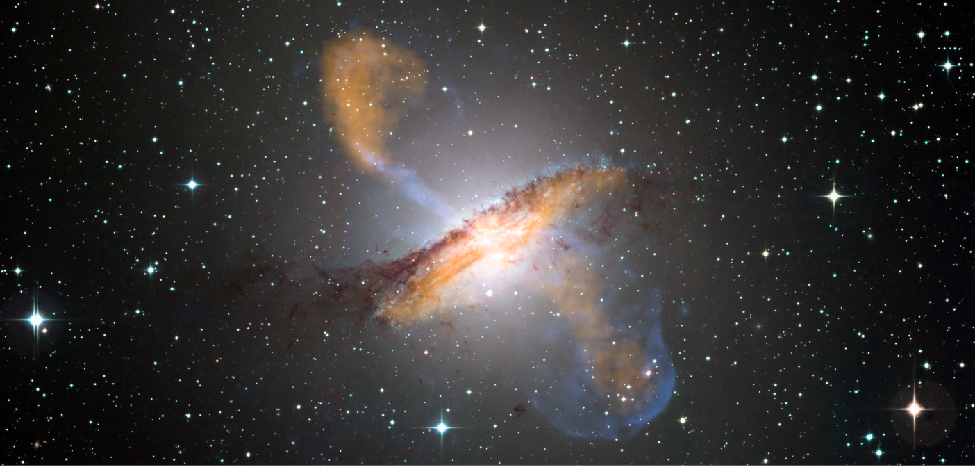
AGN were much more common in the early universe, in part because frequent mergers provided a fresh gas supply for the black hole accretion disks. Examples of AGN in the nearby universe today include the one in galaxy M87 (see Figure 27.7), which sports a jet of material shooting out from its nucleus at speeds close to the speed of light, and the one in the bright galaxy NGC 5128, also known as Centaurus A (see Figure 28.12).
英語のヒント
活動銀河核は、初期宇宙にはるかに多かった。その一因は、頻繁な合体が、ブラックホールの降着円盤へ新しいガスを供給したことにある。現在の近くの宇宙にある例としては、M87の活動銀河核がある(図27.7)。その中心核からは、光速に近い速さで物質を噴出するジェットが伸びている。また、ケンタウルス座Aとも呼ばれる明るい銀河NGC 5128にも、活動銀河核がある(図28.12)。
Composite View of the Galaxy Centaurus A.銀河ケンタウルス座Aの合成画像
credit: modification of work by ESO/WFI (Optical); MPIfR/ESO/APEX/A. Weiss et al. (Submillimeter); NASA/CXC/CfA/R.Kraft et al. (X-ray) · CC BY 4.0
Figure 28.12 This artificially colored image was made using data from three different telescopes: submillimeter radiation with a wavelength of 870 microns is shown in orange; X-rays are seen in blue; and visible light from stars is shown in its natural color. Centaurus A has an active galactic nucleus that is powering two jets, seen in blue and orange, reaching in opposite directions far outside the galaxy’s stellar disk, and inflating two huge lobes, or clouds, of hot X-ray-emitting gas. Centaurus is at a distance of 13 million light-years, making it one of the closest active galaxies we know. (credit: modification of work by ESO/WFI (Optical); MPIfR/ESO/APEX/A. Weiss et al. (Submillimeter); NASA/CXC/CfA/R.Kraft et al. (X-ray))
図28.12 この擬似カラー画像は、三つの望遠鏡のデータを使っている。波長870マイクロメートルのサブミリ波をオレンジ色、X線を青色で示し、恒星の可視光は自然な色で表している。ケンタウルス座Aの活動銀河核は、青とオレンジで見える二つのジェットを生み出す。ジェットは反対方向へ、銀河の恒星円盤のはるか外まで伸び、X線を放射する高温ガスの巨大なローブ、つまり雲を二つ膨らませている。ケンタウルス座Aまでの距離は1300万光年で、知られている中でも特に近い活動銀河の一つである。(クレジット:可視光はESO/WFI、サブミリ波はMPIfR/ESO/APEX/A. Weissほか、X線はNASA/CXC/CfA/R. Kraftほかによる作品を改変)
Many highly accelerated particles move with the jets in such galaxies. Along the way, the particles in the jets can plow into gas clouds in the interstellar medium, breaking them apart and scattering them. Since denser clouds of gas and dust are required for material to clump together to make stars, the disruption of the clouds can halt star formation in the host galaxy or cut it off before it even begins.
英語のヒント
こうした銀河のジェットには、強く加速された粒子が多数、乗って流れている。途中で、それらが星間物質のガス雲へ突っ込み、雲を壊して散らしてしまうことがある。物質がまとまって星を作るには、ガスや塵が密な雲を作る必要がある。そのため、雲の破壊は母銀河の星形成を止めたり、始まる前に断ってしまったりする。
In this way, quasars and other kinds of AGN can play a crucial role in the evolution of their galaxies. For example, there is growing evidence that the merger of two gas-rich galaxies not only produces a huge burst of star formation, but also triggers AGN activity in the core of the new galaxy. That activity, in turn, could then slow down or shut off the burst of star formation—which could have significant implications for the apparent shape, brightness, chemical content, and stellar components of the entire galaxy. Astronomers refer to that process as AGN feedback, and it is apparently an important factor in the evolution of most galaxies.
英語のヒント
このように、クエーサーやその他の活動銀河核は、銀河進化に決定的な役割を果たしうる。例えば、ガスに富む二つの銀河の合体は、大規模な星形成を引き起こすだけでなく、新しい銀河の中心で活動銀河核の活動も誘発する、という証拠が増えている。その活動は、今度は星形成の爆発的な進行を遅らせたり、止めたりするかもしれない。これは、銀河全体の見かけの形、明るさ、化学組成、恒星の構成に、大きな影響を及ぼしうる。天文学者は、この過程をAGNフィードバックと呼ぶ。どうやら、大半の銀河の進化にとって重要な要因のようである。
Key Concepts and Summary重要事項のまとめ
When galaxies of comparable size collide and coalesce we call it a merger, but when a small galaxy is swallowed by a much larger one, we use the term galactic cannibalism. Collisions play an important role in the evolution of galaxies. If the collision involves at least one galaxy rich in interstellar matter, the resulting compression of the gas will result in a burst of star formation, leading to a starburst galaxy. Mergers were much more common when the universe was young, and many of the most distant galaxies that we see are starburst galaxies that are involved in collisions. Active galactic nuclei powered by supermassive black holes in the centers of most galaxies can have major effects on the host galaxy, including shutting off star formation.
英語のヒント
同程度の大きさの銀河が衝突して一体化することを、合体と呼ぶ。小さな銀河が、はるかに大きな銀河にのみ込まれる場合は、銀河の共食いという言葉を使う。衝突は銀河進化に重要な役割を果たす。衝突する銀河の少なくとも一つが星間物質に富んでいれば、ガスの圧縮によって星形成が急増し、スターバースト銀河になる。宇宙が若いころには合体がはるかに多く、観測される最遠方の銀河の多くは、衝突中のスターバースト銀河である。大半の銀河の中心で、超大質量ブラックホールを動力源とする活動銀河核は、星形成の停止など、母銀河に大きな影響を与えうる。
galactic cannibalism
銀河の共食い
a process by which a larger galaxy strips material from or completely swallows a smaller one
大きい銀河が、小さい銀河から物質をはぎ取ったり、小さい銀河を丸ごとのみ込んだりする過程。
merger
合体
a collision between galaxies (of roughly comparable size) that combine to form a single new structure
ほぼ同じ大きさの銀河同士の衝突によって、両者が結び付き、一つの新しい構造を作ること。
starburst
スターバースト
a galaxy or merger of multiple galaxies that turns gas into stars much faster than usual
通常よりはるかに速いペースでガスを恒星へ変える銀河、または合体中の複数の銀河。