第28章銀河の進化と分布The Evolution and Distribution of Galaxies
Dark Matter in Clusters of Galaxies銀河団のダークマター
Galaxies in clusters also move around: they orbit the cluster’s center of mass. It is not possible for us to follow a galaxy around its entire orbit because that typically takes about a billion years. It is possible, however, to measure the velocities with which galaxies in a cluster are moving, and then estimate what the total mass in the cluster must be to keep the individual galaxies from flying out of the cluster. The observations indicate that the mass of the galaxies alone cannot keep the cluster together—some other gravity must again be present. The total amount of dark matter in clusters exceeds by more than ten times the luminous mass contained within the galaxies themselves, indicating that dark matter exists between galaxies as well as inside them.
英語のヒント
銀河団内の銀河も動いている。銀河団の重心を回っているのである。通常、一周には約10億年かかるので、軌道全体にわたって銀河を追いかけることはできない。しかし、銀河団内の銀河の速度を測り、個々の銀河が飛び出さないために必要な、銀河団の全質量を見積もることはできる。観測によると、銀河の質量だけでは銀河団を結び付けておけず、ここでも別の重力が必要になる。銀河団のダークマター総量は、銀河そのものに含まれる光る物質の質量の10倍を超える。このことは、ダークマターが銀河の内部だけでなく、銀河と銀河の間にも存在することを示している。
There is another approach we can take to measuring the amount of dark matter in clusters of galaxies. As we saw, the universe is expanding, but this expansion is not perfectly uniform, thanks to the interfering hand of gravity. Suppose, for example, that a galaxy lies outside but relatively close to a rich cluster of galaxies. The gravitational force of the cluster will tug on that neighboring galaxy and slow down the rate at which it moves away from the cluster due to the expansion of the universe.
英語のヒント
銀河団のダークマター量を測るには、別の方法もある。すでに見たように、宇宙は膨張しているが、重力が干渉するため、膨張は完全には一様ではない。例えば、豊かな銀河団の外側で、その比較的近くに一つの銀河があるとしよう。銀河団の重力は、その近隣の銀河を引っ張り、宇宙膨張によって銀河団から遠ざかる速さを遅くする。
Consider the Local Group of galaxies, lying on the outskirts of the Virgo Supercluster. The mass concentrated at the center of the Virgo Cluster exerts a gravitational force on the Local Group. As a result, the Local Group is moving away from the center of the Virgo Cluster at a velocity a few hundred kilometers per second slower than the Hubble law predicts. By measuring such deviations from a smooth expansion, astronomers can estimate the total amount of mass contained in large clusters.
英語のヒント
おとめ座超銀河団の外縁にある局所銀河群を考えよう。おとめ座銀河団の中心に集中した質量は、局所銀河群に重力を及ぼす。その結果、局所銀河群は、ハッブルの法則が予測するより毎秒数百km遅い速度で、おとめ座銀河団の中心から遠ざかっている。滑らかな膨張からの、こうしたずれを測ることで、天文学者は大きな銀河団の全質量を見積もれる。
There are two other very useful methods for measuring the amount of dark matter in galaxy clusters, and both of them have produced results in general agreement with the method of measuring galaxy velocities: gravitational lensing and X-ray emission. Let’s take a look at both.
英語のヒント
銀河団のダークマター量を測るには、さらに二つの非常に有用な方法がある。重力レンズとX線放射である。どちらも、銀河速度の測定による方法と、おおむね一致する結果を与えてきた。両方を見てみよう。
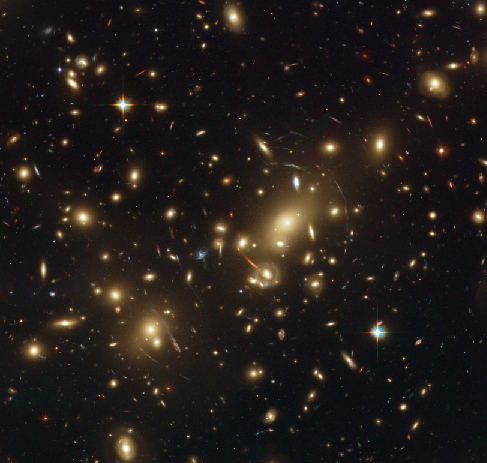
As Albert Einstein showed in his general theory of relativity, the presence of mass bends the surrounding fabric of spacetime. Light follows those bends, so very massive objects can bend light significantly. You saw examples of this in the Astronomy Basics feature box Gravitational Lensing in the previous section. Visible galaxies are not the only possible gravitational lenses. Dark matter can also reveal its presence by producing this effect. Figure 28.24 shows a galaxy cluster that is acting like a gravitational lens; the streaks and arcs you see on the picture are lensed images of more distant galaxies. Gravitational lensing is well enough understood that astronomers can use the many ovals and arcs seen in this image to calculate detailed maps of how much matter there is in the cluster and how that mass is distributed. The result from studies of many such gravitational lens clusters shows that, like individual galaxies, galaxy clusters contain more than ten times as much dark matter as luminous matter.
英語のヒント
アルベルト・アインシュタインが一般相対性理論で示したように、質量の存在は周囲の時空を曲げる。光はその曲がりに沿って進むので、非常に大きな質量の天体は、光を大きく曲げられる。前節の「天文学の基礎:重力レンズ」で、その例を見た。目に見える銀河だけでなく、ダークマターも同じ効果を起こして、自らの存在を示せる。図28.24は、重力レンズとして働く銀河団である。写真に見える筋や弧は、さらに遠方の銀河のレンズ像だ。重力レンズは十分よく理解されており、天文学者は、画像の多数の楕円形や弧を使って、銀河団にどれほどの物質があり、それがどう分布するかを、詳しい地図にできる。こうした重力レンズ銀河団を数多く調べた結果、個々の銀河と同じく、銀河団も、光る物質の10倍を超えるダークマターを含むことがわかった。
Cluster Abell 2218.銀河団Abell 2218
credit: modification of work by NASA, ESA, and Johan Richard (Caltech) · NASA media use guidelines
Figure 28.24 This view from the Hubble Space Telescope shows the massive galaxy cluster Abell 2218 at a distance of about 2 billion light-years. Most of the yellowish objects are galaxies belonging to the cluster. But notice the numerous long, thin streaks, many of them blue; those are the distorted and magnified images of even more distant background galaxies, gravitationally lensed by the enormous mass of the intervening cluster. By carefully analyzing the lensed images, astronomers can construct a map of the dark matter that dominates the mass of the cluster. (credit: modification of work by NASA, ESA, and Johan Richard (Caltech))
図28.24 ハッブル宇宙望遠鏡による、約20億光年先の大質量銀河団Abell 2218の画像。黄色みを帯びた天体の多くは、銀河団に属する銀河である。しかし、細長い筋が多数あり、その多くが青いことに注目しよう。これらは、手前の銀河団の巨大な質量による重力レンズで、ゆがみ、拡大された、さらに遠方の背景銀河の像である。レンズ像を詳しく分析すると、銀河団の質量の大半を占めるダークマターの分布図を作れる。(クレジット:NASA, ESA, Johan Richard〔Caltech〕による作品を改変)
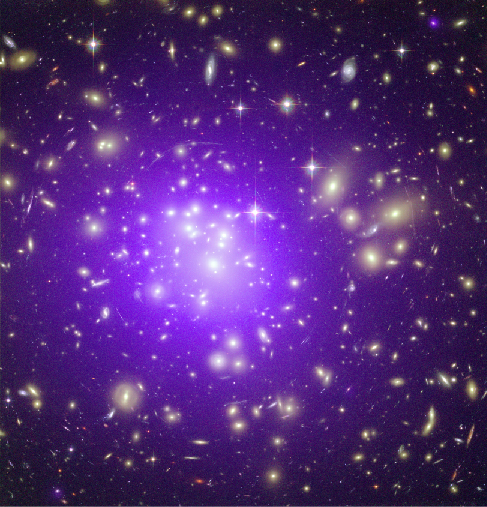
The third method astronomers use to detect and measure dark matter in galaxy clusters is to image them in the light of X-rays. When the first sensitive X-ray telescopes were launched into orbit around Earth in the 1970s and trained on massive galaxy clusters, it was quickly discovered that the clusters emit copious X-ray radiation (see Figure 28.25). Most stars do not emit much X-ray radiation, and neither does most of the gas or dust between the stars inside galaxies. What could be emitting the X-rays seen from virtually all massive galaxy clusters?
英語のヒント
銀河団のダークマターを検出し、測る第三の方法は、X線で画像を撮ることである。1970年代、最初の高感度X線望遠鏡が地球周回軌道へ打ち上げられ、大質量の銀河団へ向けられると、銀河団が大量のX線を放射することが、すぐにわかった(図28.25)。大半の恒星はX線をあまり放出せず、銀河内の星間のガスや塵も、大半はそうである。ほぼすべての大質量銀河団から見えるX線は、何が放出しているのだろうか。
It turns out that just as galaxies have gas distributed between their stars, clusters of galaxies have gas distributed between their galaxies. The particles in these huge reservoirs of gas are not just sitting still; rather, they are constantly moving, zooming around under the influence of the cluster’s immense gravity like mini planets around a giant sun. As they move and bump against each other, the gas heats up hotter and hotter until, at temperatures as high as 100 million K, it shines brightly at X-ray wavelengths. The more mass the cluster has, the faster the motions, the hotter the gas, and the brighter the X-rays. Astronomers calculate that the mass present to induce those motions must be about ten times the mass they can see in the clusters, including all the galaxies and all the gas. Once again, this is evidence that the galaxy clusters are seen to be dominated by dark matter.
英語のヒント
銀河の恒星同士の間にガスがあるのと同じように、銀河団でも、銀河同士の間にガスが分布しているとわかった。この巨大なガスの集まりの粒子は、静止しているわけではない。銀河団の強大な重力のもとで、巨大な太陽を回る小さな惑星のように、絶えず飛び回っている。粒子が動き、互いに衝突すると、ガスはますます熱くなる。やがて1億Kにも達すると、X線で明るく輝く。銀河団の質量が大きいほど、動きは速く、ガスは高温になり、X線も明るくなる。天文学者の計算では、その運動を引き起こすのに必要な質量は、銀河とガスをすべて含めた、見える質量の約10倍なければならない。ここでも、銀河団の大部分をダークマターが占めるという証拠が得られる。
X-Ray Image of a Galaxy Cluster.銀河団のX線画像
credit: modification of work by NASA/ESA/JPL-Caltech/Yale/CNRS · JPL image use policy
Figure 28.25 This composite image shows the galaxy cluster Abell 1689 at a distance of 2.3 billion light-years. The finely detailed views of the galaxies, most of them yellow, are in visible and near-infrared light from the Hubble Space Telescope, while the diffuse purple haze shows X-rays as seen by Chandra X-ray Observatory. The abundant X-rays, the gravitationally lensed images (thin curving arcs) of background galaxies, and the measured velocities of galaxies in the clusters all show that the total mass of Abell 1689—most of it dark matter—is about 1015 solar masses. (credit: modification of work by NASA/ESA/JPL-Caltech/Yale/CNRS)
図28.25 23億光年先の銀河団Abell 1689の合成画像。主に黄色で見える銀河の細かな姿は、ハッブル宇宙望遠鏡の可視光・近赤外線画像による。淡く広がる紫のもやは、チャンドラX線天文台が捉えたX線である。大量のX線、背景銀河の重力レンズ像である細い曲がった弧、そして銀河団内の銀河の実測速度は、いずれも、Abell 1689の全質量が約1015太陽質量で、その大半がダークマターであることを示す。(クレジット:NASA/ESA/JPL-Caltech/Yale/CNRSによる作品を改変)