Describe the challenges of determining the Galaxy’s structure from our vantage point within it
天の川銀河の内側という私たちの観測位置から、その構造を明らかにする難しさを説明する。
Identify the main components of the Galaxy
天の川銀河の主要な構成要素を挙げる。
The Milky Way Galaxy surrounds us, and you might think it is easy to study because it is so close. However, the very fact that we are embedded within it presents a difficult challenge. Suppose you were given the task of mapping New York City. You could do a much better job from a helicopter flying over the city than you could if you were standing in Times Square. Similarly, it would be easier to map our Galaxy if we could only get a little way outside it, but instead we are trapped inside and way out in its suburbs—far from the galactic equivalent of Times Square.
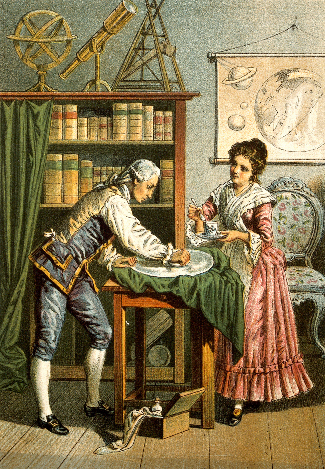
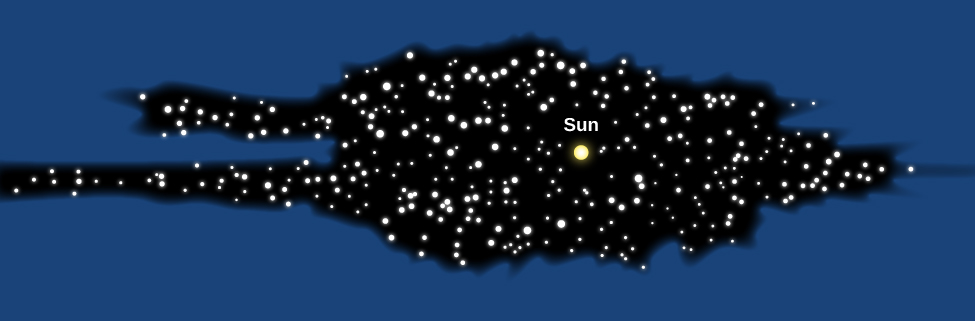
In 1785, William Herschel (Figure 25.2) made the first important discovery about the architecture of the Milky Way Galaxy. Using a large reflecting telescope that he had built, William and his sister Caroline counted stars in different directions of the sky. They found that most of the stars they could see lay in a flattened structure encircling the sky, and that the numbers of stars were about the same in any direction around this structure. Herschel therefore concluded that the stellar system to which the Sun belongs has the shape of a disk or wheel (he might have called it a Frisbee except Frisbees hadn’t been invented yet), and that the Sun must be near the hub of the wheel (Figure 25.3).
William Herschel (1738–1822) and Caroline Herschel (1750–1848).ウィリアム・ハーシェル(1738〜1822年)とカロライン・ハーシェル(1750〜1848年)
credit: modification of work by the Wellcome Library · CC BY 4.0
Figure 25.2 William Herschel was a German musician who emigrated to England and took up astronomy in his spare time. He discovered the planet Uranus, built several large telescopes, and made measurements of the Sun’s place in the Galaxy, the Sun’s motion through space, and the comparative brightnesses of stars. This painting shows William and his sister Caroline polishing a telescope lens. (credit: modification of work by the Wellcome Library)
To understand why Herschel reached this conclusion, imagine that you are a member of a band standing in formation during halftime at a football game. If you count the band members you see in different directions and get about the same number each time, you can conclude that the band has arranged itself in a circular pattern with you at the center. Since you see no band members above you or underground, you know that the circle made by the band is much flatter than it is wide.
Figure 25.3 Herschel constructed this cross section of the Galaxy by counting stars in various directions.
図25.3 ハーシェルは、さまざまな方向の星を数えて、銀河のこの断面図を作った。
We now know that Herschel was right about the shape of our system, but wrong about where the Sun lies within the disk. As we saw in Between the Stars: Gas and Dust in Space, we live in a dusty Galaxy. Because interstellar dust absorbs the light from stars, Herschel could see only those stars within about 6000 light-years of the Sun. Today we know that this is a very small section of the entire 100,000-light-year-diameter disk of stars that makes up the Galaxy.