第6章天文学の観測装置Astronomical Instruments
Radio Interferometry電波干渉計法
As we discussed earlier, a telescope’s ability to show us fine detail (its resolution) depends upon its aperture, but it also depends upon the wavelength of the radiation that the telescope is gathering. The longer the waves, the harder it is to resolve fine detail in the images or maps we make. Because radio waves have such long wavelengths, they present tremendous challenges for astronomers who need good resolution. In fact, even the largest radio dishes on Earth, operating alone, cannot make out as much detail as the typical small visible-light telescope used in a college astronomy lab. To overcome this difficulty, radio astronomers have learned to sharpen their images by linking two or more radio telescopes together electronically. Two or more telescopes linked together in this way are called an interferometer.
英語のヒント
すでに述べたように、望遠鏡が細部を見せる能力、すなわち分解能は口径に依存するが、集めている放射の波長にも依存する。波長が長いほど、作った画像や地図の細部を見分けることは難しくなる。電波の波長はとても長いため、高い分解能を必要とする天文学者にとって、大きな課題になる。実際、地球上で最大の電波反射鏡でさえ、単独で使うと、大学の天文学実習室にあるような小さな可視光望遠鏡ほどには細部を見分けられない。この困難を乗り越えるため、電波天文学者は、2基以上の電波望遠鏡を電子的に結び、画像を鮮明にする方法を開発した。このように結び付けた2基以上の望遠鏡を、干渉計という。
“Interferometer” may seem like a strange term because the telescopes in an interferometer work cooperatively; they don’t “interfere” with each other. Interference, however, is a technical term for the way that multiple waves interact with each other when they arrive in our instruments, and this interaction allows us to coax more detail out of our observations. The resolution of an interferometer depends upon the separation of the telescopes, not upon their individual apertures. Two telescopes separated by 1 kilometer provide the same resolution as would a single dish 1 kilometer across (although they are not, of course, able to collect as much radiation as a radio-wave bucket that is 1 kilometer across).
英語のヒント
「干渉計」という名前は、奇妙に思えるかもしれない。英語のinterfereには「邪魔をする」という意味があるが、干渉計の望遠鏡は協力して働き、互いの邪魔はしないからである。しかし物理学のinterference、つまり干渉は、複数の波が装置に到達したとき、互いに作用し合う仕方を表す専門用語である。その相互作用を使うことで、観測からさらに細かな情報を引き出せる。干渉計の分解能は、個々の望遠鏡の口径ではなく、望遠鏡同士の距離によって決まる。1キロメートル離れた2基の望遠鏡は、直径1キロメートルの単一反射鏡と同じ分解能を与える。もちろん、直径1キロメートルの「電波のバケツ」ほど多くの放射を集めることはできない。
To get even better resolution, astronomers combine a large number of radio dishes into an interferometer array. In effect, such an array works like a large number of two-dish interferometers, all observing the same part of the sky together. Computer processing of the results permits the reconstruction of a high-resolution radio image. The most extensive such instrument in the United States is the National Radio Astronomy Observatory’s Jansky Very Large Array (VLA) near Socorro, New Mexico. It consists of 27 movable radio telescopes (on railroad tracks), each having an aperture of 25 meters, spread over a total span of about 36 kilometers. By electronically combining the signals from all of its individual telescopes, this array permits the radio astronomer to make pictures of the sky at radio wavelengths comparable to those obtained with a visible-light telescope, with a resolution of about 1 arcsecond.
英語のヒント
さらに高い分解能を得るため、天文学者は多数の電波反射鏡を組み合わせて干渉計アレイを作る。実質的に、このアレイは、同じ空の領域を一緒に観測する多数の2素子干渉計のように働く。結果をコンピューターで処理すると、高分解能の電波画像を再構成できる。米国で最も広がりのあるそのような装置は、ニューメキシコ州ソコロ近郊にある、米国国立電波天文台のジャンスキー超大型干渉電波望遠鏡群VLAである。鉄道のレール上を移動できる、口径25メートルの電波望遠鏡27基で構成され、全体は約36キロメートルにわたって広がる。各望遠鏡からの信号をすべて電子的に合わせることで、このアレイは、電波天文学者が可視光望遠鏡で得るものに匹敵する空の画像を、電波の波長で作れるようにする。分解能は約1秒角である。
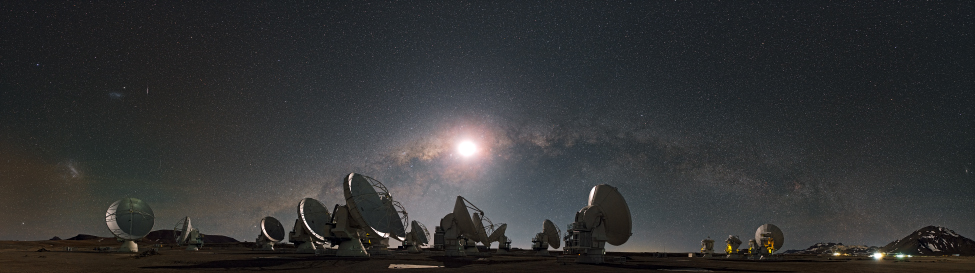
The Atacama Large Millimeter/submillimeter array (ALMA) in the Atacama Desert of Northern Chile (Figure 6.20), at an altitude of 16,400 feet, consists of 12 7-meter and 54 12-meter telescopes, and can achieve baselines up to 16 kilometers. Since it became operational in 2013, it has made observations at resolutions down to 6 milliarcseconds (0.006 arcseconds), a remarkable achievement for radio astronomy.
英語のヒント
チリ北部のアタカマ砂漠、標高1万6400フィートにあるアタカマ大型ミリ波サブミリ波干渉計ALMA(図6.20)は、7メートル望遠鏡12基と12メートル望遠鏡54基で構成され、最大16キロメートルの基線長を実現できる。2013年に運用を始めて以来、6ミリ秒角、すなわち0.006秒角にまで達する分解能で観測しており、電波天文学にとって目覚ましい成果である。
Atacama Large Millimeter/Submillimeter Array (ALMA).アタカマ大型ミリ波サブミリ波干渉計(ALMA)。
credit: ESO/S. Guisard · CC BY 4.0
Figure 6.20 Located in the Atacama Desert of Northern Chile, ALMA currently provides the highest resolution for radio observations. (credit: ESO/S. Guisard)
図6.20 チリ北部のアタカマ砂漠にあるALMAは、現在、電波観測で最も高い分解能を提供している。(クレジット:ESO/S. Guisard)
Initially, the size of interferometer arrays was limited by the requirement that all of the dishes be physically wired together. The maximum dimensions of the array were thus only a few tens of kilometers. However, larger interferometer separations can be achieved if the telescopes do not require a physical connection. Astronomers, with the use of current technology and computing power, have learned to time the arrival of electromagnetic waves coming from space very precisely at each telescope and combine the data later. If the telescopes are as far apart as California and Australia, or as West Virginia and Crimea in Ukraine, the resulting resolution far surpasses that of visible-light telescopes.
英語のヒント
当初、干渉計アレイの大きさは、すべての反射鏡を実際にケーブルでつなぐ必要があることによって制限されていた。そのため、アレイの最大の広がりは数十キロメートルにとどまっていた。しかし望遠鏡同士を物理的につなぐ必要がなくなれば、さらに遠く離した干渉計を実現できる。天文学者は、現代の技術と計算能力を使い、各望遠鏡で宇宙からの電磁波の到着時刻を極めて正確に測り、後でデータを組み合わせる方法を開発した。カリフォルニアとオーストラリア、あるいはウェストバージニアとウクライナのクリミアほど遠く離れた望遠鏡を使えば、得られる分解能は可視光望遠鏡をはるかに上回る。
The United States operates the Very Long Baseline Array (VLBA), made up of 10 individual telescopes stretching from the Virgin Islands to Hawaii (Figure 6.21). The VLBA, completed in 1993, can form astronomical images with a resolution of 0.0001 arcseconds, permitting features as small as 10 astronomical units (AU) to be distinguished at the center of our Galaxy.
英語のヒント
米国は、バージン諸島からハワイまで広がる10基の望遠鏡からなる、超長基線アレイVLBAを運用している(図6.21)。1993年に完成したVLBAは、0.0001秒角の分解能で天体画像を作り、天の川銀河の中心にある、わずか10天文単位(AU)の構造を見分けることを可能にする。
Very Long Baseline Array.超長基線アレイ。

OpenStax / Rice University · CC BY 4.0
Figure 6.21 This map shows the distribution of 10 antennas that constitute an array of radio telescopes stretching across the United States and its territories.
図6.21 この地図は、米国本土とその領土にまたがる電波望遠鏡アレイを構成する、10基のアンテナの分布を示す。
Recent advances in technology have also made it possible to do interferometry at visible-light and infrared wavelengths. At the beginning of the twenty-first century, three observatories with multiple telescopes each began using their dishes as interferometers, combining their light to obtain a much greater resolution. In addition, a dedicated interferometric array was built on Mt. Wilson in California. Just as in radio arrays, these observations allow astronomers to make out more detail than a single telescope could provide.
英語のヒント
近年の技術進歩によって、可視光や赤外線の波長でも干渉計観測が可能になった。21世紀の初め、それぞれ複数の望遠鏡を持つ3か所の天文台が、その鏡を干渉計として使い始めた。光を組み合わせ、はるかに高い分解能を得るためである。さらに、カリフォルニアのウィルソン山には、干渉計観測専用のアレイが建設された。電波アレイと同じように、これらの観測でも、単独の望遠鏡より細かな構造を見分けられる。
Visible-Light Interferometers 可視光干渉計 |
||||
|---|---|---|---|---|
Longest Baseline (m) 最長基線長(m) |
Telescope Name 望遠鏡名 |
Location 所在地 |
Mirrors 鏡 |
Status 状況 |
| 400 | CHARA Array (Center for High Angular Resolution Astronomy) CHARAアレイ(高角分解能天文学センター) |
Mount Wilson, CA 米国カリフォルニア州、ウィルソン山 |
Six 1-m telescopes 1 m望遠鏡6基 |
Operational since 2004 2004年から稼働 |
| 200 | Very Large Telescope 超大型望遠鏡VLT |
Cerro Paranal, Chile チリ、パラナル山 |
Four 8.2-m telescopes 8.2 m望遠鏡4基 |
Completed 2000 2000年完成 |
| 85 | Keck I and II telescopes ケックI・II望遠鏡 |
Maunakea, HI 米国ハワイ州、マウナケア |
Two 10-m telescopes 10 m望遠鏡2基 |
Operated from 2001 to 2012 2001〜2012年に運用 |
| 22.8 | Large Binocular Telescope 大型双眼望遠鏡 |
Mount Graham, AZ 米国アリゾナ州、グラハム山 |
Two 8.4-m telescopes 8.4 m望遠鏡2基 |
First light 2004 ファーストライト:2004年 |
Radar Astronomyレーダー天文学
Radar is the technique of transmitting radio waves to an object in our solar system and then detecting the radio radiation that the object reflects back. The time required for the round trip can be measured electronically with great precision. Because we know the speed at which radio waves travel (the speed of light), we can determine the distance to the object or a particular feature on its surface (such as a mountain).
英語のヒント
レーダーは、太陽系内の天体へ電波を送り、その天体が反射して返す電波を検出する技術である。往復にかかる時間は、電子的な方法で極めて正確に測定できる。電波の進む速さ、すなわち光速はわかっているので、天体までの距離や、その表面にある山などの特定の構造までの距離を求められる。
Radar observations have been used to determine the distances to planets and how fast things are moving in the solar system (using the Doppler effect, discussed in the Radiation and Spectra chapter). Radar waves have played important roles in navigating spacecraft throughout the solar system. In addition, as will be discussed in later chapters, radar observations have determined the rotation periods of Venus and Mercury, probed tiny Earth-approaching asteroids, and allowed us to investigate the mountains and valleys on the surfaces of Mercury, Venus, Mars, and the large moons of Jupiter.
英語のヒント
レーダー観測は、惑星までの距離や、太陽系内のものがどれほど速く動いているかを求めるために使われてきた。速さの測定には、「放射とスペクトル」の章で述べたドップラー効果を利用する。レーダー波は、太陽系各地へ向かう探査機の航行にも重要な役割を果たしてきた。さらに、後の章で述べるように、金星と水星の自転周期を決め、地球に近づく小さな小惑星を調べ、水星、金星、火星、そして木星の大きな衛星の表面にある山や谷を研究することも、レーダー観測によって可能になった。
Any radio dish can be used as a radar telescope if it is equipped with a powerful transmitter as well as a receiver. For many years, the most spectacular facility in the world for radar astronomy was the 1000-foot (305-meter) telescope at Arecibo in Puerto Rico (Figure 6.22). The Arecibo telescope was too large to be pointed directly at different parts of the sky. Instead, it was constructed in a huge natural “bowl” (more than a mere dish) formed by several hills, and it was lined with reflecting metal panels. A limited ability to track astronomical sources was achieved by moving the receiver system, which was suspended on cables 100 meters above the surface of the bowl. Unfortunately, the telescope was seriously damaged in the powerful storms of 2020 and had to be decommissioned. An even larger (500-meter) radio telescope has recently gone into operation in China and is called the Five-hundred-meter Aperture Spherical Telescope (FAST).
英語のヒント
電波反射鏡は、受信機に加えて強力な送信機を備えれば、どれでもレーダー望遠鏡として使える。長年、レーダー天文学の世界で最も目を見張る施設は、プエルトリコのアレシボにあった、1000フィート、すなわち305メートル望遠鏡だった(図6.22)。アレシボ望遠鏡は大きすぎて、空のさまざまな方向へ直接向きを変えることができなかった。そこで、いくつかの丘が作る巨大な自然の「鉢」の中に建設し、その内面に金属の反射パネルを並べた。単なる浅い皿というより、大きな鉢である。鉢の表面から100メートル上にケーブルでつり下げた受信システムを動かすことで、限られた範囲ながら天体を追尾できた。残念ながら、2020年の激しい嵐で望遠鏡は大きく損傷し、廃止せざるを得なくなった。最近では、中国でさらに大きな500メートル電波望遠鏡が運用を始めた。500メートル口径球面電波望遠鏡、略してFASTと呼ばれている。
Largest Radio and Radar Dish.最大の電波・レーダー反射鏡。
Figure 6.22 The Arecibo Observatory in Puerto Rico was the largest and most powerful astronomical radar faculty in the world and was often featured in films. In November 2020 it collapsed, damaging the 300-meter diameter “dish” and destroying the radar transmitter and receiver. (credit: National Astronomy and Ionosphere Center, Cornell U., NSF)
図6.22 プエルトリコのアレシボ天文台は、世界最大で最も強力な天文学用レーダー施設であり、映画にもたびたび登場した。2020年11月に崩壊し、直径300メートルの「皿」が損傷し、レーダーの送受信装置が破壊された。(クレジット:National Astronomy and Ionosphere Center、コーネル大学、NSF)
In the 1930s, radio astronomy was pioneered by Karl G. Jansky and Grote Reber. A radio telescope is basically a radio antenna (often a large, curved dish) connected to a receiver. Significantly enhanced resolution can be obtained with interferometers, including interferometer arrays like the 27-element VLA and the 66-element ALMA. Expanding to very long baseline interferometers, radio astronomers can achieve resolutions as precise as 0.0001 arcsecond. Radar astronomy involves transmitting as well as receiving. The largest radio telescope dish currently in operation is the 500-meter FAST bowl in China."
1930年代、カール・G・ジャンスキーとグロート・リーバーが電波天文学を切り開いた。電波望遠鏡は基本的に、受信機につながった電波アンテナであり、多くは大きな曲面の反射鏡を持つ。干渉計を使えば、分解能を大幅に高められる。27基のVLAや66基のALMAのような干渉計アレイも含まれる。超長基線干渉計へと拡張することで、電波天文学者は0.0001秒角ほどの細かい分解能を達成できる。レーダー天文学では、受信だけでなく送信も行う。現在稼働している最大の電波望遠鏡の反射鏡は、中国にある500メートルの鉢状のFASTである。
interference
干渉
process in which waves mix together such that their crests and troughs can alternately reinforce and cancel one another
波が重なり合い、その山と谷が互いに強め合ったり打ち消し合ったりする現象。
interferometer
干渉計
instrument that combines electromagnetic radiation from one or more telescopes to obtain a resolution equivalent to what would be obtained with a single telescope with a diameter equal to the baseline separating the individual separate telescopes
一つまたは複数の望遠鏡からの電磁放射を組み合わせ、個々の望遠鏡を隔てる基線長に等しい直径の単一望遠鏡と、同等の分解能を得る装置。
interferometer array
干渉計アレイ
combination of multiple radio dishes to, in effect, work like a large number of two-dish interferometers
複数の電波反射鏡を組み合わせ、実質的に多数の2素子干渉計のように働かせるもの。
radar
レーダー
technique of transmitting radio waves to an object and then detecting the radiation that the object reflects back to the transmitter; used to measure the distance to, and motion of, a target object or to form images of it
対象へ電波を送り、対象が送信機へ向けて反射した放射を検出する技術。対象までの距離や運動を測ったり、その像を作ったりするために用いる。