第6章天文学の観測装置Astronomical Instruments
6.4 Radio Telescopes6.4 電波望遠鏡
Learning Objectives学習の目標
By the end of this section, you will be able to:
この節を学び終えると、次のことができるようになる。
Describe how radio waves from space are detected
宇宙からの電波をどのように検出するか説明する。
Identify the world’s largest radio telescopes
世界最大級の電波望遠鏡を挙げる。
Define the technique of interferometry and discuss the benefits of interferometers over single-dish telescopes
干渉計法という技術を定義し、単一鏡の望遠鏡と比べた干渉計の利点を論じる。
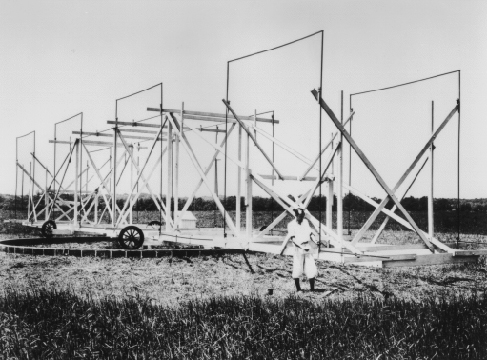
In addition to visible and infrared radiation, radio waves from astronomical objects can also be detected from the surface of Earth. In the early 1930s, Karl G. Jansky, an engineer at Bell Telephone Laboratories, was experimenting with antennas for long-range radio communication when he encountered some mysterious static—radio radiation coming from an unknown source (Figure 6.17). He discovered that this radiation came in strongest about four minutes earlier on each successive day and correctly concluded that since Earth’s sidereal rotation period (how long it takes us to rotate relative to the stars) is four minutes shorter than a solar day, the radiation must be originating from some region fixed on the celestial sphere. Subsequent investigation showed that the source of this radiation was part of the Milky Way Galaxy; Jansky had discovered the first source of cosmic radio waves.
英語のヒント
可視光や赤外線に加えて、天体からの電波も地上から検出できる。1930年代初め、ベル電話研究所の技術者カール・G・ジャンスキーは、長距離無線通信のアンテナ実験をしていたとき、不思議な雑音に遭遇した。未知の放射源から来る電波だった(図6.17)。彼は、その電波が最も強くなる時刻が、毎日約4分ずつ早まることを発見した。地球が恒星に対して一回転する恒星自転周期は太陽日より4分短い。したがって、この放射は天球上の固定された領域から来ているはずだと、正しく結論した。その後の調査で、放射源は天の川銀河の一部だとわかった。ジャンスキーは、宇宙から来る電波の最初の放射源を発見したのである。
First Radio Telescope.最初の電波望遠鏡。
OpenStax / Rice University · CC BY 4.0
Figure 6.17 This rotating radio antenna was used by Jansky in his serendipitous discovery of radio radiation from the Milky Way.
図6.17 この回転式電波アンテナは、ジャンスキーが天の川銀河からの電波を偶然発見した際に使ったものである。
In 1936, Grote Reber, who was an amateur astronomer interested in radio communications, used galvanized iron and wood to build the first antenna specifically designed to receive cosmic radio waves. Over the years, Reber built several such antennas and used them to carry out pioneering surveys of the sky for celestial radio sources; he remained active in radio astronomy for more than 30 years. During the first decade, he worked practically alone because professional astronomers had not yet recognized the vast potential of radio astronomy.
英語のヒント
1936年、無線通信に関心を持つアマチュア天文家グロート・リーバーは、亜鉛めっき鉄板と木材を使い、宇宙からの電波を受けることを目的にした最初のアンテナを造った。その後何年にもわたって同様のアンテナをいくつか製作し、天体の電波源を探す先駆的な全天調査を行った。彼は30年以上、電波天文学の第一線で活動を続けた。最初の10年間は、ほぼ独力で研究した。専門の天文学者が、電波天文学の大きな可能性にまだ気づいていなかったからである。
Detection of Radio Energy from Space宇宙からの電波エネルギーの検出
It is important to understand that radio waves cannot be “heard”: they are not the sound waves you hear coming out of the radio receiver in your home or car. Like light, radio waves are a form of electromagnetic radiation, but unlike light, we cannot detect them with our senses—we must rely on electronic equipment to pick them up. In commercial radio broadcasting, we encode sound information (music or a newscaster’s voice) into radio waves. These must be decoded at the other end and then turned back into sound by speakers or headphones.
英語のヒント
電波は「耳で聞く」ことができないと理解しておくことが大切である。電波は、自宅や車のラジオ受信機から聞こえる音波ではない。光と同じく電磁放射の一種だが、光とは違って人間の感覚では検出できず、電子機器で受けなければならない。商業ラジオ放送では、音楽やニュースキャスターの声などの音の情報を電波に載せる。受信側ではその情報を取り出し、スピーカーやヘッドホンで音へ戻す必要がある。
The radio waves we receive from space do not, of course, have music or other program information encoded in them. If cosmic radio signals were translated into sound, they would sound like the static you hear when scanning between stations. Nevertheless, there is information in the radio waves we receive—information that can tell us about the chemistry and physical conditions of the sources of the waves.
英語のヒント
もちろん、宇宙から届く電波には、音楽や放送番組の情報が載っているわけではない。宇宙の電波信号を音に変換すれば、ラジオで局と局の間を探っているときの雑音のように聞こえるだろう。それでも、受け取る電波には情報がある。放射源の化学的な性質や物理的な状態を教えてくれる情報である。
Just as vibrating charged particles can produce electromagnetic waves (see the Radiation and Spectra chapter), electromagnetic waves can make charged particles move back and forth. Radio waves can produce a current in conductors of electricity such as metals. An antenna is such a conductor: it intercepts radio waves, which create a feeble current in it. The current is then amplified in a radio receiver until it is strong enough to measure or record. Like your television or radio, receivers can be tuned to select a single frequency (channel). In astronomy, however, it is more common to use sophisticated data-processing techniques that allow thousands of separate frequency bands to be detected simultaneously. Thus, the astronomical radio receiver operates much like a spectrometer on a visible-light or infrared telescope, providing information about how much radiation we receive at each wavelength or frequency. After computer processing, the radio signals are recorded on magnetic disks for further analysis.
英語のヒント
振動する荷電粒子が電磁波を生み出せるのと同じように、電磁波は荷電粒子を往復運動させられる。「放射とスペクトル」の章も参照してほしい。電波は、金属などの電気の導体に電流を生じさせる。アンテナもそのような導体であり、電波を受け止めると内部にごく弱い電流が生じる。その電流は、測定や記録ができる強さになるまで、無線受信機で増幅される。テレビやラジオと同様に、受信機は特定の一つの周波数、つまりチャンネルを選ぶように調整できる。しかし天文学では、精密なデータ処理技術を使い、何千もの周波数帯を同時に検出するほうが一般的である。したがって天文学の電波受信機は、可視光・赤外線望遠鏡の分光器とよく似た働きをし、波長や周波数ごとにどれだけの放射を受け取るかという情報を与える。コンピューターで処理した後、電波信号は、さらに解析するために磁気ディスクへ記録される。
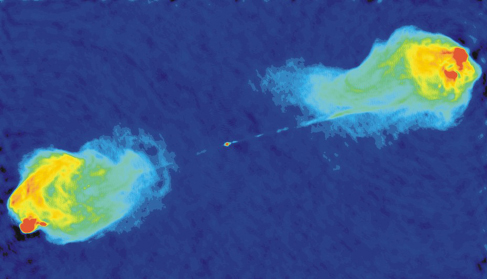
Radio waves are reflected by conducting surfaces, just as light is reflected from a shiny metallic surface, and according to the same laws of optics. A radio-reflecting telescope consists of a concave metal reflector (called a dish), analogous to a telescope mirror. The radio waves collected by the dish are reflected to a focus, where they can then be directed to a receiver and analyzed. Because humans are such visual creatures, radio astronomers often construct a pictorial representation of the radio sources they observe. Figure 6.18 shows such a radio image of a distant galaxy, where radio telescopes reveal vast jets and complicated regions of radio emissions that are completely invisible in photographs taken with light.
英語のヒント
電波は、光が光沢のある金属面で反射するのと同じように、電気を通す表面で反射し、同じ光学の法則に従う。反射式の電波望遠鏡は、光学望遠鏡の鏡に相当する、皿状の凹面金属反射器で構成される。この反射器をディッシュという。ディッシュが集めた電波は焦点へ反射され、そこから受信機へ導いて解析できる。人間は視覚に強く頼る生き物なので、電波天文学者は、観測した電波源を画像で表すことが多い。図6.18は、遠方の銀河を示すそのような電波画像である。電波望遠鏡によって、光で撮った写真ではまったく見えない、巨大なジェットや複雑な電波放射の領域が明らかになっている。
Radio Image.電波画像。
credit: NRAO/AUI · CC BY 4.0
Figure 6.18 This image has been constructed of radio observations at the Very Large Array of a galaxy called Cygnus A. Colors have been added to help the eye sort out regions of different radio intensities. Red regions are the most intense, blue the least. The visible galaxy would be a small dot in the center of the image. The radio image reveals jets of expelled material (more than 160,000 light-years long) on either side of the galaxy. (credit: NRAO/AUI)
図6.18 この画像は、はくちょう座Aと呼ばれる銀河を、超大型干渉電波望遠鏡群VLAで観測したデータから作られた。電波強度の異なる領域を目で見分けやすくするため、色を付けてある。赤い領域が最も強く、青い領域が最も弱い。可視光で見える銀河は、画像中央の小さな点に相当する。電波画像には、銀河の両側へ噴き出した物質のジェットが見え、長さは16万光年を超える。(クレジット:NRAO/AUI)
Radio astronomy is a young field compared with visible-light astronomy, but it has experienced tremendous growth in recent decades. The world’s largest radio reflectors that can be pointed to any direction in the sky have apertures of 100 meters. One of these has been built at the US National Radio Astronomy Observatory in West Virginia (Figure 6.19). Table 6.2 lists some of the major radio telescopes of the world.
英語のヒント
電波天文学は、可視光天文学に比べれば若い分野だが、ここ数十年で著しく発展した。空のどの方向へも向けられる、世界最大の反射式電波望遠鏡の口径は100メートルである。その一つが、ウェストバージニア州の米国国立電波天文台に建設されている(図6.19)。表6.2に、世界の主な電波望遠鏡の一部を挙げる。
Robert C. Byrd Green Bank Telescope.ロバート・C・バード・グリーンバンク望遠鏡。
Figure 6.19 This fully steerable radio telescope in West Virginia went into operation in August 2000. Its dish is about 100 meters across. (credit: modification of work by “b3nscott”/Flickr)
図6.19 ウェストバージニア州にあるこの全面可動式電波望遠鏡は、2000年8月に運用を始めた。反射面の大きさは約100メートルである。(クレジット:「b3nscott」/Flickrの作品を改変)
Major Radio Observatories of the World 世界の主な電波天文台 |
|||
|---|---|---|---|
Observatory 天文台・施設 |
Location 所在地 |
Description 概要 |
Website ウェブサイト |
Individual Radio Dishes 単一の電波反射鏡 |
|||
Five-hundred-meter Aperture Spherical radio Telescope (FAST) 500メートル口径球面電波望遠鏡(FAST) |
Guizhou, China 中国、貴州省 |
500-m fixed dish 500 mの固定式反射鏡 |
fast.bao.ac.cn/en/ |
Green Bank Telescope (GBT) グリーンバンク望遠鏡(GBT) |
Green Bank, WV 米国ウェストバージニア州、グリーンバンク |
110 × 100-m steerable dish 110×100 mの可動式反射鏡 |
www.science.nrao.edu/facilities/gbt |
Effelsberg 100-m Telescope エフェルスベルク100 m望遠鏡 |
Bonn, Germany ドイツ、ボン |
100-m steerable dish 100 mの可動式反射鏡 |
www.mpifr-bonn.mpg.de/en/effelsberg |
Lovell Telescope ラベル望遠鏡 |
Manchester, England イングランド、マンチェスター |
76-m steerable dish 76 mの可動式反射鏡 |
www.jb.man.ac.uk/aboutus/lovell |
Canberra Deep Space Communication Complex (CDSCC) キャンベラ深宇宙通信施設(CDSCC) |
Tidbinbilla, Australia オーストラリア、ティドビンビラ |
70-m steerable dish 70 mの可動式反射鏡 |
www.cdscc.nasa.gov |
Goldstone Deep Space Communications Complex (GDSCC) ゴールドストーン深宇宙通信施設(GDSCC) |
Barstow, CA 米国カリフォルニア州、バーストー |
70-m steerable dish 70 mの可動式反射鏡 |
www.gdscc.nasa.gov |
Parkes Observatory パークス天文台 |
Parkes, Australia オーストラリア、パークス |
64-m steerable dish 64 mの可動式反射鏡 |
www.parkes.atnf.csiro.au |
Arrays of Radio Dishes 複数の電波反射鏡からなるアレイ |
|||
Square Kilometre Array (SKA) スクエア・キロメートル・アレイ(SKA) |
South Africa and Western Australia 南アフリカおよび西オーストラリア |
Thousands of dishes, km2 collecting area, partial array in 2020 数千枚の反射鏡、km²規模の集光面積、2020年に一部のアレイ |
www.skatelescope.org |
Atacama Large Millimeter/submillimeter Array (ALMA) アタカマ大型ミリ波サブミリ波干渉計(ALMA) |
Atacama desert, Northern Chile チリ北部、アタカマ砂漠 |
66 7-m and 12-m dishes 口径7 mと12 mの反射鏡、計66基 |
www.almaobservatory.org |
Jansky Very Large Array (VLA) ジャンスキー超大型干渉電波望遠鏡群(VLA) |
Socorro, New Mexico 米国ニューメキシコ州、ソコロ |
27-element array of 25-m dishes (36-km baseline) 25 m反射鏡27基のアレイ(基線長36 km) |
www.science.nrao.edu/facilities/vla |
Westerbork Synthesis Radio Telescope (WSRT) ウェステルボルク合成電波望遠鏡(WSRT) |
Westerbork, the Netherlands オランダ、ウェステルボルク |
12-element array of 25-m dishes (1.6-km baseline) 25 m反射鏡12基のアレイ(基線長1.6 km) |
www.astron.nl/radio-observatory/public/public-0 |
Very Long Baseline Array (VLBA) 超長基線アレイ(VLBA) |
Ten US sites, HI to the Virgin Islands 米国内10地点、ハワイからバージン諸島まで |
10-element array of 25-m dishes (9000 km baseline) 25 m反射鏡10基のアレイ(基線長9000 km) |
www.science.nrao.edu/facilities/vlba |
Australia Telescope Compact Array (ATCA) オーストラリア望遠鏡コンパクト・アレイ(ATCA) |
Several sites in Australia オーストラリア国内の複数の地点 |
8-element array (seven 22-m dishes plus Parkes 64 m) 8基のアレイ(22 m反射鏡7基とパークスの64 m反射鏡) |
www.narrabri.atnf.csiro.au |
Multi-Element Radio Linked Interferometer Network (MERLIN) 多素子電波結合干渉計ネットワーク(MERLIN) |
Cambridge, England, and other British sites イングランドのケンブリッジ、および英国のほかの地点 |
Network of seven dishes (the largest is 32 m) 反射鏡7基のネットワーク(最大は32 m) |
www.e-merlin.ac.uk |
Millimeter-wave Telescopes ミリ波望遠鏡 |
|||
IRAM ミリ波電波天文学研究所(IRAM) |
Granada, Spain スペイン、グラナダ |
30-m steerable mm-wave dish 30 mの可動式ミリ波反射鏡 |
www.iram-institute.org |
James Clerk Maxwell Telescope (JCMT) ジェイムズ・クラーク・マクスウェル望遠鏡(JCMT) |
Maunakea, HI 米国ハワイ州、マウナケア |
15-m steerable mm-wave dish 15 mの可動式ミリ波反射鏡 |
www.eaobservatory.org/jcmt |
Nobeyama Radio Observatory (NRO) 野辺山宇宙電波観測所(NRO) |
Minamimaki, Japan 日本、南牧村 |
6-element array of 10-m wave dishes 10 m電波反射鏡6基のアレイ |
www.nro.nao.ac.jp/en |
Hat Creek Radio Observatory (HCRO) ハットクリーク電波天文台(HCRO) |
Cassel, CA 米国カリフォルニア州、カッセル |
6-element array of 5-m wave dishes 5 m電波反射鏡6基のアレイ |
www.sri.com/research-development/specialized-facilities/hat-creek-radio-observatory |