第6章天文学の観測装置Astronomical Instruments
6.3 Visible-Light Detectors and Instruments6.3 可視光の検出器と観測装置
Learning Objectives学習の目標
By the end of this section, you will be able to:
この節を学び終えると、次のことができるようになる。
Describe the difference between photographic plates and charge-coupled devices
写真乾板と電荷結合素子の違いを説明する。
Describe the unique difficulties associated with infrared observations and their solutions
赤外線観測に特有の難しさと、その解決方法を説明する。
Describe how a spectrometer works
分光器の働きを説明する。
After a telescope collects radiation from an astronomical source, the radiation must be detected and measured. The first detector used for astronomical observations was the human eye, but it suffers from being connected to an imperfect recording and retrieving device—the human brain. Photography and modern electronic detectors have eliminated the quirks of human memory by making a permanent record of the information from the cosmos.
英語のヒント
望遠鏡が天体からの放射を集めたら、その放射を検出して測定しなければならない。天体観測に最初に使われた検出器は人間の目だった。しかし目には、不完全な記録・検索装置である人間の脳につながっているという弱点がある。写真や現代の電子検出器は、宇宙からの情報を後に残る形で記録することで、人間の記憶の癖を取り除いた。
The eye also suffers from having a very short integration time; it takes only a fraction of a second to add light energy together before sending the image to the brain. One important advantage of modern detectors is that the light from astronomical objects can be collected by the detector over longer periods of time; this technique is called “taking a long exposure.” Exposures of several hours are required to detect very faint objects in the cosmos.
英語のヒント
目には、積分時間が非常に短いという弱点もある。光のエネルギーを足し合わせるのは1秒のごく一部の時間だけで、その後、像を脳へ送る。現代の検出器の大きな利点の一つは、天体の光をより長い時間にわたって蓄積できることである。この方法を長時間露光という。宇宙の非常に暗い天体を検出するには、数時間の露光が必要になる。
Before the light reaches the detector, astronomers today normally use some type of instrument to sort the light according to wavelength. The instrument may be as simple as colored filters, which transmit light within a specified range of wavelengths. A red transparent plastic is an everyday example of a filter that transmits only the red light and blocks the other colors. After the light passes through a filter, it forms an image that astronomers can then use to measure the apparent brightness and color of objects. We will show you many examples of such images in the later chapters of this book, and we will describe what we can learn from them.
英語のヒント
現在の天文学者は普通、光が検出器に達する前に、何らかの装置を使って波長ごとに分ける。その装置は、指定した波長範囲の光だけを通す色フィルターのような単純なものでもよい。赤い透明なプラスチックは、赤い光だけを通し、それ以外の色を遮るフィルターの身近な例である。フィルターを通った光が像を作り、天文学者はその像を使って天体の見かけの明るさや色を測れる。この本の後の章では、そのような画像を数多く示し、そこから何がわかるかを説明する。
Alternatively, the instrument between telescope and detector may be one of several devices that spread the light out into its full rainbow of colors so that astronomers can measure individual lines in the spectrum. Such an instrument (which you learned about in the chapter on Radiation and Spectra) is called a spectrometer because it allows astronomers to measure (to meter) the spectrum of a source of radiation. Whether a filter or a spectrometer, both types of wavelength-sorting instruments still have to use detectors to record and measure the properties of light.
英語のヒント
別の方法として、望遠鏡と検出器の間に置く装置が、光を虹のようなすべての色へと広げ、天文学者がスペクトル中の個々の線を測れるようにする機器の場合もある。「放射とスペクトル」の章で学んだこの装置は、放射源のスペクトルを測定する、つまりmeterするため、spectrometer、すなわち分光器と呼ばれる。フィルターでも分光器でも、波長を分ける装置はどちらも、光の性質を記録・測定するために検出器を必要とする。
Photographic and Electronic Detectors写真による検出器と電子検出器
Throughout most of the twentieth century, photographic film or glass plates served as the prime astronomical detectors, whether for photographing spectra or direct images of celestial objects. In a photographic plate, a light-sensitive chemical coating is applied to a piece of glass that, when developed, provides a lasting record of the image. At observatories around the world, vast collections of photographs preserve what the sky has looked like during the past 100 years. Photography represents a huge improvement over the human eye, but it still has limitations. Photographic films are inefficient: only about 1% of the light that actually falls on the film contributes to the chemical change that makes the image; the rest is wasted.
英語のヒント
20世紀の大部分を通じて、天体の直接画像を撮る場合もスペクトルを撮る場合も、主な検出器は写真フィルムやガラス乾板だった。写真乾板では、ガラス板に感光性の化学物質を塗り、現像すると像が長く残る。世界中の天文台に保管された膨大な写真の集積は、過去100年間に空がどのように見えていたかを保存している。写真は人間の目からの大きな進歩だったが、それでも限界がある。写真フィルムは効率が悪く、実際に当たった光のうち、像を作る化学変化に寄与するのは約1%だけで、残りは無駄になる。
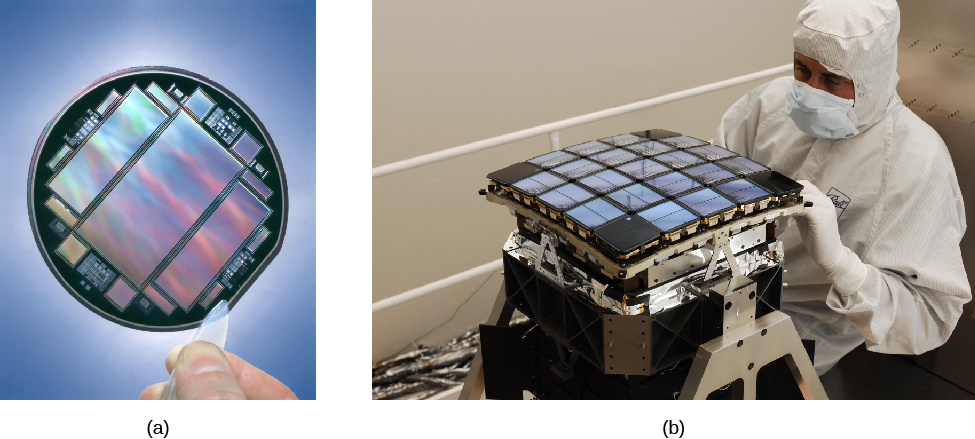
Astronomers today have much more efficient electronic detectors to record astronomical images. Most often, these are charge-coupled devices (CCDs), which are similar to the detectors used in video camcorders or in digital cameras (like the one more and more students have on their cell phones) (see Figure 6.14). In a CCD, photons of radiation hitting any part of the detector generate a stream of charged particles (electrons) that are stored and counted at the end of the exposure. Each place where the radiation is counted is called a pixel (picture element), and modern detectors can count the photons in millions of pixels (megapixels, or MPs).
英語のヒント
今日の天文学者は、天体画像を記録するために、はるかに効率のよい電子検出器を使える。その多くは電荷結合素子、すなわちCCDで、ビデオカメラやデジタルカメラの検出器と似ている。ますます多くの学生が携帯電話に持つようになったカメラも、その例である(図6.14)。CCDでは、検出器のどの部分でも、放射の光子が当たると荷電粒子である電子が生じ、それが蓄えられて露光の終了時に数えられる。放射を数える一つひとつの場所をピクセル、すなわち画素という。現代の検出器は、数百万もの画素で光子を数えられる。100万画素をメガピクセル、略してMPという。
Charge-Coupled Devices (CCDs).電荷結合素子(CCD)。
credit a: modification of work by US Department of Energy; credit b: modification of work by NASA and Ball Aerospace · NASA media use guidelines
Figure 6.14 (a) This CCD is a mere 300-micrometers thick (thinner than a human hair) yet holds more than 21 million pixels. (b) This matrix of 42 CCDs served the Kepler telescope. (credit a: modification of work by US Department of Energy; credit b: modification of work by NASA and Ball Aerospace)
図6.14 (a)このCCDは厚さわずか300マイクロメートル、髪の毛より薄いにもかかわらず、2100万を超える画素を持つ。(b)この42個のCCDの配列は、ケプラー望遠鏡で使われた。(クレジットa:米国エネルギー省の作品を改変;b:NASAおよびBall Aerospaceの作品を改変)
Because CCDs typically record as much as 60–70% of all the photons that strike them, and the best silicon and infrared CCDs exceed 90% sensitivity, we can detect much fainter objects. Among these are many small moons around the outer planets, icy dwarf planets beyond Pluto, and dwarf galaxies of stars. CCDs also provide more accurate measurements of the brightness of astronomical objects than photography, and their output is digital—in the form of numbers that can go directly into a computer for analysis.
英語のヒント
CCDは通常、当たった光子全体の60〜70%もの量を記録し、最良のシリコンCCDや赤外線CCDでは感度が90%を超えるため、はるかに暗い天体を検出できる。その中には、外惑星のまわりにある多数の小さな衛星、冥王星より遠くにある氷の準惑星、恒星からなる矮小銀河などが含まれる。またCCDは、写真よりも正確に天体の明るさを測れる。出力もデジタル、すなわち数値なので、そのままコンピューターへ入れて解析できる。
Infrared Observations赤外線観測
Observing the universe in the infrared band of the spectrum presents some additional challenges. The infrared region extends from wavelengths near 1 micrometer (µm), which is about the long wavelength sensitivity limit of both CCDs and photography, to 100 micrometers or longer. Recall from the discussion on radiation and spectra that infrared is “heat radiation” (given off at temperatures that we humans are comfortable with). The main challenge to astronomers using infrared is to distinguish between the tiny amount of heat radiation that reaches Earth from stars and galaxies, and the much greater heat radiated by the telescope itself and our planet’s atmosphere.
英語のヒント
宇宙を赤外線の波長帯で観測するには、さらにいくつかの難しさがある。赤外線域は、CCDと写真の両方で感度の長波長側の限界にほぼ当たる1マイクロメートル(µm)付近から、100マイクロメートル、あるいはそれ以上へ広がる。放射とスペクトルの説明で、赤外線は私たち人間が快適に感じる温度で放出される「熱放射」だと述べたことを思い出そう。赤外線を使う天文学者にとって主な難題は、恒星や銀河から地球へ届く微量の熱放射を、望遠鏡自体や地球大気が放つ、はるかに多い熱から見分けることである。
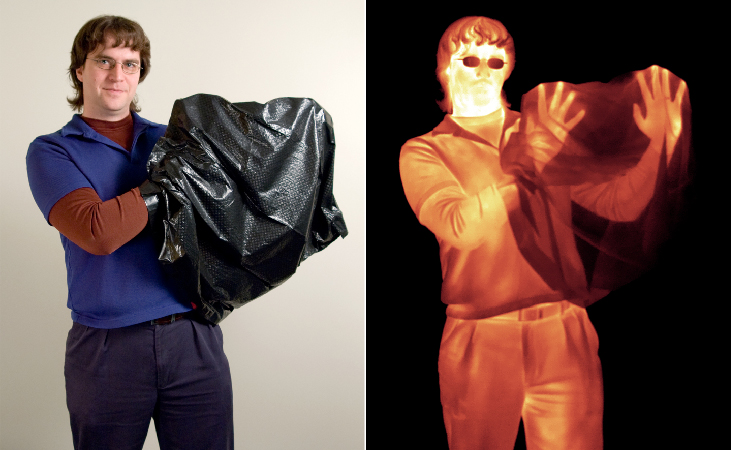
Typical temperatures on Earth’s surface are near 300 K, and the atmosphere through which observations are made is only a little cooler. According to Wien’s law (from the chapter on Radiation and Spectra), the telescope, the observatory, and even the sky are radiating infrared energy with a peak wavelength of about 10 micrometers. To infrared eyes, everything on Earth is brightly aglow—including the telescope and camera (Figure 6.15). The challenge is to detect faint cosmic sources against this sea of infrared light. Another way to look at this is that an astronomer using infrared must always contend with the situation that a visible-light observer would face if working in broad daylight with a telescope and optics lined with bright fluorescent lights.
英語のヒント
地表の典型的な温度は300 K程度であり、観測の光が通る大気も、それより少し冷たいだけである。「放射とスペクトル」の章で扱ったウィーンの法則によると、望遠鏡、天文台、そして空自体さえも、約10マイクロメートルをピーク波長とする赤外線のエネルギーを放っている。赤外線を見られる目には、地球上のあらゆるものが、望遠鏡やカメラまで含めて明るく輝いて見える(図6.15)。この赤外線の光の海を背景に、暗い宇宙の放射源を検出しなければならない。別の言い方をすれば、赤外線の天文学者は常に、可視光の観測者が明るい蛍光灯を内側に並べた望遠鏡や光学系を使い、真昼間に観測するような状況と闘わなければならないのである。
Infrared Eyes.赤外線の目。
credit: NASA/JPL-Caltech/R. Hurt (SSC) · JPL image use policy
Figure 6.15 Infrared waves can penetrate places in the universe from which light is blocked, as shown in this infrared image where the plastic bag blocks visible light but not infrared. (credit: NASA/JPL-Caltech/R. Hurt (SSC))
図6.15 赤外線は、可視光が遮られる宇宙の場所にも入り込める。この赤外線画像でも、ビニール袋は可視光を遮るが、赤外線は遮っていない。(クレジット:NASA/JPL-Caltech/R. Hurt〔SSC〕)
To solve this problem, astronomers must protect the infrared detector from nearby radiation, just as you would shield photographic film from bright daylight. Since anything warm radiates infrared energy, the detector must be isolated in very cold surroundings; often, it is held near absolute zero (1 to 3 K) by immersing it in liquid helium. The second step is to reduce the radiation emitted by the telescope structure and optics, and to block this heat from reaching the infrared detector.
英語のヒント
この問題を解決するには、写真フィルムを明るい昼の光から守るのと同じように、赤外線検出器を近くから来る放射から守らなければならない。温かいものは何でも赤外線のエネルギーを放つので、検出器は非常に冷たい環境に隔離する必要がある。液体ヘリウムに浸し、絶対零度に近い1〜3 Kに保つことが多い。第二の対策は、望遠鏡の構造物や光学系が放出する放射を減らし、その熱が赤外線検出器へ届くのを遮ることである。