第6章天文学の観測装置Astronomical Instruments
Picking the Best Observing Sites最適な観測地を選ぶ
A telescope like the Gemini or Keck telescope costs about $100 million to build. That kind of investment demands that the telescope be placed in the best possible site. Since the end of the nineteenth century, astronomers have realized that the best observatory sites are on mountains, far from the lights and pollution of cities. Although a number of urban observatories remain, especially in the large cities of Europe, they have become administrative centers or museums. The real action takes place far away, often on desert mountains or isolated peaks in the Atlantic and Pacific Oceans, where we find the staff’s living quarters, computers, electronic and machine shops, and of course the telescopes themselves. A large observatory today requires a supporting staff of 20 to 100 people in addition to the astronomers.
英語のヒント
ジェミニやケックのような望遠鏡を建設するには、約1億ドルかかる。それだけの投資をするなら、できる限りよい場所に設置しなければならない。19世紀末以来、天文学者たちは、都市の明かりや汚染から遠く離れた山の上が、天文台に最適な場所だと理解してきた。都市の天文台も、特にヨーロッパの大都市にはいくつか残っているが、現在では管理拠点や博物館になっている。実際の観測活動は、遠く離れた砂漠の山地や、大西洋・太平洋に孤立する山頂などで行われる。そこには職員の宿舎、コンピューター、電子機器や機械の工作室、そしてもちろん望遠鏡そのものがある。今日の大きな天文台には、天文学者のほかに20〜100人の支援職員が必要である。
The performance of a telescope is determined not only by the size of its mirror but also by its location. Earth’s atmosphere, so vital to life, presents challenges for the observational astronomer. In at least four ways, our air imposes limitations on the usefulness of telescopes:
英語のヒント
望遠鏡の性能は、鏡の大きさだけでなく設置場所によっても決まる。生命にとって不可欠な地球大気は、観測を行う天文学者には難題をもたらす。大気は少なくとも次の四つの点で、望遠鏡の働きを制限する。
The most obvious limitation is weather conditions such as clouds, wind, and rain. At the best sites, the weather is clear as much as 75% of the time.
最もわかりやすい制約は、雲、風、雨などの気象条件である。最良の観測地では、全体の75%もの時間、晴天に恵まれる。
Even on a clear night, the atmosphere filters out a certain amount of starlight, especially in the infrared, where the absorption is due primarily to water vapor. Astronomers therefore prefer dry sites, generally found at high altitudes.
英語のヒント
晴れた夜でも、大気は星の光の一定量を吸収して取り除く。特に赤外線では、主に水蒸気が吸収を引き起こす。そのため天文学者は乾燥した場所を好み、そのような場所は一般に標高の高いところにある。
The sky above the telescope should be dark. Near cities, the air scatters the glare from lights, producing an illumination that hides the faintest stars and limits the distances that can be probed by telescopes. (Astronomers call this effect light pollution.) Observatories are best located at least 100 miles from the nearest large city.
英語のヒント
望遠鏡の上の空は暗くなければならない。都市の近くでは、大気が照明のまぶしい光を散乱させ、空を明るくして暗い星を隠し、望遠鏡で探れる距離を制限する。天文学者はこの影響を光害と呼ぶ。天文台は、最寄りの大都市から少なくとも100マイル離れた場所に置くのが望ましい。
Finally, the air is often unsteady; light passing through this turbulent air is disturbed, resulting in blurred star images. Astronomers call these effects “bad seeing.” When seeing is bad, images of celestial objects are distorted by the constant twisting and bending of light rays by turbulent air.
英語のヒント
最後に、大気は安定していないことが多い。乱れた大気を通る光は乱され、星の像がぼやける。天文学者は、こうした状態を「シーイングが悪い」という。シーイングが悪いと、乱流によって光線が絶えずねじ曲げられ、天体の像がゆがむ。
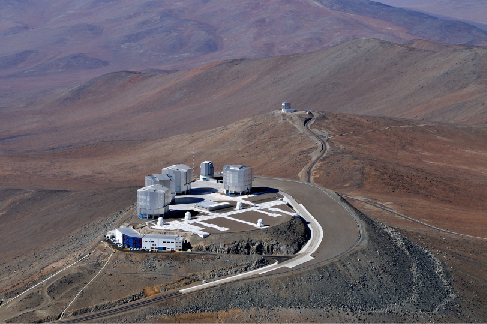
The best observatory sites are therefore high, dark, and dry. The world’s largest telescopes are found in such remote mountain locations as the Andes Mountains of Chile (Figure 6.12), the desert peaks of Arizona, the Canary Islands in the Atlantic Ocean, and Maunakea in Hawaii, a dormant volcano with an altitude of 13,700 feet (4200 meters).
英語のヒント
したがって、天文台に最もよいのは、標高が高く、暗く、乾燥した場所である。世界最大級の望遠鏡は、チリのアンデス山脈(図6.12)、アリゾナの砂漠の山頂、大西洋のカナリア諸島、ハワイのマウナケアなど、人里離れた山地にある。マウナケアは標高1万3700フィート、約4200メートルの休火山である。
High and Dry Site.標高が高く乾燥した観測地。
credit: ESO · CC BY 4.0
Figure 6.12 Cerro Paranal, a mountain summit 2.7 kilometers above sea level in Chile’s Atacama Desert, is the site of the European Southern Observatory’s Very Large Telescope. This photograph shows the four 8-meter telescope buildings on the site and vividly illustrates that astronomers prefer high, dry sites for their instruments. The 4.1-meter Visible and Infrared Survey Telescope for Astronomy (VISTA) can be seen in the distance on the next mountain peak. (credit: ESO)
図6.12 チリのアタカマ砂漠にある標高2.7キロメートルのパラナル山は、欧州南天天文台の超大型望遠鏡VLTの設置場所である。この写真には、敷地内にある8メートル望遠鏡の建物4棟が写っており、天文学者が装置の設置場所として高く乾燥した場所を好むことがよくわかる。遠くの隣の山頂には、口径4.1メートルの可視光・赤外線サーベイ望遠鏡VISTAが見える。(クレジット:ESO)
The Resolution of a Telescope望遠鏡の分解能
In addition to gathering as much light as they can, astronomers also want to have the sharpest images possible. Resolution refers to the precision of detail present in an image: that is, the smallest features that can be distinguished. Astronomers are always eager to make out more detail in the images they study, whether they are following the weather on Jupiter or trying to peer into the violent heart of a “cannibal galaxy” that recently ate its neighbor for lunch.
英語のヒント
天文学者は、できるだけ多くの光を集めるだけでなく、できる限り鮮明な像も得たいと考えている。分解能とは、画像にどれほど細かいものが写っているか、すなわち見分けられる最小の構造を指す。木星の天気を追っている場合でも、最近隣の銀河を昼食として食べたばかりの「共食い銀河」の激しい中心部をのぞこうとする場合でも、研究する画像からもっと細かな情報を読み取りたいという思いは変わらない。
One factor that determines how good the resolution will be is the size of the telescope. Larger apertures produce sharper images. Until very recently, however, visible-light and infrared telescopes on Earth’s surface could not produce images as sharp as the theory of light said they should.
英語のヒント
分解能がどれほどよくなるかを決める要因の一つは、望遠鏡の大きさである。口径が大きいほど、像は鮮明になる。しかし、ごく最近まで、地上の可視光・赤外線望遠鏡は、光の理論から期待されるほど鮮明な像を作ることができなかった。
The problem—as we saw earlier in this chapter—is our planet’s atmosphere, which is turbulent. It contains many small-scale blobs or cells of gas that range in size from inches to several feet. Each cell has a slightly different temperature from its neighbor, and each cell acts like a lens, bending (refracting) the path of the light by a small amount. This bending slightly changes the position where each light ray finally reaches the detector in a telescope. The cells of air are in motion, constantly being blown through the light path of the telescope by winds, often in different directions at different altitudes. As a result, the path followed by the light is constantly changing.
英語のヒント
この章の前のほうで見たように、問題は乱流のある地球大気である。大気には、大きさが数インチから数フィートの、小さなガスの塊や区画が多数ある。それぞれの塊は隣の塊と温度が少し異なり、レンズのように働いて光の進路をわずかに曲げる、つまり屈折させる。この屈折により、各光線が最終的に望遠鏡の検出器に到達する位置が少し変わる。空気の塊は動いており、風によって絶えず望遠鏡の光路を横切る。高度が異なれば、動く方向も異なることが多い。その結果、光の通る経路は常に変わり続ける。
For an analogy, think about watching a parade from a window high up in a skyscraper. You decide to throw some confetti down toward the marchers. Even if you drop a handful all at the same time and in the same direction, air currents will toss the pieces around, and they will reach the ground at different places. As we described earlier, we can think of the light from the stars as a series of parallel beams, each making its way through the atmosphere. Each path will be slightly different, and each will reach the detector of the telescope at a slightly different place. The result is a blurred image, and because the cells are being blown by the wind, the nature of the blur will change many times each second. You have probably noticed this effect as the “twinkling” of stars seen from Earth. The light beams are bent enough that part of the time they reach your eye, and part of the time some of them miss, thereby making the star seem to vary in brightness. In space, however, the light of the stars is steady.
英語のヒント
たとえとして、高層ビルの高い階の窓からパレードを見ていると考えよう。行進する人たちへ紙吹雪を投げることにする。一握りの紙を、すべて同時に同じ方向へ落としたとしても、気流が紙片をあちこちに運ぶので、それぞれ別の場所に落ちる。すでに説明したように、星の光は、大気の中をそれぞれ進む平行な光線の集まりと考えられる。一つひとつの経路は少しずつ異なり、望遠鏡の検出器に達する場所も少しずつ異なる。その結果、像がぼやける。しかも空気の塊が風で流されるため、ぼやけ方は1秒の間に何度も変わる。地上から見た星の「またたき」として、この現象に気づいたことがあるだろう。光線は十分に曲げられ、目に届くこともあれば、その一部が目を外れることもある。そのため、星の明るさが変わるように見える。しかし宇宙空間では、星の光は安定している。
Astronomers search the world for locations where the amount of atmospheric blurring, or turbulence, is as small as possible. It turns out that the best sites are in coastal mountain ranges and on isolated volcanic peaks in the middle of an ocean. Air that has flowed long distances over water before it encounters land is especially stable.
英語のヒント
天文学者は、大気による像のぼやけ、つまり乱流ができる限り少ない場所を、世界中で探している。最もよい場所は、沿岸の山脈や、大洋の中央に孤立する火山の山頂だとわかっている。陸地に出合う前に海上を長距離にわたって流れてきた空気は、特に安定している。
The resolution of an image is measured in units of angle on the sky, typically in units of arcseconds. One arcsecond is 1/3600 degree, and there are 360 degrees in a full circle. So we are talking about tiny angles on the sky. To give you a sense of just how tiny, we might note that 1 arcsecond is how big a quarter would look when seen from a distance of 5 kilometers. The best images obtained from the ground with traditional techniques reveal details as small as several tenths of an arcsecond across. This image size is remarkably good. One of the main reasons for launching the Hubble Space Telescope was to escape Earth’s atmosphere and obtain even sharper images.
英語のヒント
画像の分解能は空の上の角度で測り、通常は秒角を単位とする。1秒角は1度の3600分の1で、円一周は360度である。つまり、空の上の非常に小さな角度を扱っている。どれほど小さいかというと、5キロメートル先から見た米国の25セント硬貨の大きさがおよそ1秒角である。従来の技術で地上から得られる最良の画像では、幅が0.1秒角の数倍ほどの構造を見分けられる。これだけでも、画像の細かさは驚くほど優れている。ハッブル宇宙望遠鏡を打ち上げた主な理由の一つは、地球大気の外へ出て、さらに鮮明な像を得ることだった。
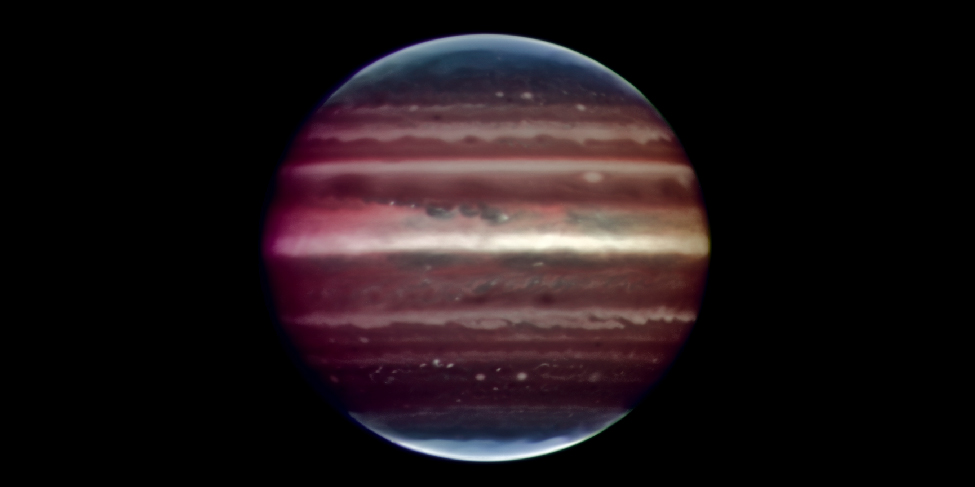
But since we can’t put every telescope into space, astronomers have devised a technique called adaptive optics that can beat Earth’s atmosphere at its own game of blurring. This technique (which is most effective in the infrared region of the spectrum with our current technology) makes use of a small flexible mirror placed in the beam of a telescope. A sensor measures how much the atmosphere has distorted the image, and as often as 500 times per second, it sends instructions to the flexible mirror on how to change shape in order to compensate for distortions produced by the atmosphere. The light is thus brought back to an almost perfectly sharp focus at the detector. Figure 6.13 shows just how effective this technique is. With adaptive optics, ground-based telescopes can achieve resolutions of 0.1 arcsecond or a little better in the infrared region of the spectrum. This impressive figure is the equivalent of the resolution that the Hubble Space Telescope achieves in the visible-light region of the spectrum.
英語のヒント
すべての望遠鏡を宇宙へ運ぶことはできない。そこで天文学者は、像をぼかす大気に、その大気のやり方を逆手に取って対抗する技術を考案した。補償光学である。現在の技術では赤外線域で最も効果的なこの方法は、望遠鏡の光束の中に、小さく変形しやすい鏡を置いて使う。センサーが、大気によって像がどれほどゆがんだかを測定する。そして毎秒500回もの頻度で、変形する鏡に、大気のゆがみを補うにはどのように形を変えるべきかを指示する。こうして光は、検出器上でほぼ完全に鮮明な焦点へと戻される。図6.13は、この技術がいかに有効かを示している。補償光学を用いれば、地上望遠鏡でも赤外線域で0.1秒角、あるいはそれより少しよい分解能を達成できる。この優れた値は、ハッブル宇宙望遠鏡が可視光域で達成する分解能に相当する。
Power of Adaptive Optics.補償光学の威力。
credit: modification of work by ESO, F.Marchis, M.Wong (UC Berkeley); E.Marchetti, P.Amico, S.Tordo (ESO) · CC BY 4.0
Figure 6.13 One of the clearest pictures of Jupiter ever taken from the ground, this image was produced with adaptive optics using an 8-meter-diameter telescope at the Very Large Telescope in Chile. Adaptive optics uses infrared wavelengths to remove atmospheric blurring, resulting in a much clearer image. (credit: modification of work by ESO, F.Marchis, M.Wong (UC Berkeley); E.Marchetti, P.Amico, S.Tordo (ESO))
図6.13 地上から撮られた木星の画像の中でも、ひときわ鮮明な一枚。チリの超大型望遠鏡VLTの口径8メートル望遠鏡で、補償光学を用いて撮影した。補償光学は赤外線の波長を使って大気によるぼやけを除き、はるかに鮮明な像をもたらす。(クレジット:ESO、F. Marchis、M. Wong〔カリフォルニア大学バークレー校〕、E. Marchetti、P. Amico、S. Tordo〔ESO〕の作品を改変)
New technologies for creating and supporting lightweight mirrors have led to the construction of a number of large telescopes since 1990. The site for an astronomical observatory must be carefully chosen for clear weather, dark skies, low water vapor, and excellent atmospheric seeing (low atmospheric turbulence). The resolution of a visible-light or infrared telescope is degraded by turbulence in Earth’s atmosphere. The technique of adaptive optics, however, can make corrections for this turbulence in real time and produce exquisitely detailed images.
軽い鏡を作り支えるための新技術により、1990年以来、多数の大望遠鏡が建設されてきた。天文台の立地は、晴れが多く、空が暗く、水蒸気が少なく、シーイングが非常によい、つまり大気の乱流が少ないことを条件に、慎重に選ばなければならない。可視光・赤外線望遠鏡の分解能は地球大気の乱流で低下する。しかし補償光学を使えば、その乱流の影響をリアルタイムで補正し、非常に細部までわかる画像を得られる。
adaptive optics
補償光学
systems used with telescopes that can compensate for distortions in an image introduced by the atmosphere, thus resulting in sharper images
大気が引き起こす像のゆがみを補正して、より鮮明な像を得るために、望遠鏡と組み合わせて用いるシステム。
resolution
分解能
detail in an image; specifically, the smallest angular (or linear) features that can be distinguished
画像に含まれる細部の細かさ。特に、見分けられる最小の構造を角度または長さで表したもの。
seeing
シーイング
unsteadiness of Earth’s atmosphere, which blurs telescopic images; good seeing means the atmosphere is steady
望遠鏡の像をぼかす、地球大気の揺らぎの状態。シーイングがよいとは、大気が安定していることをいう。