第6章天文学の観測装置Astronomical Instruments
6.6 The Future of Large Telescopes6.6 大望遠鏡の未来
Learning Objectives学習の目標
By the end of this section, you will be able to:
この節を学び終えると、次のことができるようになる。
Describe the next generation of ground- and space-based observatories
次世代の地上および宇宙の観測施設を説明する。
Explain some of the challenges involved in building these observatories
これらの施設の建設に伴う課題の一部を説明する。
If you’ve ever gone on a hike, you have probably been eager to see what lies just around the next bend in the path. Researchers are no different, and astronomers and engineers are working on the technologies that will allow us to explore even more distant parts of the universe and to see them more clearly.
英語のヒント
ハイキングに出かけたことがあれば、道の次の曲がり角のすぐ向こうに何があるのか、見たくてたまらなかったことがあるだろう。研究者も同じである。天文学者や技術者は、宇宙のさらに遠い場所を探り、よりはっきり見ることを可能にする技術に取り組んでいる。
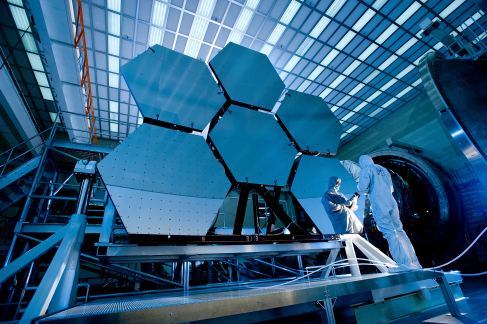
As we saw earlier, the premier space facility for the coming decade will be the James Webb Space Telescope (Figure 6.27). Its work is just beginning, but its flawless deployment in the first half of 2022 has given astronomers a strong sense of optimism about its ability to probe the infrared universe. The smaller Hubble Space Telescope is still functioning after more than 30 years in space. NASA is also looking at launching (around 2027) the Nancy Grace Roman Space Telescope, an infrared instrument which will have a smaller mirror but a wider field of view than the Webb.
英語のヒント
前に見たように、これからの10年間を代表する宇宙観測施設は、ジェイムズ・ウェッブ宇宙望遠鏡になるだろう(図6.27)。その仕事は始まったばかりだが、2022年前半の展開作業が申し分なく成功したことで、天文学者は赤外線宇宙を探る能力に大きな期待を抱いている。より小さなハッブル宇宙望遠鏡は、宇宙に出て30年以上を経ても稼働を続けている。NASAはまた、2027年ごろにナンシー・グレース・ローマン宇宙望遠鏡を打ち上げることを検討している。これはウェッブより鏡は小さいが、視野は広い赤外線観測装置になる。
James Webb Space Telescope (JWST).ジェイムズ・ウェッブ宇宙望遠鏡(JWST)。
credit: NASA/MSFC/David Higginbotham/Emmett Given · NASA media use guidelines
Figure 6.27 This image shows some of the mirrors of the JWST as they underwent cryogenic testing. The mirrors were exposed to extreme temperatures in order to gather accurate measurements on changes in their shape as they heated and cooled. (credit: NASA/MSFC/David Higginbotham/Emmett Given)
図6.27 この画像は、極低温試験を受けているJWSTの鏡の一部を示す。加熱・冷却に伴う形の変化を正確に測るため、鏡を極端な温度にさらした。(クレジット:NASA/MSFC/David Higginbotham/Emmett Given)
On the ground, astronomers have built the Vera Rubin Observatory, which has an 8.4-meter telescope with a significantly larger field of view than any existing telescopes and the largest digital camera ever built. From its location in Chile, it will photograph the entire southern sky in only three nights, and then start again, essentially making a movie of the sky for ten years. Astronomers are looking for transients, phenomena that change quickly, such as exploding stars and chunks of rock that orbit near Earth. The observatory saw first light in 2025. By the way, the observatory is named after the American astronomer whose work led us to the understanding that much of the universe is made of a mysterious substance that scientists call dark matter (which we explain in The Mass of the Galaxy).
英語のヒント
地上では、ヴェラ・ルービン天文台が建設された。既存のどの望遠鏡よりはるかに広い視野を持つ口径8.4メートル望遠鏡と、これまでに造られた最大のデジタルカメラを備える。チリから南天全体をわずか3晩で撮影し、また最初から繰り返す。実質的に、10年間にわたる空の動画を作ることになる。天文学者が探しているのは、突発天体や一時的に現れる現象、すなわち急速に変わるものだ。爆発する星や、地球の近くを公転する岩石の塊などが含まれる。この天文台は2025年にファーストライトを迎えた。ちなみに、名前の由来となった米国の天文学者は、その研究によって、宇宙の大部分が暗黒物質と呼ばれる謎の物質からできているという理解を導いた人物である。暗黒物質については「天の川銀河の質量」で説明する。
The international gamma-ray community is planning the Cherenkov Telescope Array (CTA), two arrays of telescopes, one in each hemisphere, which will indirectly measure gamma rays from the ground. The CTA will measure gamma-ray energies a thousand times as great as the Fermi telescope can detect.
英語のヒント
世界のガンマ線研究者たちは、チェレンコフ望遠鏡アレイCTAを計画している。南北両半球に一つずつ、計二つの望遠鏡アレイを置き、地上からガンマ線を間接的に測定する。CTAは、フェルミ望遠鏡が検出できるものの1000倍ものエネルギーのガンマ線を測る予定である。
Several groups of astronomers around the globe interested in studying visible light and the infrared are exploring the feasibility of building ground-based telescopes with mirrors larger than 30 meters across. Stop and think what this means: 30 meters is one-third the length of a football field. It is technically impossible to build and transport a single astronomical mirror that is 30 meters or larger in diameter. The primary mirror of these giant telescopes will consist of smaller mirrors, all aligned so that they act as a very large mirror in combination.
英語のヒント
世界各地で、可視光や赤外線の研究に関心を持ついくつかの天文学者のグループが、口径30メートルを超える鏡を備えた地上望遠鏡を造れるかどうか、検討している。少し立ち止まり、その意味を考えてみよう。30メートルは、アメリカンフットボールのフィールドの長さの3分の1である。直径30メートル以上の一枚の天体望遠鏡用鏡を造り、運ぶことは技術的に不可能である。こうした巨大望遠鏡の主鏡は小さな鏡からなり、すべてを調整して、組み合わせた全体が一枚の非常に大きな鏡として働くようにする。
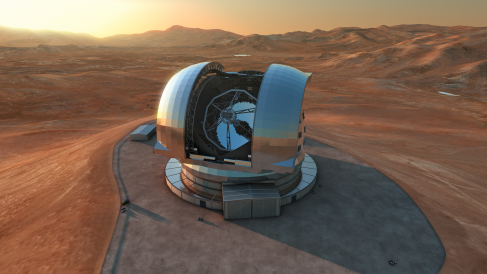
The most ambitious of these projects is the European Extremely Large Telescope (ELT) (Figure 6.28). (Astronomers try to outdo each other not only with the size of these telescopes, but also their names!) The design of the European ELT calls for a 39.3-meter primary mirror, which will follow the Keck design and be made up of 798 hexagonal mirrors, each 1.4 meters in diameter and all held precisely in position so that they form a continuous surface. Construction on the site in the Atacama Desert in Northern Chile started in 2014, and operations are expected to begin in about 2025.
英語のヒント
これらの計画の中で最も野心的なのは、欧州超大型望遠鏡ELTである(図6.28)。天文学者たちは、望遠鏡の大きさだけでなく、名前でも互いをしのごうとしている。欧州ELTの設計では、39.3メートルの主鏡を使う。ケックの方式にならい、直径1.4メートルの六角形の鏡798枚で構成する。すべてを正確な位置に保ち、連続した一つの面を作る。チリ北部のアタカマ砂漠の建設地では2014年に工事が始まり、2025年ごろの運用開始が見込まれている。
International consortia with major contributions from U.S. astronomers have developed plans for the construction of two large new telescopes. One is a Thirty-Meter Telescope (TMT) for which the preferred site is Maunakea in Hawaii. The design of this telescope is similar to that of the European ELT and will make use of 492 hexagonal elements. Each segment is about 1.44 meters (56.6 inches) across corners. The segments are closely spaced, with gaps between the segments only 2.5 mm (0.1 inch) wide.
英語のヒント
米国の天文学者たちが大きく貢献する国際共同体は、2基の新たな大望遠鏡の建設計画を立てている。一つは30メートル望遠鏡TMTで、設置場所の第一候補はハワイのマウナケアである。設計は欧州ELTに似ており、六角形の分割鏡492枚を用いる。それぞれの対角の長さは約1.44メートル、56.6インチである。鏡は密に並び、間の隙間はわずか2.5 mm、0.1インチしかない。
The Giant Magellan Telescope (GMT) is the second ELT project with major participation by U.S. astronomers. The GMT is also a segmented mirror telescope that employs seven stiff monolith 8.4-meter mirrors as segments. Construction has started at the selected site, which is near the Las Campanas Observatory on the southern edge of the Atacama Desert.
英語のヒント
巨大マゼラン望遠鏡GMTは、米国の天文学者が大きく参加する、もう一つの超大型望遠鏡計画である。GMTも分割鏡方式だが、分割単位には、剛性の高い口径8.4メートルの一体成形鏡を7枚使う。アタカマ砂漠の南端、ラスカンパナス天文台の近くに選ばれた場所で、建設が始まっている。
These giant telescopes will combine light-gathering power with high-resolution imaging. These powerful new instruments will enable astronomers to tackle many important astronomical problems. As just one example, they provide us images and spectra of planets around other stars and thus, perhaps, give us the first real evidence (from the chemistry of these planets’ atmospheres) that life exists elsewhere.
英語のヒント
こうした巨大望遠鏡は、大きな集光力と高分解能の撮像を兼ね備える。強力な新装置によって、天文学者は多くの重要な問題に取り組めるようになる。一例を挙げるだけでも、ほかの恒星を回る惑星の画像やスペクトルが得られ、その大気の化学的な性質から、地球以外にも生命が存在するという初めての確かな証拠が、もしかすると得られるかもしれない。
Artist’s Conception of the European Extremely Large Telescope.欧州超大型望遠鏡の想像図。
credit: ESO/L. Calçada · CC BY 4.0
Figure 6.28 The primary mirror in this telescope is 39.3 meters across. The telescope is under construction in the Atacama Desert in Northern Chile. (credit: ESO/L. Calçada)
図6.28 この望遠鏡の主鏡は直径39.3メートルである。チリ北部のアタカマ砂漠で建設が進んでいる。(クレジット:ESO/L. Calçada)
The largest space telescope yet, the 6.5-meter James Webb Space Telescope, was launched in December 2021 and is sending back a flood of useful information about the infrared universe. New and even larger telescopes are on the drawing boards. Gamma-ray astronomers are planning to build the CTA to measure very energetic gamma rays. Astronomers built the Vera Rubin Observatory to observe with a field of view that is unprecedented in size, and are planning a new generation of visible-light/infrared telescopes with apertures of 24.5 to 39 meters in diameter.
これまでで最大の宇宙望遠鏡、口径6.5メートルのジェイムズ・ウェッブ宇宙望遠鏡は、2021年12月に打ち上げられ、赤外線宇宙について大量の役立つ情報を送り返している。新しい、さらに大きな望遠鏡も計画段階にある。ガンマ線天文学者は、非常に高エネルギーのガンマ線を測るCTAの建設を計画している。天文学者は前例のない広さの視野で観測するヴェラ・ルービン天文台を造り、口径24.5〜39メートルの次世代可視光・赤外線望遠鏡を計画している。