第6章天文学の観測装置Astronomical Instruments
6.2 Telescopes Today6.2 今日の望遠鏡
Learning Objectives学習の目標
By the end of this section, you will be able to:
この節を学び終えると、次のことができるようになる。
Recognize the largest visible-light and infrared telescopes in operation today
現在稼働している、最大級の可視光・赤外線望遠鏡を知る。
Discuss the factors relevant to choosing an appropriate telescope site
望遠鏡に適した設置場所を選ぶ際に関係する要因を論じる。
Define the technique of adaptive optics and describe the effects of the atmosphere on astronomical observations
補償光学という技術を定義し、大気が天体観測に及ぼす影響を説明する。
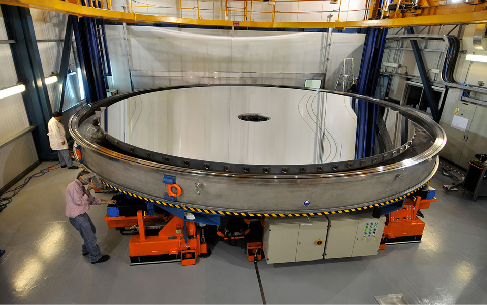
Since Newton’s time, when the sizes of the mirrors in telescopes were measured in inches, reflecting telescopes have grown ever larger. In 1948, US astronomers built a telescope with a 5-meter (200-inch) diameter mirror on Palomar Mountain in Southern California. It remained the largest visible-light telescope in the world for several decades. The giants of today, however, have primary mirrors (the largest mirrors in the telescope) that are 8- to 10-meters in diameter, and larger ones are being built (Figure 6.7).
英語のヒント
望遠鏡の鏡の大きさをインチで測っていたニュートンの時代から、反射望遠鏡はますます大型化してきた。1948年、米国の天文学者たちは、南カリフォルニアのパロマー山に、直径5メートル、すなわち200インチの鏡を持つ望遠鏡を建設した。その後数十年にわたり、世界最大の可視光望遠鏡であり続けた。しかし今日の巨大望遠鏡は、直径8〜10メートルの主鏡、つまり望遠鏡の中で最も大きな鏡を持ち、さらに大きなものも建設されつつある(図6.7)。
Large Telescope Mirror.大望遠鏡の鏡。
credit: ESO/G. Huedepohl · CC BY 4.0
Figure 6.7 This image shows one of the primary mirrors of the European Southern Observatory’s Very Large Telescope, named Yepun, just after it was recoated with aluminum. The mirror is a little over 8 meters in diameter. (credit: ESO/G. Huedepohl)
図6.7 この画像は、欧州南天天文台の超大型望遠鏡VLTのうち、イェプンという名の望遠鏡の主鏡を示す。アルミニウムを蒸着し直した直後の姿である。鏡の直径は8メートルを少し超える。(クレジット:ESO/G. Huedepohl)
Modern Visible-Light and Infrared Telescopes現代の可視光・赤外線望遠鏡
The decades starting in 1990 saw telescope building around the globe grow at an unprecedented rate. (See Table 6.1, which also includes websites for each telescope in case you want to visit or learn more about them.) Technological advancements had finally made it possible to build telescopes significantly larger than the 5-meter telescope at Palomar at a reasonable cost. New technologies have also been designed to work well in the infrared, and not just visible, wavelengths.
英語のヒント
1990年からの数十年間には、世界中で望遠鏡の建設が前例のない速さで進んだ。表6.1を参照してほしい。訪問したり詳しく調べたりしたい場合に備えて、各望遠鏡のウェブサイトも載せてある。技術の進歩によって、パロマーの5メートル望遠鏡よりはるかに大きな望遠鏡を、妥当な費用で造ることがついに可能になった。新しい技術は、可視光だけでなく赤外線の波長でもよく働くように開発されている。
Large Single-Dish Visible-Light and Infrared Telescopes 大型の単一口径可視光・赤外線望遠鏡 |
||||
|---|---|---|---|---|
Aperture (m) 口径(m) |
Telescope Name 望遠鏡名 |
Location 所在地 |
Status 状況 |
Website ウェブサイト |
| 39 | European Extremely Large Telescope (E-ELT) 欧州超大型望遠鏡(E-ELT) |
Cerro Armazonas, Chile チリ、アルマゾネス山 |
First light 2028 (estimated) ファーストライト:2028年(予測) |
www.eso.org/sci/facilities/eelt |
| 30 | Thirty-Meter Telescope (TMT) 30メートル望遠鏡(TMT) |
Maunakea, HI 米国ハワイ州、マウナケア |
Uncertain 未確定 |
www.tmt.org |
| 24.5 | Giant Magellan Telescope (GMT) 巨大マゼラン望遠鏡(GMT) |
Las Campanas Observatory, Chile チリ、ラスカンパナス天文台 |
Early 2030s (estimated) 2030年代前半(予測) |
www.gmto.org |
Southern African Large Telescope (SALT) 南アフリカ大型望遠鏡(SALT) |
Sutherland, South Africa 南アフリカ、サザーランド |
2005 2005年 |
www.salt.ac.za | |
| 10.4 | Gran Telescopio Canarias (GTC) カナリア大望遠鏡(GTC) |
La Palma, Canary Islands カナリア諸島、ラ・パルマ島 |
First light 2007 ファーストライト:2007年 |
http://www.gtc.iac.es |
| 10.0 | Keck I and II (two telescopes) ケックI・II望遠鏡(2基) |
Maunakea, HI 米国ハワイ州、マウナケア |
Completed 1993–96 1993〜1996年完成 |
www.keckobservatory.org |
| 9.1 | Hobby–Eberly Telescope (HET) ホビー・エバリー望遠鏡(HET) |
Mount Locke, TX 米国テキサス州、ロック山 |
Completed 1997 1997年完成 |
www.as.utexas.edu/mcdonald/het |
| 8.4 | Large Binocular Telescope (LBT) (two telescopes) 大型双眼望遠鏡(LBT、望遠鏡2基) |
Mount Graham, AZ 米国アリゾナ州、グラハム山 |
First light 2004 ファーストライト:2004年 |
www.lbto.org |
| 8.4 | Large Synoptic Survey Telescope (Rubin Obs.) 大型シノプティック・サーベイ望遠鏡(ルービン天文台) |
The Cerro Pachón, Chile チリ、パチョン山 |
First light 2021 ファーストライト:2021年 |
www.lsst.org |
8.3 8.3 |
Subaru Telescope すばる望遠鏡 |
Maunakea, HI 米国ハワイ州、マウナケア |
First light 1998 ファーストライト:1998年 |
www.naoj.org |
| 8.2 | Very Large Telescope (VLT) 超大型望遠鏡(VLT) |
Cerro Paranal, Chile チリ、パラナル山 |
All four telescopes completed 2000 2000年に4基すべて完成 |
www.eso.org/public/teles-instr/paranal |
| 8.1 | Gemini North and Gemini South ジェミニ北望遠鏡・ジェミニ南望遠鏡 |
Maunakea, HI (North) and Cerro Pachón, Chile (South) 北:米国ハワイ州マウナケア、南:チリのパチョン山 |
First light 1999 (North), First light 2000 (South) ファーストライト:北は1999年、南は2000年 |
www.gemini.edu |
| 6.5 | Magellan Telescopes (two telescopes: Baade and Landon Clay) マゼラン望遠鏡(バーデとランドン・クレイの2基) |
Las Campanas, Chile チリ、ラスカンパナス |
First light 2000 and 2002 ファーストライト:2000年および2002年 |
obs.carnegiescience.edu/Magellan |
| 6.5 | Multi-Mirror Telescope (MMT) マルチミラー望遠鏡(MMT) |
Mount Hopkins, AZ 米国アリゾナ州、ホプキンス山 |
Completed 1979 1979年完成 |
www.mmto.org |
| 6.0 | Big Telescope Altazimuth (BTA-6) 大型経緯台望遠鏡(BTA-6) |
Mount Pastukhov, Russia ロシア、パストゥホフ山 |
Completed 1976 1976年完成 |
w0.sao.ru/Doc-en/Telescopes/bta/descrip.html |
| 5.1 | Hale Telescope ヘール望遠鏡 |
Mount Palomar, CA 米国カリフォルニア州、パロマー山 |
Completed 1948 1948年完成 |
www.astro.caltech.edu/palomar/about/telescopes/hale.html |
The differences between the Palomar telescope and the modern Gemini North telescope (to take an example) are easily seen in Figure 6.8. The Palomar telescope is a massive steel structure designed to hold the 14.5-ton primary mirror with a 5-meter diameter. Glass tends to sag under its own weight; hence, a huge steel structure is needed to hold the mirror. A mirror 8 meters in diameter, the size of the Gemini North telescope, if it were built using the same technology as the Palomar telescope, would have to weigh at least eight times as much and would require an enormous steel structure to support it.
英語のヒント
パロマー望遠鏡と現代の望遠鏡、たとえばジェミニ北望遠鏡との違いは、図6.8を見るとよくわかる。パロマー望遠鏡は、直径5メートル、質量14.5トンの主鏡を支えるように設計された、巨大な鋼鉄製構造物である。ガラスは自重でたわみやすいため、それを支える巨大な鋼鉄の構造が必要になる。ジェミニ北望遠鏡と同じ直径8メートルの鏡を、パロマー望遠鏡と同じ技術で造ったとすれば、少なくとも8倍の重さが必要となり、支えるための鋼鉄製構造物も途方もなく大きなものになる。
Modern Reflecting Telescopes.現代の反射望遠鏡。
Figure 6.8 (a) The Palomar 5-meter reflector: The Hale telescope on Palomar Mountain has a complex mounting structure that enables the telescope (in the open “tube” pointing upward in this photo) to swing easily into any position. (b) The Gemini North 8-meter telescope: The Gemini North mirror has a larger area than the Palomar mirror, but note how much less massive the whole instrument seems. (credit a: modification of work by Caltech/Palomar Observatory; credit b: modification of work by Gemini Observatory/AURA)
図6.8 (a)パロマー5メートル反射望遠鏡。パロマー山のヘール望遠鏡は複雑な架台構造を備え、望遠鏡をどの方向へも容易に振り向けられる。写真で上を向いている開放型の「筒」が望遠鏡である。(b)ジェミニ北8メートル望遠鏡。ジェミニ北の鏡はパロマーの鏡より面積が大きいが、装置全体がどれほど軽そうに見えるかに注目しよう。(クレジットa:Caltech/Palomar Observatoryの作品を改変;b:Gemini Observatory/AURAの作品を改変)
The 8-meter Gemini North telescope looks like a featherweight by contrast, and indeed it is. The mirror is only about 8 inches thick and weighs 24.5 tons, less than twice as much as the Palomar mirror. The Gemini North telescope was completed about 50 years after the Palomar telescope. Engineers took advantage of new technologies to build a telescope that is much lighter in weight relative to the size of the primary mirror. The Gemini mirror does sag, but with modern computers, it is possible to measure that sag many times each second and apply forces at 120 different locations to the back of the mirror to correct the sag, a process called active control. Seventeen telescopes with mirrors 6.5 meters in diameter and larger have been constructed since 1990.
英語のヒント
対照的に、ジェミニ北8メートル望遠鏡はフェザー級のように軽く見え、実際に軽い。鏡の厚さはわずか約8インチで、重さは24.5トンと、パロマーの鏡の2倍未満である。ジェミニ北望遠鏡はパロマー望遠鏡の約50年後に完成した。技術者たちは新技術を活用し、主鏡の大きさに対して、はるかに軽い望遠鏡を造った。ジェミニの鏡も確かにたわむ。しかし現代のコンピューターを使えば、毎秒何度もたわみを測り、鏡の背面の120か所に力を加えて補正できる。この方法を能動制御という。1990年以来、直径6.5メートル以上の鏡を備えた望遠鏡が17基建設されている。
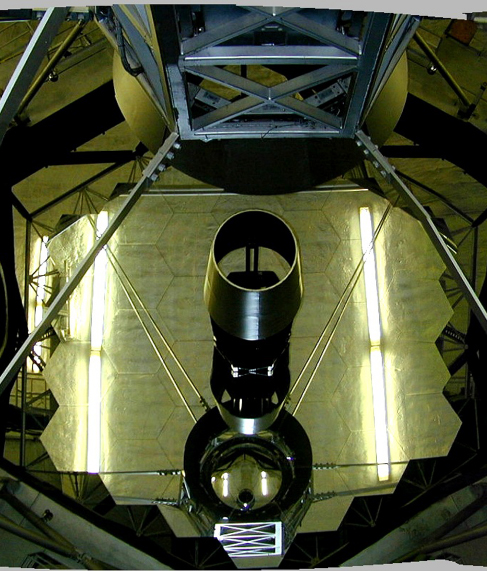
The twin 10-meter Keck telescopes on Maunakea, which were the first of these new-technology instruments, use precision control in an entirely novel way. Instead of a single primary mirror 10 meters in diameter, each Keck telescope achieves its larger aperture by combining the light from 36 separate hexagonal mirrors, each 1.8 meters wide (Figure 6.9). Computer-controlled actuators (motors) constantly adjust these 36 mirrors so that the overall reflecting surface acts like a single mirror with just the right shape to collect and focus the light into a sharp image.
英語のヒント
こうした新技術を用いる装置の先駆けとなったマウナケアの10メートル・ケック望遠鏡2基は、まったく新しい方法で精密制御を使っている。各望遠鏡は、直径10メートルの一枚の主鏡を使う代わりに、幅1.8メートルの六角形の鏡36枚からの光を合わせて、大口径を実現している(図6.9)。コンピューター制御のアクチュエーター、すなわち駆動モーターが36枚の鏡を絶えず調節する。それによって反射面全体が、光を集めて鮮明な像を結ぶのに適した形の、一枚の鏡のように働く。
Thirty-Six Eyes Are Better Than One.一つの目より、36の目。
credit: NASA · NASA media use guidelines
Figure 6.9 The mirror of the 10-meter Keck telescope is composed of 36 hexagonal sections. (credit: NASA)
図6.9 10メートル・ケック望遠鏡の鏡は、六角形の鏡36枚で構成されている。(クレジット:NASA)
In addition to holding the mirror, the steel structure of a telescope is designed so that the entire telescope can be pointed quickly toward any object in the sky. Since Earth is rotating, the telescope must have a motorized drive system that moves it very smoothly from east to west at exactly the same rate that Earth is rotating from west to east, so it can continue to point at the object being observed. All this machinery must be housed in a dome to protect the telescope from the elements. The dome has an opening in it that can be positioned in front of the telescope and moved along with it, so that the light from the objects being observed is not blocked.
英語のヒント
望遠鏡の鋼鉄製構造物は、鏡を支えるだけでなく、空のどの天体へも望遠鏡全体を素早く向けられるように設計されている。地球は自転しているため、望遠鏡にはモーター駆動の追尾装置が必要になる。地球が西から東へ回転するのとまったく同じ速さで、望遠鏡を東から西へ極めて滑らかに動かし、観測中の天体へ向け続けられるようにする。こうした機械はすべて、望遠鏡を風雨から守るドームの中に収めなければならない。ドームには開口部があり、望遠鏡の正面に位置を合わせて一緒に動かせるので、観測している天体の光を遮らずに済む。