第6章天文学の観測装置Astronomical Instruments
James Webb Space Telescopeジェイムズ・ウェッブ宇宙望遠鏡
The largest telescope sent into space so far, and one specifically designed to observe infrared radiation from the universe, is the James Webb Space Telescope. (In a departure from the tradition of naming space telescopes after noted astronomers of the past, it is named after a former administrator at NASA.) Launched on December 25, 2021, the telescope is in a stable orbit about 1.5 million km from Earth—four times further than the Moon. This is a good, cold location for infrared viewing, but a place where no astronauts can currently travel if the facility needs repair.
英語のヒント
これまでに宇宙へ送られた最大の望遠鏡で、宇宙からの赤外線を観測するために特に設計されたものが、ジェイムズ・ウェッブ宇宙望遠鏡である。過去の著名な天文学者の名前を付ける伝統とは異なり、NASAの元長官にちなんで名付けられている。2021年12月25日に打ち上げられたこの望遠鏡は、地球から約150万km、月までの距離の4倍離れた、安定した軌道にある。赤外線観測に適した冷たい場所だが、修理が必要になっても、現在は宇宙飛行士が行くことのできない場所でもある。
The Webb’s 18-segment primary mirror is 6.5 meters in diameter (Figure 6.1). A multi-layer shield the size of a tennis court protects it from the heat of the Sun and allows its liquid-helium-cooled instruments to gather extremely faint infrared radiation from the universe. NASA estimates that its resolution (ability to make out small details) would be sufficient to distinguish a U.S. penny held up 40 km (24 miles) away.
英語のヒント
ウェッブの主鏡は18枚の分割鏡からなり、直径は6.5メートルである(図6.1)。テニスコートほどの大きさの多層の遮蔽板が、太陽の熱から望遠鏡を守り、液体ヘリウムで冷やした観測装置が、宇宙からの極めてかすかな赤外線を集められるようにする。NASAの推定によれば、その分解能、つまり細部を見分ける能力は、40 km、約24マイル先に掲げた米国の1セント硬貨を見分けられるほどである。
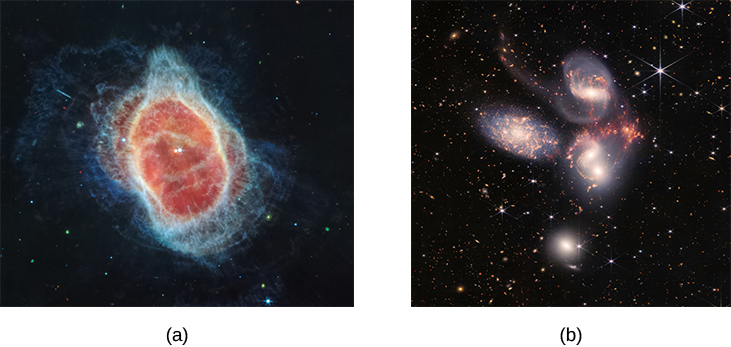
Some of the first images taken with the telescope are shown and explained in Figure 6.25. When looking at these and future images from the Webb, bear in mind that its instruments are observing infrared radiation, whose different wavelengths are not visible to the human eye, and thus are not assigned colors by our senses. The colors are added by the science team and represent the different infrared channels (wavelengths) that were observed.
英語のヒント
望遠鏡が撮った最初期の画像の一部を、図6.25に説明とともに示す。これらや今後のウェッブの画像を見るときは、装置が観測しているのは赤外線だと覚えておいてほしい。赤外線の異なる波長は人間の目には見えず、私たちの感覚によって色が割り当てられているわけではない。色を付けるのは科学チームであり、それぞれの色は、観測した赤外線の異なるチャンネル、つまり波長を表す。
First Images from the James Webb Space Telescope.ジェイムズ・ウェッブ宇宙望遠鏡の最初の画像。
credit: modification of “Southern Ring Nebula (MIRI Image)” by NASA, ESA, CSA, STScI, Webb ERO Production Team; credit: modification of “Stephan's Quintet (NIRCam + MIRI Image)” by NASA, ESA, CSA, STScI, Webb ERO Production Team · CC BY 4.0
Figure 6.25 Bear in mind that these are infrared images, so the colors are assigned by the science team to bring out scientifically interesting details. (a) Southern Ring Nebula. We are looking at a complex series of shells expelled from a dying star, some 2000 light-years away from us. On visible-light images, only one star can be seen in the middle, but in this infrared view, it’s clear that there are two stars in the nebula’s central region. It is the reddish star to the left which is dying, and responsible for giving off the shells of dusty material we see expanding around it. But the presence of a companion star makes the dying star wobble, explaining some of the spiky, asymmetrical structure in the shells. We’ll be discussing these “death shroud” nebulae in Further Evolution of Stars. (b) Stephan’s Quintet. About 1000 separate image files were combined into this remarkably detailed portrait of a compact, interacting group of galaxies. Actually, only four of the Quintet’s galaxies, the ones on the right, move together in space, about 290 million light-years away; the fifth galaxy, the one on the left, is much closer to us, and just happens to line up with the others in the sky. You can see giant, sweeping “tails” made of stars, gas, and dust that are pulled out of the four galaxies by the gravity of their neighbors. As we will see in Galaxies, Active Galaxies, Quasars, and Supermassive Black Holes, and The Evolution and Distribution of Galaxies, interactions among galaxies in groups have a strong influence on the shape and structure of the galaxies involved. (credit: modification of “Southern Ring Nebula (MIRI Image)” by NASA, ESA, CSA, STScI, Webb ERO Production Team; credit: modification of “Stephan's Quintet (NIRCam + MIRI Image)” by NASA, ESA, CSA, STScI, Webb ERO Production Team)
図6.25 これらは赤外線の画像なので、科学的に興味深い細部を際立たせるため、科学チームが色を割り当てていることを覚えておこう。(a)南のリング星雲。私たちは、約2000光年先の死にゆく星から放出された、複雑な一連の殻を見ている。可視光の画像では中央に星が一つしか見えないが、この赤外線画像では星雲の中心領域に二つの星があることがはっきりわかる。死にゆき、まわりに膨張して見える塵を含んだ物質の殻を放出しているのは、左の赤みを帯びた星である。しかし伴星があるため、その星は揺れ動き、殻のとがった非対称の構造の一部が生じる。このように星を包む「死装束」のような星雲は、「恒星のその後の進化」で取り上げる。(b)ステファンの五つ子。約1000個の個別の画像ファイルを組み合わせ、密集して相互作用する銀河群の、この驚くほど詳細な姿が作られた。実際には、五つ子のうち宇宙空間を一緒に動くのは右側の4個だけで、距離は約2億9000万光年である。5個目の左の銀河は、私たちにずっと近く、たまたま空でほかの銀河と重なる方向に見えている。星、ガス、塵からなる、大きく弧を描く「尾」が見える。それらは隣の銀河の重力によって、4個の銀河から引き出されたものである。「銀河」「活動銀河・クエーサー・超大質量ブラックホール」「銀河の進化と分布」で見るように、群れをなす銀河同士の相互作用は、それぞれの形や構造に強く影響する。(クレジット:「Southern Ring Nebula (MIRI Image)」を改変、NASA、ESA、CSA、STScI、Webb ERO Production Team;「Stephan's Quintet (NIRCam + MIRI Image)」を改変、NASA、ESA、CSA、STScI、Webb ERO Production Team)
With the Webb, astronomers are able to look into the dusty regions where stars are formed and to probe the atmospheres of planets orbiting other stars, just to name two of its primary aims. Its giant mirror is allowing scientists to look back close to the time when galaxies of stars were first being assembled by the pull of gravity. As always with a pioneering telescope, astronomers are particularly looking forward to learning things that they cannot yet predict.
英語のヒント
ウェッブによって、天文学者は、塵に覆われて星が形成される領域をのぞき込み、ほかの恒星を回る惑星の大気を調べられる。これは主な目的のうち、二つを挙げただけである。その巨大な鏡は、重力によって恒星の銀河が初めて組み立てられつつあった時代の近くまで、科学者がさかのぼって見ることを可能にしている。先駆的な望遠鏡ではいつもそうであるように、天文学者は、自分たちがまだ予測もできないことを学べるのを、特に楽しみにしている。
High-Energy Observatories高エネルギーの観測施設
Ultraviolet, X-ray, and direct gamma-ray (high-energy electromagnetic wave) observations can be made only from space. Such observations first became possible in 1946, with V2 rockets captured from Germany after World War II. The US Naval Research Laboratory put instruments on these rockets for a series of pioneering flights, used initially to detect ultraviolet radiation from the Sun. Since then, many other rockets have been launched to make X-ray and ultraviolet observations of the Sun, and later of other celestial objects.
英語のヒント
紫外線、X線、そして高エネルギー電磁波であるガンマ線の直接観測は、宇宙からしか行えない。初めて可能になったのは1946年で、第二次世界大戦後にドイツから接収したV2ロケットが使われた。米国海軍研究所はロケットに装置を載せ、先駆的な飛行を何度も行った。初めは太陽の紫外線を検出するために使われた。その後、太陽のX線や紫外線、さらに別の天体を観測するため、多くのロケットが打ち上げられた。
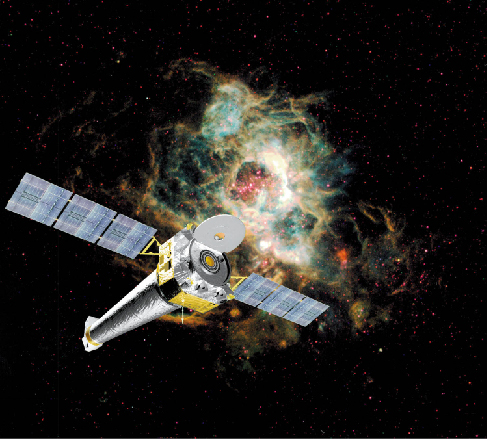
Beginning in the 1960s, a steady stream of high-energy observatories has been launched into orbit to reveal and explore the universe at short wavelengths. Among recent X-ray telescopes is the Chandra X-ray Observatory, which was launched in 1999 (Figure 6.26). It is producing X-ray images with unprecedented resolution and sensitivity. Designing instruments that can collect and focus energetic radiation like X-rays and gamma rays is an enormous technological challenge. The 2002 Nobel Prize in physics was awarded to Riccardo Giacconi, a pioneer in the field of building and launching sophisticated X-ray instruments. In 2008, NASA launched the Fermi Gamma-ray Space Telescope, designed to measure cosmic gamma rays at energies greater than any previous telescope, and thus able to collect radiation from some of the most energetic events in the universe.
英語のヒント
1960年代以降、短い波長で宇宙を明らかにし、探るため、高エネルギーを観測する施設が次々に軌道へ打ち上げられてきた。近年のX線望遠鏡には、1999年に打ち上げられたチャンドラX線天文台がある(図6.26)。前例のない分解能と感度でX線画像を作り出している。X線やガンマ線のような高エネルギーの放射を集めて焦点に導く装置の設計は、技術的に途方もなく難しい。高度なX線装置の製作・打ち上げの分野を切り開いたリカルド・ジャコーニには、2002年のノーベル物理学賞が授与された。2008年には、NASAがフェルミ・ガンマ線宇宙望遠鏡を打ち上げた。従来のどの望遠鏡より高いエネルギーの宇宙ガンマ線を測定するように設計され、宇宙で最も激しい現象の一部からの放射を集められる。
Chandra X-Ray Satellite.チャンドラX線衛星。
credit: modification of work by NASA · NASA media use guidelines
Figure 6.26 Chandra, the world’s most powerful X-ray telescope, was developed by NASA and launched in July 1999. (credit: modification of work by NASA)
図6.26 世界で最も強力なX線望遠鏡チャンドラは、NASAが開発し、1999年7月に打ち上げた。(クレジット:NASAの作品を改変)
One major challenge is to design “mirrors” to reflect such penetrating radiation as X-rays and gamma rays, which normally pass straight through matter. However, although the technical details of design are more complicated, the three basic components of an observing system, as we explained earlier in this chapter, are the same at all wavelengths: a telescope to gather up the radiation, filters or instruments to sort the radiation according to wavelength, and some method of detecting and making a permanent record of the observations. Table 6.4 lists some of the most important active space observatories that humanity has launched.
英語のヒント
大きな難題の一つは、X線やガンマ線のように、普通は物質をそのまま通り抜ける透過力の強い放射を反射する「鏡」を設計することである。しかし、設計の技術的な細部は複雑になっても、この章の前で説明した観測システムの三つの基本要素は、どの波長でも同じである。放射を集める望遠鏡、波長に応じて放射を分けるフィルターや装置、そして観測を検出して後に残る記録にする方法である。表6.4に、人類が打ち上げた、稼働中の重要な宇宙天文台の一部を挙げる。
Gamma-ray detections can also be made from Earth’s surface by using the atmosphere as the primary detector. When a gamma ray hits our atmosphere, it accelerates charged particles (mostly electrons) in the atmosphere. Those energetic particles hit other particles in the atmosphere and give off their own radiation. The effect is a cascade of light and energy that can be detected on the ground. The VERITAS array in Arizona and the H.E.S.S. array in Namibia are two such ground-based gamma-ray observatories.
英語のヒント
ガンマ線は、大気を主要な検出器として使えば、地上から検出することもできる。ガンマ線が大気にぶつかると、大気中の荷電粒子、主に電子を加速する。これらの高エネルギー粒子は大気中の別の粒子に衝突し、自らも放射を出す。その結果、光とエネルギーの連鎖的な流れが生じ、地上で検出できる。アリゾナのVERITASアレイとナミビアのH.E.S.S.アレイは、このような地上ガンマ線観測施設の例である。
Recent Observatories in Space 近年の宇宙観測施設 |
||||
|---|---|---|---|---|
Observatory 観測施設 |
Date Operation Began 運用開始年 |
Bands of the Spectrum 観測する波長帯 |
Notes 備考 |
Website ウェブサイト |
James Webb Space Telescope (JWST) ジェイムズ・ウェッブ宇宙望遠鏡(JWST) |
2022 2022年 |
infrared (IR) 赤外線(IR) |
6.5-m mirror; images and spectra 6.5 m鏡、画像・スペクトル |
webb.nasa.gov |
Hubble Space Telescope (HST) ハッブル宇宙望遠鏡(HST) |
1990 1990年 |
visible, UV, IR 可視光・紫外線・赤外線 |
2.4-m mirror; images and spectra 2.4 m鏡、画像・スペクトル |
hubblesite.org |
Chandra X-Ray Observatory チャンドラX線天文台 |
1999 1999年 |
X-rays X線 |
X-ray images and spectra X線の画像・スペクトル |
chandra.si.edu |
XMM-Newton XMMニュートン |
1999 1999年 |
X-rays X線 |
X-ray spectroscopy X線分光 |
cosmos.esa.int/web/xmm-newton |
International Gamma-Ray Astrophysics Laboratory (INTEGRAL) 国際ガンマ線天体物理学研究所(INTEGRAL) |
2002 2002年 |
X- and gamma-rays X線・ガンマ線 |
higher resolution gamma-ray images より高分解能のガンマ線画像 |
sci.esa.int/integral/ |
Spitzer Space Telescope スピッツァー宇宙望遠鏡 |
2003 2003年 |
IR 赤外線 |
0.85-m telescope 0.85 m望遠鏡 |
spitzer.caltech.edu |
Fermi Gamma-ray Space Telescope フェルミ・ガンマ線宇宙望遠鏡 |
2008 2008年 |
gamma-rays ガンマ線 |
first high-energy gamma-ray observations 高エネルギーガンマ線の最初の観測 |
fermi.gsfc.nasa.gov |
Wide-field Infrared Survey Explorer (WISE) 広域赤外線探査衛星(WISE) |
2009 2009年 |
IR 赤外線 |
whole-sky map, asteroid searches 全天地図、小惑星探査 |
nasa.gov/mission_pages/WISE/main |
Gaia ガイア |
2013 2013年 |
visible-light 可視光 |
Precise map of the Milky Way 天の川銀河の精密な地図 |
sci.esa.int/gaia/ |
Transiting Exoplanet Survey Satellite (TESS) トランジット系外惑星探索衛星(TESS) |
2018 2018年 |
visible-light 可視光 |
Planet finder 惑星の探索 |
tess.mit.edu |
Infrared observations are made with telescopes aboard aircraft and in space, as well as from ground-based facilities on dry mountain peaks. Ultraviolet, X-ray, and gamma-ray observations must be made from above the atmosphere. Many orbiting observatories have been flown to observe in these bands of the spectrum in the last few decades. The largest-aperture telescope in space is the James Webb Space Telescope, which went into operation in 2022, and observes the infrared sky. Chandra and Fermi are the premier X-ray and gamma-ray observatories, respectively.
英語のヒント
赤外線観測は、乾燥した山頂の地上施設に加えて、航空機や宇宙に搭載した望遠鏡でも行われる。紫外線、X線、ガンマ線の観測は、大気の上から行わなければならない。ここ数十年の間に、これらの波長帯を観測するため、多数の軌道上天文台が飛ばされてきた。宇宙で最も口径の大きい望遠鏡は、2022年に運用を開始して赤外線の空を観測する、ジェイムズ・ウェッブ宇宙望遠鏡である。チャンドラとフェルミは、それぞれX線とガンマ線の代表的な観測施設である。