第6章天文学の観測装置Astronomical Instruments
Formation of an Image by a Lens or a Mirrorレンズや鏡による結像
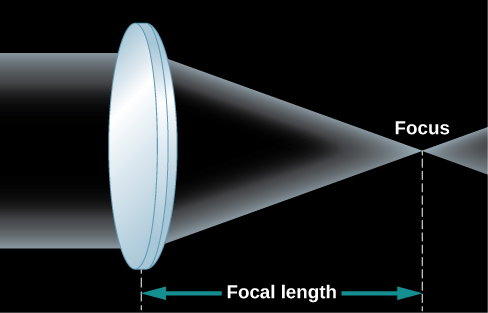
Whether or not you wear glasses, you see the world through lenses; they are key elements of your eyes. A lens is a transparent piece of material that bends the rays of light passing through it. If the light rays are parallel as they enter, the lens brings them together in one place to form an image (Figure 6.4). If the curvatures of the lens surfaces are just right, all parallel rays of light (say, from a star) are bent, or refracted, in such a way that they converge toward a point, called the focus of the lens. At the focus, an image of the light source appears. In the case of parallel light rays, the distance from the lens to the location where the light rays focus, or image, behind the lens is called the focal length of the lens.
英語のヒント
眼鏡をかけていてもいなくても、私たちはレンズを通して世界を見ている。レンズは目の重要な構成要素だからである。レンズとは、通り抜ける光線を曲げる透明な材料である。光線が互いに平行な状態で入ってくると、レンズはそれらを一か所に集めて像を作る(図6.4)。レンズ表面の曲がり具合が適切なら、たとえば恒星から届くような平行な光線はすべて曲げられ、つまり屈折して、レンズの焦点と呼ばれる一点へ向かって集まる。その焦点に、光源の像が現れる。平行な光線の場合、レンズから、その後方で光線が集まって像を結ぶ位置までの距離を、レンズの焦点距離という。
Formation of an Image by a Simple Lens.単純なレンズによる結像。
OpenStax / Rice University · CC BY 4.0
Figure 6.4 Parallel rays from a distant source are bent by the convex lens so that they all come together in a single place (the focus) to form an image.
図6.4 遠くの光源から届く平行光線は凸レンズで曲げられ、一つの場所、すなわち焦点に集まって像を作る。
As you look at Figure 6.4, you may ask why two rays of light from the same star would be parallel to each other. After all, if you draw a picture of star shining in all directions, the rays of light coming from the star don’t look parallel at all. But remember that the stars (and other astronomical objects) are all extremely far away. By the time the few rays of light pointed toward us actually arrive at Earth, they are, for all practical purposes, parallel to each other. Put another way, any rays that were not parallel to the ones pointed at Earth are now heading in some very different direction in the universe.
英語のヒント
図6.4を見て、同じ星から来る2本の光線が、なぜ互いに平行なのかと疑問に思うかもしれない。確かに、全方向へ光を放つ星を絵に描くと、その星から出る光線はまったく平行には見えない。しかし、恒星をはじめとする天体は、いずれも極めて遠くにあることを思い出そう。私たちのほうに向いたわずかな光線が実際に地球に届くころには、実用上、それらは平行とみなせる。言い換えれば、地球のほうを向いた光線と平行でなかった光線は、今ごろ宇宙のまったく別の方向へ進んでいるのである。
To view the image formed by the lens in a telescope, we use an additional lens called an eyepiece. The eyepiece focuses the image at a distance that is either directly viewable by a human or at a convenient place for a detector. Using different eyepieces, we can change the magnification (or size) of the image and also redirect the light to a more accessible location. Stars look like points of light, and magnifying them makes little difference, but the image of a planet or a galaxy, which has structure, can often benefit from being magnified.
英語のヒント
望遠鏡のレンズが作る像を見るために、接眼レンズと呼ばれるもう一つのレンズを使う。接眼レンズは、人が直接見られる距離、あるいは検出器を置くのに都合のよい場所に像を結ばせる。接眼レンズを替えれば、像の倍率、つまり大きさを変えることができ、光を扱いやすい位置へ向け直すこともできる。恒星は光の点のように見えるため、拡大してもあまり違いはない。しかし、構造を持つ惑星や銀河の像は、拡大すると見やすくなることが多い。
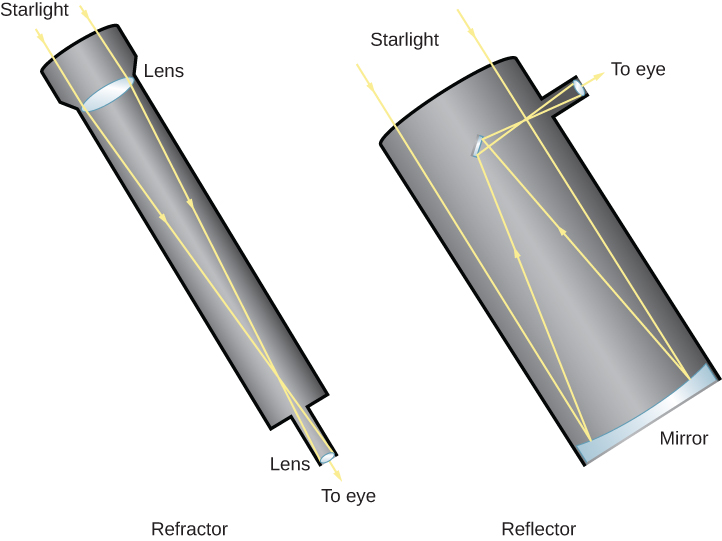
Many people, when thinking of a telescope, picture a long tube with a large glass lens at one end. This design, which uses a lens as its main optical element to form an image, as we have been discussing, is known as a refractor (Figure 6.5), and a telescope based on this design is called a refracting telescope. Galileo’s telescopes were refractors, as are today’s binoculars and field glasses. However, there is a limit to the size of a refracting telescope. The largest one ever built was a 49-inch refractor built for the Paris 1900 Exposition, and it was dismantled after the Exposition. Currently, the largest refracting telescope is the 40-inch refractor at Yerkes Observatory in Wisconsin.
英語のヒント
望遠鏡というと、多くの人は片端に大きなガラスレンズの付いた長い筒を思い浮かべる。これまで説明してきたように、レンズを主要な光学素子として像を作るこの設計は屈折式と呼ばれ(図6.5)、この設計による望遠鏡を屈折望遠鏡という。ガリレオの望遠鏡も屈折式であり、現在の双眼鏡や携帯用の双眼鏡も同じ方式である。ただし、屈折望遠鏡の大きさには限界がある。これまでに造られた最大のものは、1900年のパリ万国博覧会のために造られた49インチ屈折望遠鏡で、博覧会の後に解体された。現在、最大の屈折望遠鏡は、ウィスコンシン州のヤーキス天文台にある40インチ屈折望遠鏡である。
Refracting and Reflecting Telescopes.屈折望遠鏡と反射望遠鏡。
OpenStax / Rice University · CC BY 4.0
Figure 6.5 Light enters a refracting telescope through a lens at the upper end, which focuses the light near the bottom of the telescope. An eyepiece then magnifies the image so that it can be viewed by the eye, or a detector like a photographic plate can be placed at the focus. The upper end of a reflecting telescope is open, and the light passes through to the mirror located at the bottom of the telescope. The mirror then focuses the light at the top end, where it can be detected. Alternatively, as in this sketch, a second mirror may reflect the light to a position outside the telescope structure, where an observer can have easier access to it. Professional astronomers’ telescopes are more complicated than this, but they follow the same principles of reflection and refraction.
図6.5 光は屈折望遠鏡の上端のレンズを通って入り、そのレンズによって望遠鏡の下端近くに集められる。接眼レンズで像を拡大して目で見ることも、写真乾板のような検出器を焦点に置くこともできる。反射望遠鏡の上端は開いており、光はそこを通って下端の鏡に達する。その鏡が上端のほうへ光を集め、そこで検出できるようにする。この図のように、2枚目の鏡で望遠鏡の構造物の外側へ光を反射させ、観測者が扱いやすい位置へ導く方法もある。専門の天文学者が使う望遠鏡はこれより複雑だが、反射と屈折の同じ原理に従っている。
One problem with a refracting telescope is that the light must pass through the lens of a refractor. That means the glass must be perfect all the way through, and it has proven very difficult to make large pieces of glass without flaws and bubbles in them. Also, optical properties of transparent materials change a little bit with the wavelengths (or colors) of light, so there is some additional distortion, known as chromatic aberration. Each wavelength focuses at a slightly different spot, causing the image to appear blurry.
英語のヒント
屈折望遠鏡の問題の一つは、光がレンズの中を通り抜けなければならないことだ。そのため、ガラスは内部まで完全でなければならないが、欠陥や気泡のない大きなガラスを作ることは極めて難しいとわかっている。また、透明な材料の光学的な性質は、光の波長、つまり色によって少し変わる。そのため、色収差という別のひずみも生じる。波長ごとに焦点の位置が少しずつ異なり、像がぼやけて見える。
In addition, since the light must pass through the lens, the lens can only be supported around its edges (just like the frames of our eyeglasses). The force of gravity will cause a large lens to sag and distort the path of the light rays as they pass through it. Finally, because the light passes through it, both sides of the lens must be manufactured to precisely the right shape in order to produce a sharp image.
英語のヒント
さらに、光を通す必要があるため、レンズは縁の部分でしか支えられない。眼鏡のフレームと同じである。大きなレンズは重力でたわみ、その中を通る光線の進路をゆがめてしまう。最後に、光がレンズを通過する以上、くっきりした像を作るには、両面とも正確に適切な形に仕上げなければならない。
A different type of telescope uses a concave primary mirror as its main optical element. The mirror is curved like the inner surface of a sphere, and it reflects light in order to form an image (Figure 6.5). Telescope mirrors are coated with a shiny metal, usually silver, aluminum, or, occasionally, gold, to make them highly reflective. If the mirror has the correct shape, all parallel rays are reflected back to the same point, the focus of the mirror. Thus, images are produced by a mirror exactly as they are by a lens.
英語のヒント
別の方式の望遠鏡では、凹面の主鏡を主要な光学素子として使う。鏡は球の内面のように曲がっており、光を反射して像を作る(図6.5)。望遠鏡の鏡は、反射率を高くするため、通常は銀やアルミニウム、ときには金などの光沢のある金属でコーティングされる。鏡の形が適切であれば、平行な光線はすべて同じ点、すなわち鏡の焦点へ向かって反射される。このように、鏡でもレンズと同様に像ができる。
Telescopes designed with mirrors avoid the problems of refracting telescopes. Because the light is reflected from the front surface only, flaws and bubbles within the glass do not affect the path of the light. In a telescope designed with mirrors, only the front surface has to be manufactured to a precise shape, and the mirror can be supported from the back. For these reasons, most astronomical telescopes today (both amateur and professional) use a mirror rather than a lens to form an image; this type of telescope is called a reflecting telescope. The first successful reflecting telescope was built by Isaac Newton in 1668.
英語のヒント
鏡を使う設計の望遠鏡は、屈折望遠鏡の問題を避けられる。光は前面で反射するだけなので、ガラス内部の欠陥や気泡は光の進路に影響しない。正確な形に仕上げる必要があるのも前面だけで、鏡を後ろから支えることもできる。こうした理由から、現在の天体望遠鏡は、アマチュア用でも専門家用でも、多くがレンズではなく鏡で像を作る。この方式の望遠鏡を反射望遠鏡という。最初に実用となった反射望遠鏡は、1668年にアイザック・ニュートンが製作した。
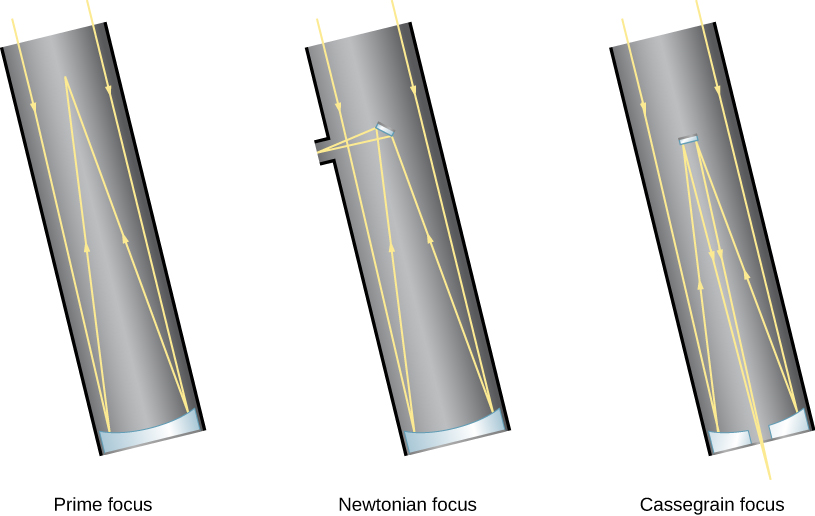
In a reflecting telescope, the concave mirror is placed at the bottom of a tube or open framework. The mirror reflects the light back up the tube to form an image near the front end at a location called the prime focus. The image can be observed at the prime focus, or additional mirrors can intercept the light and redirect it to a position where the observer can view it more easily (Figure 6.6). Since an astronomer at the prime focus can block much of the light coming to the main mirror, the use of a small secondary mirror allows more light to get through the system.
英語のヒント
反射望遠鏡では、凹面鏡を筒や骨組みの底部に置く。鏡は光を筒の上方へ反射し、前端近くの主焦点と呼ばれる場所に像を作る。その主焦点で像を観測してもよいし、追加の鏡で光を受け、観測者がもっと見やすい位置へ向け直してもよい(図6.6)。主焦点に天文学者がいると、主鏡へ入る光の多くを遮ってしまうことがある。そのため、小さな副鏡を使うほうが、装置全体を通る光の量を多くできる。
Focus Arrangements for Reflecting Telescopes.反射望遠鏡の焦点の配置。
OpenStax / Rice University · CC BY 4.0
Figure 6.6 Reflecting telescopes have different options for where the light is brought to a focus. With prime focus, light is detected where it comes to a focus after reflecting from the primary mirror. With Newtonian focus, light is reflected by a small secondary mirror off to one side, where it can be detected (see also Figure 6.5). Most large professional telescopes have a Cassegrain focus in which light is reflected by the secondary mirror down through a hole in the primary mirror to an observing station below the telescope.
図6.6 反射望遠鏡では、どこに光を集めて焦点を作るかを選べる。主焦点方式では、主鏡で反射した光が集まる場所で検出する。ニュートン焦点方式では、小さな副鏡で光を横へ反射し、その先で検出する(図6.5も参照)。専門家用の大型望遠鏡の多くはカセグレン焦点を備えている。この方式では、副鏡が光を下方へ反射し、主鏡に開けた穴を通して、望遠鏡の下にある観測位置へ導く。
A telescope collects the faint light from astronomical sources and brings it to a focus, where an instrument can sort the light according to wavelength. Light is then directed to a detector, where a permanent record is made. The light-gathering power of a telescope is determined by the diameter of its aperture, or opening—that is, by the area of its largest or primary lens or mirror. The primary optical element in a telescope is either a convex lens (in a refracting telescope) or a concave mirror (in a reflector) that brings the light to a focus. Most large telescopes are reflectors; it is easier to manufacture and support large mirrors because the light does not have to pass through glass.
英語のヒント
望遠鏡は天体からのかすかな光を集めて焦点に導き、そこで装置を使って波長ごとに分けられるようにする。その後、光は検出器へ送られ、後に残る記録が作られる。望遠鏡の集光力は口径、つまり開口部の直径によって決まり、言い換えれば、最も大きな主レンズや主鏡の面積によって決まる。望遠鏡の主要な光学素子は、屈折望遠鏡では凸レンズ、反射望遠鏡では凹面鏡であり、光を焦点に集める。大型望遠鏡の多くは反射式である。光がガラスを通過する必要がないため、大きな鏡のほうが製作しやすく、支えやすいからである。
aperture
口径
diameter of the primary lens or mirror of a telescope
望遠鏡の主レンズまたは主鏡の直径。
chromatic aberration
色収差
distortion that causes an image to appear fuzzy when each wavelength coming into a transparent material focuses at a different spot
透明な材料に入る光の波長ごとに焦点の位置が異なり、像がぼやけて見えるひずみ。
detector
検出器
device sensitive to electromagnetic radiation that makes a record of astronomical observations
電磁放射を感知し、天体観測の記録を作る装置。
eyepiece
接眼レンズ
magnifying lens used to view the image produced by the objective lens or primary mirror of a telescope
望遠鏡の対物レンズや主鏡によって作られた像を見るための拡大レンズ。
focus
焦点
(of telescope) point where the rays of light converged by a mirror or lens meet
望遠鏡で、鏡やレンズによって集められた光線が交わる点。
prime focus
主焦点
point in a telescope where the objective lens or primary mirror focuses the light
望遠鏡の対物レンズや主鏡が光を集める点。
reflecting telescope
反射望遠鏡
telescope in which the principal light collector is a concave mirror
主な集光素子として凹面鏡を使う望遠鏡。
refracting telescope
屈折望遠鏡
telescope in which the principal light collector is a lens or system of lenses
主な集光素子として、レンズまたは複数のレンズの組み合わせを使う望遠鏡。
telescope
望遠鏡
instrument for collecting visible-light or other electromagnetic radiation
可視光や、それ以外の電磁放射を集める装置。