第31章政府借入の影響
Public Investment in Human Capital人的資本への公共投資
In most countries, the government plays a large role in society's investment in human capital through the education system. A highly educated and skilled workforce contributes to a higher rate of economic growth. For the low-income nations of the world, additional investment in human capital seems likely to increase productivity and growth. For the United States, critics have raised tough questions about how much increases in government spending on education will improve the actual level of education.
英語のヒント
ほとんどの国では、政府は教育制度を通じた社会の人的資本投資に、大きな役割を果たす。高度な教育と技能を備えた労働力は、経済成長率の上昇に寄与する。世界の低所得国では、人的資本への追加投資は、生産性と成長を高める可能性が高い。アメリカでは、教育への政府支出を増やすことが、実際の教育水準をどの程度改善するかについて、批判者が厳しい問いを投げかけている。
Among economists, discussions of education reform often begin with some uncomfortable facts. As Figure 31.9 shows, total federal spending in the U.S. for kindergarten through grade 12 (K–12) increased substantially in nominal dollars through 2010, declined slightly in 2011 and 2012, and began rising again after that through 2020. However, as measured by standardized tests like the SAT, the level of student academic achievement has barely budged in recent decades. On international tests, U.S. students lag behind students from many other countries. (Of course, test scores are an imperfect measure of education for a variety of reasons. It would be difficult, however, to argue that there are not real problems in the U.S. education system and that the tests are just inaccurate.)
英語のヒント
経済学者の間では、教育改革の議論は、しばしば不都合な事実から始まる。図31.9が示すように、アメリカの幼稚園から第12学年まで(K–12)に対する連邦総支出は、名目ドルで2010年まで大幅に増え、2011年と2012年にわずかに減り、その後2020年まで再び増え始めた。しかし、SATのような標準化テストで測った生徒の学力水準は、ここ数十年ほとんど動いていない。国際的なテストでは、アメリカの生徒は多くの他国の生徒に遅れをとっている。(もちろん、テストの得点は、さまざまな理由で教育の不完全な尺度である。しかし、アメリカの教育制度には実際の問題はなく、テストが不正確なだけだと論じるのは難しいだろう。)
Total Spending for Elementary, Secondary, and Vocational Education (1998–2020) in the United Statesアメリカの初等・中等・職業教育に対する総支出(1998~2020年)
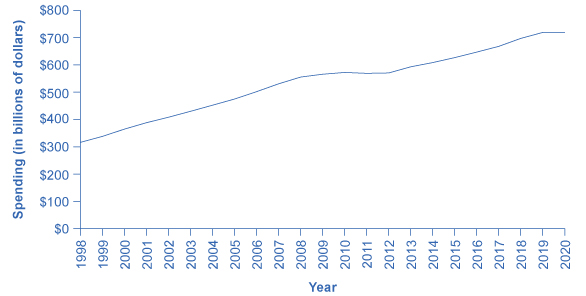

Figure 31.9図 31.9
The graph shows that government spending on education was continually increasing up until 2008 where it leveled off until 2010, then declined slightly in 2011 and 2012. Since 2012, spending has steadily increased. (Source: Federal Reserve Economic Data (FRED) https://fred.stlouisfed.org/series/G160291A027NBEA)
英語のヒント
このグラフは、政府の教育支出が2008年まで増え続け、そこで2010年まで横ばいとなり、その後2011年と2012年にわずかに減ったことを示す。2012年以降、支出は着実に増加している。(出所:連邦準備経済データ(FRED)、https://fred.stlouisfed.org/series/G160291A027NBEA)
The fact that increased financial resources have not brought greater measurable gains in student performance has led some education experts to question whether the problems may be due to structure, not just to the resources spent.
英語のヒント
財源の増加が、生徒の成績の測定可能な改善をそれ以上にもたらさなかったという事実から、一部の教育専門家は、問題が投入する資源だけでなく、構造にあるのではないかと疑問を呈している。
Other government programs seek to increase human capital either before or after the K–12 education system. Programs for early childhood education, like the federal Head Start program, are directed at families where the parents may have limited educational and financial resources. Government also offers substantial support for universities and colleges. For example, in the United States about 60% of students take at least a few college or university classes beyond the high school level. In Germany and Japan, about half of all students take classes beyond the comparable high school level. In the countries of Latin America, only about one student in four takes classes beyond the high school level, and in the nations of sub-Saharan Africa, only about one student in 20.
英語のヒント
他の政府事業は、K–12教育制度の前か後に人的資本を増やそうとする。連邦のヘッド・スタート事業のような幼児教育の事業は、親の教育面・経済面の資源が限られているかもしれない家庭を対象とする。政府は大学にも多額の支援を提供する。たとえばアメリカでは、生徒の約60%が、高校を超える水準の大学の授業を少なくともいくつか受ける。ドイツと日本では、全生徒の約半数が、同等の高校段階を超える授業を受ける。ラテンアメリカ諸国では、高校を超える授業を受けるのは生徒の約4人に1人にすぎず、サハラ以南のアフリカ諸国では約20人に1人にすぎない。
Not all spending on educational human capital needs to happen through the government: many college students in the United States pay a substantial share of the cost of their education. If low-income countries of the world are going to experience a widespread increase in their education levels for grade-school children, government spending seems likely to play a substantial role. For the U.S. economy, and for other high-income countries, the primary focus at this time is more on how to get a bigger return from existing spending on education and how to improve the performance of the average high school graduate, rather than dramatic increases in education spending.
英語のヒント
教育を通じた人的資本への支出が、すべて政府を通じて行われる必要はない。アメリカの大学生の多くは、自分の教育費のかなりの部分を支払う。世界の低所得国が、小学生の教育水準の広範な向上を実現するには、政府支出が大きな役割を果たしそうである。アメリカ経済や他の高所得国では、現在の主な焦点は、教育支出を劇的に増やすことより、既存の教育支出からどうすればより大きな成果を得られるか、平均的な高校卒業者の能力をどう改善するかにある。
How Fiscal Policy Can Improve Technology財政政策は技術をどう改善できるか
Research and development (R&D) efforts are the lifeblood of new technology. According to the National Science Foundation, federal outlays for research, development, and physical plant improvements to various governmental agencies have remained at an average of 8.8% of GDP. About one-fifth of U.S. R&D spending goes to defense and space-oriented research. Although defense-oriented R&D spending may sometimes produce consumer-oriented spinoffs, R&D that is aimed at producing new weapons is less likely to benefit the civilian economy than direct civilian R&D spending.
英語のヒント
研究開発(R&D)の努力は、新技術の生命線である。全米科学財団によると、さまざまな政府機関の研究、開発、施設改善に対する連邦支出は、平均でGDPの8.8%を維持してきた。アメリカの研究開発支出の約5分の1は、国防や宇宙関連の研究に向かう。国防目的の研究開発支出が、ときには消費者向けの派生技術を生むこともあるが、新兵器の製造を目的とする研究開発は、直接的な民生研究開発支出に比べて、民間経済に利益をもたらしにくい。
Fiscal policy can encourage R&D using either direct spending or tax policy. Government could spend more on the R&D that it carries out in government laboratories, as well as expanding federal R&D grants to universities and colleges, nonprofit organizations, and the private sector. By 2014, the federal share of R&D outlays totaled $135.5 billion, or about 4% of the federal government's total budget outlays, according to data from the National Science Foundation. Fiscal policy can also support R&D through tax incentives, which allow firms to reduce their tax bill as they increase spending on research and development.
英語のヒント
財政政策は、直接支出または税制のいずれかによって研究開発を促進できる。政府は、政府の研究所で実施する研究開発への支出を増やすとともに、大学、非営利組織、民間部門への連邦研究開発補助金を拡充できる。全米科学財団のデータによると、2014年には研究開発支出の連邦負担分は計1,355億ドルに達し、連邦政府の総予算支出の約4%となった。財政政策は税制上の優遇措置によって研究開発を支援することもできる。企業は研究開発支出を増やすにつれて、税額を減らすことができる。