第31章政府借入の影響
31.1 How Government Borrowing Affects Investment and the Trade Balance31.1 政府借入れが投資と貿易収支に及ぼす影響
Learning Objectives学習目標
Learning Objectives学習目標
By the end of this section, you will be able to:
英語のヒント
この節を学ぶと、次のことができるようになる。
- Explain the national saving and investment identity in terms of demand and supply
英語のヒント
需要と供給の観点から、国民貯蓄・投資恒等式を説明する - Evaluate the role of budget surpluses and trade surpluses in national saving and investment identity
英語のヒント
国民貯蓄・投資恒等式における、財政黒字と貿易黒字の役割を評価する
When governments are borrowers in financial markets, there are three possible sources for the funds from a macroeconomic point of view: (1) households might save more; (2) private firms might borrow less; and (3) the additional funds for government borrowing might come from outside the country, from foreign financial investors. Let’s begin with a review of why one of these three options must occur, and then explore how interest rates and exchange rates adjust to these connections.
英語のヒント
政府が金融市場の借り手となるとき、マクロ経済の観点からは、資金源として三つの可能性がある。(1)家計がより多く貯蓄する。(2)民間企業が借入れを減らす。(3)政府借入れに必要な追加資金が、国外の金融投資家から来る。まず、なぜこの三つの選択肢のいずれかが起こらなければならないかを復習し、その後、こうしたつながりに金利や為替レートがどう調整するかを検討しよう。
The National Saving and Investment Identity国民貯蓄・投資恒等式
The national saving and investment identity, which we first introduced in The International Trade and Capital Flows chapter, provides a framework for showing the relationships between the sources of demand and supply in financial capital markets. The identity begins with a statement that must always hold true: the quantity of financial capital supplied in the market must equal the quantity of financial capital demanded.
英語のヒント
「国際貿易と資本移動」の章で初めて導入した国民貯蓄・投資恒等式は、金融資本市場における需要源と供給源の関係を示す枠組みとなる。この恒等式は、必ず成立しなければならない次の命題から出発する。市場で供給される金融資本の量は、需要される金融資本の量に等しくなければならない。
The U.S. economy has two main sources for financial capital: private savings from inside the U.S. economy and public savings.
英語のヒント
アメリカ経済の金融資本には、二つの主要な供給源がある。アメリカ経済内部の民間貯蓄と、政府貯蓄である。
These include the inflow of foreign financial capital from abroad. The inflow of savings from abroad is, by definition, equal to the trade deficit, as we explained in The International Trade and Capital Flows chapter. We can write this inflow of foreign investment capital as imports (M) minus exports (X). There are also two main sources of demand for financial capital: private sector investment (I) and government borrowing. Government borrowing in any given year is equal to the budget deficit, which we can write as the difference between government spending (G) and net taxes (T). Let’s call this equation 1.
英語のヒント
これらには、海外からの金融資本の流入が含まれる。海外からの貯蓄流入は、「国際貿易と資本移動」の章で説明したように、定義上、貿易赤字に等しい。この外国投資資本の流入は、輸入(M)から輸出(X)を引いたものと書ける。金融資本への需要にも、二つの主要な源泉がある。民間部門の投資(I)と、政府借入れである。ある年の政府借入れは財政赤字に等しく、政府支出(G)と純租税(T)の差として書ける。この式を式1と呼ぼう。
Governments often spend more than they receive in taxes and, therefore, public savings (T – G) is negative. This causes a need to borrow money in the amount of (G – T) instead of adding to the nation’s savings. If this is the case, we can view governments as demanders of financial capital instead of suppliers. In algebraic terms, we can rewrite the national savings and investment identity like this:
英語のヒント
政府は、税として受け取る以上に支出することが多いため、政府貯蓄(T-G)は負になる。そのため、国の貯蓄に追加する代わりに、(G-T)だけの金額を借りる必要が生じる。その場合、政府を金融資本の供給者ではなく、需要者と見ることができる。代数的には、国民貯蓄・投資恒等式を次のように書き換えられる。
Let’s call this equation 2. We must accompany a change in any part of the national saving and investment identity by offsetting changes in at least one other part of the equation because we assume that the equality of quantity supplied and quantity demanded always holds. If the government budget deficit changes, then either private saving or investment or the trade balance—or some combination of the three—must change as well. Figure 31.2 shows the possible effects.
英語のヒント
これを式2と呼ぼう。国民貯蓄・投資恒等式のどこか一部分が変われば、式の少なくとも別の一部分に、それを相殺する変化が伴わなければならない。供給量と需要量の等しさが、常に成立すると仮定しているからである。政府の財政赤字が変わるなら、民間貯蓄、投資、貿易収支のいずれか、またはその組合せも変わらなければならない。図31.2は、起こりうる影響を示す。
Effects of Change in Budget Surplus or Deficit on Investment, Savings, and The Trade Balance財政黒字・赤字の変化が投資、貯蓄、貿易収支に及ぼす影響
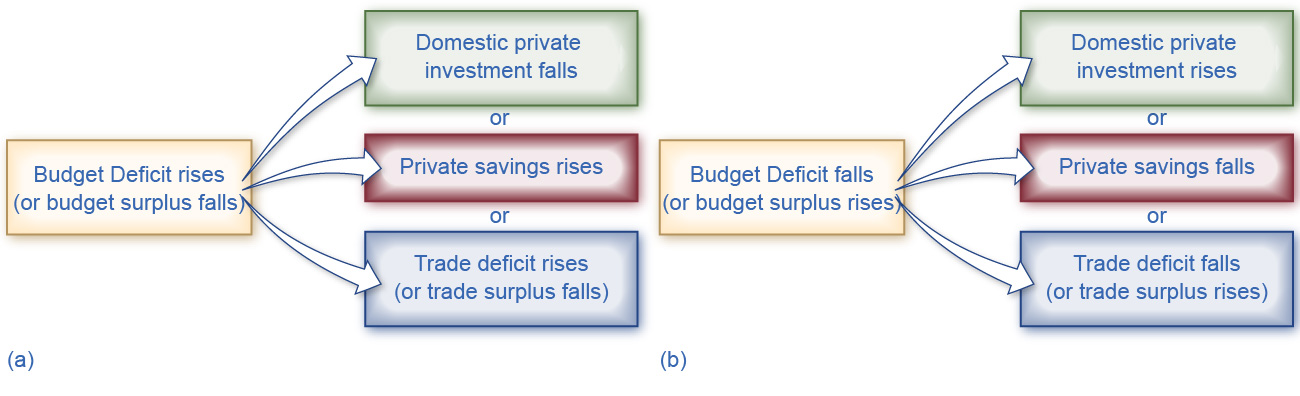
Figure 31.2図 31.2
Chart (a) shows the potential results when the budget deficit rises (or budget surplus falls). Chart (b) shows the potential results when the budget deficit falls (or budget surplus rises).
英語のヒント
図(a)は、財政赤字が増える、または財政黒字が減る場合に、起こりうる結果を示す。図(b)は、財政赤字が減る、または財政黒字が増える場合に、起こりうる結果を示す。
What about Budget Surpluses and Trade Surpluses?財政黒字や貿易黒字の場合はどうか
The national saving and investment identity must always hold true because, by definition, the quantity supplied and quantity demanded in the financial capital market must always be equal. However, the formula will look somewhat different if the government budget is in deficit rather than surplus or if the balance of trade is in surplus rather than deficit. For example, in 1999 and 2000, the U.S. government had budget surpluses, although the economy was still experiencing trade deficits. When the government was running budget surpluses, it was acting as a saver rather than a borrower, and supplying rather than demanding financial capital. As a result, we would write the national saving and investment identity during this time as:
英語のヒント
国民貯蓄・投資恒等式は、常に成立しなければならない。定義上、金融資本市場の供給量と需要量は常に等しくなければならないからである。しかし、政府予算が黒字ではなく赤字の場合や、貿易収支が赤字ではなく黒字の場合、式の見た目はいくらか変わる。たとえば1999年と2000年、アメリカ政府は財政黒字だったが、経済はなお貿易赤字を経験していた。政府は財政黒字を計上しているとき、借り手ではなく貯蓄者として行動し、金融資本を需要するのではなく供給していた。そのため、この時期の国民貯蓄・投資恒等式は、次のように書ける。
Let's call this equation 3. Notice that this expression is mathematically the same as equation 2 except the savings and investment sides of the identity have simply flipped sides.
英語のヒント
これを式3と呼ぼう。この式は、恒等式の貯蓄側と投資側の左右を入れ替えただけで、数学的には式2と同じであることに注意しよう。
During the 1960s, the U.S. government was often running a budget deficit, but the economy was typically running trade surpluses. Since a trade surplus means that an economy is experiencing a net outflow of financial capital, we would write the national saving and investment identity as:
英語のヒント
1960年代、アメリカ政府はしばしば財政赤字を計上したが、経済は通常、貿易黒字だった。貿易黒字は、経済から金融資本が純流出していることを意味するため、国民貯蓄・投資恒等式は次のように書ける。
Instead of the balance of trade representing part of the supply of financial capital, which occurs with a trade deficit, a trade surplus represents an outflow of financial capital leaving the domestic economy and invested elsewhere in the world.
英語のヒント
貿易赤字の場合には、貿易収支は金融資本供給の一部を表す。それに対し、貿易黒字は、金融資本が国内経済を出て、世界のほかの場所で投資される流出を表す。
We assume that the point to these equations is that the national saving and investment identity always hold. When you write these relationships, it is important to engage your brain and think about what is on the supply and demand side of the financial capital market before you start your calculations.
英語のヒント
これらの式の要点は、国民貯蓄・投資恒等式が常に成立すると仮定することにある。こうした関係を書くときは、計算を始める前に頭を働かせ、金融資本市場の供給側と需要側に何があるのかを考えることが重要である。
As you can see in Figure 31.3, the Office of Management and Budget shows that the United States has consistently run budget deficits since 1977, with the exception of 1999 and 2000. What is alarming is the dramatic increase in budget deficits that has occurred since 2008, which in part reflects declining tax revenues and increased safety net expenditures due to the Great Recession. While deficits were controlled as the economy began to recover in the mid-2010s, the budget deficit increased again in 2020 during the pandemic, and forecasters expect deficits to remain high for the foreseeable future. (Recall that T is net taxes. When the government must transfer funds back to individuals for safety net expenditures like Social Security and unemployment benefits, budget deficits rise.) These deficits have implications for the future health of the U.S. economy.
英語のヒント
図31.3に見られるように、行政管理予算局は、アメリカが1999年と2000年を除き、1977年以降、一貫して財政赤字を計上してきたことを示している。懸念されるのは、2008年以降の財政赤字の劇的な増加であり、その一部は、大不況による税収減と安全網支出の増加を反映する。2010年代半ば、経済の回復が始まると赤字は抑制されたが、2020年のパンデミック中に再び増加し、予測担当者は、見通せる将来にわたって赤字が高い水準にとどまると予想している。(Tは純租税であることを思い出そう。社会保障や失業給付といった安全網支出のため、政府が個人へ資金を戻さなければならないとき、財政赤字は増える。)これらの赤字は、アメリカ経済の将来の健全性に影響を持つ。
United States On-Budget, Surplus, and Deficit, 1952–2020 ($ billions)アメリカの一般予算、黒字、赤字、1952~2020年(単位:10億ドル)
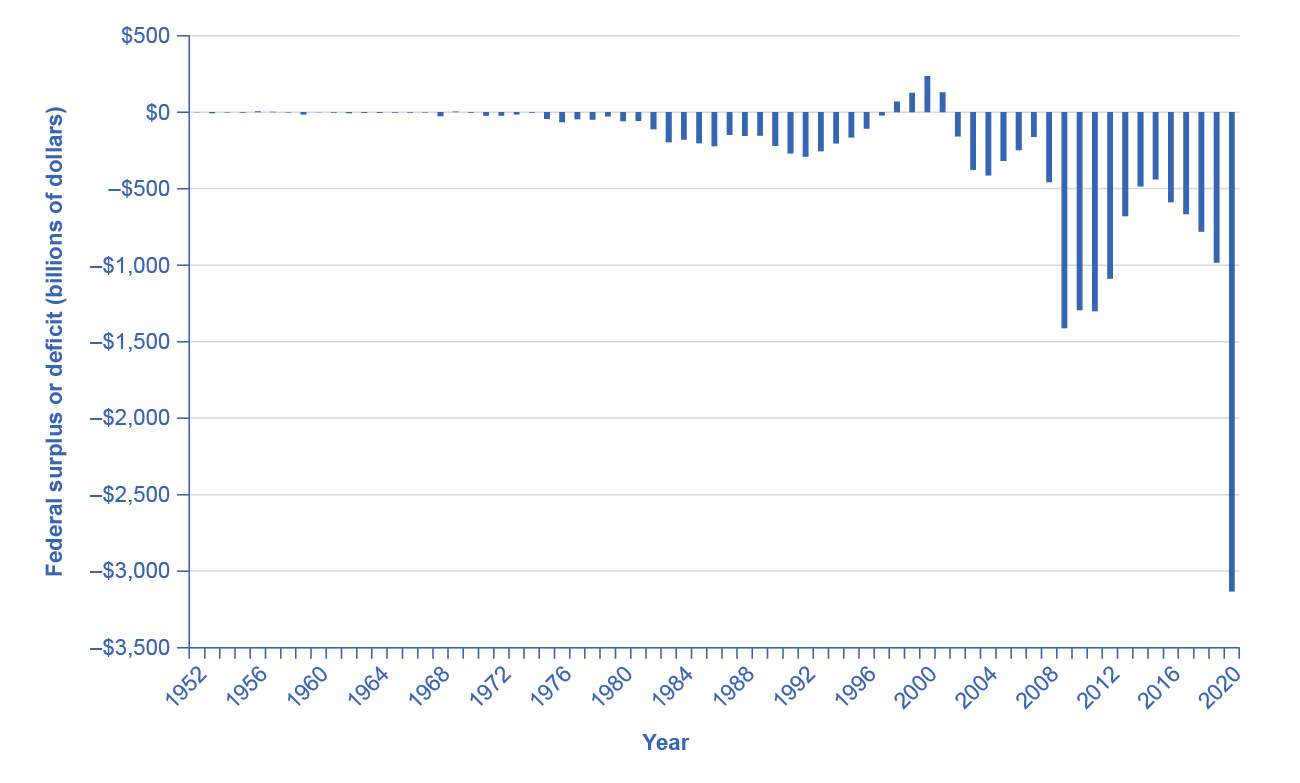


Figure 31.3図 31.3
The United States has run a budget deficit for over 30 years, with the exception of 1999 and 2000. Military expenditures, entitlement programs, and the decrease in tax revenue coupled with increased safety net support during the Great Recession are major contributors to the dramatic increases in the deficit after 2008. (Source: Office of Management and Budget, https://fred.stlouisfed.org/series/FYFSGDA188S)
英語のヒント
アメリカは、1999年と2000年を除き、30年以上にわたって財政赤字を計上してきた。2008年以降の赤字の劇的な増加には、軍事支出、受給資格に基づく給付制度、そして大不況中の税収減と安全網支援の増加が、大きく寄与している。(出典:行政管理予算局、https://fred.stlouisfed.org/series/FYFSGDA188S)
A rising budget deficit may result in a fall in domestic investment, a rise in private savings, or a rise in the trade deficit. The following modules discuss each of these possible effects in more detail.
英語のヒント
財政赤字の増加は、国内投資の減少、民間貯蓄の増加、または貿易赤字の増加をもたらす場合がある。以下の節で、これらの可能性をそれぞれ詳しく論じる。