第31章政府借入の影響
The Interest Rate Connection金利とのつながり
Assume that government borrowing of substantial amounts will have an effect on the quantity of private investment. How will this affect interest rates in financial markets? In Figure 31.8, the original equilibrium (E0) where the demand curve (D0) for financial capital intersects with the supply curve (S0) occurs at an interest rate of 5% and an equilibrium quantity equal to 20% of GDP. However, as the government budget deficit increases, the demand curve for financial capital shifts from D0 to D1. The new equilibrium (E1) occurs at an interest rate of 6% and an equilibrium quantity of 21% of GDP.
英語のヒント
多額の政府借入れが、民間投資の量に影響すると仮定しよう。これは金融市場の金利にどう影響するだろうか。図31.8では、金融資本の需要曲線(D0)と供給曲線(S0)が交わる当初の均衡(E0)は、金利5%、均衡量はGDPの20%に等しいところで生じる。しかし、政府の財政赤字が増えると、金融資本の需要曲線はD0からD1へ移動する。新しい均衡(E1)は、金利6%、均衡量はGDPの21%で生じる。
Budget Deficits and Interest Rates財政赤字と金利
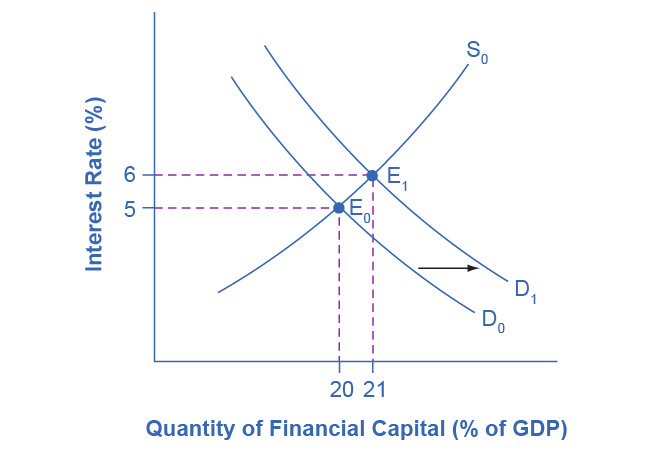

Figure 31.8図 31.8
In the financial market, an increase in government borrowing can shift the demand curve for financial capital to the right from D0 to D1. As the equilibrium interest rate shifts from E0 to E1, the interest rate rises from 5% to 6% in this example. The higher interest rate is one economic mechanism by which government borrowing can crowd out private investment.
英語のヒント
金融市場では、政府借入れの増加は、金融資本の需要曲線をD0からD1へ右に移動させうる。均衡金利がE0からE1へ移ると、この例では金利は5%から6%へ上がる。金利の上昇は、政府借入れが民間投資をクラウディング・アウトする経済的な仕組みの一つである。
A survey of economic studies on the connection between government borrowing and interest rates in the U.S. economy suggests that an increase of 1% in the budget deficit will lead to a rise in interest rates of between 0.5 and 1.0%, other factors held equal. In turn, a higher interest rate tends to discourage firms from making physical capital investments. One reason government budget deficits crowd out private investment, therefore, is the increase in interest rates. There are, however, economic studies that show a limited connection between the two (at least in the United States), but as the budget deficit grows, the dangers of rising interest rates become more real.
英語のヒント
アメリカ経済の政府借入れと金利のつながりに関する経済研究の調査は、他の条件が同じなら、財政赤字が1%増えると金利が0.5~1.0%上がることを示唆する。次に、金利の上昇は、企業の実物資本投資を抑える傾向がある。したがって、政府の財政赤字が民間投資をクラウディング・アウトする一つの理由は、金利の上昇である。しかし、両者のつながりは(少なくともアメリカでは)限定的だと示す経済研究もあるが、財政赤字が大きくなるにつれて、金利上昇の危険はより現実的になる。
At this point, you may wonder about the Federal Reserve. After all, can the Federal Reserve not use expansionary monetary policy to reduce interest rates, or in this case, to prevent interest rates from rising? This useful question emphasizes the importance of considering how fiscal and monetary policies work in relation to each other. Imagine a central bank faced with a government that is running large budget deficits, causing a rise in interest rates and crowding out private investment. If the budget deficits are increasing aggregate demand when the economy is already producing near potential GDP, threatening an inflationary increase in price levels, the central bank may react with a contractionary monetary policy. In this situation, the higher interest rates from the government borrowing would be made even higher by contractionary monetary policy, and the government borrowing might crowd out a great deal of private investment.
英語のヒント
ここで、連邦準備制度について疑問に思うかもしれない。結局、連邦準備制度は、拡張的金融政策によって金利を下げたり、この場合には金利の上昇を防いだりできないのだろうか。この有益な問いは、財政政策と金融政策が互いにどう関係して働くかを考える重要性を強調する。大幅な財政赤字を出し、金利上昇と民間投資のクラウディング・アウトを起こしている政府に、中央銀行が直面していると考えよう。経済がすでに潜在GDP近くで生産しているのに、財政赤字が総需要を増やし、物価水準のインフレ的上昇の恐れを生んでいるなら、中央銀行は引締め的金融政策で対応するかもしれない。この状況では、政府借入れによって上がった金利が、引締め的金融政策によってさらに高くなり、政府借入れは大量の民間投資をクラウディング・アウトするかもしれない。
Alternatively, if the budget deficits are increasing aggregate demand when the economy is producing substantially less than potential GDP, an inflationary increase in the price level is not much of a danger and the central bank might react with expansionary monetary policy. In this situation, higher interest rates from government borrowing would be largely offset by lower interest rates from expansionary monetary policy, and there would be little crowding out of private investment.
英語のヒント
別の場合として、経済が潜在GDPを大きく下回る生産をしているときに財政赤字が総需要を増やしているなら、物価水準のインフレ的上昇はあまり危険ではなく、中央銀行は拡張的金融政策で対応するかもしれない。この状況では、政府借入れによる金利上昇は、拡張的金融政策による金利低下で大部分相殺され、民間投資のクラウディング・アウトはほとんど生じないだろう。
However, even a central bank cannot erase the overall message of the national savings and investment identity. If government borrowing rises, then private investment must fall, or private saving must rise, or the trade deficit must rise. By reacting with contractionary or expansionary monetary policy, the central bank can only help to determine which of these outcomes is likely.
英語のヒント
しかし、中央銀行でさえ、国民貯蓄・投資恒等式が全体として示す内容を消すことはできない。政府借入れが増えれば、民間投資が減るか、民間貯蓄が増えるか、貿易赤字が増えるかしなければならない。中央銀行は、引締め的または拡張的金融政策で対応することによって、これらのうち、どの結果が生じやすいかを決める手助けしかできない。
Public Investment in Physical Capital実物資本への公共投資
Government can invest in physical capital directly: roads and bridges; water supply and sewers; seaports and airports; schools and hospitals; plants that generate electricity, like hydroelectric dams or windmills; telecommunications facilities; and military weapons. In 2021, the United States spent about $146 billion on transportation, including highways, mass transit, and airports. Table 31.1 shows the federal government's total outlay for 2021 for major public physical capital investment in the United States. We have omitted physical capital related to the military or to residences where people live from this table, because the focus here is on public investments that have a direct effect on raising output in the private sector.
英語のヒント
政府は実物資本に直接投資できる。道路や橋、水道や下水道、港や空港、学校や病院、水力発電ダムや風車のような発電施設、通信施設、そして軍事兵器である。2021年、アメリカは、高速道路、公共交通、空港を含む交通に約1,460億ドルを支出した。表31.1は、2021年のアメリカの主要な公共実物資本投資に対する、連邦政府の総支出を示す。ここでは、民間部門の生産量を増やすことに直接影響する公共投資に注目するため、軍事や、人々が暮らす住宅に関連する実物資本は、この表から除いてある。
Type of Public Physical Capital 公共実物資本の種類 |
Federal Outlays 2014 2014年の連邦支出 |
Federal Outlays 2021 2021年の連邦支出 |
|---|---|---|
Transportation 交通 |
$91,915 |
$146,156 |
Community and regional development 地域社会・地域開発 |
$20,670 |
$83,619 |
Natural resources and the environment 天然資源と環境 |
$36,171 |
$40,691 |
Education, training, employment, and social services 教育、訓練、雇用、社会サービス |
$90,615 |
$236,723 |
Other その他 |
$37,282 |
$41,227 |
Total 合計 |
$276,653 |
$548,416 |
Public physical capital investment of this sort can increase the economy's output and productivity. An economy with reliable roads and electricity will be able to produce more. However, it is hard to quantify how much government investment in physical capital will benefit the economy, because government responds to political as well as economic incentives. When a firm makes an investment in physical capital, it is subject to the discipline of the market: If it does not receive a positive return on investment, the firm may lose money or even go out of business.
英語のヒント
この種の公共実物資本投資は、経済の生産量と生産性を高めうる。信頼できる道路と電力を備えた経済は、より多く生産できる。しかし、政府の実物資本投資が経済にどれほど利益をもたらすかを数量化するのは難しい。政府は経済的な誘因だけでなく、政治的な誘因にも反応するからである。企業が実物資本に投資するときには、市場の規律に従う。投資で正の収益を得られなければ、企業は損失を出したり、廃業したりさえする。
In some cases, lawmakers make investments in physical capital as a way of spending money in key politicians' districts. The result may be unnecessary roads or office buildings. Even if a project is useful and necessary, it might be done in a way that is excessively costly, because local contractors who make campaign contributions to politicians appreciate the extra business. Alternatively, governments sometimes do not make the investments they should because a decision to spend on infrastructure does not need to just make economic sense. It must be politically popular as well. Managing public investment cost-effectively can be difficult.
英語のヒント
場合によっては、議員は有力政治家の選挙区に金を使う手段として、実物資本に投資する。その結果、不要な道路や事務所ビルができることがある。事業が有用で必要でも、費用が過大な方法で行われることがある。政治家に選挙資金を献金する地元の請負業者が、仕事の追加を喜ぶからである。逆に、政府が行うべき投資を行わないこともある。インフラに支出するという決定には、経済的な合理性だけでは足りないからである。政治的な人気も必要なのだ。公共投資を費用に見合う効果が得られるように管理するのは、難しいことがある。
If a government decides to finance an investment in public physical capital with higher taxes or lower government spending in other areas, it need not worry that it is directly crowding out private investment. Indirectly however, higher household taxes could cut down on the level of private savings available and have a similar effect. If a government decides to finance an investment in public physical capital by borrowing, it may end up increasing the quantity of public physical capital at the cost of crowding out investment in private physical capital, which could be more beneficial to the economy.
英語のヒント
政府が、増税や他分野の政府支出削減で公共実物資本投資を賄うと決めた場合、民間投資を直接クラウディング・アウトする心配はない。しかし間接的には、家計への増税が利用可能な民間貯蓄を減らし、同様の効果をもたらしうる。政府が借入れで公共実物資本投資を賄うと決めた場合、経済にとってより有益かもしれない民間実物資本への投資をクラウディング・アウトする代償として、公共実物資本の量を増やす結果になることがある。