第31章政府借入の影響
31.2 Fiscal Policy and the Trade Balance31.2 財政政策と貿易収支
Learning Objectives学習目標
Learning Objectives学習目標
By the end of this section, you will be able to:
英語のヒント
この節を学ぶと、次のことができるようになる。
- Discuss twin deficits as they related to budget and trade deficit
英語のヒント
財政赤字と貿易赤字に関連する双子の赤字を論じる - Explain the relationship between budget deficits and exchange rates
英語のヒント
財政赤字と為替レートの関係を説明する - Explain the relationship between budget deficits and inflation
英語のヒント
財政赤字とインフレの関係を説明する - Identify causes of recessions
英語のヒント
景気後退の原因を特定する
Government budget balances can affect the trade balance. As The Keynesian Perspective chapter discusses, a net inflow of foreign financial investment always accompanies a trade deficit, while a net outflow of financial investment always accompanies a trade surplus. One way to understand the connection from budget deficits to trade deficits is that when government creates a budget deficit with some combination of tax cuts or spending increases, it will increase aggregate demand in the economy, and some of that increase in aggregate demand will result in a higher level of imports. A higher level of imports, with exports remaining fixed, will cause a larger trade deficit. That means foreigners’ holdings of dollars increase as Americans purchase more imported goods. Foreigners use those dollars to invest in the United States, which leads to an inflow of foreign investment. One possible source of funding our budget deficit is foreigners buying Treasury securities that the U.S. government sells, thus a trade deficit often accompanies a budget deficit.
英語のヒント
政府の財政収支は、貿易収支に影響しうる。「ケインズ派の視点」の章で論じたように、貿易赤字には必ず海外金融投資の純流入が伴い、貿易黒字には必ず金融投資の純流出が伴う。財政赤字から貿易赤字へのつながりを理解する一つの方法は、政府が減税と支出増加の組合せによって財政赤字を生み出すと、経済の総需要が増え、その総需要の増加の一部が、輸入の増加につながるということである。輸出が一定のまま輸入が増えると、貿易赤字は拡大する。これは、アメリカ人が輸入財をより多く買うにつれて、外国人のドル保有が増えることを意味する。外国人はそのドルを使ってアメリカに投資し、海外投資の流入につながる。財政赤字の資金源の一つは、アメリカ政府が売る財務省証券を外国人が買うことであり、そのため財政赤字にはしばしば貿易赤字が伴う。
Twin Deficits?双子の赤字か?
In the mid-1980s, it was common to hear economists and even newspaper articles refer to the twin deficits, as the budget deficit and trade deficit both grew substantially. Figure 31.4 shows the pattern. The federal budget deficit went from 2.6% of GDP in 1981 to 5.1% of GDP in 1985—a drop of 2.5% of GDP. Over that time, the trade deficit moved from 0.5% in 1981 to 2.9% in 1985—a drop of 2.4% of GDP. In the mid-1980s an inflow of foreign investment capital matched, the considerable increase in government borrowing, so the government budget deficit and the trade deficit moved together.
英語のヒント
1980年代半ばには、財政赤字と貿易赤字がともに大幅に増えたため、経済学者や新聞記事までが「双子の赤字」に言及するのを、よく耳にした。図31.4はその推移を示す。連邦財政赤字は、1981年のGDP比2.6%から1985年の5.1%へ変化し、GDP比で2.5%の低下となった。同じ期間に貿易赤字は、1981年の0.5%から1985年の2.9%へ変化し、GDP比で2.4%の低下となった。1980年代半ばには、政府借入れの大幅な増加に海外投資資本の流入が対応しており、政府の財政赤字と貿易赤字は一緒に動いた。
U.S. Budget Deficits and Trade Deficitsアメリカの財政赤字と貿易赤字
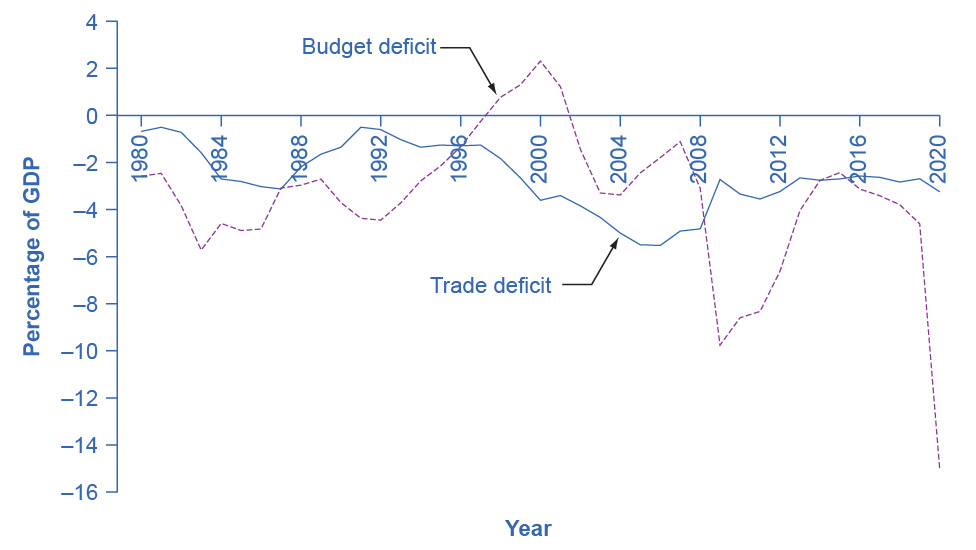
Figure 31.4図 31.4
In the 1980s, the budget deficit and the trade deficit declined at the same time. However, since then, the deficits have stopped being twins. The trade deficit grew smaller in the early 1990s as the budget deficit increased, and then the trade deficit grew larger in the late 1990s as the budget deficit turned into a surplus. In the first half of the 2000s, both budget and trade deficits increased. However, in 2009, the trade deficit declined as the budget deficit increased. Through the 2010s, the trade deficit remained relatively stable as the budget deficit declined. While the budget deficit increased in 2020, there has been hardly any change in the trade deficit.
英語のヒント
1980年代には、財政赤字と貿易赤字は同時に減少した。しかし、その後、二つの赤字は双子ではなくなった。1990年代初頭には財政赤字が増えるなかで貿易赤字は縮小し、1990年代後半には財政赤字が黒字へ転じるなかで貿易赤字は拡大した。2000年代前半には、財政赤字と貿易赤字の両方が増えた。しかし2009年には、財政赤字が増えるなかで貿易赤字は減った。2010年代を通じて、財政赤字が減るなかで貿易赤字は比較的安定していた。2020年には財政赤字が増えたが、貿易赤字にはほとんど変化がない。
Of course, no one should expect the budget deficit and trade deficit to move in lockstep, because the other parts of the national saving and investment identity—investment and private savings—will often change as well. In the late 1990s, for example, the government budget balance turned from deficit to surplus, but the trade deficit remained large and growing. During this time, the inflow of foreign financial investment was supporting a surge of physical capital investment by U.S. firms. In the first half of the 2000s, the budget and trade deficits again increased together, but in 2009, the budget deficit increased while the trade deficit declined. Through the 2010s, as there were bigger changes in the budget deficit, the trade deficit remained stable. The budget deficit and the trade deficits are related to each other, but they are more like cousins than twins.
英語のヒント
もちろん、財政赤字と貿易赤字が足並みをそろえて動くと考えるべきではない。国民貯蓄・投資恒等式の他の部分、すなわち投資と民間貯蓄もしばしば変化するからである。たとえば1990年代後半には、政府の財政収支は赤字から黒字へ転じたが、貿易赤字は大きいまま拡大し続けた。この間、海外金融投資の流入は、アメリカ企業の実物資本投資の急増を支えていた。2000年代前半には、財政赤字と貿易赤字は再び一緒に増えたが、2009年には財政赤字が増える一方、貿易赤字は減った。2010年代を通じて、財政赤字がより大きく変化するなか、貿易赤字は安定していた。財政赤字と貿易赤字は互いに関係しているが、双子というより、いとこに近い。
Budget Deficits and Exchange Rates財政赤字と為替レート
Exchange rates can also help to explain why budget deficits are linked to trade deficits. Figure 31.5 shows a situation using the exchange rate for the U.S. dollar, measured in euros. At the original equilibrium (E0), where the demand for U.S. dollars (D0) intersects with the supply of U.S. dollars (S0) on the foreign exchange market, the exchange rate is 0.9 euros per U.S. dollar and the equilibrium quantity traded in the market is $100 billion per day. Then the U.S. budget deficit rises and foreign financial investment provides the source of funds for that budget deficit.
英語のヒント
為替レートも、財政赤字が貿易赤字と結び付く理由の説明に役立つ。図31.5は、ユーロで測った米ドルの為替レートを使って、ある状況を示している。当初の均衡(E0)では、外国為替市場における米ドルの需要(D0)と米ドルの供給(S0)が交わり、為替レートは1米ドル当たり0.9ユーロ、市場で取引される均衡量は1日当たり1,000億ドルである。その後、アメリカの財政赤字が増え、その財政赤字の資金源を海外金融投資が提供するとしよう。
International financial investors, as a group, will demand more U.S. dollars on foreign exchange markets to purchase the U.S. government bonds, and they will supply fewer of the U.S. dollars that they already hold in these markets. Demand for U.S. dollars on the foreign exchange market shifts from D0 to D1 and the supply of U.S. dollars falls from S0 to S1. At the new equilibrium (E1), the exchange rate has appreciated to 1.05 euros per dollar while, in this example, the quantity of dollars traded remains the same.
英語のヒント
国際的な金融投資家は、全体として、アメリカの国債を買うために外国為替市場でより多くの米ドルを需要し、すでに保有している米ドルの市場への供給を減らす。外国為替市場での米ドル需要はD0からD1へ移動し、米ドル供給はS0からS1へ減少する。新しい均衡(E1)では、為替レートは1ドル当たり1.05ユーロへ増価するが、この例では取引されるドルの量は同じままである。
Budget Deficits and Exchange Rates財政赤字と為替レート
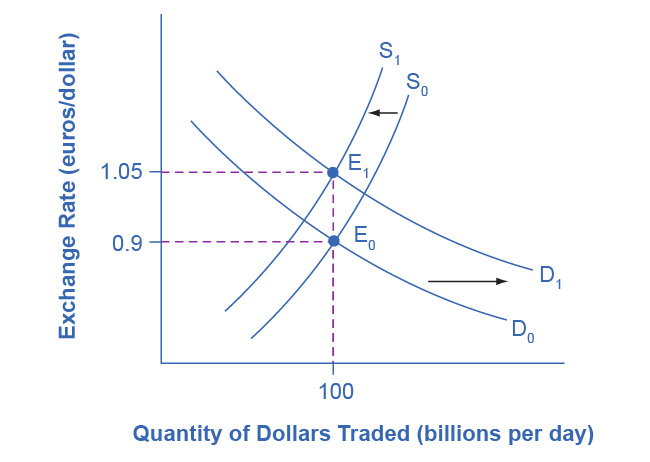


Figure 31.5図 31.5
Imagine that the U.S. government increases its borrowing and the funds come from European financial investors. To purchase U.S. government bonds, those European investors will need to demand more U.S. dollars on foreign exchange markets, causing the demand for U.S. dollars to shift to the right from D0 to D1. European financial investors as a group will also be less likely to supply U.S. dollars to the foreign exchange markets, causing the supply of U.S. dollars to shift from S0 to S1. The equilibrium exchange rate strengthens from 0.9 euro/ dollar at E0 to 1.05 euros/dollar at E1.
英語のヒント
アメリカ政府が借入れを増やし、その資金がヨーロッパの金融投資家から来ると考えてみよう。アメリカの国債を買うため、そのヨーロッパの投資家は外国為替市場でより多くの米ドルを需要する必要があり、米ドルの需要はD0からD1へ右に移動する。ヨーロッパの金融投資家は全体として、外国為替市場へ米ドルを供給することも減らすため、米ドルの供給はS0からS1へ移動する。均衡為替レートは、E0の1ドル当たり0.9ユーロから、E1の1ドル当たり1.05ユーロへ強くなる。
A stronger exchange rate, of course, makes it more difficult for exporters to sell their goods abroad while making imports cheaper, so a trade deficit (or a reduced trade surplus) results. Thus, a budget deficit can easily result in an inflow of foreign financial capital, a stronger exchange rate, and a trade deficit.
英語のヒント
為替レートが強くなると、当然、輸出業者は自国の財を海外で売りにくくなる一方、輸入品は安くなるため、貿易赤字(または貿易黒字の縮小)が生じる。したがって、財政赤字は、海外金融資本の流入、為替レートの上昇、貿易赤字に容易につながりうる。
You can also imagine interest rates are driving the exchange rate appreciation. As we explained earlier in Figure 31.8, a budget deficit increases demand in markets for domestic financial capital, raising the domestic interest rate. A higher interest rate will attract an inflow of foreign financial capital, and appreciate the exchange rate in response to the increase in demand for U.S. dollars by foreign investors and a decrease in supply of U. S. dollars. Because of higher interest rates in the United States, Americans find U.S. bonds more attractive than foreign bonds. When Americans are buying fewer foreign bonds, they are supplying fewer U.S. dollars. U.S. dollar appreciation leads to a larger trade deficit (or reduced surplus). The connections between inflows of foreign investment capital, interest rates, and exchange rates are all just different ways of drawing the same economic connections: a larger budget deficit can result in a larger trade deficit, although do not expect the connection to be one-to-one.
英語のヒント
金利が為替レートの増価を引き起こす、と考えることもできる。先に図31.8で説明したように、財政赤字は国内金融資本市場の需要を増やし、国内金利を上げる。金利の上昇は海外金融資本の流入を引き寄せ、外国人投資家による米ドル需要の増加と米ドル供給の減少に対応して、為替レートを増価させる。アメリカの金利が高いため、アメリカ人は外国債よりアメリカの債券を魅力的に感じる。アメリカ人が外国債の購入を減らせば、米ドルの供給も減る。米ドルの増価は、貿易赤字の拡大(または黒字の縮小)につながる。海外投資資本の流入、金利、為替レートのつながりは、すべて同じ経済的関係を異なる方法で描いたものにすぎない。つまり、財政赤字の拡大は貿易赤字の拡大をもたらしうるが、その関係が一対一になるとは考えないことである。