第32章世界のマクロ経済政策
Growth Policies for the Middle-Income Economies中所得経済の成長政策
The world’s great economic success stories in the last few decades began in the 1970s with that group of nations sometimes known as the East Asian Tigers: South Korea, Thailand, Malaysia, Indonesia, and Singapore. The list sometimes includes Hong Kong and Taiwan, although often under international law they are treated as part of China, rather than as separate countries. The economic growth of the Tigers has been phenomenal, typically averaging 5.5% real per capita growth for several decades. In the 1980s, other countries began to show signs of convergence. China began growing rapidly, often at annual rates of 8% to 10% per year. India began growing rapidly, first at rates of about 5% per year in the 1990s, but then higher still in the first decade of the 2000s.
英語のヒント
ここ数十年間の世界の大きな経済的成功物語は、1970年代に、東アジアの虎と呼ばれることがある国々、韓国、タイ、マレーシア、インドネシア、シンガポールから始まった。この一覧には香港と台湾が含まれることもあるが、国際法上はしばしば、独立した国ではなく中国の一部として扱われる。これらの虎の経済成長は驚異的で、通常、何十年にもわたって実質1人当たり成長率が平均5.5%だった。1980年代には、他の国も収束の兆しを見せ始めた。中国は急成長を始め、年率8~10%になることもしばしばだった。インドも急成長を始め、1990年代には当初年率約5%だったが、2000年代にはさらに高くなった。
We know the underlying causes of these rapid growth rates:
英語のヒント
こうした高い成長率の根底にある原因は分かっている。
- China and the East Asian Tigers, in particular, have been among the highest savers in the world, often saving one-third or more of GDP as compared to the roughly one-fifth of GDP, which would be a more typical saving rate in Latin America and Africa. These countries harnessed higher savings for domestic investment to build physical capital.
英語のヒント
とくに中国と東アジアの虎は、世界で最も貯蓄する国々に含まれ、GDPの3分の1以上を貯蓄することもしばしばだった。対して、ラテンアメリカやアフリカでより一般的な貯蓄率はGDPの約5分の1である。これらの国は、高い貯蓄を国内投資に活用し、実物資本を築いた。 - These countries had policies that supported heavy investments in human capital, first building up primary-level education and then expanding secondary-level education. Many focused on encouraging math and science education, which is useful in engineering and business.
英語のヒント
これらの国には、人的資本への大きな投資を支援する政策があり、まず初等教育を充実させ、次に中等教育を拡大した。多くの国は、工学やビジネスに役立つ数学・科学教育の促進に重点を置いた。 - Governments made a concerted effort to seek out applicable technology, by sending students and government commissions abroad to look at the most efficient industrial operations elsewhere. They also created policies to support innovative companies that wished to build production facilities to take advantage of the abundant and inexpensive human capital.
英語のヒント
政府は、学生や政府調査団を海外へ派遣して他国の最も効率的な産業活動を調べることで、利用可能な技術を見つけ出す協調的な努力を行った。また、豊富で安価な人的資本を活用するために生産施設を建てようとする革新的企業を支援する政策も作った。 - China and India in particular also allowed far greater freedom for market forces, both within their own domestic economies and also in encouraging their firms to participate in world markets.
英語のヒント
とくに中国とインドは、国内経済の中でも、自国企業の世界市場への参加を促すうえでも、市場の力に従来よりはるかに大きな自由を認めた。
This combination of technology, human capital, and physical capital, combined with the incentives of a market-oriented economic context, proved an extremely powerful stimulant to growth. Challenges that these middle-income countries faced are a legacy of government economic controls that for political reasons can be dismantled only slowly over time. In many of them, the government heavily regulates the banking and financial sector. Governments have also sometimes selected certain industries to receive low-interest loans or government subsidies. These economies have found that an increased dose of market-oriented incentives for firms and workers has been a critical ingredient in the recipe for faster growth. To learn more about measuring economic growth, read the following Clear It Up feature.
英語のヒント
技術、人的資本、実物資本のこの組合せは、市場志向の経済環境の誘因と結び付いて、成長へのきわめて強い刺激となった。これらの中所得国が直面した課題は、政府による経済統制の遺産であり、政治的な理由で時間をかけてゆっくりしか撤廃できない。多くの国では、政府が銀行・金融部門を厳しく規制している。政府はまた、低利融資や政府補助金を受ける特定の産業を選ぶこともあった。これらの経済は、企業や労働者に対する市場志向の誘因を増やすことが、より速い成長を実現する処方の重要な材料だと気付いた。経済成長の測定について詳しくは、次の「疑問を解こう」を読もう。
Growth Policies for Economically-Challenged Countries経済的な困難を抱える国の成長政策
Many economically-challenged or low-income countries are geographically located in Sub-Saharan Africa. Other pockets of low income are in the former Soviet Bloc, and in parts of Central America and the Caribbean.
英語のヒント
経済的な困難を抱える国や低所得国の多くは、地理的にはサハラ以南のアフリカに位置する。低所得地域は、旧ソ連圏や、中央アメリカ・カリブ海の一部にも点在する。
There are macroeconomic policies and prescriptions that might alleviate the extreme poverty and low standard of living. However, many of these countries lack the economic and legal stability, along with market-oriented institutions, needed to provide a fertile climate for domestic economic growth and to attract foreign investment. Thus, macroeconomic policies for low income economies are vastly different from those of the high income economies. The World Bank has made it a priority to combat poverty and raise overall income levels through 2030. One of the key obstacles to achieving this is the political instability that seems to be a common feature of low-income countries.
英語のヒント
極度の貧困と低い生活水準を軽減しうるマクロ経済政策や処方箋はある。しかし、これらの国の多くには、国内経済成長に適した環境を整え、海外投資を引き寄せるために必要な、市場志向の制度や、経済・法律上の安定が欠けている。したがって、低所得経済のマクロ経済政策は、高所得経済のそれとは大きく異なる。世界銀行は、2030年までに貧困と闘い、全体的な所得水準を上げることを優先事項としている。その達成への主要な障害の一つは、低所得国に共通する特徴に見える政治的不安定である。
Figure 32.5 shows the ten lowest income countries as ranked by The World Bank in 2020. These countries share some common traits, the most significant of which is the recent failures of their governments to provide a legal framework for economic growth. Civil and ethnic wars have impacted Burundi. Command economies, corruption, as well as political factionalism and infighting are commonly adopted elements in these low-income countries. The Democratic Republic of the Congo (often referred to as “Congo”) is a resource-wealthy country that has not been able to increase its subsistence standard of living due to the political environment.
英語のヒント
図32.5は、世界銀行の2020年の順位による、最も所得の低い10か国を示す。これらの国には共通する特徴があり、その最も重要なものは、政府が近年、経済成長のための法的枠組みを提供できていないことである。内戦や民族間の戦争はブルンジに影響を及ぼした。指令経済、汚職、政治的な派閥主義や内紛は、これらの低所得国で一般的に見られる要素である。コンゴ民主共和国(しばしば「コンゴ」と呼ばれる)は、資源豊かな国であるが、政治的環境のために、生存ぎりぎりの生活水準を引き上げられていない。
The Ten Lowest Income Countries所得が最も低い10か国
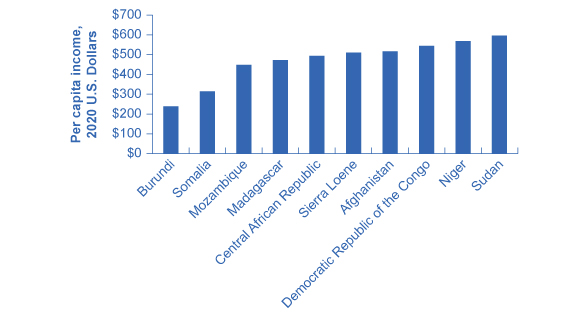

Figure 32.5図 32.5
This bar chart that shows the ten lowest-income countries by per capita income. They are, from lowest income to highest: Burundi, Somalia, Mozambique, Madagascar, Central African Republic, Sierra Leone, Afghanistan, Democratic Republic of Congo, Niger, and Sudan. (Source: http://databank.worldbank.org/data/views/reports/map.aspx#)
英語のヒント
この棒グラフは、1人当たり所得が最も低い10か国を示す。所得の低い順に、ブルンジ、ソマリア、モザンビーク、マダガスカル、中央アフリカ共和国、シエラレオネ、アフガニスタン、コンゴ民主共和国、ニジェール、スーダンである。(出所:http://databank.worldbank.org/data/views/reports/map.aspx#)
Low-income countries are at a disadvantage because any incomes that people receive are spent immediately on necessities such as food. People in these countries live on less than $1,035 per year, which is less than $100 per month. Lack of saving means a lack of capital accumulation and a lack of loanable funds for investment in physical and human capital. Recent research by two MIT economists, Abhijit Bannerjee and Esther Duflo, has confirmed that the households in these economies are trapped in low incomes because they cannot muster enough investment to push themselves out of poverty.
英語のヒント
低所得国は不利な立場にある。人々が得るどのような所得も、すぐに食料のような必需品に使われるからである。これらの国の人々は、年間1,035ドル未満、つまり月100ドル未満で暮らす。貯蓄の不足は、資本蓄積の不足と、実物資本・人的資本への投資に使える貸付資金の不足を意味する。MITの二人の経済学者、アビジット・バナジーとエステル・デュフロの最近の研究は、これらの経済の家計が、貧困から自分たちを押し出すだけの投資を集められないため、低所得に閉じ込められていることを確認した。
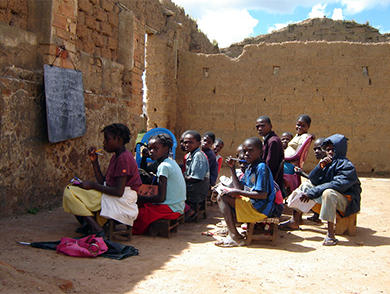
For example, the average citizen of Burundi, a low-income country, subsists on $239 per year (adjusted to 2020 dollars). According to Central Intelligence Agency data in its CIA Factbook, as of 2021, 85% of Burundi’s population is agrarian, with bananas as the main income producing crop. Only one in two children attends school and, as Figure 32.6 shows, many are not in schools comparable to what occurs in developed countries. Political instability has made it difficult for Burundi to make significant headway toward growth, as verified by the electrification of only 11% of households and 40% of its national income coming from foreign aid.
英語のヒント
たとえば、低所得国ブルンジの平均的な国民は、年間239ドル(2020年ドルに調整)で暮らす。中央情報局の『CIAファクトブック』のデータによると、2021年時点でブルンジの人口の85%は農業に従事し、主要な収入源となる作物はバナナである。学校に通う子どもは2人に1人だけで、図32.6が示すように、多くの子どもは先進国で見られるような学校に通っていない。政治的不安定のために、ブルンジが成長へ向けて大きく前進するのは難しかった。電化された世帯はわずか11%で、国民所得の40%が海外援助によるということが、それを裏付ける。
Lack of Funds for Investing in Human Capital人的資本投資の資金不足
In low-income countries, people often spend all income on necessities for living and cannot accumulate or invest in physical or human capital. The students in this photograph learn in an outside “classroom” void of not only technology, but even chairs and desks. (Credit: “Living in Kuito” by Rafaela Printes/Flickr Creative Commons, CC BY 2.0) · CC BY 2.0 · Source出典

Figure 32.6図 32.6
In low-income countries, people often spend all income on necessities for living and cannot accumulate or invest in physical or human capital. The students in this photograph learn in an outside “classroom” void of not only technology, but even chairs and desks. (Credit: “Living in Kuito” by Rafaela Printes/Flickr Creative Commons, CC BY 2.0)
英語のヒント
低所得国では、人々はしばしば所得のすべてを生活必需品に使い、実物資本や人的資本を蓄積したり、それらに投資したりできない。この写真の生徒は、技術だけでなく、椅子や机さえない屋外の「教室」で学んでいる。(クレジット:Rafaela Printes/Flickr Creative Commonsによる「Living in Kuito」、CC BY 2.0)
Additional Resources追加教材
Other low-income countries share similar stories. These countries have found it difficult to generate investments for themselves or to find foreign investors willing to put up the money for more than the basic needs. Foreign aid and external investment comprise significant portions of the income in these economies, but are not sufficient to allow for the capital accumulation necessary to invest in physical and human capital. However, is foreign aid always a contributor to economic growth?
英語のヒント
他の低所得国にも同様の事情がある。これらの国は、自国で投資を生み出すことも、基本的な必要を超えて資金を提供しようとする外国人投資家を見つけることも難しかった。海外援助と外部からの投資は、これらの経済の所得のかなりの部分を構成するが、実物資本や人的資本への投資に必要な資本蓄積を可能にするには足りない。しかし、海外援助は常に経済成長に寄与するのだろうか。
Development economics is a branch of economics that often focuses on answering that question and others like it. Development economists analyze the forces and outcomes of economics in developing nations. The field is typically focused on—and sometimes defined as—understanding and implementing policies and practices to improve economic and social wellbeing in low- and middle-income nations or regions. But it is an extremely wide and varied area of study, often blending politics, fiscal policy, education, innovation, health and medicine, international trade, natural resources, and military/geopolitical considerations.
英語のヒント
開発経済学は、しばしばその問いや同様の問いに答えることに焦点を当てる経済学の一分野である。開発経済学者は、発展途上国の経済を動かす力と、その結果を分析する。この分野は通常、低所得・中所得の国や地域の経済的・社会的福祉を改善する政策や実践を理解し、実行することに焦点を当て、ときにはそのように定義される。しかし、それは非常に広く多様な研究分野であり、政治、財政政策、教育、革新、健康と医療、国際貿易、天然資源、軍事・地政学上の考慮を、しばしば組み合わせる。
Many development economists have focused on understanding the best mix of approaches to foster equitable and sustainable growth. Like other economists, they may analyze practices or outcomes from the past and apply that knowledge to the present and future. And many prominent development economists challenge traditional ways of thinking. Dambisa Moyo, for example, provides evidence indicating that foreign aid is rarely a positive solution and often does more harm than good. In her book Dead Aid: Why Aid Is Not Working and How There Is Another Way for Africa (2009), she lays out the failure of past aid, indicating that it typically ends up in the pockets of corrupt officials and has the adverse effect of minimizing other types of investment. At the time, Moyo proposed a complete stoppage of foreign aid into Africa. Moyo sees far greater promise in increases in trade and direct private investment, as well as other financing options such as bonds.
英語のヒント
多くの開発経済学者は、公平で持続可能な成長を促す、最も適切な手法の組合せを理解することに取り組んできた。他の経済学者と同じく、過去の実践や結果を分析し、その知識を現在と未来に応用することがある。また、多くの著名な開発経済学者は、従来の考え方に異議を唱える。たとえばダンビサ・モヨは、海外援助は有効な解決策になることがまれで、しばしば利益より害をもたらすと示す証拠を提示する。著書『援助の死:なぜ援助は機能しないのか、そしてアフリカにはどのような別の道があるのか』(2009年)で、過去の援助の失敗を説明し、援助は通常、腐敗した役人の懐に入り、他の種類の投資を最小限にしてしまう悪影響を持つと指摘する。当時、モヨはアフリカへの海外援助の全面停止を提案した。モヨは、貿易や民間直接投資の増加、そして債券のような他の資金調達方法に、はるかに大きな可能性を見ている。