第32章世界のマクロ経済政策
Many nations are taking steps to reduce the risk that their economy will be injured if foreign financial capital takes flight, including having their central banks hold large reserves of foreign exchange and stepping up their regulation of domestic banks to avoid a wave of imprudent lending. The most controversial steps in this area involve whether countries should try to take steps to control or reduce the flows of foreign capital. If a country could discourage some speculative short-term capital inflow, and instead only encourage investment capital that it committed for the medium and the long term, then it could be at least somewhat less susceptible to swings in the sentiments of global investors.
英語のヒント
多くの国は、海外金融資本が逃げ出した場合に経済が損なわれる危険を減らす措置を取っている。中央銀行に多額の外貨準備を保有させることや、無分別な融資の波を避けるために国内銀行の規制を強めることなどである。この分野で最も議論を呼ぶ措置は、海外資本の流れを管理・削減する措置を国が取るべきかどうかに関わる。投機的な短期資本流入の一部を抑え、その代わりに、中長期の約束を伴う投資資本だけを促すことができれば、世界の投資家の心理の揺れに、少なくともいくらか影響されにくくなりうる。
If economies participate in the global trade of goods and services, they will also need to participate in international flows of financial payments and investments. These linkages can offer great benefits to an economy. However, any nation that is experiencing a substantial and sustained pattern of trade deficits, along with the corresponding net inflow of international financial capital, has some reason for concern. During the Asian Financial Crisis in the late 1990s, countries that grew dramatically in the years leading up to the crisis as international capital flowed in, saw their economies collapse when the capital very quickly flowed out.
英語のヒント
経済が財・サービスの世界貿易に参加するなら、国際的な金融決済や投資の流れにも参加する必要がある。これらのつながりは、経済に大きな便益をもたらしうる。しかし、大幅で持続的な貿易赤字と、それに対応する国際金融資本の純流入を経験している国には、懸念する理由がある。1990年代後半のアジア金融危機では、危機までの数年間、国際資本の流入によって劇的に成長していた国々が、資本が非常に急速に流出すると、経済の崩壊を経験した。
Market-Oriented Economic Reforms市場志向の経済改革
The standard of living has increased dramatically for billions of people around the world in the last half century. Such increases have occurred not only in the technological leaders like the United States, Canada, the nations of Europe, and Japan, but also in the East Asian Tigers and in many nations of Latin America and Eastern Europe. The challenge for most of these countries is to maintain these growth rates. The economically-challenged regions of the world have stagnated and become stuck in poverty traps. These countries need to focus on the basics: health and education, or human capital development. As Figure 32.8 illustrates, modern technology allows for the investment in education and human capital development in ways that would have not been possible just a few short years ago.
英語のヒント
過去半世紀に、世界の何十億人もの人々の生活水準は劇的に上昇した。こうした上昇は、アメリカ、カナダ、ヨーロッパ諸国、日本のような技術先進国だけでなく、東アジアの虎や、ラテンアメリカ・東ヨーロッパの多くの国でも起きた。これらの国の多くにとって、課題はその成長率を維持することである。世界の経済的な困難を抱える地域は停滞し、貧困の罠にはまっている。これらの国は、健康と教育、つまり人的資本の開発という基本に集中する必要がある。図32.8が示すように、現代の技術は、ほんの数年前には不可能だった方法で、教育と人的資本開発への投資を可能にする。
Solar-powered Technology太陽光で動く技術
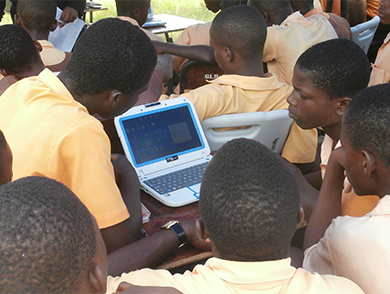
Modern technologies, such as solar-power and Wi-Fi, enable students to obtain education even in remote parts of a country without electricity. These students in Ghana are sharing a laptop provided by a van with solar-power. (Credit: “Hands on computer class - children in Ho, Volta Region, Ghana” by EIFL/Flickr Creative Commons, CC BY 2.0) · CC BY 2.0 · Source出典

Figure 32.8図 32.8
Modern technologies, such as solar-power and Wi-Fi, enable students to obtain education even in remote parts of a country without electricity. These students in Ghana are sharing a laptop provided by a van with solar-power. (Credit: “Hands on computer class - children in Ho, Volta Region, Ghana” by EIFL/Flickr Creative Commons, CC BY 2.0)
英語のヒント
太陽光発電やWi-Fiのような現代の技術は、電力のない国の遠隔地でも、生徒が教育を受けられるようにする。ガーナのこれらの生徒は、太陽光発電を備えたバンが提供するノートパソコンを共有している。(クレジット:EIFL/Flickr Creative Commonsによる「Hands on computer class - children in Ho, Volta Region, Ghana」、CC BY 2.0)
Other than the issue of economic growth, the other three main goals of macroeconomic policy—that is, low unemployment, low inflation, and a sustainable balance of trade—all involve situations in which, for some reason, the economy fails to coordinate the forces of supply and demand. In the case of cyclical unemployment, for example, the intersection of aggregate supply and aggregate demand occurs at a level of output below potential GDP. In the case of the natural rate of unemployment, government regulations create a situation where otherwise-willing employers become unwilling to hire otherwise-willing workers. Inflation is a situation in which aggregate demand outstrips aggregate supply, at least for a time, so that too much buying power is chasing too few goods. A trade imbalance is a situation where, because of a net inflow or outflow of foreign capital, domestic savings are not aligned with domestic investment. Each of these situations can create a range of easier or harder policy choices.
英語のヒント
経済成長の問題以外の、マクロ経済政策の三つの主な目標、すなわち低失業、低インフレ、持続可能な貿易収支は、いずれも、何らかの理由で経済が需要と供給の力を調整できない状況に関わる。たとえば循環的失業の場合、総供給と総需要の交点は、潜在GDPを下回る生産水準で生じる。自然失業率の場合、政府規制によって、本来は意欲のある雇用主が、本来は意欲のある労働者を雇おうとしなくなる状況が生じる。インフレは、少なくとも一時的には総需要が総供給を上回り、多すぎる購買力が少なすぎる財を追いかける状況である。貿易不均衡は、海外資本の純流入または純流出のため、国内貯蓄が国内投資と一致していない状況である。これらの各状況は、より容易なものからより困難なものまで、さまざまな政策選択を生み出しうる。