第6章消費者の選択
6.2 How Changes in Income and Prices Affect Consumption Choices6.2 所得と価格の変化が消費の選択に与える影響
Learning Objectives学習目標
Learning Objectives学習目標
By the end of this section, you will be able to:
英語のヒント
この節を学ぶと、次のことができるようになる。
- Explain how income, prices, and preferences affect consumer choices
英語のヒント
所得、価格、好みが消費者の選択にどう影響するかを説明する。 - Contrast the substitution effect and the income effect
英語のヒント
代替効果と所得効果を比較する。 - Utilize concepts of demand to analyze consumer choices
英語のヒント
需要の概念を使って消費者の選択を分析する。 - Apply utility-maximizing choices to governments and businesses
英語のヒント
効用を最大にする選択を政府と企業に適用する。
Just as we can use utility and marginal utility to discuss making consumer choices along a budget constraint, we can also use these ideas to think about how consumer choices change when the budget constraint shifts in response to changes in income or price. Because we can use the budget constraint framework to analyze how quantities demanded change because of price movements, the budget constraint model can illustrate the underlying logic behind demand curves.
英語のヒント
予算制約に沿った消費者の選択を効用と限界効用で論じられるのと同じように、所得や価格の変化で予算制約が動くと、消費者の選択がどう変わるかも考えられる。予算制約の枠組みで、価格変動による需要量の変化を分析できるため、予算制約モデルは需要曲線の基礎にある論理を示せる。
How Changes in Income Affect Consumer Choices所得の変化が消費者の選択に与える影響
Let’s begin with a concrete example illustrating how changes in income level affect consumer choices. Figure 6.3 shows a budget constraint that represents Kimberly’s choice between concert tickets at $50 each and getting away overnight to a bed-and-breakfast for $200 per night. Kimberly has $1,000 per year to spend between these two choices. After thinking about her total utility and marginal utility and applying the decision rule that the ratio of the marginal utilities to the prices should be equal between the two products, Kimberly chooses point M, with eight concerts and three overnight getaways as her utility-maximizing choice.
英語のヒント
所得水準の変化が消費者の選択に与える影響を、具体例で見よう。図6.3の予算制約は、1枚50ドルのコンサート券と、1泊200ドルの朝食付き宿泊施設への小旅行との間での、キンバリーの選択を表す。二つに使える金額は年1,000ドルだ。総効用と限界効用を考え、二つの製品の限界効用と価格の比を等しくするという規則を使った結果、効用最大化の選択として、コンサート8回と小旅行3泊の点Mを選ぶ。
How a Change in Income Affects Consumption Choices所得の変化が消費の選択に与える影響
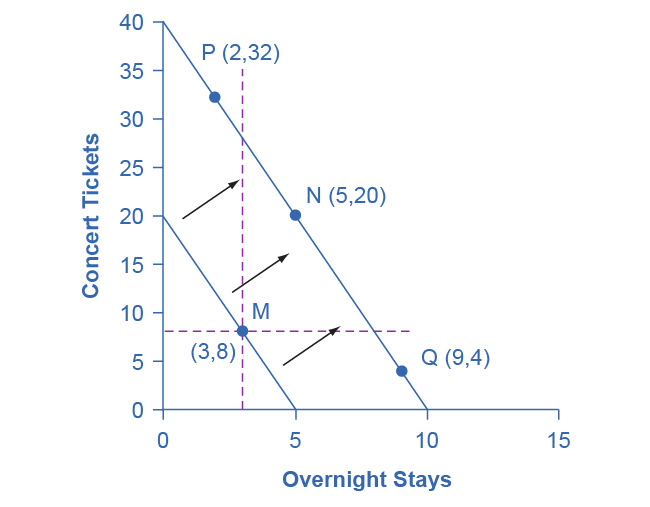

Figure 6.3図 6.3
The utility-maximizing choice on the original budget constraint is M. The dashed horizontal and vertical lines extending through point M allow you to see at a glance whether the quantity consumed of goods on the new budget constraint is higher or lower than on the original budget constraint. On the new budget constraint, Kimberly will make a choice like N if both goods are normal goods. If overnight stays is an inferior good, Kimberly will make a choice like P. If concert tickets are an inferior good, Kimberly will make a choice like Q.
英語のヒント
元の予算制約上の効用最大化点はM。Mを通る横と縦の破線により、新しい予算制約上で各財の消費量が元より多いか少ないか、一目で分かる。新しい予算制約では、両方が正常財ならNのような点、宿泊が下級財ならPのような点、コンサート券が下級財ならQのような点を選ぶ。
Now, assume that the income Kimberly has to spend on these two items rises to $2,000 per year, causing her budget constraint to shift out to the right. How does this rise in income alter her utility-maximizing choice? Kimberly will again consider the utility and marginal utility that she receives from concert tickets and overnight getaways and seek her utility-maximizing choice on the new budget line, but how will her new choice relate to her original choice?
英語のヒント
この二つに使える所得が年2,000ドルへ増え、予算制約が右外側へシフトしたとしよう。所得増加は効用最大化の選択をどう変えるか。キンバリーは再び、コンサート券と宿泊から得る効用・限界効用を考え、新しい予算線上で効用最大化の選択を探す。その新しい選択は、元の選択とどう関係するだろうか。
We can replace the possible choices along the new budget constraint into three groups, which the dashed horizontal and vertical lines that pass through the original choice M in the figure divide. All choices on the upper left of the new budget constraint that are to the left of the vertical dashed line, like choice P with two overnight stays and 32 concert tickets, involve less of the good on the horizontal axis but much more of the good on the vertical axis. All choices to the right of the vertical dashed line and above the horizontal dashed line—like choice N with five overnight getaways and 20 concert tickets—have more consumption of both goods. Finally, all choices that are to the right of the vertical dashed line but below the horizontal dashed line, like choice Q with four concerts and nine overnight getaways, involve less of the good on the vertical axis but much more of the good on the horizontal axis.
英語のヒント
新しい予算制約上の選択肢を、図の元の選択Mを通る縦と横の破線で、三つの集団に分けられる。縦の破線より左にある左上の選択肢、例えば宿泊2泊、コンサート券32枚のPでは、横軸の財は減るが、縦軸の財は大きく増える。縦の破線より右、横の破線より上の選択肢、例えば宿泊5泊、コンサート券20枚のNでは、両方の消費が増える。最後に、縦の破線より右、横の破線より下の選択肢、例えばコンサート4回、宿泊9泊のQでは、縦軸の財は減るが、横軸の財は大きく増える。
All of these choices are theoretically possible, depending on Kimberly’s personal preferences as expressed through the total and marginal utility she would receive from consuming these two goods. When income rises, the most common reaction is to purchase more of both goods, like choice N, which is to the upper right relative to Kimberly’s original choice M, although exactly how much more of each good will vary according to personal taste. Conversely, when income falls, the most typical reaction is to purchase less of both goods. As we defined in the chapter on Demand and Supply and again in the chapter on Elasticity, we call goods and services normal goods when a rise in income leads to a rise in the quantity consumed of that good and a fall in income leads to a fall in quantity consumed.
英語のヒント
However, depending on Kimberly’s preferences, a rise in income could cause consumption of one good to increase while consumption of the other good declines. A choice like P means that a rise in income caused her quantity consumed of overnight stays to decline, while a choice like Q would mean that a rise in income caused her quantity of concerts to decline. Goods where demand declines as income rises (or conversely, where the demand rises as income falls) are called “inferior goods.” An inferior good occurs when people trim back on a good as income rises, because they can now afford the more expensive choices that they prefer. For example, a higher-income household might eat fewer hamburgers or be less likely to buy a used car, and instead eat more steak and buy a new car.
英語のヒント
しかし、キンバリーの好みによっては、所得が増えると一方の財の消費が増え、もう一方は減る。Pのような選択は、所得増加で宿泊の消費量が減ったことを示し、Qのような選択は、コンサートの消費量が減ったことを示す。所得が増えると需要が減る財、逆に所得が減ると需要が増える財を、下級財と呼ぶ。所得が上がると、より高価で好ましい選択肢を買えるようになり、その財を減らす場合に生じる。例えば高所得の家計は、ハンバーガーを減らしてステーキを増やし、中古車を買わず新車を選ぶかもしれない。