第6章消費者の選択
How Price Changes Affect Consumer Choices価格の変化が消費者の選択に与える影響
For analyzing the possible effect of a change in price on consumption, let’s again use a concrete example. Figure 6.4 represents Sergei's consumer choice, who chooses between purchasing baseball bats and cameras. A price increase for baseball bats would have no effect on the ability to purchase cameras, but it would reduce the number of bats Sergei could afford to buy. Thus a price increase for baseball bats, the good on the horizontal axis, causes the budget constraint to rotate inward, as if on a hinge, from the vertical axis. As in the previous section, the point labeled M represents the originally preferred point on the original budget constraint, which Sergei has chosen after contemplating his total utility and marginal utility and the tradeoffs involved along the budget constraint. In this example, the units along the horizontal and vertical axes are not numbered, so the discussion must focus on whether Sergei will consume more or less of certain goods, not on numerical amounts.
英語のヒント
価格変化が消費に及ぼしうる影響も、具体例で分析しよう。図6.4は、野球のバットとカメラを選ぶセルゲイの消費の選択を表す。バットが値上がりしても、カメラだけを買う能力は変わらないが、買えるバットの本数は減る。そのため、横軸に置いたバットの値上がりは、縦軸上の点をちょうつがいのように固定して、予算制約を内側へ回転させる。前の節と同様、Mは元の予算制約上で最初に好まれた点である。セルゲイが総効用・限界効用と、制約上のトレードオフを考えて選んだものだ。この例では両軸の単位に数値を付けていないので、具体的な数量ではなく、消費が増えるか減るかに注目する。
How a Change in Price Affects Consumption Choices価格の変化が消費の選択に与える影響
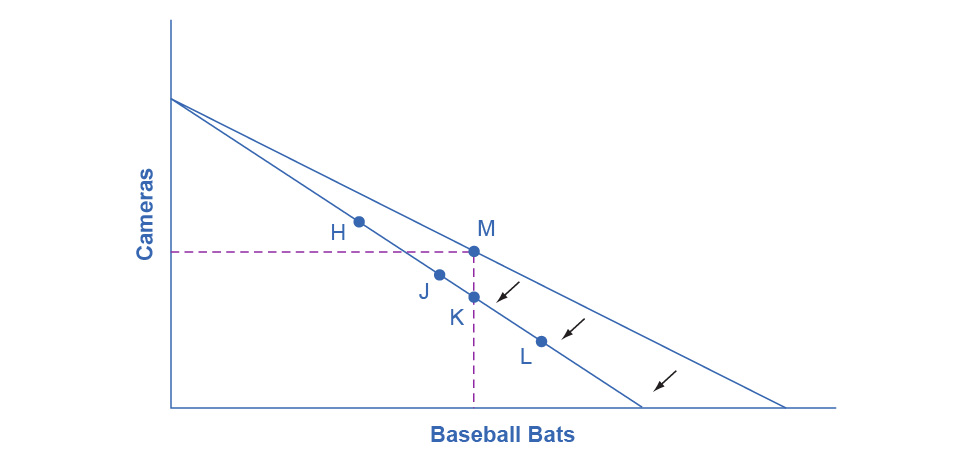

Figure 6.4図 6.4
The original utility-maximizing choice is M. When the price rises, the budget constraint rotates clockwise. The dashed lines make it possible to see at a glance whether the new consumption choice involves less of both goods, or less of one good and more of the other. The new possible choices would be fewer baseball bats and more cameras, like point H, or less of both goods, as at point J. Choice K would mean that the higher price of bats led to exactly the same quantity of bat consumption, but fewer cameras. Theoretically possible, but unlikely in the real world, we rule out choices like L because they would mean that a higher price for baseball bats means a greater consumption of baseball bats.
英語のヒント
元の効用最大化点はM。値上がりすると予算制約は時計回りに回転する。破線を見ると、新しい選択が両方を減らすものか、一方を減らして他方を増やすものか分かる。新しい選択には、Hのようにバットを減らしてカメラを増やす場合や、Jのように両方を減らす場合がある。Kでは、バットが値上がりしてもその消費量は同じで、カメラが減る。Lでは、値上がりしたバットの消費が増える。これは理論上は可能でも現実には起こりにくいため、ここでは除く。
After the price increase, Sergei will make a choice along the new budget constraint. Again, we can divide his choices into three segments by the dashed vertical and horizontal lines. In the upper left portion of the new budget constraint, at a choice like H, Sergei consumes more cameras and fewer bats. In the central portion of the new budget constraint, at a choice like J, he consumes less of both goods. At the right-hand end, at a choice like L, he consumes more bats but fewer cameras.
英語のヒント
値上がり後、セルゲイは新しい予算制約上で選ぶ。縦と横の破線で、再び三つの部分に分けられる。左上のHのような点では、カメラを増やし、バットを減らす。中央のJのような点では、両方を減らす。右端のLのような点では、バットを増やし、カメラを減らす。
The typical response to higher prices is that a person chooses to consume less of the product with the higher price. This occurs for two reasons, and both effects can occur simultaneously. The substitution effect occurs when a price changes and consumers have an incentive to consume less of the good with a relatively higher price and more of the good with a relatively lower price. The income effect is that a higher price means, in effect, the buying power of income has been reduced (even though actual income has not changed), which leads to buying less of the good (when the good is normal). In this example, the higher price for baseball bats would cause Sergei to buy fewer bats for both reasons. Exactly how much will a higher price for bats cause Sergei's bat consumption to fall? Figure 6.4 suggests a range of possibilities. Sergei might react to a higher price for baseball bats by purchasing the same quantity of bats, but cutting his camera consumption. This choice is the point K on the new budget constraint, straight below the original choice M. Alternatively, Sergei might react by dramatically reducing his bat purchases and instead buy more cameras.
英語のヒント
値上がりに対する典型的な反応は、その製品の消費を減らすことである。理由は二つあり、両方が同時に起こりうる。代替効果とは、価格が変わると、相対的に高くなった財を減らし、安くなった財を増やす誘因が生じることだ。所得効果とは、実際の所得は同じでも、値上がりによって実質的な購買力が下がり、正常財なら購入が減ることである。この例では、バットの値上がりは、両方の理由でセルゲイのバット購入を減らす。具体的にはどれほど減るのか。図6.4は幅広い可能性を示す。セルゲイは、バットの本数を変えず、カメラを減らすかもしれない。これは元のMの真下、新しい予算制約上のKである。反対に、バット購入を大幅に減らし、カメラを増やすかもしれない。
The key is that it would be imprudent to assume that a change in the price of one good will only affect consumption of that good. In our example, since Sergei purchases all his products out of the same budget, a change in the price of baseball bats can also have a range of effects, either positive or negative, on his purchases of cameras.
英語のヒント
重要なのは、ある財の価格変化が、その財の消費だけに影響すると決め付けるのは軽率だということだ。セルゲイは同じ予算からすべてを購入するため、バットの価格変化はカメラの購入にも、増減どちらの方向にも影響しうる。
In short, a higher price typically causes reduced consumption of the good in question, but it can affect the consumption of other goods as well.
英語のヒント
つまり値上がりは通常、その財の消費を減らすが、ほかの財の消費にも影響しうる。