第6章消費者の選択
6.1 Consumption Choices6.1 消費の選択
Learning Objectives学習目標
Learning Objectives学習目標
By the end of this section, you will be able to:
英語のヒント
この節を学ぶと、次のことができるようになる。
- Calculate total utility
英語のヒント
総効用を計算する。 - Propose decisions that maximize utility
英語のヒント
効用を最大にする決定を提案する。 - Explain marginal utility and the significance of diminishing marginal utility
英語のヒント
限界効用と、限界効用逓減の重要性を説明する。
Information on the consumption choices of Americans is available from the Consumer Expenditure Survey carried out by the U.S. Bureau of Labor Statistics. Table 6.1 shows spending patterns for the average U.S. household in 2010. The first row shows income and, excluding taxes and personal savings, the second row shows that the average U.S. household spent $48,109 on consumption. The table then breaks down consumption into various categories. The average U.S. household spent roughly one-third of its consumption on shelter and other housing expenses, another one-third on food and vehicle expenses, and the rest on a variety of items, as shown. These patterns will vary for specific households by differing levels of family income, by geography, and by preferences.
英語のヒント
米国人の消費の選択については、米国労働統計局の消費者支出調査から情報が得られる。表6.1は、2010年の平均的な米国家計の支出構成を示す。最初の行は所得、2行目は税金と個人貯蓄を除いた消費支出で、48,109ドルである。以降は消費を分類している。平均的な家計は、約3分の1を住居などの住宅費、別の3分の1を食料と車両関係の費用に使い、残りを表にあるさまざまなものに使った。実際の家計の構成は、所得、地域、好みによって異なる。
Average Household Income before Taxes 平均税引き前世帯所得 |
$62,481 |
|---|---|
Average Annual Expenditures 平均年間支出 |
$48,109 |
Food at home 家庭内の食事 |
$3,264 |
Food away from home 外食 |
$2,505 |
Housing 住居 |
$16,557 |
Apparel and services 英語のヒント衣服と関連サービス |
$1,700 |
Transportation 交通 |
$7,677 |
Healthcare 医療 |
$3,157 |
Entertainment 娯楽 |
$2,504 |
Education 教育 |
$1,074 |
Personal insurance and pensions 個人保険と年金 |
$5,357 |
All else: alcohol, tobacco, reading, personal care, cash contributions, miscellaneous 英語のヒントその他すべて:酒、たばこ、読書、身の回りの手入れ、現金の寄付、雑費 |
$3,356 |
Total Utility and Diminishing Marginal Utility総効用と限界効用逓減
To understand how a household will make its choices, economists look at what consumers can afford, as shown in a budget constraint (or budget line), and the total utility or satisfaction derived from those choices. In a budget constraint line, the quantity of one good is on the horizontal axis and the quantity of the other good on the vertical axis. The budget constraint line shows the various combinations of two goods that are affordable given consumer income. Consider José's situation, shown in Figure 6.2. José likes to collect T-shirts and watch movies.
英語のヒント
家計の選択を理解するため、経済学者は、予算制約、または予算線が示す購入可能なものと、その選択から得る総効用、つまり満足を見る。予算制約線では、一方の財の数量を横軸、もう一方を縦軸に取る。この線は、消費者の所得で購入できる二つの財の組み合わせを示す。図6.2のホセの場合を考えよう。ホセはTシャツを集めることと映画を見ることが好きだ。
In Figure 6.2 we show the quantity of T-shirts on the horizontal axis while we show the quantity of movies on the vertical axis. If José had unlimited income or goods were free, then he could consume without limit. However, José, like all of us, faces a budget constraint. José has a total of $56 to spend. The price of T-shirts is $14 and the price of movies is $7. Notice that the vertical intercept of the budget constraint line is at eight movies and zero T-shirts ($56/$7=8). The horizontal intercept of the budget constraint is four, where José spends of all of his money on T-shirts and no movies ($56/14=4). The slope of the budget constraint line is rise/run or –8/4=–2. The specific choices along the budget constraint line show the combinations of affordable T-shirts and movies.
英語のヒント
図6.2では、横軸がTシャツの枚数、縦軸が映画の本数である。ホセの所得が無限か、財が無料なら、際限なく消費できる。しかし、私たちと同じくホセにも予算制約がある。使えるお金は計56ドルで、Tシャツは14ドル、映画は7ドルだ。予算制約線の縦軸切片は、映画8本、Tシャツ0枚に当たる。56ドル÷7ドル=8だからだ。横軸切片は4で、全額をTシャツに使い、映画には使わない。56÷14=4である。予算制約線の傾きは、縦の変化÷横の変化、つまり−8/4=−2である。線上の各選択は、買えるTシャツと映画の組み合わせを示す。
A Choice between Consumption Goods消費財の間での選択
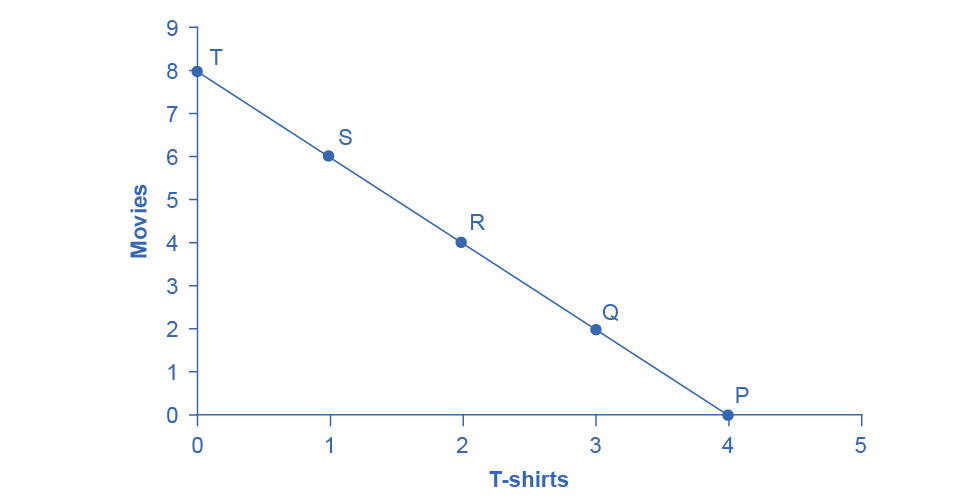

Figure 6.2図 6.2
José has income of $56. Movies cost $7 and T-shirts cost $14. The points on the budget constraint line show the combinations of affordable movies and T-shirts.
英語のヒント
ホセの所得は56ドル。映画は7ドル、Tシャツは14ドルである。予算制約線上の点は、購入可能な映画とTシャツの組み合わせを示す。
José wishes to choose the combination that will provide him with the greatest utility, which is the term economists use to describe a person’s level of satisfaction or happiness with their choices.
英語のヒント
ホセは、最大の効用が得られる組み合わせを選びたい。効用とは、自分の選択から得る満足や幸福の水準を、経済学者が表すときに使う言葉である。
Let’s begin with an assumption, which we will discuss in more detail later, that José can measure his own utility with something called utils. (It is important to note that you cannot make comparisons between the utils of individuals. If one person gets 20 utils from a cup of coffee and another gets 10 utils, this does not mean than the first person gets more enjoyment from the coffee than the other or that they enjoy the coffee twice as much. The reason why is that utils are subjective to an individual. The way one person measures utils is not the same as the way someone else does.) Table 6.2 shows how José’s utility is connected with his T-shirt or movie consumption. The first column of the table shows the quantity of T-shirts consumed. The second column shows the total utility, or total amount of satisfaction, that José receives from consuming that number of T-shirts. The most common pattern of total utility, in this example, is that consuming additional goods leads to greater total utility, but at a decreasing rate. The third column shows marginal utility, which is the additional utility provided by one additional unit of consumption. This equation for marginal utility is:
英語のヒント
まず、ホセが「ユーティル」という単位で自分の効用を測れると仮定しよう。この仮定は後で詳しく検討する。(人と人のユーティルは比較できない点が重要だ。ある人がコーヒー1杯から20ユーティル、別の人が10ユーティルを得ても、前者のほうが楽しんでいるとか、2倍楽しんでいるという意味ではない。ユーティルは個人にとって主観的だからだ。ある人の測り方と、別の人の測り方は同じではない。)表6.2は、ホセの効用がTシャツや映画の消費とどう関係するかを示す。1列目はTシャツの枚数、2列目はその枚数から得る総効用、つまり満足の総量である。この例での総効用の最も一般的な型は、追加の消費によって総効用は増えるが、その増え方は次第に小さくなるというものだ。3列目は限界効用、つまり追加で1単位消費すると得られる追加効用である。限界効用の式は次のとおり。
Notice that marginal utility diminishes as additional units are consumed, which means that each subsequent unit of a good consumed provides less additional utility. For example, the first T-shirt José picks is his favorite and it gives him an addition of 22 utils. The fourth T-shirt is just something to wear when all his other clothes are in the wash and yields only 18 additional utils. This is an example of the law of diminishing marginal utility, which holds that the additional utility decreases with each unit added. Diminishing marginal utility is another example of the more general law of diminishing returns we learned earlier in the chapter on Choice in a World of Scarcity.
英語のヒント
消費を追加するにつれて限界効用が減る点に注目しよう。財を1単位ずつ追加するごとに、得られる追加効用は少なくなる。例えば、最初に選ぶTシャツはホセのお気に入りで、22ユーティルを追加する。4枚目は、ほかの服がすべて洗濯中のときに着るだけのもので、18ユーティルしか追加しない。これは限界効用逓減の法則の例で、追加1単位から得る効用が次第に減るという法則である。限界効用逓減は、「希少性の世界での選択」で学んだ、より一般的な収穫逓減の法則の別の例でもある。
The rest of Table 6.2 shows the quantity of movies that José attends, and his total and marginal utility from seeing each movie. Total utility follows the expected pattern: it increases as the number of movies that José watches rises. Marginal utility also follows the expected pattern: each additional movie brings a smaller gain in utility than the previous one. The first movie José attends is the one he wanted to see the most, and thus provides him with the highest level of utility or satisfaction. The fifth movie he attends is just to kill time. Notice that total utility is also the sum of the marginal utilities. Read the next Work It Out feature for instructions on how to calculate total utility.
英語のヒント
表6.2の残りの部分は、ホセが見る映画の本数と、各映画から得る総効用・限界効用を示す。総効用は予想どおり、見る本数が増えるほど大きくなる。限界効用も予想どおり、映画を1本追加するごとに、前の1本より小さな効用しか増えなくなる。最初の映画は最も見たかったものなので、最大の効用、つまり満足を与える。5本目は単なる暇つぶしだ。総効用は限界効用の合計でもある点に注目しよう。次の「考えてみよう」で計算方法を見る。
T-Shirts (Quantity) Tシャツ(枚数) |
Total Utility 総効用 |
Marginal Utility 限界効用 |
Movies (Quantity) 映画(本数) |
Total Utility 総効用 |
Marginal Utility 限界効用 |
|---|---|---|---|---|---|
1 |
22 |
22 |
1 |
16 |
16 |
2 |
43 |
21 |
2 |
31 |
15 |
3 |
63 |
20 |
3 |
45 |
14 |
4 |
81 |
18 |
4 |
58 |
13 |
5 |
97 |
16 |
5 |
70 |
12 |
6 |
111 |
14 |
6 |
81 |
11 |
7 |
123 |
12 |
7 |
91 |
10 |
8 |
133 |
10 |
8 |
100 |
9 |
Table 6.3 looks at each point on the budget constraint in Figure 6.2, and adds up José’s total utility for five possible combinations of T-shirts and movies.
英語のヒント
Point 点 |
T-Shirts Tシャツ |
Movies 映画 |
Total Utility 総効用 |
|---|---|---|---|
P |
4 |
0 |
81 + 0 = 81 |
Q |
3 |
2 |
63 + 31 = 94 |
R |
2 |
4 |
43 + 58 = 101 |
S |
1 |
6 |
22 + 81 = 103 |
T |
0 |
8 |
0 + 100 = 100 |
For José, the highest total utility for all possible combinations of goods occurs at point S, with a total utility of 103 from consuming one T-shirt and six movies.
英語のヒント
ホセの可能な財の組み合わせの中で、総効用が最大になるのは点Sである。Tシャツ1枚と映画6本を消費し、総効用は103になる。