第1章経済学へようこそ
1.3 How Economists Use Theories and Models to Understand Economic Issues1.3 経済学者は理論とモデルを使って経済問題をどう理解するか
Learning Objectives学習目標
Learning Objectives学習目標
By the end of this section, you will be able to:
英語のヒント
この節を学ぶと、次のことができるようになる。
- Interpret a circular flow diagram
英語のヒント
経済循環図を読み取る。 - Explain the importance of economic theories and models
英語のヒント
経済理論とモデルの重要性を説明する。 - Describe goods and services markets and labor markets
英語のヒント
財・サービス市場と労働市場を説明する。
John Maynard Keynesジョン・メイナード・ケインズ
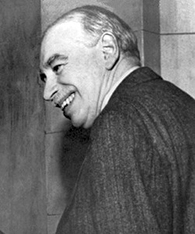
One of the most influential economists in modern times was John Maynard Keynes. (Credit: “John Maynard Keynes” by IMF/Wikimedia Commons, Public Domain) · Public Domain · Source出典
Figure 1.6図 1.6
One of the most influential economists in modern times was John Maynard Keynes. (Credit: “John Maynard Keynes” by IMF/Wikimedia Commons, Public Domain)
英語のヒント
ジョン・メイナード・ケインズは、近現代で最も影響力のある経済学者の一人であった。(出典:IMFによる「John Maynard Keynes」/Wikimedia Commons、パブリックドメイン)
John Maynard Keynes (1883–1946), one of the greatest economists of the twentieth century, pointed out that economics is not just a subject area but also a way of thinking. Keynes (Figure 1.6) famously wrote in the introduction to a fellow economist’s book: “[Economics] is a method rather than a doctrine, an apparatus of the mind, a technique of thinking, which helps its possessor to draw correct conclusions.” In other words, economics teaches you how to think, not what to think.
英語のヒント
20世紀を代表する経済学者の一人、ジョン・メイナード・ケインズ(1883~1946年)は、経済学は単なる学問分野ではなく、思考の方法でもあると指摘した。ケインズ(図1.6)は、ある同僚の経済学者の本の序文に、次の有名な言葉を書いている。「[経済学は]教義というより方法であり、精神の道具、思考の技法であり、それを持つ者が正しい結論を導く助けになる」。つまり経済学は、何を考えるかではなく、どのように考えるかを教える。
Additional Resources追加教材
Economists see the world through a different lens than anthropologists, biologists, classicists, or practitioners of any other discipline. They analyze issues and problems using economic theories that are based on particular assumptions about human behavior. These assumptions tend to be different than the assumptions an anthropologist or psychologist might use. A theory is a simplified representation of how two or more variables interact with each other. The purpose of a theory is to take a complex, real-world issue and simplify it down to its essentials. If done well, this enables the analyst to understand the issue and any problems around it. A good theory is simple enough to understand, while complex enough to capture the key features of the object or situation you are studying.
英語のヒント
経済学者は、人類学者、生物学者、古典学者など、ほかの分野の専門家とは違う視点で世界を見る。人間の行動についての特定の仮定に基づく経済理論を使って、課題や問題を分析する。その仮定は、人類学者や心理学者が使う仮定とは異なることが多い。理論とは、二つ以上の変数がどのように相互作用するかを簡略化して表したものである。理論の目的は、現実の複雑な問題を取り上げ、本質的な部分にまで単純化することである。それがうまくできれば、分析者はその課題や周囲の問題を理解できる。良い理論は、理解できるほど単純でありながら、研究対象となる物事や状況の主要な特徴を捉えられるだけの複雑さも備えている。
Sometimes economists use the term model instead of theory. Strictly speaking, a theory is a more abstract representation, while a model is a more applied or empirical representation. We use models to test theories, but for this course we will use the terms interchangeably.
英語のヒント
経済学者は、理論の代わりにモデルという言葉を使うこともある。厳密にいえば、理論はより抽象的な表現であり、モデルはより応用的、または実証的な表現である。理論を検証するためにモデルを使うが、この授業では両者を同じ意味で用いる。
For example, an architect who is planning a major office building will often build a physical model that sits on a tabletop to show how the entire city block will look after the new building is constructed. Companies often build models of their new products, which are more rough and unfinished than the final product, but can still demonstrate how the new product will work.
英語のヒント
たとえば大きなオフィスビルを計画する建築家は、建物ができた後に街区全体がどう見えるかを示すため、卓上に置ける模型を作ることが多い。企業もしばしば新製品の模型を作る。完成品より粗く未完成であっても、新製品がどう機能するかを示すことはできる。
A good model to start with in economics is the circular flow diagram (Figure 1.7). It pictures the economy as consisting of two groups—households and firms—that interact in two markets: the goods and services market in which firms sell and households buy and the labor market in which households sell labor to business firms or other employees.
英語のヒント
経済学で最初に学ぶモデルとして適しているのが、経済循環図(図1.7)である。この図は、経済を家計と企業という二つの集団からなるものとして描く。両者は、企業が売り家計が買う財・サービス市場と、家計が企業やほかの労働者に労働を売る労働市場という、二つの市場で相互に関わる。
The Circular Flow Diagram経済循環図
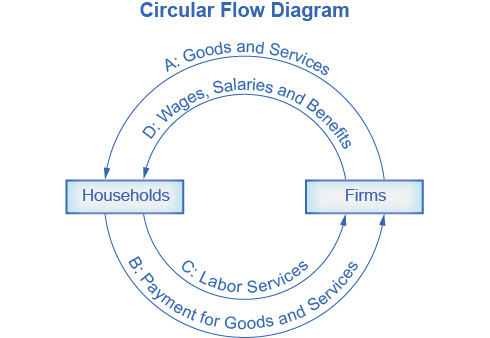


Figure 1.7図 1.7
The circular flow diagram shows how households and firms interact in the goods and services market, and in the labor market. The direction of the arrows shows that in the goods and services market, households receive goods and services and pay firms for them. In the labor market, households provide labor and receive payment from firms through wages, salaries, and benefits.
英語のヒント
経済循環図は、家計と企業が財・サービス市場および労働市場でどう関わるかを示す。矢印の方向から、財・サービス市場では家計が財やサービスを受け取り、その対価を企業に支払うことが分かる。労働市場では家計が労働を提供し、賃金、給与、福利厚生という形で企業から報酬を受け取る。
Firms produce and sell goods and services to households in the market for goods and services (or product market). Arrow “A” indicates this. Households pay for goods and services, which becomes the revenues to firms. Arrow “B” indicates this. Arrows A and B represent the two sides of the product market. Where do households obtain the income to buy goods and services? They provide the labor and other resources (e.g., land, capital, raw materials) firms need to produce goods and services in the market for inputs (or factors of production). Arrow “C” indicates this. In return, firms pay for the inputs (or resources) they use in the form of wages and other factor payments. Arrow “D” indicates this. Arrows “C” and “D” represent the two sides of the factor market.
英語のヒント
企業は財・サービス市場、すなわち生産物市場で、財やサービスを生産して家計に売る。これを矢印Aが示す。家計が支払う財やサービスの代金は、企業の収入になる。これを矢印Bが示す。AとBは、生産物市場の二つの側面を表している。家計は、財やサービスを買うための所得をどこから得るのか。投入物、すなわち生産要素の市場で、企業が財やサービスを生産するのに必要な労働や、土地・資本・原材料などの資源を提供する。これを矢印Cが示す。その見返りに、企業は使った投入物や資源に対し、賃金などの要素報酬を支払う。これを矢印Dが示す。CとDは、生産要素市場の二つの側面を表している。
Of course, in the real world, there are many different markets for goods and services and markets for many different types of labor. The circular flow diagram simplifies this to make the picture easier to grasp. In the diagram, firms produce goods and services, which they sell to households in return for revenues. The outer circle shows this, and represents the two sides of the product market (for example, the market for goods and services) in which households demand and firms supply. Households sell their labor as workers to firms in return for wages, salaries, and benefits. The inner circle shows this and represents the two sides of the labor market in which households supply and firms demand.
英語のヒント
現実には、さまざまな財やサービスの市場や、多くの種類の労働市場がある。経済循環図は、それを理解しやすい形に単純化している。図では、企業は財やサービスを生産して家計に売り、収入を得る。外側の円がこれを示し、家計が需要し企業が供給する生産物市場、たとえば財・サービス市場の二つの側面を表す。家計は労働者として企業に労働を売り、賃金、給与、福利厚生を受け取る。内側の円がこれを示し、家計が供給し企業が需要する労働市場の二つの側面を表す。
This version of the circular flow model is stripped down to the essentials, but it has enough features to explain how the product and labor markets work in the economy. We could easily add details to this basic model if we wanted to introduce more real-world elements, like financial markets, governments, and interactions with the rest of the globe (imports and exports).
英語のヒント
この経済循環モデルは必要最小限の要素に絞られているが、経済の中で生産物市場と労働市場がどう働くかを説明するには十分な特徴を備えている。金融市場、政府、外国との関係である輸出入など、現実の要素をさらに取り入れたい場合は、この基本モデルに詳しい要素を容易に付け加えられる。
Economists carry a set of theories in their heads like a carpenter carries around a toolkit. When they see an economic issue or problem, they go through the theories they know to see if they can find one that fits. Then they use the theory to derive insights about the issue or problem. Economists express theories as diagrams, graphs, or even as mathematical equations. (Do not worry. In this course, we will mostly use graphs.) Economists do not figure out the answer to the problem first and then draw the graph to illustrate. Rather, they use the graph of the theory to help them figure out the answer. Although at the introductory level, you can sometimes figure out the right answer without applying a model, if you keep studying economics, before too long you will run into issues and problems that you will need to graph to solve. We explain both micro and macroeconomics in terms of theories and models. The most well-known theories are probably those of supply and demand, but you will learn a number of others.
英語のヒント
大工が道具箱を持ち歩くように、経済学者は頭の中に幾つもの理論を持っている。経済の課題や問題に出会うと、知っている理論を順に検討し、合うものを探す。そしてその理論を使い、問題についての知見を導く。経済学者は理論を図やグラフ、さらには数式で表す。心配する必要はない。この授業では主にグラフを使う。先に問題の答えを出してから説明用のグラフを描くのではなく、理論のグラフを使って答えを考える。入門の段階では、モデルを使わなくても正しい答えが分かることがある。しかし経済学を学び続けると、やがて解くためにグラフが必要な課題や問題に出会う。本書ではミクロもマクロも、理論とモデルを使って説明する。最もよく知られているのはおそらく需要と供給の理論だが、それ以外にも多くを学ぶ。