第1章経済学へようこそ
1.1 What Is Economics, and Why Is It Important?1.1 経済学とは何か、なぜ重要なのか
Learning Objectives学習目標
Learning Objectives学習目標
By the end of this section, you will be able to:
英語のヒント
この節を学ぶと、次のことができるようになる。
- Discuss the importance of studying economics
英語のヒント
経済学を学ぶ重要性を論じる。 - Explain the relationship between production and division of labor
英語のヒント
生産と分業の関係を説明する。 - Evaluate the significance of scarcity
英語のヒント
希少性の意味を評価する。
Economics is the study of how humans make decisions in the face of scarcity. These can be individual decisions, family decisions, business decisions or societal decisions. If you look around carefully, you will see that scarcity is a fact of life. Scarcity means that human wants for goods, services and resources exceed what is available. Resources, such as labor, tools, land, and raw materials are necessary to produce the goods and services we want but they exist in limited supply. Of course, the ultimate scarce resource is time- everyone, rich or poor, has just 24 expendable hours in the day to earn income to acquire goods and services, for leisure time, or for sleep. At any point in time, there is only a finite amount of resources available.
英語のヒント
経済学は、人間が希少性に直面したとき、どのように意思決定をするかを研究する学問である。それは個人、家族、企業、あるいは社会の決定でありうる。周囲を注意深く見れば、希少性が現実の生活に存在することが分かる。希少性とは、人間が財・サービス・資源に対して抱く欲求が、利用できる量を上回ることをいう。労働、道具、土地、原材料などの資源は、私たちが望む財やサービスを生産するのに必要だが、その供給量には限りがある。究極の希少な資源は時間である。裕福でも貧しくても、財やサービスを手に入れる収入を得ること、余暇、睡眠などに使える時間は1日24時間しかない。どの時点でも、利用できる資源の量は有限である。
Think about it this way: In 2015 the labor force in the United States contained over 158 million workers, according to the U.S. Bureau of Labor Statistics. The total land area was 3,794,101 square miles. While these are certainly large numbers, they are not infinite. Because these resources are limited, so are the numbers of goods and services we produce with them. Combine this with the fact that human wants seem to be virtually infinite, and you can see why scarcity is a problem.
英語のヒント
次のように考えてみよう。米国労働統計局によると、2015年の米国の労働力人口は1億5800万人を超えていた。国土の総面積は379万4101平方マイルであった。確かに大きな数字だが、無限ではない。こうした資源が限られているため、それらを使って生産できる財やサービスの量も限られる。そこに、人間の欲求はほぼ無限に見えるという事実を重ねれば、なぜ希少性が問題となるかが分かる。
Introduction to FREDFRED入門
Data is very important in economics because it describes and measures the issues and problems that economics seek to understand. A variety of government agencies publish economic and social data. For this course, we will generally use data from the St. Louis Federal Reserve Bank's FRED database. FRED is very user friendly. It allows you to display data in tables or charts, and you can easily download it into spreadsheet form if you want to use the data for other purposes. The FRED website includes data on nearly 400,000 domestic and international variables over time, in the following broad categories:
英語のヒント
データは、経済学が理解しようとする課題や問題を記述し測定するため、経済学では非常に重要である。さまざまな政府機関が経済・社会データを公表している。この授業では、主にセントルイス連邦準備銀行のFREDデータベースを使用する。FREDはとても使いやすく、データを表やグラフに表示できる。ほかの目的で使いたい場合には、表計算の形式で簡単にダウンロードすることもできる。FREDのウェブサイトには、以下の大きな分類に分かれた、約40万の国内外の変数の時系列データがある。
- Money, Banking & Finance
英語のヒント
貨幣・銀行・金融 - Population, Employment, & Labor Markets (including Income Distribution)
英語のヒント
人口・雇用・労働市場(所得分配を含む) - National Accounts (Gross Domestic Product & its components), Flow of Funds, and International Accounts
英語のヒント
国民経済計算(国内総生産とその構成項目)、資金循環、国際勘定 - Production & Business Activity (including Business Cycles)
英語のヒント
生産と企業活動(景気循環を含む) - Prices & Inflation (including the Consumer Price Index, the Producer Price Index, and the Employment Cost Index)
英語のヒント
物価とインフレーション(消費者物価指数、生産者物価指数、雇用コスト指数を含む) - International Data from other nations
英語のヒント
他国の国際データ - U.S. Regional Data
英語のヒント
米国の地域別データ - Academic Data (including Penn World Tables & NBER Macrohistory database)
英語のヒント
研究用データ(ペン・ワールド・テーブルとNBERマクロ経済史データベースを含む)
For more information about how to use FRED, see the variety of videos on YouTube starting with this introduction.
英語のヒント
FREDの詳しい使い方については、この入門動画をはじめとするYouTubeの各種動画を参照のこと。
Scarcity of Resources資源の希少性

People experiencing homelessness are a stark reminder that scarcity of resources is real. (Credit: "Pittsburgh Homeless" by "daveyinn"/Flickr Creative Commons, CC BY 2.0) · CC BY 2.0 · Source出典

Figure 1.2図 1.2
People experiencing homelessness are a stark reminder that scarcity of resources is real. (Credit: "Pittsburgh Homeless" by "daveyinn"/Flickr Creative Commons, CC BY 2.0)
英語のヒント
住まいのない人々の存在は、資源の希少性が現実であることをはっきりと思い起こさせる。(出典:「daveyinn」による「Pittsburgh Homeless」/Flickr Creative Commons、CC BY 2.0)
If you still do not believe that scarcity is a problem, consider the following: Does everyone require food to eat? Does everyone need a decent place to live? Does everyone have access to healthcare? In every country in the world, there are people who are hungry, homeless (for example, those who call park benches their beds, as Figure 1.2 shows), and in need of healthcare, just to focus on a few critical goods and services. Why is this the case? It is because of scarcity. Let’s delve into the concept of scarcity a little deeper, because it is crucial to understanding economics.
英語のヒント
希少性が問題であるとまだ思えないなら、次のことを考えてみよう。誰もが食べ物を必要としているか。誰もがきちんとした住まいを必要としているか。誰もが医療を利用できるか。重要な財やサービスを幾つか挙げるだけでも、世界のどの国にも、空腹に苦しむ人、図1.2のように公園のベンチを寝床にするなど住まいのない人、医療を必要とする人がいる。なぜそうなるのか。希少性があるからである。経済学を理解するうえで不可欠な、希少性という概念をもう少し詳しく考えてみよう。
The Problem of Scarcity希少性の問題
Think about all the things you consume: food, shelter, clothing, transportation, healthcare, and entertainment. How do you acquire those items? You do not produce them yourself. You buy them. How do you afford the things you buy? You work for pay. If you do not, someone else does on your behalf. Yet most of us never have enough income to buy all the things we want. This is because of scarcity. So how do we solve it?
英語のヒント
自分が消費するものをすべて考えてみよう。食べ物、住まい、衣服、移動手段、医療、娯楽がある。これらをどうやって手に入れるのか。自分で生産するのではなく、購入する。買うためのお金はどう得るのか。働いて賃金を得る。自分がそうしていないなら、誰かが代わりに働いている。それでも、欲しいものをすべて買えるほどの所得を得ている人はほとんどいない。これも希少性のためである。では、この問題にどう対処すればよいのか。
Additional Resources追加教材
Every society, at every level, must make choices about how to use its resources. Families must decide whether to spend their money on a new car or a fancy vacation. Towns must choose whether to put more of the budget into police and fire protection or into the school system. Nations must decide whether to devote more funds to national defense or to protecting the environment. In most cases, there just isn’t enough money in the budget to do everything. How do we use our limited resources the best way possible, that is, to obtain the most goods and services we can? There are a couple of options. First, we could each produce everything we each consume. Alternatively, we could each produce some of what we want to consume, and “trade” for the rest of what we want. Let’s explore these options. Why do we not each just produce all of the things we consume? Think back to pioneer days, when individuals knew how to do so much more than we do today, from building their homes, to growing their crops, to hunting for food, to repairing their equipment. Most of us do not know how to do all—or any—of those things, but it is not because we could not learn. Rather, we do not have to. The reason why is something called the division and specialization of labor, a production innovation first put forth by Adam Smith (Figure 1.3) in his book, The Wealth of Nations.
英語のヒント
あらゆる社会は、あらゆる水準で、資源の使い方を選ばなければならない。家族は、新しい車にお金を使うか、豪華な休暇に使うかを決める。町は、警察・消防に多くの予算を割くか、学校制度に割くかを選ぶ。国は、国防により多くの資金を回すか、環境保護に回すかを決める。ほとんどの場合、すべてを実行できるほどの予算はない。限られた資源を可能な限りうまく使い、できるだけ多くの財やサービスを得るにはどうすればよいのか。幾つかの選択肢がある。一つは、一人ひとりが自分の消費するものをすべて作ることである。もう一つは、消費したいものの一部を自分で作り、残りは「交換」で手に入れることである。この二つを考えてみよう。なぜ一人ひとりが消費するものをすべて自分で作らないのか。開拓時代を思い浮かべると、当時の人々は、家を建て、作物を育て、食べ物を狩り、道具を修理するなど、現代の私たちよりはるかに多くのことを自分でできた。私たちの多くは、それらのすべて、あるいはどれ一つとしてやり方を知らない。しかし学べないからではなく、そうする必要がないからである。その理由は、労働の分業と専門化と呼ばれるものにある。これはアダム・スミス(図1.3)が『国富論』で初めて提唱した、生産上の革新である。
Adam Smithアダム・スミス
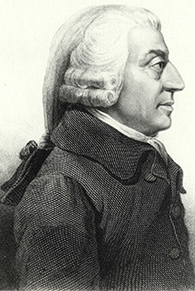
Adam Smith introduced the idea of dividing labor into discrete tasks. (Credit: "Adam Smith" by Cadell and Davies (1811), John Horsburgh (1828), or R.C. Bell (1872)/Wikimedia Commons, Public Domain) · Public Domain · Source出典

Figure 1.3図 1.3
Adam Smith introduced the idea of dividing labor into discrete tasks. (Credit: "Adam Smith" by Cadell and Davies (1811), John Horsburgh (1828), or R.C. Bell (1872)/Wikimedia Commons, Public Domain)
英語のヒント
アダム・スミスは、労働を個別の作業に分けるという考えを紹介した。(出典:Cadell and Davies(1811年)、John Horsburgh(1828年)、またはR.C. Bell(1872年)による「Adam Smith」/Wikimedia Commons、パブリックドメイン)