第15章心理的障害
Risk Factors for Antisocial Personality Disorder反社会性パーソナリティ障害の危険因子
Antisocial personality disorder is observed in about 3.6% of the population; the disorder is much more common among men, with a 3 to 1 ratio of men to women, and it is more likely to occur in men who are younger, widowed, separated, divorced, of lower socioeconomic status, who live in urban areas, and who live in the western United States (Compton, Conway, Stinson, Colliver, & Grant, 2005). Compared to men with antisocial personality disorder, women with the disorder are more likely to have experienced emotional neglect and sexual abuse during childhood, and they are more likely to have had parents who abused substances and who engaged in antisocial behaviors themselves (Alegria et al., 2013).
英語のヒント
反社会性パーソナリティ障害は人口の約3.6%に見られる。この障害は男性にはるかに多く、男女比は3対1である。また、年齢が若い、配偶者と死別している、別居中である、離婚している、社会経済的地位が低い、都市部に住んでいる、アメリカ西部に住んでいる、といった男性に生じる可能性が高い(Compton, Conway, Stinson, Colliver, & Grant, 2005)。反社会性パーソナリティ障害を持つ男性と比べて、この障害を持つ女性は、子ども時代に情緒的ネグレクトや性的虐待を経験している可能性が高く、また、物質を乱用し、自らも反社会的な行動をとっていた親を持っている可能性が高い(Alegria et al., 2013)。
Table 15.3 shows some of the differences in the specific types of antisocial behaviors that men and women with antisocial personality disorder exhibit (Alegria et al., 2013).
英語のヒント
表15.3は、反社会性パーソナリティ障害を持つ男性と女性が示す反社会的行動の具体的な種類について、その違いの一部を示している(Alegria et al., 2013)。
Gender Differences in Antisocial Personality Disorder 反社会性パーソナリティ障害における性差 |
|
|---|---|
Men with antisocial personality disorder are more likely than women with antisocial personality disorder to 反社会性パーソナリティ障害を持つ男性の方が、反社会性パーソナリティ障害を持つ女性よりも、次のことに当てはまる可能性が高い |
Women with antisocial personality disorder are more likely than men with antisocial personality disorder to 反社会性パーソナリティ障害を持つ女性の方が、反社会性パーソナリティ障害を持つ男性よりも、次のことに当てはまる可能性が高い |
|
|
Family, twin, and adoption studies suggest that both genetic and environmental factors influence the development of antisocial personality disorder, as well as general antisocial behavior (criminality, violence, aggressiveness) (Baker, Bezdjian, & Raine, 2006). Personality and temperament dimensions that are related to this disorder, including fearlessness, impulsive antisociality, and callousness, have a substantial genetic influence (Livesley & Jang, 2008). Adoption studies clearly demonstrate that the development of antisocial behavior is determined by the interaction of genetic factors and adverse environmental circumstances (Rhee & Waldman, 2002). For example, one investigation found that adoptees of biological parents with antisocial personality disorder were more likely to exhibit adolescent and adult antisocial behaviors if they were raised in adverse adoptive family environments (e.g., adoptive parents had marital problems, were divorced, used drugs, and had legal problems) than if they were raised in a more normal adoptive environment (Cadoret, Yates, Ed, Woodworth, & Stewart, 1995).
英語のヒント
家族研究、双生児研究、養子研究は、遺伝的要因と環境要因の両方が、反社会性パーソナリティ障害の発症と、一般的な反社会的行動(犯罪性、暴力、攻撃性)に影響を与えることを示唆している(Baker, Bezdjian, & Raine, 2006)。この障害に関連するパーソナリティと気質の次元、たとえば恐れ知らず、衝動的な反社会性、冷淡さには、かなりの遺伝的影響がある(Livesley & Jang, 2008)。養子研究は、反社会的行動の発達が、遺伝的要因と逆境的な環境条件の相互作用によって決まることを明確に示している(Rhee & Waldman, 2002)。たとえば、ある研究では、実の親が反社会性パーソナリティ障害を持つ養子は、より普通の養家の環境で育てられた場合よりも、逆境的な養家の環境(たとえば養父母に夫婦間の問題があった、離婚していた、薬物を使っていた、法的な問題を抱えていた)で育てられた場合の方が、青年期や成人期に反社会的行動を示す可能性が高いことが分かった(Cadoret, Yates, Ed, Woodworth, & Stewart, 1995)。
Researchers who are interested in the importance of environment in the development of antisocial personality disorder have directed their attention to such factors as the community, the structure and functioning of the family, and peer groups. Each of these factors influences the likelihood of antisocial behavior. One longitudinal investigation of more than 800 Seattle-area youth measured risk factors for violence at 10, 14, 16, and 18 years of age (Herrenkohl et al., 2000). The risk factors examined included those involving the family, peers, and community. A portion of the findings from this study are provided in Figure 15.20.
英語のヒント
反社会性パーソナリティ障害の発症における環境の重要性に関心を持つ研究者たちは、地域社会、家族の構造と機能、仲間集団といった要因に注意を向けてきた。これらの要因はいずれも、反社会的行動が生じる見込みに影響を与える。シアトル地域の800人を超える若者を対象にしたある縦断的研究は、10歳、14歳、16歳、18歳の時点で暴力の危険因子を測定した(Herrenkohl et al., 2000)。調べられた危険因子には、家族、仲間、地域社会にかかわるものが含まれていた。この研究の結果の一部を図15.20に示す。
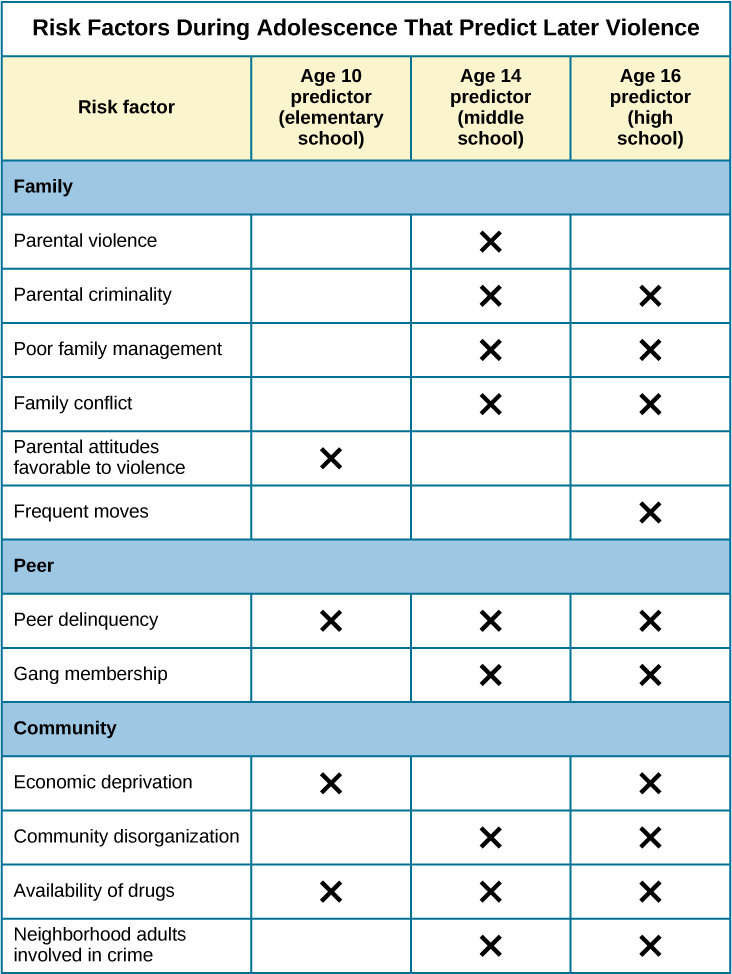

Figure 15.20図 15.20
Longitudinal studies have helped to identify risk factors for predicting violent behavior.
縦断的研究は、暴力的行動を予測する危険因子を特定するのに役立ってきた。
Those with antisocial tendencies do not seem to experience emotions the way most other people do. These individuals fail to show fear in response to environment cues that signal punishment, pain, or noxious stimulation. For instance, they show less skin conductance (sweatiness on hands) in anticipation of electric shock than do people without antisocial tendencies (Hare, 1965). Skin conductance is controlled by the sympathetic nervous system and is used to assess autonomic nervous system functioning. When the sympathetic nervous system is active, people become aroused and anxious, and sweat gland activity increases. Thus, increased sweat gland activity, as assessed through skin conductance, is taken as a sign of arousal or anxiety. For those with antisocial personality disorder, a lack of skin conductance may indicate the presence of characteristics such as emotional deficits and impulsivity that underlie the propensity for antisocial behavior and negative social relationships (Fung et al., 2005).
英語のヒント
反社会的な傾向を持つ人は、ほかの大多数の人と同じようには感情を経験しないようである。こうした人は、罰や痛み、有害な刺激を知らせる環境の手がかりに反応して恐怖を示すことがない。たとえば、電気ショックを予期しているとき、彼らは反社会的な傾向のない人よりも皮膚コンダクタンス(手の発汗)が小さい(Hare, 1965)。皮膚コンダクタンスは交感神経系によって制御されており、自律神経系の機能を評価するのに用いられる。交感神経系が活発になると、人は覚醒して不安になり、汗腺の活動が高まる。したがって、皮膚コンダクタンスによって評価される汗腺の活動の高まりは、覚醒や不安のしるしとみなされる。反社会性パーソナリティ障害を持つ人の場合、皮膚コンダクタンスの欠如は、感情の欠損や衝動性など、反社会的行動や好ましくない社会的関係に向かう傾向の根底にある特徴が存在することを示しているのかもしれない(Fung et al., 2005)。
Another example showing that those with antisocial personality disorder fail to respond to environmental cues comes from a recent study by Stuppy-Sullivan and Baskin-Sommers (2019). The researchers studied cognitive and reward factors associated with antisocial personality disorder dysfunction in 119 incarcerated males. Each subject was administered three tasks targeting different aspects of cognition and reward. High-magnitude rewards tended to impair perception in those with antisocial personality disorder, worsened executive function when they were consciously aware of the high rewards, and worsened inhibition when the tasks placed high demand on working memory.
英語のヒント
反社会性パーソナリティ障害を持つ人が環境の手がかりに反応しないことを示すもう一つの例は、スタッピー=サリヴァンとバスキン=ソマーズ(2019)による最近の研究から得られている。研究者たちは、収監されている男性119人を対象に、反社会性パーソナリティ障害の機能不全に関連する認知と報酬の要因を調べた。各対象者には、認知と報酬の異なる側面をねらった三つの課題が実施された。大きな報酬は、反社会性パーソナリティ障害を持つ人の知覚を損なう傾向があった。また、大きな報酬を意識的に認識しているときには実行機能を悪化させ、課題がワーキングメモリーに高い負荷をかけるときには抑制を悪化させた。