第15章心理的障害
Hoarding Disorderためこみ障害
Although hoarding was traditionally considered to be a symptom of OCD, considerable evidence suggests that hoarding represents an entirely different disorder (Mataix-Cols et al., 2010). People with hoarding disorder cannot bear to part with personal possessions, regardless of how valueless or useless these possessions are. As a result, these individuals accumulate excessive amounts of usually worthless items that clutter their living areas (Figure 15.12). Often, the quantity of cluttered items is so excessive that the person is unable to use his kitchen, or sleep in his bed. People who suffer from this disorder have great difficulty parting with items because they believe the items might be of some later use, or because they form a sentimental attachment to the items (APA, 2013). Importantly, a diagnosis of hoarding disorder is made only if the hoarding is not caused by another medical condition and if the hoarding is not a symptom of another disorder (e.g., schizophrenia) (APA, 2013).
英語のヒント
ためこみは、従来はOCDの症状の一つとみなされていたが、ためこみがまったく別の障害であることを示唆する証拠がかなりある(Mataix-Cols et al., 2010)。ためこみ障害の人は、個人の持ち物が、どれほど価値がなく役に立たないものであっても、それを手放すことに耐えられない。その結果、こうした人々は、たいていは価値のない物を過剰にためこみ、それが生活空間を散らかしてしまう(図15.12)。多くの場合、散らかった物の量があまりに多いため、本人は台所を使うことも、自分のベッドで眠ることもできなくなる。この障害に苦しむ人が物を手放すことをひどく難しく感じるのは、その物がのちに何かの役に立つかもしれないと信じているため、あるいはその物に感情的な愛着を抱いているためである(APA, 2013)。重要なのは、ためこみ障害の診断が下されるのは、ためこみがほかの医学的疾患によって引き起こされたものではなく、かつ、ほかの障害(たとえば統合失調症)の症状でもない場合に限られる、という点である(APA, 2013)。

Figure 15.12図 15.12
Those who suffer from hoarding disorder have great difficulty in discarding possessions, usually resulting in an accumulation of items that clutter living or work areas. (credit: “puuikibeach”/Flickr)
ためこみ障害に苦しむ人は、持ち物を捨てることがきわめて難しく、その結果たいてい、物がたまって生活空間や仕事場が散らかってしまう。(出典:“puuikibeach”/Flickr)
Causes of OCDOCDの原因
The results of family and twin studies suggest that OCD has a moderate genetic component. The disorder is five times more frequent in the first-degree relatives of people with OCD than in people without the disorder (Nestadt et al., 2000). Additionally, the concordance rate of OCD among identical twins is around 57%; however, the concordance rate for fraternal twins is 22% (Bolton, Rijsdijk, O’Connor, Perrin, & Eley, 2007). Studies have implicated about two dozen potential genes that may be involved in OCD; these genes regulate the function of three neurotransmitters: serotonin, dopamine, and glutamate (Pauls, 2010). Many of these studies included small sample sizes and have yet to be replicated. Thus, additional research needs to be done in this area.
英語のヒント
家族研究と双生児研究の結果は、OCDには中程度の遺伝的要素があることを示唆している。OCDの人の第一度近親者では、この障害のない人と比べて、この障害が5倍多く見られる(Nestadt et al., 2000)。さらに、一卵性双生児におけるOCDの一致率は約57%であるのに対し、二卵性双生児の一致率は22%である(Bolton, Rijsdijk, O’Connor, Perrin, & Eley, 2007)。これまでの研究によって、OCDに関与している可能性のある候補遺伝子が20数個指摘されている。これらの遺伝子は、セロトニン、ドーパミン、グルタミン酸という三つの神経伝達物質の働きを調節している(Pauls, 2010)。こうした研究の多くは標本サイズが小さく、まだ追試されていない。したがって、この領域ではさらに研究を重ねる必要がある。
A brain region that is believed to play a critical role in OCD is the orbitofrontal cortex (Kopell & Greenberg, 2008), an area of the frontal lobe involved in learning and decision-making (Rushworth, Noonan, Boorman, Walton, & Behrens, 2011) (Figure 15.13). In people with OCD, the orbitofrontal cortex becomes especially hyperactive when they are provoked with tasks in which, for example, they are asked to look at a photo of a toilet or of pictures hanging crookedly on a wall (Simon, Kaufmann, Müsch, Kischkel, & Kathmann, 2010). The orbitofrontal cortex is part of a series of brain regions that, collectively, is called the OCD circuit; this circuit consists of several interconnected regions that influence the perceived emotional value of stimuli and the selection of both behavioral and cognitive responses (Graybiel & Rauch, 2000). As with the orbitofrontal cortex, other regions of the OCD circuit show heightened activity during symptom provocation (Rotge et al., 2008), which suggests that abnormalities in these regions may produce the symptoms of OCD (Saxena, Bota, & Brody, 2001). Consistent with this explanation, people with OCD show a substantially higher degree of connectivity of the orbitofrontal cortex and other regions of the OCD circuit than do those without OCD (Beucke et al., 2013).
英語のヒント
OCDで決定的に重要な役割を果たしていると考えられている脳の領域は、眼窩前頭皮質である(Kopell & Greenberg, 2008)。眼窩前頭皮質は前頭葉の一領域で、学習と意思決定にかかわっている(Rushworth, Noonan, Boorman, Walton, & Behrens, 2011)(図15.13)。OCDの人では、たとえばトイレの写真や、壁に傾いて掛かっている絵の写真を見るよう求められる課題によって症状を誘発されると、眼窩前頭皮質がとりわけ過剰に活動する(Simon, Kaufmann, Müsch, Kischkel, & Kathmann, 2010)。眼窩前頭皮質は、まとめてOCD回路と呼ばれる一連の脳領域の一部である。この回路は相互に結びついたいくつかの領域から成り、それらの領域は、刺激について知覚される感情的価値や、行動的反応と認知的反応の両方の選択に影響を与える(Graybiel & Rauch, 2000)。眼窩前頭皮質と同様に、OCD回路のほかの領域も症状誘発中に活動の高まりを示す(Rotge et al., 2008)。このことは、これらの領域の異常がOCDの症状を生み出しているのかもしれないことを示唆している(Saxena, Bota, & Brody, 2001)。この説明と一致して、OCDの人は、OCDでない人に比べて、眼窩前頭皮質とOCD回路のほかの領域の結合性がかなり高い(Beucke et al., 2013)。
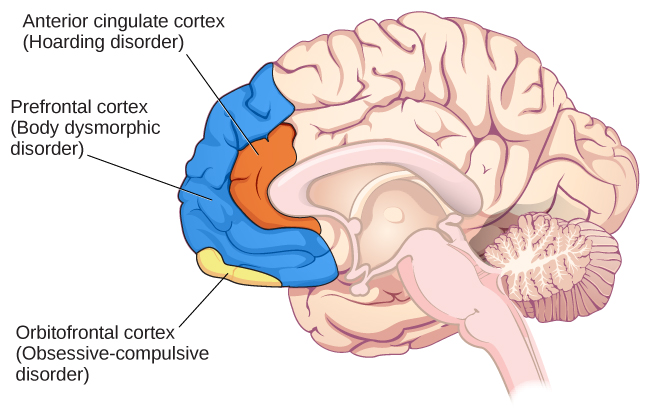


Figure 15.13図 15.13
Different regions of the brain may be associated with different psychological disorders.
脳の異なる領域が、それぞれ異なる心理的障害と関連している可能性がある。
The findings discussed above were based on imaging studies, and they highlight the potential importance of brain dysfunction in OCD. However, one important limitation of these findings is the inability to explain differences in obsessions and compulsions. Another limitation is that the correlational relationship between neurological abnormalities and OCD symptoms cannot imply causation (Abramowitz & Siqueland, 2013).
英語のヒント
ここまでに述べた知見は画像研究に基づくものであり、OCDにおける脳の機能不全が重要である可能性を浮き彫りにしている。しかし、これらの知見の重要な限界の一つは、強迫観念や強迫行為に見られる違いを説明できないことである。もう一つの限界は、神経学的な異常とOCDの症状とのあいだの相関関係が、因果関係を意味しえないことである(Abramowitz & Siqueland, 2013)。