第15章心理的障害
Causes of Autism Spectrum Disorder自閉症スペクトラム障害の原因
The exact causes of autism spectrum disorder remain unknown despite massive research efforts over the last two decades (Meek, Lemery-Chalfant, Jahromi, & Valiente, 2013). Autism appears to be strongly influenced by genetics, as identical twins show concordance rates of 60%–90%, whereas concordance rates for fraternal twins and siblings are 5%–10% (Autism Genome Project Consortium, 2007). Many different genes and gene mutations have been implicated in autism (Meek et al., 2013). Among the genes involved are those important in the formation of synaptic circuits that facilitate communication between different areas of the brain (Gauthier et al., 2011). A number of environmental factors are also thought to be associated with increased risk for autism spectrum disorder, at least in part, because they contribute to new mutations. These factors include exposure to pollutants, such as plant emissions and mercury, urban versus rural residence, and vitamin D deficiency (Kinney, Barch, Chayka, Napoleon, & Munir, 2009).
英語のヒント
過去20年にわたる膨大な研究努力にもかかわらず、自閉症スペクトラム障害の正確な原因はいまだに分かっていない(Meek, Lemery-Chalfant, Jahromi, & Valiente, 2013)。自閉症は遺伝の影響を強く受けているようである。一卵性双生児では60〜90%の一致率が見られるのに対し、二卵性双生児やきょうだいの一致率は5〜10%だからである(Autism Genome Project Consortium, 2007)。自閉症には、多くの異なる遺伝子や遺伝子の突然変異がかかわっていることが示されてきた(Meek et al., 2013)。かかわる遺伝子の中には、脳の異なる領域間のコミュニケーションを助けるシナプス回路の形成に重要な遺伝子がある(Gauthier et al., 2011)。また、多くの環境要因も、自閉症スペクトラム障害のリスクの上昇と関連していると考えられている。少なくとも部分的には、それらが新たな突然変異の一因となるからである。こうした要因には、工場の排出物や水銀などの汚染物質への曝露、都市部に住むか農村部に住むか、ビタミンD欠乏がある(Kinney, Barch, Chayka, Napoleon, & Munir, 2009)。
Child Vaccinations and Autism Spectrum Disorder子どもの予防接種と自閉症スペクトラム障害
In the late 1990s, a prestigious medical journal published an article purportedly showing that autism is triggered by the MMR (measles, mumps, and rubella) vaccine. These findings were very controversial and drew a great deal of attention, sparking an international forum on whether children should be vaccinated. In a shocking turn of events, some years later the article was retracted by the journal that had published it after evidence surfaced indicating fraud and unethical practices on the part of the lead researcher. Despite the retraction, the reporting in popular media led to concerns about a possible link between vaccines and autism persisting. A recent survey of parents, for example, found that roughly a third of respondents expressed such a concern (Kennedy, LaVail, Nowak, Basket, & Landry, 2011); and perhaps fearing that their children would develop autism, more than 10% of parents of young children refuse or delay vaccinations (Dempsey et al., 2011). Some parents of children with autism mounted a campaign against scientists who refuted the vaccine-autism link. Even politicians and several well-known celebrities weighed in; for example, actress Jenny McCarthy (who believed that a vaccination caused her son’s autism) co-authored a book on the matter. However, there is no scientific evidence that a link exists between autism and vaccinations (Hughes, 2007). Indeed, a recent study compared the vaccination histories of 256 children with autism spectrum disorder with that of 752 control children across three time periods during their first two years of life (birth to 3 months, birth to 7 months, and birth to 2 years) (DeStefano, Price, & Weintraub, 2013). At the time of the study, the children were between 6 and 13 years old, and their prior vaccination records were obtained. Because vaccines contain immunogens (substances that fight infections), the investigators examined medical records to see how many immunogens children received to determine if those children who received more immunogens were at greater risk for developing autism spectrum disorder. The results of this study, a portion of which are shown in Figure 15.19, clearly demonstrate that the quantity of immunogens from vaccines received during the first two years of life were not at all related to the development of autism spectrum disorder. There is not a relationship between vaccinations and autism spectrum disorders.
英語のヒント
1990年代後半、権威ある医学雑誌が、自閉症はMMR(麻疹・おたふくかぜ・風疹)ワクチンによって引き起こされることを示したとする論文を掲載した。この知見は大きな論争を呼んで多くの注目を集め、子どもに予防接種を受けさせるべきかどうかをめぐる国際的な議論を巻き起こした。衝撃的な展開として、数年後、筆頭研究者による不正と非倫理的な行為を示す証拠が明るみに出たのち、この論文は掲載した雑誌によって撤回された。撤回されたにもかかわらず、一般のメディアでの報道によって、ワクチンと自閉症の関連の可能性についての懸念が根強く残ることになった。たとえば、親を対象とした最近の調査では、回答者のおよそ3分の1がそうした懸念を示した(Kennedy, LaVail, Nowak, Basket, & Landry, 2011)。そして、おそらく子どもが自閉症になることを恐れて、幼い子どもの親の10%以上が予防接種を拒否したり遅らせたりしている(Dempsey et al., 2011)。自閉症の子どもを持つ親の中には、ワクチンと自閉症の関連を否定した科学者たちに対して反対運動を起こした人もいた。政治家や何人かの有名人までもが議論に加わった。たとえば、女優のジェニー・マッカーシー(予防接種が息子の自閉症を引き起こしたと信じていた)は、この問題についての本を共同で執筆した。しかし、自閉症と予防接種のあいだに関連が存在するという科学的証拠はない(Hughes, 2007)。実際、最近のある研究は、自閉症スペクトラム障害の子ども256人の予防接種歴を、統制群の子ども752人の予防接種歴と、生後2年間のうちの三つの期間(出生から3か月、出生から7か月、出生から2年)について比較した(DeStefano, Price, & Weintraub, 2013)。研究の時点で子どもたちは6〜13歳であり、それまでの予防接種の記録が入手された。ワクチンには免疫原(感染と闘う物質)が含まれているため、研究者たちは医療記録を調べて、子どもたちがどれだけの免疫原を受けたかを確認し、より多くの免疫原を受けた子どもは自閉症スペクトラム障害を発症するリスクが高いのかどうかを判断しようとした。この研究の結果(その一部を図15.19に示す)は、生後2年間に受けたワクチン由来の免疫原の量が、自閉症スペクトラム障害の発症とまったく関連していなかったことを明確に示している。予防接種と自閉症スペクトラム障害のあいだに関係はない。
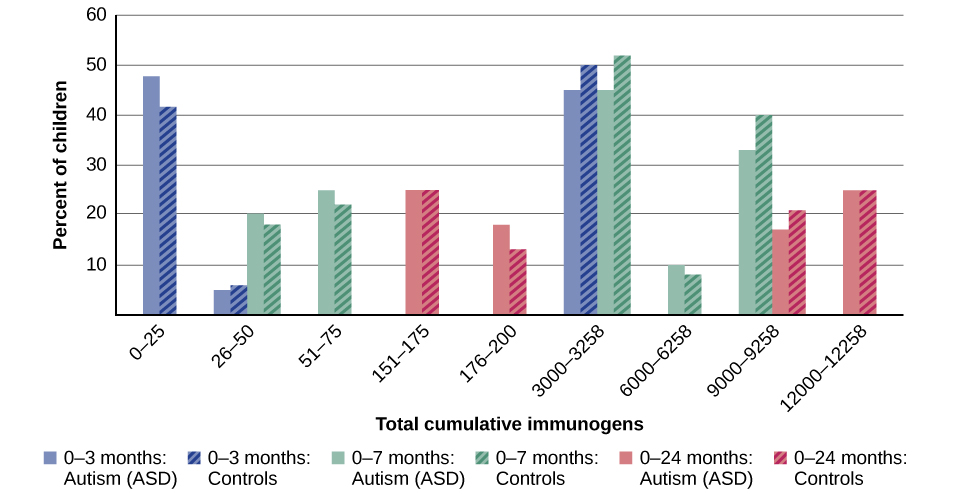

Figure 15.19図 15.19
In terms of their exposure to immunogens in vaccines, overall, there is not a significant difference between children with autism spectrum disorder and their age-matched controls without the disorder (DeStefano et al., 2013).
ワクチンに含まれる免疫原への曝露という点では、全体として、自閉症スペクトラム障害の子どもと、年齢をそろえたこの障害のない統制群の子どもとのあいだに有意な差はない(DeStefano et al., 2013)。
Why does concern over vaccines and autism spectrum disorder persist? Since the proliferation of the Internet in the 1990s, parents have been constantly bombarded with online information that can become magnified and take on a life of its own. The enormous volume of electronic information pertaining to autism spectrum disorder, combined with how difficult it can be to grasp complex scientific concepts, can make separating good research from bad challenging (Downs, 2008). Notably, the study that fueled the controversy reported that 8 out of 12 children—according to their parents—developed symptoms consistent with autism spectrum disorder shortly after receiving a vaccination. To conclude that vaccines cause autism spectrum disorder on this basis, as many did, is clearly incorrect for a number of reasons, not the least of which is because correlation does not imply causation, as you’ve learned.
英語のヒント
なぜワクチンと自閉症スペクトラム障害をめぐる懸念はなくならないのだろうか。1990年代にインターネットが急速に広まって以来、親たちはオンラインの情報を絶えず浴びせられてきた。そうした情報は増幅されて、ひとり歩きすることがある。自閉症スペクトラム障害に関する膨大な量の電子情報に、複雑な科学的概念を把握することの難しさが加わって、良い研究と悪い研究を見分けることが難しくなりうる(Downs, 2008)。注目すべきことに、この論争に火をつけた研究は、12人中8人の子どもが(親によれば)ワクチン接種の直後に自閉症スペクトラム障害と一致する症状を示すようになったと報告していた。これを根拠に、多くの人がしたように、ワクチンが自閉症スペクトラム障害を引き起こすと結論づけることは、いくつもの理由から明らかに誤りである。その中でも特に重要な理由は、すでに学んだように、相関は因果関係を意味しないということである。
Additionally, as was the case with diet and ADHD in the 1970s, the notion that autism spectrum disorder is caused by vaccinations is appealing to some because it provides a simple explanation for this condition. Like all disorders, however, there are no simple explanations for autism spectrum disorder. Although the research discussed above has shed some light on its causes, science is still a long way from complete understanding of the disorder.
英語のヒント
さらに、1970年代の食事とADHDの場合と同じように、自閉症スペクトラム障害は予防接種によって引き起こされるという考えは、この状態について単純な説明を与えてくれるため、一部の人々には魅力的に映る。しかし、すべての障害と同様に、自閉症スペクトラム障害にも単純な説明はない。上で論じた研究はその原因にいくらか光を当ててきたが、科学がこの障害を完全に理解するにはまだほど遠い。