第6章学習
Introductionはじめに
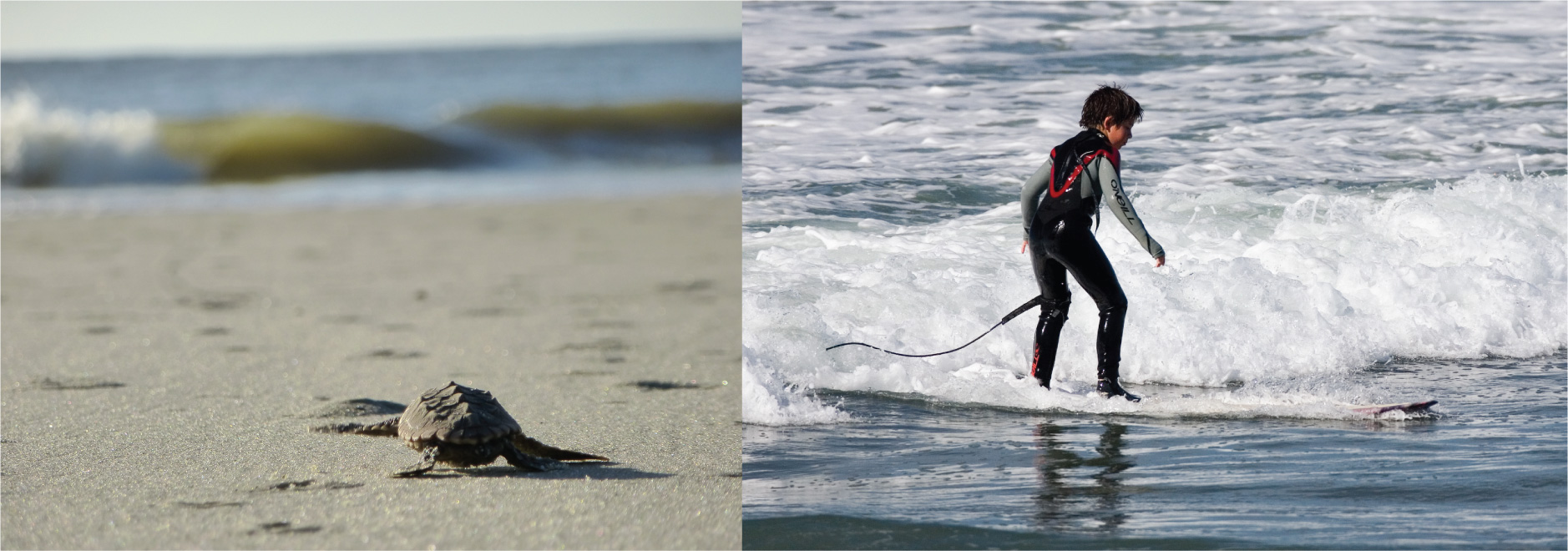
OpenStax, Rice University; Psychology 2e. (credit “turtle”: modification of work by Becky Skiba, USFWS; credit “surfer”: modification of work by Mike Baird) · CC BY 4.0 · Source出典

Figure 6.1図 6.1
Loggerhead sea turtle hatchlings are born knowing how to find the ocean and how to swim. Unlike the sea turtle, humans must learn how to swim (and surf). (credit “turtle”: modification of work by Becky Skiba, USFWS; credit “surfer”: modification of work by Mike Baird)
アカウミガメの子ガメは、海の見つけ方と泳ぎ方を知って生まれてくる。ウミガメとは違って、人間は泳ぎ方(そしてサーフィンのしかた)を学ばなければならない。(出典「カメ」:Becky Skiba, USFWSの作品を改変、出典「サーファー」:Mike Bairdの作品を改変)
The summer sun shines brightly on a deserted stretch of beach. Suddenly, a tiny grey head emerges from the sand, then another and another. Soon the beach is teeming with loggerhead sea turtle hatchlings (Figure 6.1). Although only minutes old, the hatchlings know exactly what to do. Their flippers are not very efficient for moving across the hot sand, yet they continue onward, instinctively. Some are quickly snapped up by gulls circling overhead and others become lunch for hungry ghost crabs that dart out of their holes. Despite these dangers, the hatchlings are driven to leave the safety of their nest and find the ocean.
英語のヒント
夏の太陽が、人けのない浜辺の一帯を明るく照らしている。突然、砂の中から小さな灰色の頭が一つ現れ、続いてもう一つ、またもう一つと顔を出す。まもなく浜辺は、アカウミガメの子ガメであふれかえる(図6.1)。生まれてまだ数分しかたっていないのに、子ガメたちは何をすべきかを正確に知っている。子ガメのひれ足は、熱い砂の上を進むのにはあまり効率がよくない。それでも子ガメたちは、本能のままに前へ進み続ける。頭上を旋回するカモメにすぐさまくわえ去られるものもいれば、巣穴から素早く飛び出してくる腹をすかせたスナガニの餌食になるものもいる。こうした危険にもかかわらず、子ガメたちは、巣という安全な場所を離れて海を見つけるよう駆り立てられている。
Not far down this same beach, Ben and his son, Julian, paddle out into the ocean on surfboards. A wave approaches. Julian crouches on his board, then jumps up and rides the wave for a few seconds before losing his balance. He emerges from the water in time to watch his father ride the face of the wave.
英語のヒント
同じ浜辺のそう遠くない先では、ベンと息子のジュリアンがサーフボードに乗って沖へ漕ぎ出している。波が近づいてくる。ジュリアンはボードの上でかがみ、それからぱっと立ち上がって数秒間波に乗るが、やがてバランスを崩す。水から顔を出したジュリアンは、ちょうど父親が波の斜面を滑っていくところを目にする。
Unlike baby sea turtles, which know how to find the ocean and swim with no help from their parents, we are not born knowing how to swim (or surf). Yet we humans pride ourselves on our ability to learn. In fact, over thousands of years and across cultures, we have created institutions devoted entirely to learning. But have you ever asked yourself how exactly it is that we learn? What processes are at work as we come to know what we know? This chapter focuses on the primary ways in which learning occurs.
英語のヒント
親の助けを借りずに海の見つけ方も泳ぎ方も分かっているウミガメの赤ちゃんとは違って、私たちは泳ぎ方(あるいはサーフィンのしかた)を知って生まれてくるわけではない。それでも私たち人間は、自分たちの学ぶ能力を誇りにしている。実際、私たちは何千年にもわたり、さまざまな文化のなかで、学習のためだけに設けられた機関をつくり上げてきた。しかし、私たちが学ぶのはいったいどのようにしてなのか、自分に問いかけたことはあるだろうか。私たちが、いま知っていることを知るようになるとき、どのような過程が働いているのだろうか。この章では、学習が起こる主な道筋に焦点を当てる。
References参考文献
Adibsereshki, N., Abkenar, S. J., Ashoori, M., & Mirzamani, M. (2015). The effectiveness of using reinforcements in the classroom on the academic achievement of students with intellectual disabilities. Journal of Intellectual Disabilities, 19(1), 83–93. https://doi.org/10.1177/1744629514559313
Adibsereshki, N., Abkenar, S. J., Ashoori, M., & Mirzamani, M. (2015). The effectiveness of using reinforcements in the classroom on the academic achievement of students with intellectual disabilities. Journal of Intellectual Disabilities, 19(1), 83–93. https://doi.org/10.1177/1744629514559313
Anderson, C. A., & Gentile, D. A. (2008). Media violence, aggression, and public policy. In E. Borgida & S. Fiske (Eds.), Beyond common sense: Psychological science in the courtroom (p. 322). Blackwell.
Anderson, C. A., & Gentile, D. A. (2008). Media violence, aggression, and public policy. In E. Borgida & S. Fiske (Eds.), Beyond common sense: Psychological science in the courtroom (p. 322). Blackwell.
Anderson, C. A., Bushman, B. J., Donnerstein, E., Hummer, T. A., & Warburton, W. (2015). SPSSI research summary on media violence. Analyses of Social Issues and Public Policy (ASAP), 15(1), 4–19. https://doi.org/10.1111/asap.12093
Anderson, C. A., Bushman, B. J., Donnerstein, E., Hummer, T. A., & Warburton, W. (2015). SPSSI research summary on media violence. Analyses of Social Issues and Public Policy (ASAP), 15(1), 4–19. https://doi.org/10.1111/asap.12093
Anderson, C. A., Shibuya, A., Ihori, N., Swing, E. L., Bushman, B. J., Sakamoto, A., Rothstein, H.R., & Saleem, M. (2010). Violent video game effects on aggression, empathy, and prosocial behavior in Eastern and Western countries: A meta-analytic review. Psychological Bulletin, 136(2), 151–173. HYPERLINK "https://psycnet.apa.org/doi/10.1037/a0018251"https://doi.org/10.1037/a0018251
Anderson, C. A., Shibuya, A., Ihori, N., Swing, E. L., Bushman, B. J., Sakamoto, A., Rothstein, H.R., & Saleem, M. (2010). Violent video game effects on aggression, empathy, and prosocial behavior in Eastern and Western countries: A meta-analytic review. Psychological Bulletin, 136(2), 151–173. HYPERLINK "https://psycnet.apa.org/doi/10.1037/a0018251"https://doi.org/10.1037/a0018251
Bandura, A., Ross, D., & Ross, S. A. (1961). Transmission of aggression through imitation of aggressive models. Journal of Abnormal and Social Psychology, 63, 575–582.
Bandura, A., Ross, D., & Ross, S. A. (1961). Transmission of aggression through imitation of aggressive models. Journal of Abnormal and Social Psychology, 63, 575–582.
Bushman, B. J., Anderson, C. A., Donnerstein, E., Hummer, T. A., & Warburton, W. A. (2016). Reply to comments on SPSSI research summary on media violence by Cupit (2016), Gentile (2016), Glackin and Gray (2016), Gollwitzer (2016), and Krahé (2016). Analyses of Social Issues and Public Policy (ASAP), 16(1), 443–450. https://doi.org/10.1111/asap.12123
Bushman, B. J., Anderson, C. A., Donnerstein, E., Hummer, T. A., & Warburton, W. A. (2016). Reply to comments on SPSSI research summary on media violence by Cupit (2016), Gentile (2016), Glackin and Gray (2016), Gollwitzer (2016), and Krahé (2016). Analyses of Social Issues and Public Policy (ASAP), 16(1), 443–450. https://doi.org/10.1111/asap.12123
Cangi, K., & Daly, M. (2013). The effects of token economies on the occurrence of appropriate and inappropriate behaviors by children with autism in a social skills setting. West Chester University: Journal of Undergraduate Research. http://www.wcupa.edu/UndergraduateResearch/journal/documents/cangi_S2012.pdf
Cangi, K., & Daly, M. (2013). The effects of token economies on the occurrence of appropriate and inappropriate behaviors by children with autism in a social skills setting. West Chester University: Journal of Undergraduate Research. http://www.wcupa.edu/UndergraduateResearch/journal/documents/cangi_S2012.pdf
Carlson, L., Holscher, C., Shipley, T., & Conroy Dalton, R. (2010). Getting lost in buildings. Current Directions in Psychological Science, 19(5), 284–289.
Carlson, L., Holscher, C., Shipley, T., & Conroy Dalton, R. (2010). Getting lost in buildings. Current Directions in Psychological Science, 19(5), 284–289.
Chance, P. (2009). Learning and behavior (6th ed.). Wadsworth, Cengage Learning.
Chance, P. (2009). Learning and behavior (6th ed.). Wadsworth, Cengage Learning.
Chase, H. W., & Clark, L. (2010). Gambling severity predicts midbrain response to near-miss outcomes. The Journal of Neuroscience, 30(18), 6180–6187. https://www.jneurosci.org/content/30/18/6180.short
Chase, H. W., & Clark, L. (2010). Gambling severity predicts midbrain response to near-miss outcomes. The Journal of Neuroscience, 30(18), 6180–6187. https://www.jneurosci.org/content/30/18/6180.short
Cialdini, R. B. (2008). Influence: Science and practice (5th ed.). Pearson Education.
Cialdini, R. B. (2008). Influence: Science and practice (5th ed.). Pearson Education.
DeAngelis, T. (2010). ‘Little Albert’ regains his identity. Monitor on Psychology, 41(1), 10.
DeAngelis, T. (2010). ‘Little Albert’ regains his identity. Monitor on Psychology, 41(1), 10.
Ferguson, C. J. (2011). Video games and youth violence: A prospective analysis in adolescents. Journal of Youth and Adolescence, 40(4), 377–391. https://link.springer.com/article/10.1007/s10964-010-9610-x
Ferguson, C. J. (2011). Video games and youth violence: A prospective analysis in adolescents. Journal of Youth and Adolescence, 40(4), 377–391. https://link.springer.com/article/10.1007/s10964-010-9610-x
Fryer, R. G., Jr. (2010, April). Financial incentives and student achievement: Evidence from randomized trials. National Bureau of Economic Research [NBER] Working Paper, No. 15898. http://www.nber.org/papers/w15898
Fryer, R. G., Jr. (2010, April). Financial incentives and student achievement: Evidence from randomized trials. National Bureau of Economic Research [NBER] Working Paper, No. 15898. http://www.nber.org/papers/w15898
Garcia, J., & Koelling, R. A. (1966). Relation of cue to consequence in avoidance learning. Psychonomic Science, 4, 123–124.
Garcia, J., & Koelling, R. A. (1966). Relation of cue to consequence in avoidance learning. Psychonomic Science, 4, 123–124.
Garcia, J., & Rusiniak, K. W. (1980). What the nose learns from the mouth. In D. Müller-Schwarze & R. M. Silverstein (Eds.), Chemical signals: Vertebrates and aquatic invertebrates (pp. 141–156). Plenum Press.
Garcia, J., & Rusiniak, K. W. (1980). What the nose learns from the mouth. In D. Müller-Schwarze & R. M. Silverstein (Eds.), Chemical signals: Vertebrates and aquatic invertebrates (pp. 141–156). Plenum Press.
Gentile, D. A. (2016). The evolution of scientific skepticism in the media violence “debate.” Analyses of Social Issues and Public Policy, 16, 429–434.
Gentile, D. A. (2016). The evolution of scientific skepticism in the media violence “debate.” Analyses of Social Issues and Public Policy, 16, 429–434.
Gershoff, E. T. (2002). Corporal punishment by parents and associated child behaviors and experiences: A meta-analytic and theoretical review. Psychological Bulletin, 128(4), 539–579. doi:10.1037//0033-2909.128.4.539
Gershoff, E. T. (2002). Corporal punishment by parents and associated child behaviors and experiences: A meta-analytic and theoretical review. Psychological Bulletin, 128(4), 539–579. doi:10.1037//0033-2909.128.4.539
Gershoff, E.T., Grogan-Kaylor, A., Lansford, J. E., Chang, L., Zelli, A., Deater-Deckard, K., & Dodge, K. A. (2010). Parent discipline practices in an international sample: Associations with child behaviors and moderation by perceived normativeness. Child Development, 81(2), 487–502.
Gershoff, E.T., Grogan-Kaylor, A., Lansford, J. E., Chang, L., Zelli, A., Deater-Deckard, K., & Dodge, K. A. (2010). Parent discipline practices in an international sample: Associations with child behaviors and moderation by perceived normativeness. Child Development, 81(2), 487–502.
Hickock, G. (2010). The role of mirror neurons in speech and language processing. Brain and Language, 112, 1–2.
Hickock, G. (2010). The role of mirror neurons in speech and language processing. Brain and Language, 112, 1–2.
Holmes, S. (1993). Food avoidance in patients undergoing cancer chemotherapy. Support Care Cancer, 1(6), 326–330.
Holmes, S. (1993). Food avoidance in patients undergoing cancer chemotherapy. Support Care Cancer, 1(6), 326–330.
Hunt, M. (2007). The story of psychology. Doubleday.
Hunt, M. (2007). The story of psychology. Doubleday.
Huston, A. C., Donnerstein, E., Fairchild, H., Feshbach, N. D., Katz, P. A., Murray, J. P., . . . Zuckerman, D. (1992). Big world, small screen: The role of television in American society. University of Nebraska Press.
Huston, A. C., Donnerstein, E., Fairchild, H., Feshbach, N. D., Katz, P. A., Murray, J. P., . . . Zuckerman, D. (1992). Big world, small screen: The role of television in American society. University of Nebraska Press.
Hutton, J. L., Baracos, V. E., & Wismer, W. V. (2007). Chemosensory dysfunction is a primary factor in the evolution of declining nutritional status and quality of life with patients with advanced cancer. Journal of Pain Symptom Management, 33(2), 156–165.
Hutton, J. L., Baracos, V. E., & Wismer, W. V. (2007). Chemosensory dysfunction is a primary factor in the evolution of declining nutritional status and quality of life with patients with advanced cancer. Journal of Pain Symptom Management, 33(2), 156–165.
Jacobsen, P. B., Bovbjerg, D. H., Schwartz, M. D., Andrykowski, M. A., Futterman, A. D., Gilewski, T., . . . Redd, W. H. (1993). Formation of food aversions in cancer patients receiving repeated infusions of chemotherapy. Behaviour Research and Therapy, 31(8), 739–748.
Jacobsen, P. B., Bovbjerg, D. H., Schwartz, M. D., Andrykowski, M. A., Futterman, A. D., Gilewski, T., . . . Redd, W. H. (1993). Formation of food aversions in cancer patients receiving repeated infusions of chemotherapy. Behaviour Research and Therapy, 31(8), 739–748.
Kirsch, SJ (2010). Media and youth: A developmental perspective. Wiley Blackwell.
Kirsch, SJ (2010). Media and youth: A developmental perspective. Wiley Blackwell.
Laskowski, C. S., Dorchak, D. L., Ward, K. M., Christensen, D. R., & Euston, D. R. (2019). Can slot-machine reward schedules induce gambling addiction in rats? Journal of Gambling Studies, 35(3), 887–914. https://www.ncbi.nlm.nih.gov/pubmed/31049772
Laskowski, C. S., Dorchak, D. L., Ward, K. M., Christensen, D. R., & Euston, D. R. (2019). Can slot-machine reward schedules induce gambling addiction in rats? Journal of Gambling Studies, 35(3), 887–914. https://www.ncbi.nlm.nih.gov/pubmed/31049772
Lefrançois, G. R. (2012). Theories of human learning: What the professors said (6th ed.). Wadsworth, Cengage Learning.
Lefrançois, G. R. (2012). Theories of human learning: What the professors said (6th ed.). Wadsworth, Cengage Learning.
Miller, L. E., Grabell, A., Thomas, A., Bermann, E., & Graham-Bermann, S. A. (2012). The associations between community violence, television violence, intimate partner violence, parent-child aggression, and aggression in sibling relationships of a sample of preschoolers. Psychology of Violence, 2(2), 165–78. doi:10.1037/a0027254
Miller, L. E., Grabell, A., Thomas, A., Bermann, E., & Graham-Bermann, S. A. (2012). The associations between community violence, television violence, intimate partner violence, parent-child aggression, and aggression in sibling relationships of a sample of preschoolers. Psychology of Violence, 2(2), 165–78. doi:10.1037/a0027254
Murch, W. S., & Clark, L. (2016). Games in the brain: Neural substrates of gambling addiction. The Neuroscientist, 22(5), 534–545. https://www.ncbi.nlm.nih.gov/pubmed/26116634
Murch, W. S., & Clark, L. (2016). Games in the brain: Neural substrates of gambling addiction. The Neuroscientist, 22(5), 534–545. https://www.ncbi.nlm.nih.gov/pubmed/26116634
Murrell, A., Christoff, K. & Henning, K. (2007) Characteristics of domestic violence offenders: associations with childhood exposure to violence. Journal of Family Violence, 22(7), 523-532.
Murrell, A., Christoff, K. & Henning, K. (2007) Characteristics of domestic violence offenders: associations with childhood exposure to violence. Journal of Family Violence, 22(7), 523-532.
Pavlov, I. P. (1927). Conditioned reflexes: An investigation of the physiological activity of the cerebral cortex (G. V. Anrep, Ed. & Trans.). Oxford University Press.
Pavlov, I. P. (1927). Conditioned reflexes: An investigation of the physiological activity of the cerebral cortex (G. V. Anrep, Ed. & Trans.). Oxford University Press.
Potenza, M. N. (2013). Neurobiology of gambling behaviors. Current Opinion in Neurobiology, 23(4), 660–667. https://www.ncbi.nlm.nih.gov/pmc/articles/PMC3803105/
Potenza, M. N. (2013). Neurobiology of gambling behaviors. Current Opinion in Neurobiology, 23(4), 660–667. https://www.ncbi.nlm.nih.gov/pmc/articles/PMC3803105/
Rescorla, R. A., & Wagner, A. R. (1972). A theory of Pavlovian conditioning: Variations in the effectiveness of reinforcement and nonreinforcement. Classical Conditioning II: Current Research and Theory, 2, 64-99.
Rescorla, R. A., & Wagner, A. R. (1972). A theory of Pavlovian conditioning: Variations in the effectiveness of reinforcement and nonreinforcement. Classical Conditioning II: Current Research and Theory, 2, 64-99.
Rizzolatti, G., Fadiga, L., Fogassi, L., & Gallese, V. (2002). From mirror neurons to imitation: Facts and speculations. In A. N. Meltzoff & W. Prinz (Eds.), The imitative mind: Development, evolution, and brain bases (pp. 247–66). Cambridge University Press.
Rizzolatti, G., Fadiga, L., Fogassi, L., & Gallese, V. (2002). From mirror neurons to imitation: Facts and speculations. In A. N. Meltzoff & W. Prinz (Eds.), The imitative mind: Development, evolution, and brain bases (pp. 247–66). Cambridge University Press.
Rizzolatti, G., Fogassi, L., & Gallese, V. (2006, November). Mirrors in the mind. Scientific American, pp. 54–61.
Rizzolatti, G., Fogassi, L., & Gallese, V. (2006, November). Mirrors in the mind. Scientific American, pp. 54–61.
Skinner, B. F. (1938). The behavior of organisms: An experimental analysis. Appleton-Century-Crofts.
Skinner, B. F. (1938). The behavior of organisms: An experimental analysis. Appleton-Century-Crofts.
Skinner, B. F. (1953). Science and human behavior. Macmillan.
Skinner, B. F. (1953). Science and human behavior. Macmillan.
Skinner, B. F. (1961). Cumulative record: A selection of papers. Appleton-Century-Crofts.
Skinner, B. F. (1961). Cumulative record: A selection of papers. Appleton-Century-Crofts.
Skinner’s utopia: Panacea, or path to hell? (1971, September 20). Time. http://www.wou.edu/~girodm/611/Skinner%27s_utopia.pdf
Skinner’s utopia: Panacea, or path to hell? (1971, September 20). Time. http://www.wou.edu/~girodm/611/Skinner%27s_utopia.pdf
Skolin, I., Wahlin, Y. B., Broman, D. A., Hursti, U-K. K., Larsson, M. V., & Hernell, O. (2006). Altered food intake and taste perception in children with cancer after start of chemotherapy: Perspectives of children, parents and nurses. Supportive Care in Cancer, 14, 369–78.
Skolin, I., Wahlin, Y. B., Broman, D. A., Hursti, U-K. K., Larsson, M. V., & Hernell, O. (2006). Altered food intake and taste perception in children with cancer after start of chemotherapy: Perspectives of children, parents and nurses. Supportive Care in Cancer, 14, 369–78.
Thorndike, E. L. (1911). Animal intelligence: An experimental study of the associative processes in animals. Psychological Monographs, 8.
Thorndike, E. L. (1911). Animal intelligence: An experimental study of the associative processes in animals. Psychological Monographs, 8.
Tolman, E. C., & Honzik, C. H. (1930). Degrees of hunger, reward, and non-reward, and maze performance in rats. University of California Publications in Psychology, 4, 241–256.
Tolman, E. C., & Honzik, C. H. (1930). Degrees of hunger, reward, and non-reward, and maze performance in rats. University of California Publications in Psychology, 4, 241–256.
Tolman, E. C., Ritchie, B. F., & Kalish, D. (1946). Studies in spatial learning: II. Place learning versus response learning. Journal of Experimental Psychology, 36, 221–229. doi:10.1037/h0060262
Tolman, E. C., Ritchie, B. F., & Kalish, D. (1946). Studies in spatial learning: II. Place learning versus response learning. Journal of Experimental Psychology, 36, 221–229. doi:10.1037/h0060262
Watson, J. B. & Rayner, R. (1920). Conditioned emotional reactions. Journal of Experimental Psychology, 3, 1–14.
Watson, J. B. & Rayner, R. (1920). Conditioned emotional reactions. Journal of Experimental Psychology, 3, 1–14.
Watson, J. B. (1919). Psychology from the standpoint of a behaviorist. J. B. Lippincott.
Watson, J. B. (1919). Psychology from the standpoint of a behaviorist. J. B. Lippincott.
Yamamoto, S., Humle, T., & Tanaka, M. (2013). Basis for cumulative cultural evolution in chimpanzees: Social learning of a more efficient tool-use technique. PLoS ONE, 8(1): e55768. doi:10.1371/journal.pone.0055768
Yamamoto, S., Humle, T., & Tanaka, M. (2013). Basis for cumulative cultural evolution in chimpanzees: Social learning of a more efficient tool-use technique. PLoS ONE, 8(1): e55768. doi:10.1371/journal.pone.0055768