第6章学習
Steps in the Modeling Processモデリングの過程の段階
Of course, we don’t learn a behavior simply by observing a model. Bandura described specific steps in the process of modeling that must be followed if learning is to be successful: attention, retention, reproduction, and motivation. First, you must be focused on what the model is doing—you have to pay attention. Next, you must be able to retain, or remember, what you observed; this is retention. Then, you must be able to perform the behavior that you observed and committed to memory; this is reproduction. Finally, you must have motivation. You need to want to copy the behavior, and whether or not you are motivated depends on what happened to the model. If you saw that the model was reinforced for their behavior, you will be more motivated to copy them. This is known as vicarious reinforcement. On the other hand, if you observed the model being punished, you would be less motivated to copy them. This is called vicarious punishment. For example, imagine that four-year-old Allison watched her older sister Kaitlyn playing in their mother’s makeup, and then saw Kaitlyn get a time out when their mother came in. After their mother left the room, Allison was tempted to play in the make-up, but she did not want to get a time-out from her mother. What do you think she did? Once you actually demonstrate the new behavior, the reinforcement you receive plays a part in whether or not you will repeat the behavior.
英語のヒント
もちろん、単にモデルを観察するだけで行動を学ぶわけではない。バンデューラは、学習がうまくいくためにたどらなければならない、モデリングの過程の具体的な段階を示した。注意、保持、再生、動機づけである。まず、モデルがしていることに集中している必要がある。つまり、注意を向けなければならない。次に、観察したことを保持できる、すなわち覚えておけることが求められる。これが保持である。それから、観察して記憶にとどめた行動を、自分で行えなければならない。これが再生である。最後に、動機づけがなければならない。その行動をまねしたいと思う必要があり、動機づけられるかどうかは、モデルに何が起こったかによって決まる。モデルがその行動に対して強化されたのを見たなら、そのモデルをまねようとする動機づけは高まるだろう。これは代理強化として知られる。一方、モデルが罰を受けるのを観察したなら、そのモデルをまねようとする動機づけは弱まるだろう。これは代理罰と呼ばれる。たとえば、4歳のアリソンが、姉のケイトリンが母親の化粧品で遊んでいるのを見て、その後、母親が入ってきたときにケイトリンがタイムアウトを受けるのを見たとしよう。母親が部屋を出ていった後、アリソンは化粧品で遊びたい誘惑に駆られたが、母親からタイムアウトを受けたくはなかった。アリソンはどうしたと思うだろうか。いったん新しい行動を実際に行うと、そこで受ける強化が、その行動を繰り返すかどうかを左右する一因となる。
Bandura researched modeling behavior, particularly children’s modeling of adults’ aggressive and violent behaviors (Bandura, Ross, & Ross, 1961). He conducted an experiment with a five-foot inflatable doll that he called a Bobo doll. In the experiment, children’s aggressive behavior was influenced by whether the teacher was punished for her behavior. In one scenario, a teacher acted aggressively with the doll, hitting, throwing, and even punching the doll, while a child watched. There were two types of responses by the children to the teacher’s behavior. When the teacher was punished for her bad behavior, the children decreased their tendency to act as she had. When the teacher was praised or ignored (and not punished for her behavior), the children imitated what she did, and even what she said. They punched, kicked, and yelled at the doll.
英語のヒント
バンデューラはモデリング行動、とりわけ大人の攻撃的・暴力的な行動を子どもがモデリングすることを研究した(Bandura, Ross, & Ross, 1961)。彼は、高さ5フィートのふくらませて使う人形を用いて実験を行い、その人形をボボ人形と呼んだ。この実験では、子どもの攻撃行動は、先生がその行動のために罰を受けたかどうかによって影響を受けた。ある場面では、子どもが見ている前で、先生が人形に攻撃的にふるまい、人形を叩いたり、投げたり、さらには拳で殴りつけたりした。先生の行動に対する子どもたちの反応には、二つの型があった。先生が悪い行動のために罰を受けたときには、子どもたちが先生と同じようにふるまう傾向は弱まった。先生がほめられたり無視されたりした(そしてその行動のために罰を受けなかった)ときには、子どもたちは先生がしたことを、さらには言ったことまでも模倣した。子どもたちは人形を殴り、蹴り、怒鳴りつけた。
What are the implications of this study? Bandura concluded that we watch and learn, and that this learning can have both prosocial and antisocial effects. Prosocial (positive) models can be used to encourage socially acceptable behavior. Parents in particular should take note of this finding. If you want your children to read, then read to them. Let them see you reading. Keep books in your home. Talk about your favorite books. If you want your children to be healthy, then let them see you eat right and exercise, and spend time engaging in physical fitness activities together. The same holds true for qualities like kindness, courtesy, and honesty. The main idea is that children observe and learn from their parents, even their parents’ morals, so be consistent and toss out the old adage “Do as I say, not as I do,” because children tend to copy what you do instead of what you say. Besides parents, many public figures, such as Martin Luther King, Jr. and Mahatma Gandhi, are viewed as prosocial models who are able to inspire global social change. Can you think of someone who has been a prosocial model in your life?
英語のヒント
この研究は何を意味しているのだろうか。バンデューラは、私たちは見て学ぶのであり、この学習は向社会的な効果と反社会的な効果の両方を持ちうると結論づけた。向社会的な(好ましい)モデルは、社会的に受け入れられる行動を促すために用いることができる。とりわけ親は、この知見に注目すべきである。子どもに本を読むようになってほしいなら、子どもに本を読んで聞かせよう。あなたが本を読んでいる姿を見せよう。家には本を置いておき、好きな本について話そう。子どもに健康でいてほしいなら、あなたがきちんと食べ、運動する姿を見せ、一緒に体を動かす活動をして時間を過ごそう。同じことは、親切さ、礼儀正しさ、正直さといった資質にも当てはまる。要点は、子どもは親を観察して親から学び、親の道徳観さえ学び取るということである。だから一貫した態度をとり、「私の言うようにせよ、私のするようにはするな」という古い格言は捨ててしまおう。子どもは、あなたが言うことではなく、あなたがすることをまねる傾向があるからである。親のほかにも、マーティン・ルーサー・キング・ジュニアやマハトマ・ガンジーをはじめとする多くの著名人が、世界規模の社会変革を促すことのできる向社会的モデルとみなされている。あなたの人生で向社会的モデルとなってきた人を、誰か思い浮かべられるだろうか。
The antisocial effects of observational learning are also worth mentioning. As you saw from the example of Claire at the beginning of this section, her daughter viewed Claire’s aggressive behavior and copied it. Research suggests that this may help to explain why victims of abuse often grow up to be abusers themselves (Murrell, Christoff, & Henning, 2007). In fact, about 30% of child abuse victims become abusive parents (U.S. Department of Health & Human Services, 2013). We tend to do what we know. Children who grow up witnessing their parents deal with anger and frustration through violent and aggressive acts often learn to behave in that manner themselves.
英語のヒント
観察学習の反社会的な効果にも、触れておく価値がある。この節の冒頭のクレアの例で見たように、クレアの娘はクレアの攻撃的な行動を見て、それをまねた。研究は、このことが、虐待の被害者が成長して自ら虐待する側になることが多いのはなぜかを説明する一助となるかもしれないと示唆している(Murrell, Christoff, & Henning, 2007)。実際、児童虐待の被害者の約30%が、虐待する親になる(U.S. Department of Health & Human Services, 2013)。私たちは、自分が知っていることをする傾向がある。親が怒りや欲求不満に暴力的・攻撃的な行為で対処するのを目にしながら育った子どもは、自分自身も同じようにふるまうようになることが多い。
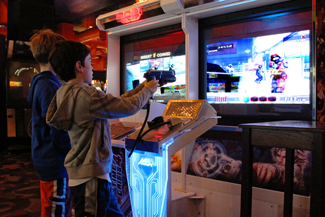
Some studies suggest that violent television shows, movies, and video games may also have antisocial effects (Figure 6.18) although further research needs to be done to understand the correlational and causational aspects of media violence and behavior. Some studies have found a link between viewing violence and aggression seen in children (Anderson & Gentile, 2008; Kirsch, 2010; Miller, Grabell, Thomas, Bermann, & Graham-Bermann, 2012). These findings may not be surprising, given that a child graduating from high school has been exposed to around 200,000 violent acts including murder, robbery, torture, bombings, beatings, and rape through various forms of media (Huston et al., 1992). Not only might viewing media violence affect aggressive behavior by teaching people to act that way in real life situations, but it has also been suggested that repeated exposure to violent acts also desensitizes people to it. Psychologists are working to understand this dynamic.
英語のヒント
暴力的なテレビ番組、映画、ビデオゲームも反社会的な効果を持ちうることを示唆する研究がある(図6.18)。ただし、メディアの暴力と行動の相関的な側面と因果的な側面を理解するには、さらなる研究が必要である。暴力を見ることと、子どもに見られる攻撃との間に関連を見いだした研究もある(Anderson & Gentile, 2008; Kirsch, 2010; Miller, Grabell, Thomas, Bermann, & Graham-Bermann, 2012)。高校を卒業する子どもが、さまざまな形のメディアを通して、殺人、強盗、拷問、爆破、暴行、レイプなどを含む約20万件の暴力行為に触れてきていることを考えれば、こうした知見は驚くことではないかもしれない(Huston et al., 1992)。メディアの暴力を見ることは、現実の場面でそのようにふるまうことを教えて攻撃行動に影響するかもしれないだけでなく、暴力行為に繰り返しさらされることによって、人々が暴力に対して鈍感になるとも指摘されている。心理学者たちは、この力学を理解しようと取り組んでいる。
OpenStax, Rice University; Psychology 2e. (credit: "woodleywonderworks"/Flickr) · CC BY 4.0 · Source出典

Figure 6.18図 6.18
Can viewing violent media make us violent? Psychological researchers study this topic. (credit: "woodleywonderworks"/Flickr)
暴力的なメディアを見ると、私たちは暴力的になるのだろうか。心理学の研究者たちは、このテーマを研究している。(出典:"woodleywonderworks"/Flickr)