第6章学習
Behaviorism行動主義
John B. Watson, shown in Figure 6.8, is considered the founder of behaviorism. Behaviorism is a school of thought that arose during the first part of the 20th century, which incorporates elements of Pavlov’s classical conditioning (Hunt, 2007). In stark contrast with Freud, who considered the reasons for behavior to be hidden in the unconscious, Watson championed the idea that all behavior can be studied as a simple stimulus-response reaction, without regard for internal processes. Watson argued that in order for psychology to become a legitimate science, it must shift its concern away from internal mental processes because mental processes cannot be seen or measured. Instead, he asserted that psychology must focus on outward observable behavior that can be measured.
英語のヒント
図6.8のジョン・B・ワトソンは、行動主義の創始者とみなされている。行動主義は20世紀前半に生まれた学派であり、パヴロフの古典的条件づけの要素を取り入れている(Hunt, 2007)。行動の理由は無意識の中に隠されていると考えたフロイトとは著しく対照的に、ワトソンは、内的な過程を考慮することなく、すべての行動を単純な「刺激-反応」型の反応として研究できるという考えを唱えた。ワトソンは、心理学が正当な科学となるためには、関心を内的な心的過程から移さなければならないと論じた。心的過程は見ることも測定することもできないからである。その代わりに、心理学は、測定できる、外に現れた観察可能な行動に焦点を当てなければならない、とワトソンは主張した。
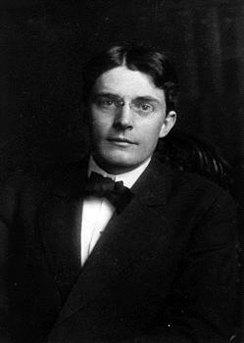
Figure 6.8図 6.8
John B. Watson used the principles of classical conditioning in the study of human emotion.
ジョン・B・ワトソンは、古典的条件づけの原理を人間の感情の研究に用いた。
Watson’s ideas were influenced by Pavlov’s work. According to Watson, human behavior, just like animal behavior, is primarily the result of conditioned responses. Whereas Pavlov’s work with dogs involved the conditioning of reflexes, Watson believed the same principles could be extended to the conditioning of human emotions (Watson, 1919).
英語のヒント
ワトソンの考えは、パヴロフの研究の影響を受けていた。ワトソンによれば、人間の行動は、動物の行動とまったく同じように、主として条件反応の結果である。パヴロフの犬の研究が反射の条件づけにかかわっていたのに対し、ワトソンは、同じ原理を人間の感情の条件づけにまで広げられると考えた(Watson, 1919)。
In 1920, while chair of the psychology department at Johns Hopkins University, Watson and his graduate student, Rosalie Rayner, conducted research on a baby nicknamed Little Albert. Rayner and Watson’s experiments with Little Albert demonstrated how fears can be conditioned using classical conditioning. Through these experiments, Little Albert was exposed to and conditioned to fear certain things. Initially he was presented with various neutral stimuli, including a rabbit, a dog, a monkey, masks, cotton wool, and a white rat. He was not afraid of any of these things. Then Watson, with the help of Rayner, conditioned Little Albert to associate these stimuli with an emotion—fear. For example, Watson handed Little Albert the white rat, and Little Albert enjoyed playing with it. Then Watson made a loud sound, by striking a hammer against a metal bar hanging behind Little Albert’s head, each time Little Albert touched the rat. Little Albert was frightened by the sound—demonstrating a reflexive fear of sudden loud noises—and began to cry. Watson repeatedly paired the loud sound with the white rat. Soon Little Albert became frightened by the white rat alone. In this case, what are the UCS, CS, UCR, and CR? Days later, Little Albert demonstrated stimulus generalization—he became afraid of other furry things: a rabbit, a furry coat, and even a Santa Claus mask (Figure 6.9). Watson had succeeded in conditioning a fear response in Little Albert, thus demonstrating that emotions could become conditioned responses. It had been Watson’s intention to produce a phobia—a persistent, excessive fear of a specific object or situation— through conditioning alone, thus countering Freud’s view that phobias are caused by deep, hidden conflicts in the mind. However, there is no evidence that Little Albert experienced phobias in later years. While Watson’s research provided new insight into conditioning, it would be considered unethical by today’s standards.
英語のヒント
1920年、ジョンズ・ホプキンズ大学の心理学科長だったワトソンは、大学院生のロザリー・レイナーとともに、「アルバート坊や」と呼ばれる赤ん坊を対象に研究を行った。レイナーとワトソンのアルバート坊やを使った実験は、古典的条件づけによって恐怖がどのように条件づけられうるかを示した。これらの実験を通して、アルバート坊やは特定のものにさらされ、それを怖がるように条件づけられた。最初に、アルバート坊やには、ウサギ、犬、サル、お面、綿、白ネズミなど、さまざまな中性刺激が提示された。アルバート坊やは、そのどれも怖がらなかった。次にワトソンは、レイナーの助けを借りて、アルバート坊やがこれらの刺激を一つの感情、すなわち恐怖と結びつけるように条件づけた。たとえば、ワトソンがアルバート坊やに白ネズミを手渡すと、アルバート坊やは喜んでそれで遊んだ。そこでワトソンは、アルバート坊やがネズミに触れるたびに、アルバート坊やの頭の後ろにつり下げられた金属の棒をハンマーでたたいて、大きな音を立てた。アルバート坊やはその音におびえて泣き出した。これは、突然の大きな音に対する反射的な恐怖を示すものである。ワトソンは、大きな音を白ネズミと繰り返し対にした。まもなくアルバート坊やは、白ネズミだけでおびえるようになった。この場合、UCS、CS、UCR、CRは何だろうか。数日後、アルバート坊やは刺激般化を示した。ほかの毛のふさふさしたもの、つまりウサギや毛皮のコート、さらにはサンタクロースのお面まで怖がるようになったのである(図6.9)。ワトソンはアルバート坊やに恐怖反応を条件づけることに成功し、それによって、感情が条件反応になりうることを示した。ワトソンの意図は、条件づけだけによって恐怖症、すなわち特定の対象や状況に対する持続的で過剰な恐怖をつくりだすことにあった。そうすることで、恐怖症は心の中の深く隠された葛藤によって引き起こされるというフロイトの見方に反論しようとしたのである。しかし、アルバート坊やがその後の年月に恐怖症を経験したという証拠はない。ワトソンの研究は条件づけについての新しい洞察をもたらしたが、今日の基準からすれば倫理に反するとみなされるだろう。
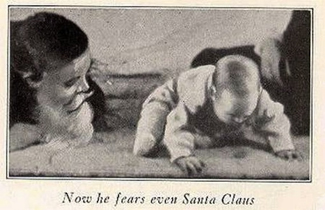


Figure 6.9図 6.9
Through stimulus generalization, Little Albert came to fear furry things, including Watson in a Santa Claus mask.
刺激般化によって、アルバート坊やは、サンタクロースのお面をかぶったワトソンを含め、毛のふさふさしたものを怖がるようになった。