第6章学習
6.4 Observational Learning (Modeling)6.4 観察学習(モデリング)
Learning Objectives学習目標
By the end of this section, you will be able to:
この節を学び終えると、次のことができるようになる。
- Define observational learning観察学習を定義する
- Discuss the steps in the modeling processモデリングの過程の段階について論じる
- Explain the prosocial and antisocial effects of observational learning観察学習の向社会的な効果と反社会的な効果を説明する
Previous sections of this chapter focused on classical and operant conditioning, which are forms of associative learning. In observational learning, we learn by watching others and then imitating, or modeling, what they do or say. For instance, have you ever gone to YouTube to find a video showing you how to do something? The individuals performing the imitated behavior are called models. Research suggests that this imitative learning involves a specific type of neuron, called a mirror neuron (Hickock, 2010; Rizzolatti, Fadiga, Fogassi, & Gallese, 2002; Rizzolatti, Fogassi, & Gallese, 2006).
英語のヒント
この章のこれまでの節では、古典的条件づけとオペラント条件づけに焦点を当ててきた。これらはどちらも連合学習の一形態である。観察学習では、私たちは他者を見て、その人たちが行ったり言ったりすることを模倣する、すなわちモデリングすることによって学ぶ。たとえば、何かのやり方を教えてくれる動画を探しに、YouTubeを見に行ったことはないだろうか。模倣される行動を行っている人は、モデルと呼ばれる。研究は、この模倣による学習に、ミラーニューロンと呼ばれる特定の種類のニューロンがかかわっていることを示唆している(Hickock, 2010; Rizzolatti, Fadiga, Fogassi, & Gallese, 2002; Rizzolatti, Fogassi, & Gallese, 2006)。
Humans and other animals are capable of observational learning. For example, in a study of social learning in chimpanzees, researchers gave juice boxes with straws to two groups of captive chimpanzees. The first group dipped the straw into the juice box, and then sucked on the small amount of juice at the end of the straw. The second group sucked through the straw directly, getting much more juice. When the first group, the “dippers,” observed the second group, “the suckers,” what do you think happened? All of the “dippers” in the first group switched to sucking through the straws directly. By simply observing the other chimps and modeling their behavior, they learned that this was a more efficient method of getting juice (Yamamoto, Humle, and Tanaka, 2013).
英語のヒント
人間もほかの動物も、観察学習を行うことができる。たとえば、チンパンジーの社会的学習についてのある研究で、研究者たちは、飼育下にあるチンパンジーの二つの群れに、ストローの付いた紙パック入りのジュースを与えた。第一の群れは、ストローをジュースのパックに浸し、ストローの先に付いたわずかなジュースを吸った。第二の群れはストローで直接吸い、はるかに多くのジュースを得た。第一の群れ、つまり「浸す組」が、第二の群れ、つまり「吸う組」を観察したとき、何が起こったと思うだろうか。第一の群れの「浸す組」は全員、ストローで直接吸うやり方に切り替えた。ほかのチンパンジーを観察してその行動をまねるだけで、彼らは、そのほうがジュースを得るのに効率のよい方法だと学んだのである(Yamamoto, Humle, and Tanaka, 2013)。
OpenStax, Rice University; Psychology 2e. (credit: U.S. Air Force, Senior Airman Kasey Close) Embedded rights notice: Public Domain · CC BY 4.0 · Source出典

Figure 6.16図 6.16
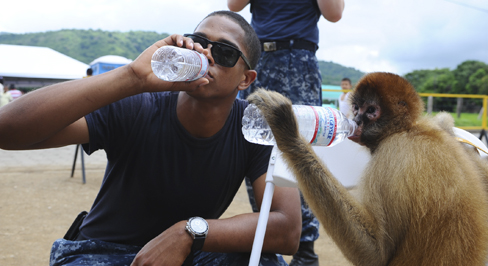
This spider monkey learned to drink water from a plastic bottle by seeing the behavior modeled by a human. (credit: U.S. Air Force, Senior Airman Kasey Close)
このクモザルは、人間が手本として示した行動を見て、ペットボトルから水を飲むことを学んだ。(出典:U.S. Air Force, Senior Airman Kasey Close)
Imitation is sometimes called the highest form of flattery. But consider Claire’s experience with observational learning. Claire’s nine-year-old son, Jay, was getting into trouble at school and was defiant at home. Claire feared that Jay would end up like her brothers, two of whom were in prison. One day, after yet another bad day at school and another negative note from the teacher, Claire, at her wit’s end, beat her son with a belt to get him to behave. Later that night, as she put her children to bed, Claire witnessed her four-year-old daughter, Anna, take a belt to her teddy bear and whip it. Claire was horrified, realizing that Anna was imitating her mother. It was then that Claire knew she wanted to discipline her children in a different manner.
英語のヒント
模倣は、ときに最上の賛辞だと言われる。しかし、観察学習にまつわるクレアの経験を考えてみよう。クレアの9歳の息子ジェイは、学校で問題を起こしており、家では反抗的だった。クレアは、ジェイが自分の兄弟たちのようになってしまうのではないかと恐れていた。その兄弟のうち2人は刑務所に入っていたのである。ある日、学校でまたしてもひどい一日があり、先生からまたしても芳しくない連絡が来た後、途方に暮れたクレアは、息子に言うことを聞かせようと、ベルトで息子を叩いた。その夜遅く、子どもたちを寝かしつけていたとき、クレアは、4歳の娘アンナがベルトを手にしてテディベアを打ちすえているのを目にした。アンナが母親をまねているのだと気づき、クレアはぞっとした。自分は子どもたちを別のやり方でしつけたいのだとクレアが悟ったのは、そのときだった。
Like Tolman, whose experiments with rats suggested a cognitive component to learning, psychologist Albert Bandura’s ideas about learning were different from those of strict behaviorists. Bandura and other researchers proposed a brand of behaviorism called social learning theory, which took cognitive processes into account. According to Bandura, pure behaviorism could not explain why learning can take place in the absence of external reinforcement. He felt that internal mental states must also have a role in learning and that observational learning involves much more than imitation. In imitation, a person simply copies what the model does. Observational learning is much more complex. According to Lefrançois (2012) there are several ways that observational learning can occur:
英語のヒント
ネズミを使った実験から、学習には認知的な要素があることを示唆したトールマンと同じく、心理学者アルバート・バンデューラの学習についての考えも、厳格な行動主義者たちの考えとは異なっていた。バンデューラとほかの研究者たちは、社会的学習理論と呼ばれる行動主義の一種を提唱した。この理論は認知過程を考慮に入れるものだった。バンデューラによれば、純粋な行動主義では、外的な強化がなくても学習が起こりうるのはなぜかを説明できなかった。バンデューラは、学習には内的な心的状態も役割を果たしているはずであり、観察学習には模倣よりはるかに多くのことが含まれていると考えた。模倣では、人はモデルがすることをただまねるだけである。観察学習はそれよりはるかに複雑である。ルフランソワ(2012)によれば、観察学習が起こりうる道筋は、次のようにいくつかある。
- You learn a new response. After watching your coworker get chewed out by your boss for coming in late, you start leaving home 10 minutes earlier so that you won’t be late.
英語のヒント
新しい反応を学ぶ。遅刻してきた同僚が上司にこっぴどく叱られるのを見た後、自分は遅刻しないように、10分早く家を出るようになる。 - You choose whether or not to imitate the model depending on what you saw happen to the model. Remember Julian and his father? When learning to surf, Julian might watch how his father pops up successfully on his surfboard and then attempt to do the same thing. On the other hand, Julian might learn not to touch a hot stove after watching his father get burned on a stove.
英語のヒント
モデルの身に何が起こるのを見たかによって、そのモデルを模倣するかどうかを選ぶ。ジュリアンと父親のことを覚えているだろうか。サーフィンを習うとき、ジュリアンは、父親がサーフボードの上でうまく立ち上がる様子を見て、それから同じことをやってみようとするかもしれない。一方で、父親がコンロでやけどをするのを見た後には、ジュリアンは熱いコンロに触らないことを学ぶかもしれない。 - You learn a general rule that you can apply to other situations.
英語のヒント
ほかの状況にも当てはめることのできる一般的な規則を学ぶ。
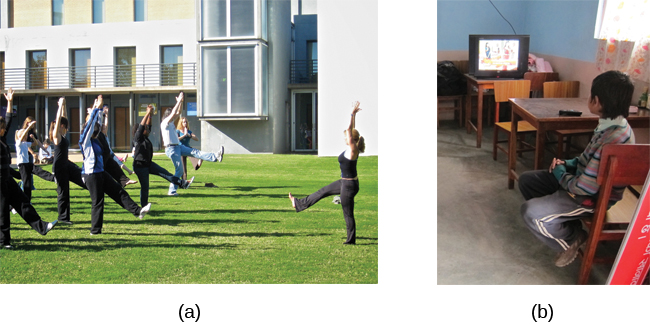
Bandura identified three kinds of models: live, verbal, and symbolic. A live model demonstrates a behavior in person, as when Ben stood up on his surfboard so that Julian could see how he did it. A verbal instructional model does not perform the behavior, but instead explains or describes the behavior, as when a soccer coach tells his young players to kick the ball with the side of the foot, not with the toe. A symbolic model can be fictional characters or real people who demonstrate behaviors in books, movies, television shows, video games, or Internet sources (Figure 6.17).
英語のヒント
バンデューラは、三種類のモデルを挙げた。生身のモデル、言語的モデル、象徴的モデルである。生身のモデルは、行動を目の前でやってみせる。たとえば、ベンがサーフボードの上に立ち上がり、ジュリアンにそのやり方が見えるようにしたときがそうである。言語的教示モデルは、行動を自分で行うのではなく、その行動を説明したり言葉で描写したりする。たとえば、サッカーのコーチが若い選手たちに、ボールはつま先ではなく足の側面で蹴るように言うときがそうである。象徴的モデルになりうるのは、本、映画、テレビ番組、ビデオゲーム、インターネット上の情報源の中で行動をやってみせる、架空の登場人物や実在の人物である(図6.17)。
OpenStax, Rice University; Psychology 2e. (credit a: modification of work by Tony Cecala; credit b: modification of work by Andrew Hyde) · CC BY 4.0 · Source出典

Figure 6.17図 6.17
(a) Yoga students learn by observation as their yoga instructor demonstrates the correct stance and movement for her students (live model). (b) Models don’t have to be present for learning to occur: through symbolic modeling, this child can learn a behavior by watching someone demonstrate it on television. (credit a: modification of work by Tony Cecala; credit b: modification of work by Andrew Hyde)
(a)ヨガの講師が生徒たちに正しい姿勢と動きをやってみせ、生徒たちはそれを観察して学ぶ(生身のモデル)。(b)学習が起こるために、モデルがその場にいる必要はない。象徴的モデリングを通して、この子どもは、誰かがテレビでやってみせる行動を見て、その行動を学ぶことができる。(出典a:Tony Cecalaの作品を改変、出典b:Andrew Hydeの作品を改変)