第6章学習
Real World Application of Classical Conditioning現実世界における古典的条件づけの応用
How does classical conditioning work in the real world? Consider the case of Moisha, who was diagnosed with cancer. When she received her first chemotherapy treatment, she vomited shortly after the chemicals were injected. In fact, every trip to the doctor for chemotherapy treatment shortly after the drugs were injected, she vomited. Moisha’s treatment was a success and her cancer went into remission. Now, when she visits her oncologist's office every 6 months for a check-up, she becomes nauseous. In this case, the chemotherapy drugs are the unconditioned stimulus (UCS), vomiting is the unconditioned response (UCR), the doctor’s office is the conditioned stimulus (CS) after being paired with the UCS, and nausea is the conditioned response (CR). Let's assume that the chemotherapy drugs that Moisha takes are given through a syringe injection. After entering the doctor's office, Moisha sees a syringe, and then gets her medication. In addition to the doctor's office, Moisha will learn to associate the syringe with the medication and will respond to syringes with nausea. This is an example of higher-order (or second-order) conditioning, when the conditioned stimulus (the doctor's office) serves to condition another stimulus (the syringe). It is hard to achieve anything above second-order conditioning. For example, if someone rang a bell every time Moisha received a syringe injection of chemotherapy drugs in the doctor's office, Moisha likely will never get sick in response to the bell.
英語のヒント
古典的条件づけは、現実の世界でどのように働くのだろうか。がんと診断されたモイシャの例を考えてみよう。最初の化学療法を受けたとき、モイシャは薬剤を注射されてまもなく嘔吐した。実際、化学療法を受けに医師のもとへ行くたびに、薬剤を注射されてまもなく嘔吐した。モイシャの治療は成功し、がんは寛解した。現在、6か月ごとの検診で腫瘍内科医の診療所を訪れると、モイシャは吐き気を催す。この場合、化学療法の薬剤は無条件刺激(UCS)、嘔吐は無条件反応(UCR)、医師の診療所はUCSと対にされた後の条件刺激(CS)、吐き気は条件反応(CR)である。モイシャが受ける化学療法の薬剤は、注射器による注射で投与されると仮定しよう。診療所に入ると、モイシャは注射器を目にし、それから薬剤を投与される。モイシャは、診療所に加えて、注射器も薬剤と結びつけるように学習し、注射器に対して吐き気で反応するようになるだろう。これは高次(あるいは二次)条件づけの一例である。この場合、条件刺激(診療所)が、別の刺激(注射器)を条件づけるはたらきをしている。二次を超える条件づけを成立させるのは難しい。たとえば、モイシャが診療所で化学療法の薬剤を注射されるたびに誰かがベルを鳴らしたとしても、モイシャがそのベルに反応して気分が悪くなることは、おそらく決してないだろう。
Consider another example of classical conditioning. Let’s say you have a cat named Tiger, who is quite spoiled. You keep her food in a separate cabinet, and you also have a special electric can opener that you use only to open cans of cat food. For every meal, Tiger hears the distinctive sound of the electric can opener (“zzhzhz”) and then gets her food. Tiger quickly learns that when she hears “zzhzhz” she is about to get fed. What do you think Tiger does when she hears the electric can opener? She will likely get excited and run to where you are preparing her food. This is an example of classical conditioning. In this case, what are the UCS, CS, UCR, and CR?
英語のヒント
古典的条件づけの別の例を考えてみよう。あなたがタイガーという名前の猫を飼っているとしよう。タイガーはかなり甘やかされている。あなたはタイガーの餌を専用の戸棚にしまっていて、キャットフードの缶を開けるときにしか使わない特別な電動缶切りも持っている。食事のたびに、タイガーは電動缶切りの独特な音(「ジジジジ」)を聞き、それから餌をもらう。タイガーはすぐに、「ジジジジ」が聞こえたらもうすぐ餌がもらえる、ということを学ぶ。電動缶切りの音を聞いたとき、タイガーはどうすると思うだろうか。おそらく興奮して、あなたが餌を用意している場所へ走っていくだろう。これは古典的条件づけの一例である。この場合、UCS、CS、UCR、CRはそれぞれ何だろうか。
What if the cabinet holding Tiger’s food becomes squeaky? In that case, Tiger hears “squeak” (the cabinet), “zzhzhz” (the electric can opener), and then she gets her food. Tiger will learn to get excited when she hears the “squeak” of the cabinet. Pairing a new neutral stimulus (“squeak”) with the conditioned stimulus (“zzhzhz”) is called higher-order conditioning, or second-order conditioning. This means you are using the conditioned stimulus of the can opener to condition another stimulus: the squeaky cabinet (Figure 6.5). It is hard to achieve anything above second-order conditioning. For example, if you ring a bell, open the cabinet (“squeak”), use the can opener (“zzhzhz”), and then feed Tiger, Tiger will likely never get excited when hearing the bell alone.
英語のヒント
タイガーの餌をしまっている戸棚がきしむようになったらどうだろう。その場合、タイガーは「キーッ」(戸棚)、「ジジジジ」(電動缶切り)と聞いてから、餌をもらうことになる。タイガーは、戸棚の「キーッ」という音を聞くと興奮するように学習するだろう。新しい中性刺激(「キーッ」)を条件刺激(「ジジジジ」)と対にすることを、高次条件づけ、または二次条件づけという。つまり、缶切りという条件刺激を使って、別の刺激、すなわちきしむ戸棚を条件づけているのである(図6.5)。二次を超える条件づけを成立させるのは難しい。たとえば、ベルを鳴らし、戸棚を開け(「キーッ」)、缶切りを使い(「ジジジジ」)、それからタイガーに餌を与えるとしても、タイガーがベルの音だけを聞いて興奮するようになることは、おそらく決してないだろう。
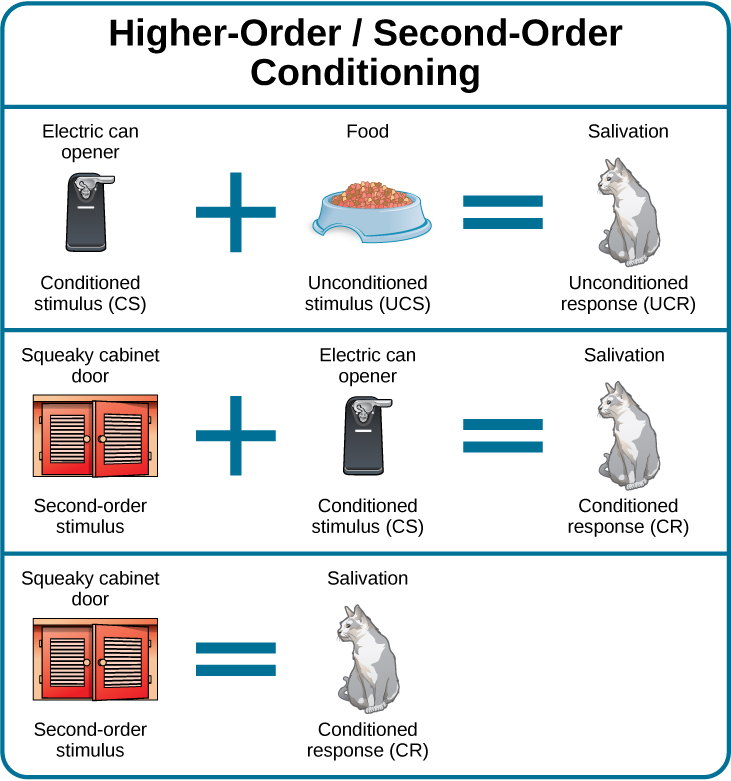

Figure 6.5図 6.5
In higher-order conditioning, an established conditioned stimulus is paired with a new neutral stimulus (the second-order stimulus), so that eventually the new stimulus also elicits the conditioned response, without the initial conditioned stimulus being presented.
高次条件づけでは、すでに確立した条件刺激が新しい中性刺激(二次刺激)と対にされる。その結果、最終的には、最初の条件刺激が提示されなくても、新しい刺激も条件反応を引き起こすようになる。
Classical conditioning also applies to humans, even babies. For example, Elan buys formula in blue canisters for their six-month-old daughter, Angelina. Whenever Elan takes out a formula container, Angelina gets excited, tries to reach toward the food, and most likely salivates. Why does Angelina get excited when she sees the formula canister? What are the UCS, CS, UCR, and CR here?
英語のヒント
古典的条件づけは人間にも、赤ちゃんにさえ当てはまる。たとえばイーランは、生後6か月の娘アンジェリーナのために、青い缶入りの粉ミルクを買っている。イーランが粉ミルクの容器を取り出すたびに、アンジェリーナは興奮し、食べ物のほうへ手を伸ばそうとし、おそらく唾液を分泌している。アンジェリーナは、なぜ粉ミルクの缶を見ると興奮するのだろうか。ここでのUCS、CS、UCR、CRは何だろうか。
So far, all of the examples have involved food, but classical conditioning extends beyond the basic need to be fed. Consider our earlier example of a dog whose owners install an invisible electric dog fence. A small electrical shock (unconditioned stimulus) elicits discomfort (unconditioned response). When the unconditioned stimulus (shock) is paired with a neutral stimulus (the edge of a yard), the dog associates the discomfort (unconditioned response) with the edge of the yard (conditioned stimulus) and stays within the set boundaries. In this example, the edge of the yard elicits fear and anxiety in the dog. Fear and anxiety are the conditioned response.
英語のヒント
ここまでの例はどれも食物にかかわるものだったが、古典的条件づけは、食べ物を与えられるという基本的な欲求を超えて広く当てはまる。前に挙げた、飼い主が目に見えない電気柵を設置した犬の例を考えてみよう。弱い電気ショック(無条件刺激)は不快感(無条件反応)を引き起こす。無条件刺激(ショック)が中性刺激(庭の端)と対にされると、犬は不快感(無条件反応)を庭の端(条件刺激)と結びつけ、決められた境界の内側にとどまる。この例では、庭の端が犬に恐怖と不安を引き起こす。恐怖と不安が条件反応である。