第6章学習
General Processes in Classical Conditioning古典的条件づけの一般的な過程
Now that you know how classical conditioning works and have seen several examples, let’s take a look at some of the general processes involved. In classical conditioning, the initial period of learning is known as acquisition, when an organism learns to connect a neutral stimulus and an unconditioned stimulus. During acquisition, the neutral stimulus begins to elicit the conditioned response, and eventually the neutral stimulus becomes a conditioned stimulus capable of eliciting the conditioned response by itself. Timing is important for conditioning to occur. Typically, there should only be a brief interval between presentation of the conditioned stimulus and the unconditioned stimulus. Depending on what is being conditioned, sometimes this interval is as little as five seconds (Chance, 2009). However, with other types of conditioning, the interval can be up to several hours.
英語のヒント
古典的条件づけの仕組みが分かり、いくつかの例も見てきたので、そこにかかわる一般的な過程をいくつか見ていこう。古典的条件づけでは、学習の最初の期間を獲得という。獲得は、生物が中性刺激と無条件刺激を結びつけるようになる時期である。獲得の間に、中性刺激は条件反応を引き起こしはじめ、やがて、それだけで条件反応を引き起こすことのできる条件刺激になる。条件づけが起こるためには、タイミングが重要である。通常、条件刺激の提示と無条件刺激の提示のあいだは、短い間隔にとどめるべきである。何を条件づけるかによっては、この間隔がわずか5秒のこともある(Chance, 2009)。しかし、ほかの種類の条件づけでは、間隔が数時間に及ぶこともありうる。
Taste aversion is a type of conditioning in which an interval of several hours may pass between the conditioned stimulus (something ingested) and the unconditioned stimulus (the taste associated with the nausea or illness). Here’s an example. Harry went to the carnival. He ate a lot of cotton candy and later that night was very sick and threw up. The next day, his friend offered him a piece of candy. He put it into his mouth and started to feel sick and had to spit it out. The unconditioned stimulus is eating too much cotton candy. The unconditioned response is getting sick and throwing up. The conditioned stimulus is the sugary flavor and the conditioned response is Harry feeling nauseous at the taste of sugar.
英語のヒント
味覚嫌悪は、条件刺激(摂取した何か)と無条件刺激(吐き気や病気と結びついた味)のあいだに、数時間の間隔があくこともある種類の条件づけである。例を挙げよう。ハリーはカーニバルに行った。綿あめをたくさん食べ、その夜遅く、ひどく気分が悪くなって吐いた。翌日、友達がハリーにキャンディーを一つくれた。ハリーはそれを口に入れると気分が悪くなりはじめ、吐き出さなければならなかった。無条件刺激は、綿あめを食べすぎることである。無条件反応は、気分が悪くなって吐くことである。条件刺激は甘い味で、条件反応は、ハリーが砂糖の味に吐き気を覚えることである。
How does this occur—conditioning based on a single instance and involving an extended time lapse between the event and the negative stimulus? Research into taste aversion suggests that this response may be an evolutionary adaptation designed to help organisms quickly learn to avoid harmful foods (Garcia & Rusiniak, 1980; Garcia & Koelling, 1966). Not only may this contribute to species survival via natural selection, but it may also help us develop strategies for challenges such as helping cancer patients through the nausea induced by certain treatments (Holmes, 1993; Jacobsen et al., 1993; Hutton, Baracos, & Wismer, 2007; Skolin et al., 2006). Garcia and Koelling (1966) showed not only that taste aversions could be conditioned, but also that there were biological constraints to learning. In their study, separate groups of rats were conditioned to associate either a flavor with illness, or lights and sounds with illness. Results showed that all rats exposed to flavor-illness pairings learned to avoid the flavor, but none of the rats exposed to lights and sounds with illness learned to avoid lights or sounds. This added evidence to the idea that classical conditioning could contribute to species survival by helping organisms learn to avoid stimuli that posed real dangers to health and welfare.
英語のヒント
たった一度の出来事に基づき、しかもその出来事と不快な刺激とのあいだに長い時間の経過を含む条件づけが、どのようにして起こるのだろうか。味覚嫌悪の研究は、この反応が、生物が有害な食物を避けることを素早く学習するのを助けるように形づくられた、進化的適応である可能性を示唆している(Garcia & Rusiniak, 1980; Garcia & Koelling, 1966)。このことは、自然選択を通じて種の生存に役立ちうるだけでなく、特定の治療によって引き起こされる吐き気をがん患者が乗り越えられるよう支援するといった課題に対して、私たちが方策を立てる助けにもなるかもしれない(Holmes, 1993; Jacobsen et al., 1993; Hutton, Baracos, & Wismer, 2007; Skolin et al., 2006)。ガルシアとケーリング(1966)は、味覚嫌悪が条件づけられうることだけでなく、学習には生物学的な制約があることも示した。彼らの研究では、ラットを別々の群に分け、味を病気と結びつけるように条件づける群と、光と音を病気と結びつけるように条件づける群を設けた。その結果、味と病気の対にさらされたラットはすべて、その味を避けることを学習したが、光と音を病気と一緒に提示されたラットは、1匹も光や音を避けることを学習しなかった。このことは、古典的条件づけが、健康と安寧に現実の危険をもたらす刺激を避けることを生物が学ぶ助けとなることで、種の生存に貢献しうるという考えを裏づける証拠を加えた。
Robert Rescorla demonstrated how powerfully an organism can learn to predict the UCS from the CS. Take, for example, the following two situations. Ari’s dad always has dinner on the table every day at 6:00. Soraya’s mom switches it up so that some days they eat dinner at 6:00, some days they eat at 5:00, and other days they eat at 7:00. For Ari, 6:00 reliably and consistently predicts dinner, so Ari will likely start feeling hungry every day right before 6:00, even if he's had a late snack. Soraya, on the other hand, will be less likely to associate 6:00 with dinner, since 6:00 does not always predict that dinner is coming. Rescorla, along with his colleague at Yale University, Allan Wagner, developed a mathematical formula that could be used to calculate the probability that an association would be learned given the ability of a conditioned stimulus to predict the occurrence of an unconditioned stimulus and other factors; today this is known as the Rescorla-Wagner model (Rescorla & Wagner, 1972)
英語のヒント
ロバート・レスコーラは、生物がCSからUCSを予測することを、どれほど強力に学習しうるかを示した。たとえば、次の二つの状況を考えてみよう。アリの父親は、毎日必ず6時に夕食を食卓に並べる。ソラヤの母親は時間を変えるので、ある日は6時に夕食を食べ、ある日は5時に、また別の日は7時に食べる。アリにとって、6時は確実に、そして一貫して夕食を予測する。そのためアリは、遅い時間に間食をしていたとしても、おそらく毎日6時の直前になるとおなかがすきはじめるだろう。一方ソラヤは、6時を夕食と結びつける可能性がより低いだろう。6時が、夕食が来ることを常に予測するとは限らないからである。レスコーラは、イェール大学の同僚アラン・ワグナーとともに、条件刺激が無条件刺激の出現を予測する力やその他の要因をもとに、連合が学習される確率を計算するのに使える数式を開発した。今日、これはレスコーラ=ワグナー・モデルとして知られている(Rescorla & Wagner, 1972)。
Once we have established the connection between the unconditioned stimulus and the conditioned stimulus, how do we break that connection and get the dog, cat, or child to stop responding? In Tiger’s case, imagine what would happen if you stopped using the electric can opener for her food and began to use it only for human food. Now, Tiger would hear the can opener, but she would not get food. In classical conditioning terms, you would be giving the conditioned stimulus, but not the unconditioned stimulus. Pavlov explored this scenario in his experiments with dogs: sounding the tone without giving the dogs the meat powder. Soon the dogs stopped responding to the tone. Extinction is the decrease in the conditioned response when the unconditioned stimulus is no longer presented with the conditioned stimulus. When presented with the conditioned stimulus alone, the dog, cat, or other organism would show a weaker and weaker response, and finally no response. In classical conditioning terms, there is a gradual weakening and disappearance of the conditioned response.
英語のヒント
無条件刺激と条件刺激のあいだの結びつきがいったん確立したら、どうすればその結びつきを断ち切り、犬や猫や子どもに反応をやめさせることができるだろうか。タイガーの場合で、あなたが電動缶切りをタイガーの餌に使うのをやめ、人間の食べ物にだけ使うようになったらどうなるかを想像してみよう。すると、タイガーは缶切りの音を聞いても、餌はもらえないことになる。古典的条件づけの用語でいえば、条件刺激は与えているが、無条件刺激は与えていないことになる。パヴロフは犬を使った実験で、この状況、つまり犬に肉粉を与えずに音を鳴らすことを検討した。まもなく犬は、音に反応しなくなった。消去とは、無条件刺激が条件刺激とともに提示されなくなったときに、条件反応が減少することである。条件刺激だけを提示されると、犬や猫、あるいはほかの生物は、しだいに弱い反応しか示さなくなり、最後にはまったく反応を示さなくなるだろう。古典的条件づけの用語でいえば、条件反応がしだいに弱まり、消えていくのである。
What happens when learning is not used for a while—when what was learned lies dormant? As we just discussed, Pavlov found that when he repeatedly presented the bell (conditioned stimulus) without the meat powder (unconditioned stimulus), extinction occurred; the dogs stopped salivating to the bell. However, after a couple of hours of resting from this extinction training, the dogs again began to salivate when Pavlov rang the bell. What do you think would happen with Tiger’s behavior if your electric can opener broke, and you did not use it for several months? When you finally got it fixed and started using it to open Tiger’s food again, Tiger would remember the association between the can opener and her food—she would get excited and run to the kitchen when she heard the sound. The behavior of Pavlov’s dogs and Tiger illustrates a concept Pavlov called spontaneous recovery: the return of a previously extinguished conditioned response following a rest period (Figure 6.7).
英語のヒント
学習したことがしばらく使われないとき、つまり学習した内容が眠ったままになっているときには、何が起こるのだろうか。いま述べたように、パヴロフは、肉粉(無条件刺激)なしでベル(条件刺激)を繰り返し提示すると消去が起こり、犬がベルに対して唾液を分泌しなくなることを見いだした。しかし、この消去訓練から2、3時間休ませた後にパヴロフがベルを鳴らすと、犬は再び唾液を分泌しはじめた。電動缶切りが壊れて、数か月使わなかったとしたら、タイガーの行動はどうなると思うだろうか。ようやく修理して、再びタイガーの餌の缶を開けるのに使いはじめると、タイガーは缶切りと餌の結びつきを思い出し、その音を聞くと、興奮して台所に走っていくだろう。パヴロフの犬とタイガーの行動は、パヴロフが自発的回復と呼んだ概念、すなわち、いったん消去された条件反応が休止期間の後に再び現れることを示している(図6.7)。
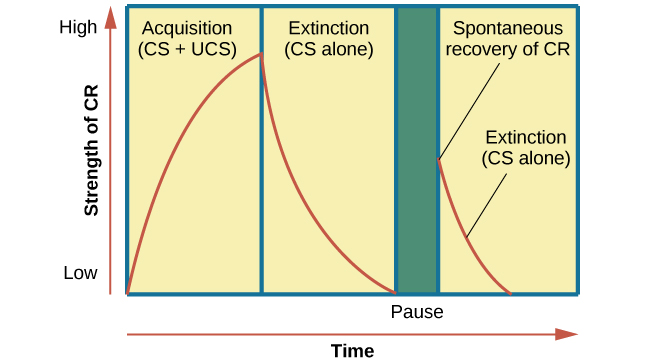

Figure 6.7図 6.7
This is the curve of acquisition, extinction, and spontaneous recovery. The rising curve shows the conditioned response quickly getting stronger through the repeated pairing of the conditioned stimulus and the unconditioned stimulus (acquisition). Then the curve decreases, which shows how the conditioned response weakens when only the conditioned stimulus is presented (extinction). After a break or pause from conditioning, the conditioned response reappears (spontaneous recovery).
これは獲得、消去、自発的回復の曲線である。上昇する曲線は、条件刺激と無条件刺激を繰り返し対にすることで、条件反応が急速に強まることを示している(獲得)。その後、曲線は下降する。これは、条件刺激だけが提示されると条件反応がどのように弱まるかを示している(消去)。条件づけからの中断や休止の後、条件反応は再び現れる(自発的回復)。
Of course, these processes also apply in humans. For example, let’s say that every day when you walk to campus, an ice cream truck passes your route. Day after day, you hear the truck’s music (neutral stimulus), so you finally stop and purchase a chocolate ice cream bar. You take a bite (unconditioned stimulus) and then your mouth waters (unconditioned response). This initial period of learning is known as acquisition, when you begin to connect the neutral stimulus (the sound of the truck) and the unconditioned stimulus (the taste of the chocolate ice cream in your mouth). During acquisition, the conditioned response gets stronger and stronger through repeated pairings of the conditioned stimulus and unconditioned stimulus. Several days (and ice cream bars) later, you notice that your mouth begins to water (conditioned response) as soon as you hear the truck’s musical jingle—even before you bite into the ice cream bar. Then one day you head down the street. You hear the truck’s music (conditioned stimulus), and your mouth waters (conditioned response). However, when you get to the truck, you discover that they are all out of ice cream. You leave disappointed. The next few days you pass by the truck and hear the music, but don’t stop to get an ice cream bar because you’re running late for class. You begin to salivate less and less when you hear the music, until by the end of the week, your mouth no longer waters when you hear the tune. This illustrates extinction. The conditioned response weakens when only the conditioned stimulus (the sound of the truck) is presented, without being followed by the unconditioned stimulus (chocolate ice cream in the mouth). Then the weekend comes. You don’t have to go to class, so you don’t pass the truck. Monday morning arrives and you take your usual route to campus. You round the corner and hear the truck again. What do you think happens? Your mouth begins to water again. Why? After a break from conditioning, the conditioned response reappears, which indicates spontaneous recovery.
英語のヒント
もちろん、こうした過程は人間にも当てはまる。たとえば、あなたが毎日歩いてキャンパスに向かうとき、その道をアイスクリームの移動販売トラックが通るとしよう。来る日も来る日もトラックの音楽(中性刺激)が聞こえるので、あなたはついに立ち止まって、チョコレートのアイスバーを買う。一口かじると(無条件刺激)、口の中につばがわいてくる(無条件反応)。この学習の最初の期間は獲得と呼ばれ、この期間に、あなたは中性刺激(トラックの音)と無条件刺激(口の中のチョコレートアイスの味)を結びつけはじめる。獲得の間、条件刺激と無条件刺激が繰り返し対になることで、条件反応はますます強くなる。数日後(そしてアイスバーを何本か食べた後)、あなたは、トラックの音楽のジングルが聞こえるとすぐに、アイスバーをかじる前から口の中につばがわきはじめる(条件反応)ことに気づく。そしてある日、あなたは通りを歩いていく。トラックの音楽(条件刺激)が聞こえ、口の中につばがわく(条件反応)。ところが、トラックのところまで行くと、アイスクリームが売り切れていることが分かる。あなたはがっかりして立ち去る。次の数日間、あなたはトラックのそばを通って音楽を聞くが、授業に遅れそうなので、立ち止まってアイスバーを買うことはしない。音楽を聞いたときのつばの出方はしだいに少なくなっていき、週の終わりには、その曲を聞いても、もう口の中につばはわかなくなる。これが消去の例である。条件刺激(トラックの音)だけが提示され、その後に無条件刺激(口の中のチョコレートアイス)が続かないと、条件反応は弱まる。やがて週末が来る。授業に行かなくてよいので、トラックのそばは通らない。月曜の朝が来て、あなたはいつもの道でキャンパスへ向かう。角を曲がると、再びトラックの音が聞こえる。何が起こると思うだろうか。口の中に、再びつばがわきはじめる。なぜだろうか。条件づけから離れて一休みした後、条件反応が再び現れたのであり、これは自発的回復を示している。
Acquisition and extinction involve the strengthening and weakening, respectively, of a learned association. Two other learning processes—stimulus discrimination and stimulus generalization—are involved in determining which stimuli will trigger learned responses. Animals (including humans) need to distinguish between stimuli—for example, between sounds that predict a threatening event and sounds that do not—so that they can respond appropriately (such as running away if the sound is threatening). When an organism learns to respond differently to various stimuli that are similar, it is called stimulus discrimination. In classical conditioning terms, the organism demonstrates the conditioned response only to the conditioned stimulus. Pavlov’s dogs discriminated between the basic tone that sounded before they were fed and other tones (e.g., the doorbell), because the other sounds did not predict the arrival of food. Similarly, Tiger, the cat, discriminated between the sound of the can opener and the sound of the electric mixer. When the electric mixer is going, Tiger is not about to be fed, so she does not come running to the kitchen looking for food. In our other example, Moisha, the cancer patient, discriminated between oncologists and other types of doctors. She learned not to feel ill when visiting doctors for other types of appointments, such as her annual physical.
英語のヒント
獲得と消去は、学習された連合がそれぞれ強まることと弱まることにかかわる。ほかの二つの学習過程、すなわち刺激弁別と刺激般化は、どの刺激が学習された反応を引き起こすかを決めることにかかわっている。動物は(人間も含めて)、適切に反応できるように(たとえば、その音が脅威となるものなら逃げ出すなど)、刺激どうしを区別する必要がある。たとえば、脅威となる出来事を予告する音と、そうでない音とを区別しなければならない。生物が、似ているさまざまな刺激に対して異なる反応をするように学習することを、刺激弁別という。古典的条件づけの用語でいえば、生物は条件刺激に対してだけ条件反応を示す。パヴロフの犬は、餌を与えられる前に鳴った基本の音と、ほかの音(たとえば玄関のベル)とを弁別した。ほかの音は食物の到来を予告しなかったからである。同じように、猫のタイガーは、缶切りの音と電動ミキサーの音とを弁別した。電動ミキサーが動いているときには餌をもらえるわけではないので、タイガーは餌を探して台所に走ってくることはない。もう一つの例では、がん患者のモイシャが、腫瘍内科医とほかの種類の医師とを弁別した。モイシャは、年に一度の健康診断など、ほかの種類の診察で医師のもとを訪れるときには、気分が悪くならないように学習した。
On the other hand, when an organism demonstrates the conditioned response to stimuli that are similar to the conditioned stimulus, it is called stimulus generalization, the opposite of stimulus discrimination. The more similar a stimulus is to the conditioned stimulus, the more likely the organism is to give the conditioned response. For instance, if the electric mixer sounds very similar to the electric can opener, Tiger may come running after hearing its sound. But if you do not feed her following the electric mixer sound, and you continue to feed her consistently after the electric can opener sound, she will quickly learn to discriminate between the two sounds (provided they are sufficiently dissimilar that she can tell them apart). In our other example, Moisha continued to feel ill whenever visiting other oncologists or other doctors in the same building as her oncologist.
英語のヒント
一方、生物が条件刺激に似た刺激に対して条件反応を示すことを、刺激般化という。刺激般化は刺激弁別の反対である。ある刺激が条件刺激に似ていればいるほど、生物が条件反応を示す可能性は高くなる。たとえば、電動ミキサーの音が電動缶切りの音にとてもよく似ていれば、タイガーはミキサーの音を聞いて走ってくるかもしれない。しかし、電動ミキサーの音の後には餌を与えず、電動缶切りの音の後には一貫して餌を与え続ければ、タイガーはすぐに二つの音を弁別するように学習するだろう(ただし、二つの音が、タイガーが聞き分けられる程度に十分異なっている場合に限る)。もう一つの例では、モイシャは、ほかの腫瘍内科医や、担当の腫瘍内科医と同じ建物にいるほかの医師を訪れるたびに、気分が悪くなり続けた。